

Navigating the world of real estate can be complex, yet it remains one of the most reliable paths to long-term wealth. For modern professionals and entrepreneurs, particularly those in demanding fields like behavioral healthcare, finding the right investment strategy is crucial. It’s about more than just buying property; it’s about aligning your capital, risk tolerance, and time commitment with a proven model for success.
As a real estate professional and CEO of So Cal Health Care Solutions, I, Robbie LaMattina, have seen firsthand how strategic real estate decisions can create financial freedom and support broader goals, from business expansion to philanthropy. This guide is designed to demystify the process, offering actionable insights into the best real estate investment strategies available today. We'll explore ten distinct approaches, from active methods like fix-and-flip to more passive routes like REITs and syndication.
This article provides a clear roadmap to help you build a resilient and profitable portfolio, whether you're making your first investment or scaling an existing one. We will break down each strategy with a focus on target investor profiles, potential returns, key metrics, and actionable steps to get started. For a deeper dive into the broader market outlook and various approaches, consider exploring these Top Property Investment Strategies UK for 2025. Our goal is to equip you with the knowledge needed to make informed decisions that resonate with your financial objectives and professional aspirations. Let’s explore the frameworks that turn property into a powerful wealth-building engine.
Key Takeaways
- Diverse Pathways to Wealth: There is no single "best" strategy. Success depends on aligning your choice—from active flipping to passive REITs—with your personal capital, time, and risk tolerance.
- Active vs. Passive Investing: Strategies like Fix and Flip or Wholesaling require hands-on effort for quick returns, while methods like Buy and Hold, REITs, or Syndication offer passive income streams for long-term growth.
- Leverage is a Core Advantage: Real estate allows you to use financing to control valuable assets. Strategies like House Hacking use owner-occupied loans to enter the market with minimal down payment.
- Due Diligence is Non-Negotiable: As expert Robbie LaMattina emphasizes, thorough analysis of the deal, market, and partners is critical for success in any strategy, from vetting a syndication sponsor to calculating a flip's After-Repair Value (ARV).
1. Fix and Flip
The fix and flip strategy is a classic, active real estate investment approach centered on speed and value-add. Investors purchase properties, typically undervalued or in distress, renovate them to increase their market value, and then sell them quickly for a profit. This method is one of the best real estate investment strategies for those with a keen eye for a property's potential and the ability to manage construction projects efficiently. Success hinges on accurately calculating the After-Repair Value (ARV) and keeping renovation costs and timelines under strict control.

This strategy is ideal for investors who are hands-on and want to generate significant capital in a short period, rather than focusing on long-term cash flow from rentals. It’s particularly effective in markets with rising home values and high buyer demand. For example, a healthcare operator might purchase a distressed single-family home near their facility, complete a modern renovation, and sell it to a medical professional looking to live close to work.
Actionable Steps for Your First Flip
- Master the 70% Rule: A guiding principle popularized by experts like Robbie LaMattina is to never pay more than 70% of the property's ARV, minus the cost of repairs. For example, if a home’s ARV is $400,000 and it needs $50,000 in renovations, your maximum offer should be $230,000 ($400,000 x 0.70 = $280,000 – $50,000).
- Build Your Team: Before you even find a property, establish relationships with a reliable general contractor, a real estate agent specializing in investment properties, and a hard money lender if needed.
- Secure Contingency Funds: Always budget an extra 10-20% of your total renovation estimate for unexpected issues like hidden structural damage or plumbing problems.
- Analyze Meticulously: Perform thorough due diligence. Use robust real estate investment analysis tools to calculate all potential costs, including purchase price, repairs, holding costs (insurance, taxes, utilities), and closing costs on both ends of the transaction.
2. Buy and Hold (Rental Properties)
The buy and hold strategy is a quintessential approach to long-term wealth creation through real estate. Investors purchase properties not to sell quickly, but to hold and rent them out to tenants. This method generates consistent passive income through monthly rent payments while building equity over time through both mortgage paydown and property appreciation. It is one of the best real estate investment strategies for those seeking steady cash flow and a less speculative, more patient path to financial growth.
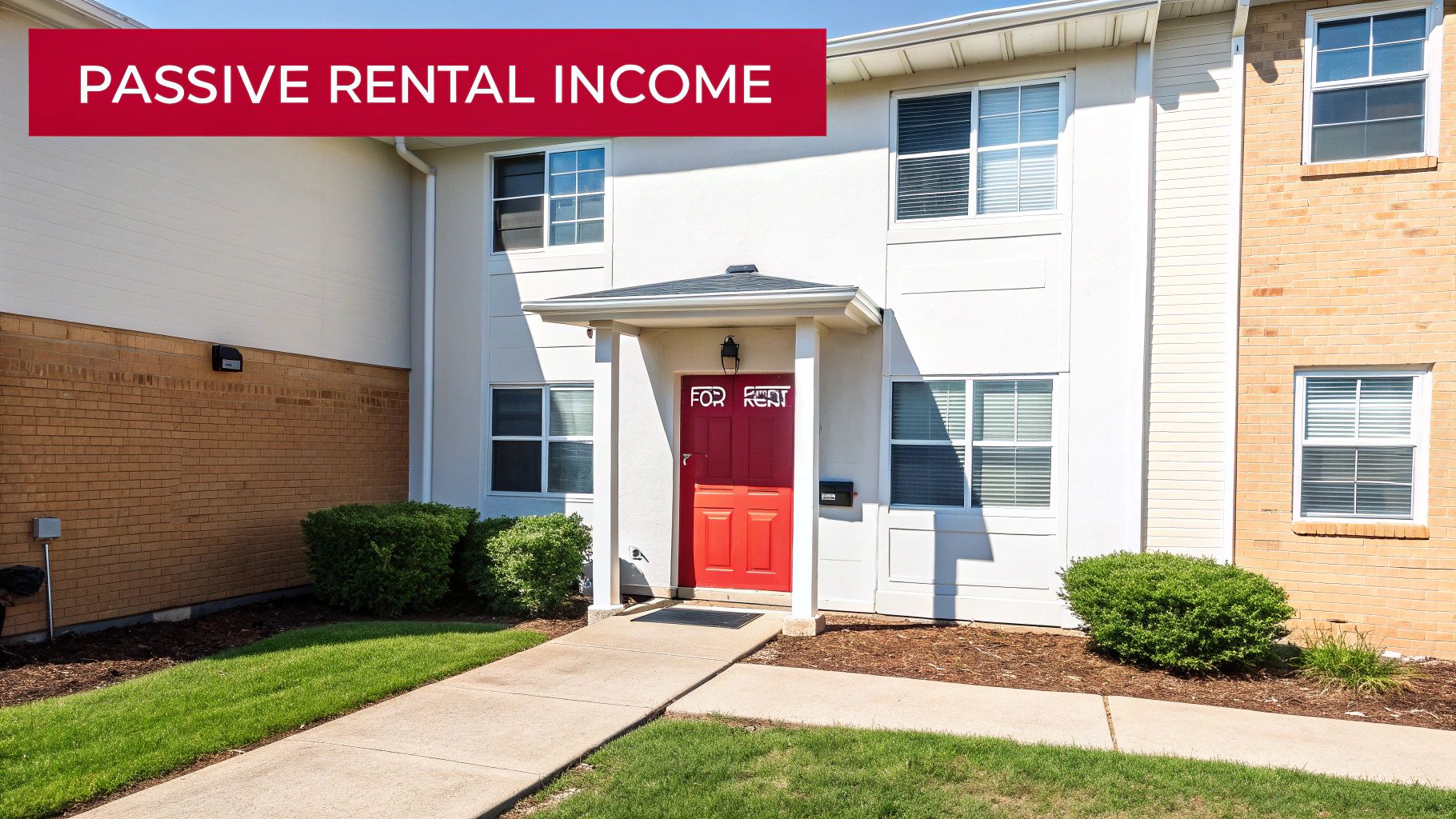
This strategy is ideal for investors focused on building a durable portfolio that produces predictable income streams. It allows investors to leverage their assets and benefit from significant tax advantages, such as deductions for mortgage interest, property taxes, and depreciation. For instance, a healthcare practice owner could purchase a small apartment building near their clinic, providing housing for staff or the general public and creating a reliable, secondary income source completely separate from their primary business operations.
Actionable Steps for Your First Rental
- Follow the 1% Rule: As a preliminary screening tool, aim for a property where the gross monthly rent is at least 1% of the total purchase price plus initial repairs. If a property costs $250,000, it should ideally rent for at least $2,500 per month.
- Screen Tenants Rigorously: Your tenants are the lifeblood of your investment. Implement a thorough screening process that includes credit checks, background checks, employment verification, and references from previous landlords to minimize turnover and payment issues.
- Build a Cash Reserve: Never operate without a safety net. Maintain a reserve fund with at least six months of operating expenses (including mortgage, taxes, insurance, and maintenance) to cover unexpected vacancies or large repairs.
- Systemize Your Operations: Whether you self-manage or hire a property manager, create clear systems for rent collection, maintenance requests, and bookkeeping. This professionalizes your investment and ensures smooth, scalable operations from day one.
3. House Hacking
House hacking is an ingenious strategy that blends personal finance with real estate investing, allowing you to live for free or at a significantly reduced cost. Investors purchase a multi-unit property, like a duplex or triplex, live in one unit, and rent out the others. The rental income is used to cover the mortgage, taxes, insurance, and other expenses, effectively having your tenants pay for your housing. This approach is one of the best real estate investment strategies for first-time buyers and those in high-cost-of-living areas.
This strategy is perfect for investors looking to build an asset base with minimal out-of-pocket living expenses. It’s a powerful entry point into real estate, popularized by communities like BiggerPockets, because it combines owner-occupied financing benefits (lower down payments and interest rates) with income generation. For example, a young professional in a tech hub could buy a fourplex using an FHA loan, live in one unit, and the rent from the other three could cover the entire mortgage plus generate positive cash flow.
Actionable Steps for Your First House Hack
- Secure Favorable Financing: Take advantage of owner-occupied loans like FHA (as low as 3.5% down) or VA loans (0% down for eligible veterans). Build relationships with lenders who understand and support this investment model.
- Analyze the Numbers: Your goal is for the rental income to cover your PITI (Principal, Interest, Taxes, and Insurance). Run the numbers on multiple properties to find one where the math works in your favor, ideally with room for cash flow.
- Screen Tenants Rigorously: Since your tenants are also your neighbors, a thorough screening process is non-negotiable. Conduct background checks, credit reports, and verify employment and rental history to ensure you find reliable and respectful occupants.
- Establish Clear Boundaries: Create a professional landlord-tenant relationship from the start. Use a formal lease agreement that clearly outlines all rules, responsibilities, and procedures for rent payment and maintenance requests to avoid personal conflicts.
4. Commercial Real Estate Investment
Investing in commercial real estate (CRE) involves acquiring income-producing properties like office buildings, retail centers, industrial warehouses, or medical facilities. Unlike residential properties, which focus on housing, CRE focuses on business operations, generating returns through rental income and appreciation. This method is one of the best real estate investment strategies for sophisticated investors seeking higher cash flow potential and longer lease terms, though it requires significant capital and specialized management expertise.
This strategy is best suited for well-capitalized investors or partnerships aiming to build a portfolio of high-yield assets. Success in CRE is heavily dependent on economic cycles, tenant quality, and location. For instance, a behavioral health operator could acquire a medical office building, occupy a portion of it, and lease the remaining suites to other healthcare practitioners, creating a stable, synergistic investment that generates multiple income streams.
Actionable Steps for Your First Commercial Investment
- Master Key Metrics: Focus on understanding the Capitalization (Cap) Rate, Net Operating Income (NOI), and Cash-on-Cash Return. The Cap Rate (NOI / Property Value) is a critical metric for comparing the potential return on different commercial properties.
- Analyze Tenant Quality and Leases: The value of a commercial property is directly tied to its tenants. Scrutinize tenant creditworthiness, lease durations (aim for long-term leases with built-in rent escalations), and lease types (e.g., NNN, Gross).
- Build an Expert Team: You cannot succeed in commercial real estate alone. Align with a commercial real estate broker, a real estate attorney specializing in commercial transactions, and a lender experienced with various commercial real estate financing options.
- Start with Smaller Deals or Partnerships: Gain experience by starting with smaller single-tenant properties or by partnering with seasoned investors like Robbie LaMattina. This approach minimizes initial risk while allowing you to learn the intricacies of commercial underwriting and asset management.
5. Wholesaling
Real estate wholesaling is an entry-level strategy focused on finding and contracting properties, then assigning that contract to another buyer for a fee. Wholesalers act as intermediaries, connecting motivated sellers with cash buyers, typically flippers or rental property investors. This method is one of the best real estate investment strategies for those with strong networking and negotiation skills but limited capital, as the wholesaler never actually takes ownership of the property. The profit comes from the "assignment fee," which is the difference between the seller's agreed-upon price and the higher price the end buyer pays.
This strategy is ideal for individuals who excel at marketing and sales and want to learn the fundamentals of deal analysis without the financial risk of purchasing property. It's particularly effective in markets with a high volume of transactions and a large pool of cash buyers. For instance, a behavioral health operator could use wholesaling to identify a distressed property near their facility, get it under contract, and then assign it to a developer partner who plans to build supportive housing, earning a fee while facilitating a community-beneficial project.
Actionable Steps for Your First Wholesale Deal
- Build Your Cash Buyers List: Before you find a deal, you need someone to sell it to. Network at local real estate meetups, connect with flippers on social media, and build a reliable database of investors ready to purchase properties quickly.
- Develop a Marketing Machine: Success in wholesaling depends on a consistent flow of leads from motivated sellers. Implement marketing systems like direct mail campaigns, cold calling, or digital ads targeting homeowners who may be in pre-foreclosure or have distressed properties.
- Learn to Analyze Deals Rapidly: You must be able to quickly and accurately calculate a property's After-Repair Value (ARV) and estimate repair costs. This allows you to make a fair offer to the seller that still leaves enough profit margin for your end buyer and your assignment fee.
- Use Ironclad Contracts: Work with a real estate attorney to draft an assignable purchase agreement. Your contract must include contingency clauses that allow you to exit the deal without penalty if you cannot find an end buyer within a specified timeframe.
6. Real Estate Investment trusts (REITs)
Real Estate Investment Trusts (REITs) offer a completely passive way to invest in large-scale, income-producing real estate. A REIT is a company that owns, operates, or finances real estate across a range of property sectors. By investing in a REIT, you are buying shares in that company's portfolio, allowing you to earn dividend-based income without ever having to manage a physical property. This makes REITs one of the best real estate investment strategies for those seeking liquidity and diversification.
This strategy is perfect for investors who want real estate exposure without the hands-on commitment of direct ownership. It's an excellent way to diversify an existing stock portfolio with real assets. For instance, a behavioral healthcare operator looking for stable, long-term income could invest in a healthcare REIT like Welltower, which owns a portfolio of senior housing and outpatient medical properties, thus aligning their investment with their professional sector while generating passive returns.
Actionable Steps for Your First REIT Investment
- Understand the Types: Not all REITs are the same. Research different categories like Equity REITs (which own properties), Mortgage REITs (which finance property), and Hybrid REITs. Within Equity REITs, you can specialize in sectors like residential, retail (Simon Property Group), office, or industrial.
- Analyze Key Metrics: Look beyond just the dividend yield. Key metrics to review include Funds From Operations (FFO), which is a better measure of a REIT's cash flow than net income, and the Net Asset Value (NAV).
- Review Management and History: A REIT's success is heavily dependent on its management team. Investigate the leadership's track record and read through annual reports and investor presentations to understand their long-term strategy and performance.
- Consider Tax Implications: REITs are required to pay out at least 90% of their taxable income as dividends to shareholders. These dividends are typically taxed as ordinary income, so holding them in a tax-advantaged account like a Roth IRA can be a smart move.
7. Syndication
Real estate syndication is a powerful strategy that allows investors to pool their capital together to acquire large-scale properties that would be unattainable individually. In this structure, a "sponsor" or "general partner" finds, manages, and operates the investment, while "limited partners" or passive investors provide the bulk of the equity. This is one of the best real estate investment strategies for accessing institutional-grade assets like apartment complexes, commercial centers, or industrial facilities without the burden of day-to-day management.
This strategy is ideal for busy professionals who want the benefits of real estate ownership, such as cash flow and appreciation, but lack the time or expertise to manage properties directly. For instance, a group of behavioral health operators could syndicate a deal to purchase a large medical office building, using one of their experienced members as the sponsor to manage the asset while the others act as passive investors, earning returns from the property's performance. It provides a direct path to portfolio diversification and scale.
Actionable Steps for Your First Syndication
- Vet the Sponsor Meticulously: The success of a syndication lies almost entirely with the sponsor. Scrutinize their track record, expertise in the specific asset class and market, and their communication history. Don't hesitate to ask for and call investor references.
- Analyze the Deal, Not Just the Projections: Sponsors will provide an offering memorandum with financial projections. Learn to read the pro forma and challenge the assumptions. Is the projected rent growth realistic for the market? Is the renovation budget adequate?
- Understand the Full Fee Structure: Syndications include various fees, such as acquisition, asset management, and disposition fees. Ensure you understand how the sponsor is compensated and that their incentives are aligned with yours as an investor.
- Review All Legal Documents: Have a qualified attorney review the Private Placement Memorandum (PPM) and the operating agreement. These documents outline the terms of the deal, risk factors, and the rights and responsibilities of all parties involved. As expert Robbie LaMattina advises, thorough due diligence is non-negotiable.
8. Land Investment and Development
Land investment and development is a forward-thinking strategy focused on acquiring raw or underutilized land with the goal of future appreciation or value creation. Investors purchase land and either hold it as it appreciates (land banking), obtain entitlements to increase its value before selling, or develop it themselves into residential, commercial, or industrial properties. This method is one of the best real estate investment strategies for patient investors who can analyze long-term growth trends and navigate complex zoning and entitlement processes. Success depends on identifying locations in the path of progress and understanding municipal development plans.
This strategy is perfect for those with a long-term vision who are comfortable with an investment that typically does not generate immediate cash flow. It's particularly powerful for investors like healthcare operators who might acquire land near a growing suburban area, anticipating the need for a future outpatient clinic or medical facility as the population expands. For example, an operator could purchase a parcel zoned for commercial use along a future highway extension, holding it until the infrastructure is complete and development demand peaks.
Actionable Steps for Your First Land Investment
- Study Growth Patterns: Dive deep into local economic and demographic data. Analyze city comprehensive plans, transportation projects, and major employer expansions to identify areas poised for future growth.
- Verify Zoning and Utilities: Before purchasing, confirm the property's current zoning classification and investigate the accessibility and cost of bringing essential utilities like water, sewer, and electricity to the site. This is a critical step in any land venture.
- Conduct a Feasibility Study: A thorough analysis is non-negotiable to assess the project's viability. A detailed real estate development feasibility study will help you evaluate potential uses, estimate costs, and project returns, ensuring your investment is sound.
- Explore Seller Financing: Raw land can be difficult to finance through traditional banks. Propose seller financing or a land contract as a way to acquire the property with more flexible terms and a potentially lower down payment.
9. Airbnb and Short-Term Rental (STR) Investing
The Airbnb and short-term rental (STR) strategy involves purchasing properties to rent out on a nightly or weekly basis through platforms like Airbnb and VRBO. This approach shifts from securing long-term tenants to capitalizing on higher per-night rates from tourists, business travelers, and other temporary visitors. As one of the best real estate investment strategies for maximizing revenue potential, success in STRs depends on excellent hospitality, dynamic pricing, and navigating local regulations.

This strategy is ideal for investors in high-demand tourist or business locations who are prepared for more active, hands-on management compared to traditional rentals. The potential for higher income is significant, but it comes with increased operational tasks like frequent cleanings, guest communication, and property maintenance. For instance, a behavioral health operator could purchase a furnished condo near a major medical conference center, offering it as a premium lodging alternative for visiting professionals and generating substantial income during peak event seasons.
Actionable Steps for Your First STR
- Verify Local Regulations: Before purchasing, thoroughly research and confirm the local zoning laws, ordinances, and HOA rules regarding short-term rentals. Many cities have strict licensing requirements or outright bans, making this the most critical first step.
- Analyze Profitability Accurately: Go beyond basic mortgage calculations. Factor in all STR-specific expenses: platform fees, professional cleaning costs, restocking supplies (coffee, toiletries), higher utility bills, specialized insurance, and dynamic vacancy rates.
- Automate and Systemize Operations: Use property management software (PMS) to automate guest messaging, sync calendars across platforms, and manage cleaning schedules. Smart locks and noise monitoring devices can also streamline management and protect your asset.
- Focus on Guest Experience: High ratings are the lifeblood of an STR. Invest in quality furnishings, professional photography, and thoughtful amenities. As noted by industry experts like Robbie LaMattina, a 5-star guest experience directly translates to higher occupancy and pricing power.
10. Note Investing (Mortgage Note Trading)
Note investing is a sophisticated, passive real estate investment strategy where you become the bank. Instead of buying physical property, investors purchase the promissory note, or the mortgage debt itself, from a lender. This approach allows you to collect mortgage payments, including principal and interest, without the responsibilities of property management. It's one of the best real estate investment strategies for those seeking regular cash flow with less hands-on effort than traditional landlording.
This strategy is ideal for investors who prefer portfolio diversification and want to generate income secured by real estate assets. You can purchase performing notes (where the borrower is current on payments) for steady cash flow, or non-performing notes (where the borrower is in default) at a deep discount, aiming to either modify the loan for the borrower or acquire the property through foreclosure. For instance, a behavioral health operator could buy a portfolio of performing notes secured by properties in a stable market, creating a reliable income stream to fund their primary business operations.
Actionable Steps for Your First Note Investment
- Start with Performing Notes: As recommended by experts like Dave Van Horn, begin with performing notes to learn the mechanics of the business. This lower-risk entry point allows you to understand the due diligence process, payment collection, and legal framework before tackling more complex non-performing notes.
- Build Your Professional Network: Your team is crucial in note investing. Before purchasing a note, establish relationships with a qualified real estate attorney who understands foreclosure laws in your target state, a reputable title company for title searches, and mortgage brokers who can source deals.
- Master Due Diligence: The value of a note is tied to the underlying property and the borrower's ability to pay. Always get a Broker Price Opinion (BPO) or an appraisal to verify the property's value and run a thorough title search to uncover any liens or encumbrances that could jeopardize your position.
- Understand the Legalities: Foreclosure laws vary significantly from state to state. Meticulously research the legal process and timelines in the states where you plan to invest. This knowledge is critical, especially when dealing with non-performing notes where acquiring the property may be the ultimate outcome.
Top 10 Real Estate Investment Strategies — Comparison
| Strategy | Implementation Complexity | Resource Requirements | Expected Outcomes | Ideal Use Cases | Key Advantages |
|---|---|---|---|---|---|
| Fix and Flip | High — renovation & project management, fast timelines | High capital for purchase & rehab, contractors, contingency funds | Short-term profit if ARV met; higher return variability; 3–12 month horizon | Distressed properties in rising neighborhoods; experienced flippers | Quick profit realization; clear ROI; value-add through rehab |
| Buy and Hold (Rental Properties) | Medium — tenant & property management, long-term ops | High down payments, reserves, possible property manager | Steady monthly cash flow + long-term appreciation and equity build | Long-term wealth builders and passive income seekers | Reliable cash flow; tax benefits; inflation hedge |
| House Hacking | Medium — owner-occupancy with tenant management | Low–Medium capital (lower down payment), owner-occupied financing | Reduced personal housing costs; accelerated mortgage paydown; modest cash flow | First-time investors; those seeking affordable housing while building equity | Very low housing cost; better financing; strong entry strategy |
| Commercial Real Estate Investment | High — complex underwriting, longer leases, professional management | Very high capital, institutional brokers, sophisticated asset management | Higher cash flow per asset, larger appreciation potential; long hold periods | Institutional investors or experienced sponsors acquiring large income properties | Higher income potential; longer leases; NNN lease structures shift expenses |
| Wholesaling | Medium — contract knowledge, marketing, negotiation skills | Minimal capital (marketing budget), large cash-buyer network | Quick assignment fees per deal; scalable but inconsistent income | Deal-finders, entrepreneurs starting in real estate without capital | Low capital entry; fast turnaround; builds market analysis skills |
| Real Estate Investment Trusts (REITs) | Low — invest via brokerage, no property management | Low capital (share purchase), brokerage account | Liquid dividend income and market returns; portfolio diversification | Passive investors wanting real-estate exposure without direct ownership | Liquidity; instant diversification; no landlord duties |
| Syndication | Medium–High — legal/financial structuring; reliance on sponsor | Medium capital commitments ($25K+), lengthy lock-up, trust in sponsor | Passive distributions and potential equity gains on sale; multi-year horizon | Accredited investors seeking access to larger institutional assets | Access to large deals; professional asset management; passive income |
| Land Investment & Development | High — zoning, entitlement, planning complexity; lower ongoing ops | Low–Medium acquisition capital, development capital if building, regulatory expertise | Long-term appreciation or development profits; little/no cash flow during hold | Investors targeting growth corridors or development opportunities | Lower acquisition cost per acre; potential for large upside on development |
| Airbnb / Short-Term Rental (STR) | High — active guest management, frequent turnover | Medium–High capital, furnishing, cleaning/management operations | Higher per-night revenue; variable and seasonal cash flow; regulatory sensitivity | Properties in tourist or business travel markets; owners wanting flexible personal use | Higher revenue potential; dynamic pricing; personal use flexibility |
| Note Investing (Mortgage Notes) | High — complex due diligence, legal and foreclosure processes | Medium capital ($10K+), title/legal support, specialized knowledge | Predictable interest income from performing notes; deep-discount gains from non-performing; variable liquidity | Investors seeking debt exposure, predictable cash flow, or distressed opportunities | Predictable cash flow (performing); potential high returns on discounted non-performing notes |
Building Your Future: Choosing the Right Strategy for You
We have navigated the diverse and dynamic landscape of real estate investing, exploring ten distinct pathways to building wealth. From the hands-on, high-reward nature of Fix and Flip projects to the steady, compounding growth of Buy and Hold rentals, each approach offers a unique set of opportunities and challenges. Whether you're drawn to the creative entry point of House Hacking, the scalable potential of Commercial Real Estate, or the passive accessibility of REITs, one central theme emerges: there is no single "best" real estate investment strategy, only the one that is best for you.
The journey from aspiring investor to successful portfolio owner is paved with strategic decisions, not just good intentions. As we've detailed, strategies like Syndication and Note Investing open doors for those with capital but limited time, while Wholesaling provides an avenue for individuals with strong networking skills but less initial capital. The key is to move beyond the theoretical and into the practical, aligning your choice with your unique circumstances.
From Blueprint to Action: Your Next Steps
The true value of this guide lies not in the information it contains, but in how you apply it. Success in real estate, much like in any entrepreneurial venture, hinges on disciplined execution. My own experience, and the work of leaders like Robbie LaMattina, underscores that building a substantial portfolio is a marathon of calculated steps, not a sprint for a quick win. It's time to translate knowledge into action.
To begin your journey, consider these critical next steps:
- Conduct a Personal Inventory: Before analyzing any property, analyze yourself. Honestly assess your financial standing (capital, credit), your available time commitment, and your genuine risk tolerance. A strategy that excites one investor may be a source of constant stress for another.
- Specialize and Deep-Dive: Resist the urge to chase multiple strategies at once. Choose the one that resonates most with your personal inventory. Commit to becoming an expert in that niche. Read books, listen to podcasts, join forums, and connect with mentors who have succeeded in that specific area.
- Build Your Local Team: Real estate is a team sport. Whether you're flipping houses or buying rentals, you will need a reliable network. Start identifying and vetting key players in your target market: a real estate agent who understands investors, a responsive lender, a trustworthy contractor, and a knowledgeable property manager.
- Define Your "Buy Box": Create a clear, non-negotiable set of criteria for your first investment. This "buy box" should define your target market, property type, price range, and desired return metrics (e.g., cash-on-cash return, cap rate). This framework will protect you from emotional decisions and keep your search focused and efficient. For instance, if you're deciding between rental models, exploring a detailed a comparison of short-term vs. long-term rentals can help you define which asset class fits your criteria.
Ultimately, mastering the best real estate investment strategies is about more than just financial gain. It's about creating autonomy, building a legacy, and gaining control over your financial future. The property is the vehicle, but your vision, discipline, and strategic action are the engine. The path you choose today-whether it's the short-term profits of a flip or the long-term cash flow of a rental portfolio-will lay the foundation for the wealth you build tomorrow. Don't wait for the "perfect" market or the "perfect" deal. Start with the perfect plan for you, and take that first decisive step.
Ready to move from strategy to execution with expert guidance? For insights on building scalable ventures and leveraging real estate within a broader entrepreneurial framework, connect with Robert LaMattina. Learn from his experience in navigating complex business landscapes to inform your own investment journey.
Frequently Asked Questions (FAQs)
What is the best real estate investment strategy for beginners?
For beginners, the Buy and Hold (rental properties) and House Hacking strategies are often the most recommended. House hacking is particularly effective as it lowers personal living expenses while providing direct, hands-on experience as a landlord. Buy and hold is a classic, straightforward way to build long-term wealth through cash flow and appreciation with a less complex entry point than flipping or development.
How much capital do I need to start investing in real estate?
The capital required varies significantly by strategy. Wholesaling requires the least capital, primarily for marketing. House Hacking is also a low-capital entry point, thanks to owner-occupied loans like FHA that require as little as 3.5% down. For strategies like Fix and Flip or traditional Buy and Hold, you will typically need at least a 20-25% down payment plus funds for renovations and reserves.
Can real estate investing truly generate passive income?
Yes, but "passive" rarely means zero effort. Strategies like investing in REITs or becoming a limited partner in a Syndication are the most passive, requiring only capital and upfront due diligence. Owning rental properties (Buy and Hold) can become largely passive once you hire a professional property manager, but it still requires oversight. Active strategies like flipping are the opposite of passive.
Is it a good time to invest in real estate in 2025?
While market conditions fluctuate with interest rates and economic trends, real estate remains a historically reliable long-term investment. Rather than trying to time the market, focus on finding a good deal that makes financial sense based on solid fundamentals. A property that cash flows positively and is located in an area with strong job and population growth will likely be a good investment regardless of broader market timing.