

Building a high-performance team isn't about buzzwords; it's the engine that drives real, sustainable growth. This is where the magic happens, where you move from a collection of individuals to a cohesive unit that consistently delivers. It's a deliberate process of hiring for mindset, nurturing a culture of psychological safety, tying performance to clear goals, and keeping the energy high with proactive leadership. This is what truly separates the best from the rest.
4 Key Takeaways for Building High-Performance Teams
- Start with the Right People: Hire for mindset, resilience, and cultural fit, not just skills on a resume. The right person elevates the entire team.
- Psychological Safety is Non-Negotiable: Create an environment where team members feel safe to speak up, take risks, and admit mistakes. This is the foundation for innovation and trust.
- Align with Clear Metrics: Use frameworks like OKRs to set inspiring goals and establish communication rituals to keep everyone in sync and focused on what matters most.
- Sustain Momentum Through Coaching: Shift from being a manager to a coach. Focus on meaningful recognition, proactively preventing burnout, and developing your people to retain top talent for the long haul.
The Blueprint for Team Excellence
Creating a team that consistently hits it out of the park requires more than just top-down management. In fact, that old-school approach often backfires, crushing the creativity and autonomy that high-performers thrive on. The modern playbook is about building a resilient, empowered culture from the ground up, a philosophy championed by leaders like Robbie LaMattina.
This guide isn't about abstract theory. It’s a practical framework for leaders ready to get to work. We’ll dig into what a high-performance culture actually looks like—from fostering genuine trust to setting up communication rituals that keep everyone on the same page. For an even deeper dive into the core principles, check out this a comprehensive guide to building high-performing teams.
Four Pillars of High-Performance Teams
Getting this right boils down to four foundational components that work in tandem. When you master these pillars, you're not just building a team; you're building a sustainable competitive advantage. It’s a core part of https://robertlamattina.net/leadership-development-best-practices/ and essential for long-term health.
The table below offers a quick snapshot of these critical areas.
Four Pillars of High-Performance Teams
| Pillar | Focus Area | Key Outcome |
|---|---|---|
| Strategic Hiring | Recruiting for mindset, resilience, and cultural fit—not just a list of skills. | A solid team foundation built with empowered, self-starting individuals. |
| Psychological Safety | Creating an environment of deep trust where people feel safe to speak up and take calculated risks. | A huge boost in innovation and much faster, more effective problem-solving. |
| Aligned Performance | Setting crystal-clear, meaningful metrics and adopting a coaching-first mindset to get there. | Consistent, measurable progress toward shared goals and ongoing skill development. |
| Sustained Momentum | Proactive leadership, genuine recognition, and smart strategies to prevent team burnout. | High retention of your best people and enduring team success. |
Think of these pillars not as separate items on a checklist, but as interconnected parts of a system that fuels itself.
The infographic below really brings this cycle to life, showing how you move from hiring great people all the way through to keeping that momentum going.
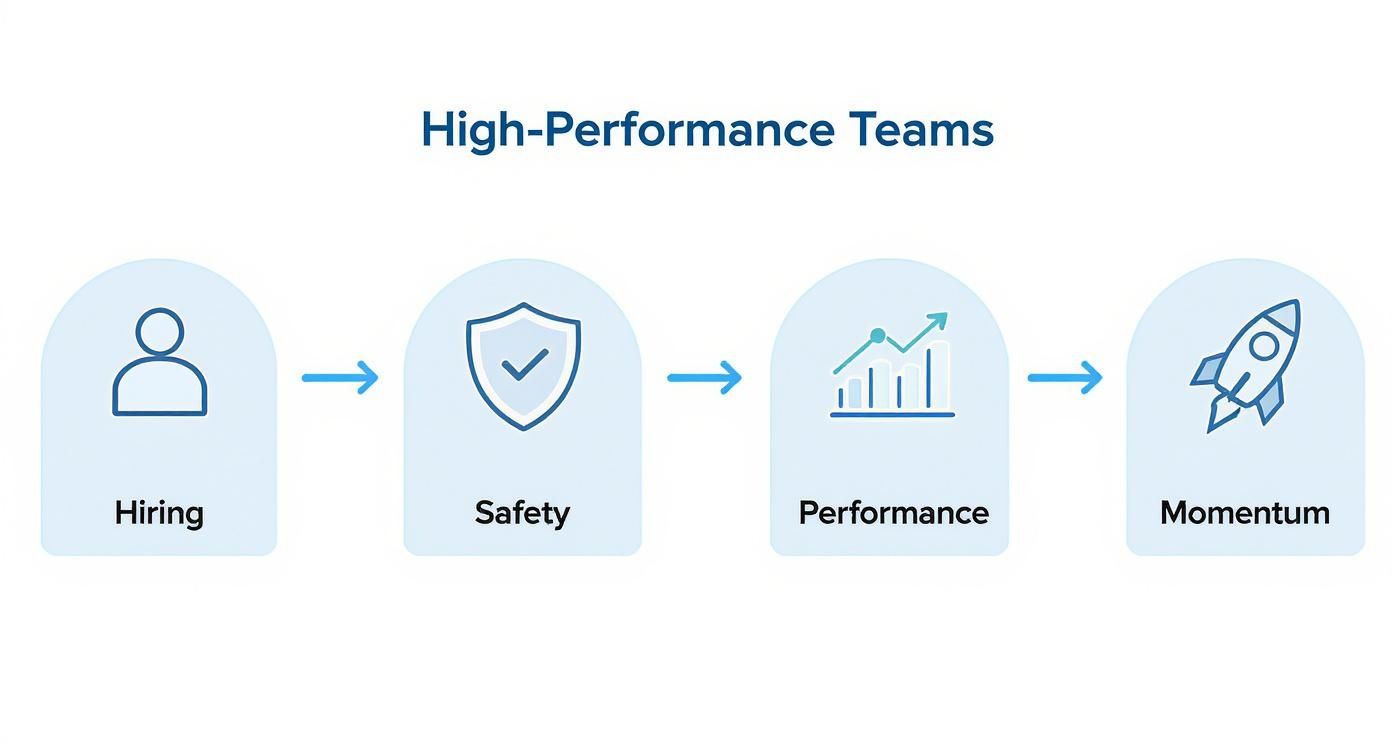
As you can see, building an elite team is a continuous loop. It’s not a project you finish; it's a discipline you practice, where each stage strengthens the next.
Start with the Right People
Building a truly high-performance team doesn't start with a project kickoff or a fancy new software tool. It begins long before that, with a fundamental decision: who you invite through the door. The foundation of an elite team isn't just a collection of impressive résumés. It's about hand-picking people who bring the right mindset, a natural adaptability, and a genuine spirit of collaboration that lifts everyone else up.
I’ve seen it time and time again: managers fall into the trap of obsessing over technical skills or years of experience. While expertise is absolutely necessary, it's just one piece of the puzzle. A team stacked with brilliant but misaligned individuals will always get outpaced by a team that shares a common purpose and is committed to winning together.
Crafting a Role to Attract the Best
The first thing to do is throw out your traditional, task-based job description. Seriously. Stop making a laundry list of responsibilities. Instead, write a role profile that tells a story. Describe the thorny challenges the new person will get to solve, the real-world impact they'll have on the company or your customers, and the specific qualities that make someone successful on your team.
This simple shift changes everything. It attracts proactive problem-solvers, not just people looking to check boxes. The best people out there are drawn to meaning and impact. When you frame a role around its purpose, you immediately start filtering for candidates who are motivated by more than just a paycheck.
"When you hire, you're not just filling a slot; you're casting a character in your team's story. Look for people who not only fit the part but also make the entire cast better."
A practical way to do this is to focus on outcomes, not just activities. For instance, don't say, "Manage social media accounts." Instead, try something like, "Develop and execute a social media strategy that grows our community engagement by 30% in the next six months." See the difference? One is a task; the other is a mission. The latter attracts people who think in terms of results.
Interviewing for Mindset and Collaboration
Once you have a solid pool of candidates, your interview process becomes the main event. The real goal here isn't to just verify what's on their résumé—it's to dig deeper and uncover their potential for growth and collaboration.
Forget the generic, softball questions. You need to use behavioral and situational prompts that reveal how a person actually thinks and acts when things get tough.
Here are a few of my go-to's:
- To assess problem-solving: "Tell me about a time a project went completely off the rails. What was your role, and what specific steps did you take to get it back on track?"
- To gauge collaboration: "Walk me through a situation where you had a significant professional disagreement with a teammate. How did you navigate that conversation, and what was the result?"
- To spot a growth mindset: "What's a new skill you've learned in the last year, and what was your process for learning it?"
These kinds of questions don't have a "right" answer. They force people to pull from real experience, giving you a much clearer picture of their character and how they'll actually behave on your team. As business leader Robbie LaMattina often says, getting the right people on board is the bedrock of any successful venture, so this stage is one you can't afford to get wrong.
Designing an Onboarding Process That Actually Integrates People
Okay, so you've hired someone amazing. The job isn't done. In fact, it’s just beginning. A structured, welcoming onboarding process is what turns a great hire into a truly integrated and productive team member. A bad onboarding experience can crush a new hire's excitement and cripple their ability to contribute right from the start.
A world-class onboarding plan is so much more than paperwork and an IT checklist. It should be a deliberate, human-centered process focused on three key areas:
- Cultural Immersion: Don't leave it to chance. Assign a "buddy" or mentor—someone who isn't their direct manager—to help them learn the unwritten rules and social dynamics of the team.
- Role Clarity: Give them a clear 30-60-90 day plan with specific, achievable goals. This provides immediate direction and lets them score some early wins, which is a huge confidence booster.
- Connection Building: Be intentional about relationships. Schedule informal one-on-ones with key people across different departments. This helps them build their internal network and understand how their work fits into the bigger picture.
Case Study: A Small Healthcare Clinic's Turnaround
I once worked with a small healthcare clinic that was bleeding talent. Staff turnover was high, and patient satisfaction scores were all over the place. Their hiring process was what you'd expect—they focused almost entirely on certifications and years on the job. They were hiring skilled nurses and admin staff, but the team just never clicked.
The clinic manager decided to blow up their old approach. They rewrote their job descriptions to highlight empathy, clear communication, and a genuine passion for patient care. In interviews, they started asking questions like, "Tell us about a time you had to calm down an anxious patient's family member. What did you do?"
Soon after, they hired a new nurse who, on paper, had less experience than other candidates. But in the interview, she demonstrated incredible compassion and a powerful "growth mindset." It turned out her attitude was infectious. She was constantly asking for feedback, collaborating with doctors to streamline patient workflows, and she had a knack for making everyone around her better.
Within a year, the clinic’s patient satisfaction scores jumped by 20%, and staff turnover plummeted. It was a powerful lesson: hiring for mindset and cultural contribution wasn't just a nice-to-have; it was the secret ingredient to building their own high-performance team.
Cultivate a Culture of Psychological Safety
You can have a room full of A-players, but if they don't trust each other, you'll never see their best work. That's where psychological safety comes in. It’s the invisible thread that holds a high-performance team together. It's the shared belief that you can speak up, ask a "dumb" question, challenge an idea, or admit you messed up without getting shut down or humiliated.
This isn’t about beanbags and free snacks. True psychological safety is woven into the daily interactions of a team. When people feel safe to take interpersonal risks, innovation isn't just a buzzword—it's what happens every day. Problems get solved faster, and people actually want to be there.
Model Vulnerability and Active Listening
Psychological safety always starts at the top. As a leader, you have to go first. You have to model the very behaviors you want to see from your team. That means being the one to say, "I don't know the answer to that," or, "I was wrong about that assumption."
When you do this, you’re giving your team permission to be human. The dynamic shifts instantly from a culture of pretending to have all the answers to one where honesty and learning are the real currency.
The other half of this equation is active listening. When someone on your team is talking, put the phone down and actually listen. Ask questions to dig deeper. Repeat back what you heard to make sure you got it right. This isn't just about being polite; it's about signaling that their perspective has value, which is absolutely fundamental to building trust.
"A psychologically safe environment isn't about being 'nice.' It's about giving candid feedback, openly admitting mistakes, and learning from each other to achieve exceptional results. It's about having tough conversations with respect."
At its core, psychological safety is built on a foundation of trust. For a deeper dive, check out this ultimate guide to building trust across teams to create an environment where your people can truly thrive.
Establish Constructive Team Norms
How your team works together is just as important as what they work on. You need to be intentional about setting ground rules for communication and conflict, creating a predictable and secure space for everyone.
One of the most effective habits you can build is the 'blameless post-mortem.' When a project goes off the rails or a mistake happens, the goal isn't to find someone to blame. Instead, the focus is on dissecting the process to understand why it happened. It’s about learning, not punishing.
Here are a few other norms that make a huge difference:
- Rotate who runs meetings. This simple change helps distribute power and ensures everyone gets a voice.
- Normalize saying "I don't know." Make it clear that not having the answer is an opportunity for collaboration, not a sign of weakness.
- Set rules for debate. Everyone should understand that you challenge the idea, not the person who brought it.
These rules don't just magically appear. You have to talk about them as a team, agree on them, and then, as the leader, consistently reinforce them.
Navigating Psychological Safety in Remote Teams
In a remote or hybrid world, fostering this culture is even more crucial—and a whole lot harder. You lose the casual coffee-machine chats and hallway conversations that naturally build rapport, which makes it easier for misunderstandings to fester. As a leader, you have to be deliberate about creating connection from a distance.
Virtual teams are no longer the exception; they're the norm. A 2016 study found that 46% of organizations globally were already using them, with that number jumping to 66% outside of America. This trend only highlights how critical it is to get remote team dynamics right.
To build safety when you're not in the same room:
- Default to video for important conversations. Seeing facial expressions and body language bridges the connection gap and cuts down on misinterpretation.
- Create a digital 'water cooler'. Set up a dedicated Slack or Teams channel for non-work chat, where people can share hobbies, photos, and personal wins.
- Start meetings with a human touch. Kick things off with a quick, non-work-related check-in to build personal rapport before jumping into the agenda.
- Over-communicate everything. In a remote setup, silence creates anxiety. Be radically transparent about goals, changes, and expectations to build a foundation of trust.
Ultimately, building psychological safety isn’t a box you can check. It’s an ongoing commitment to modeling vulnerability, setting clear ground rules, and intentionally building connections—whether your team is sitting next to you or spread across the globe.
Align Your Team with Clear Metrics and Communication

Exceptional team performance is never an accident. It’s built on purpose. It demands clear, motivating goals and a steady rhythm of communication that keeps everyone locked in on what matters.
Think about it: a team without clear metrics is like a ship without a rudder. Everyone might be working hard, but they aren't going anywhere specific. As a leader, your job is to engineer a system that provides that direction, connecting every person's daily effort to the company's bigger vision.
Setting Metrics That Actually Inspire Action
The best performance metrics don’t just track progress; they inspire it. So many teams get bogged down by a laundry list of KPIs that feel completely disconnected from their day-to-day work, which just leads to confusion and apathy.
A much better way to approach this is with a system like OKRs (Objectives and Key Results). It’s a beautifully simple framework that works because it cleanly separates the what from the how.
- Objective: This is your ambitious, qualitative goal. It should be something memorable and motivating that gets the team fired up.
- Key Results: These are the specific, measurable outcomes that prove you’ve hit your objective. They need to be concrete, quantifiable, and time-bound.
Let's say a small healthcare practice sets an objective to "Deliver an Unmatched Patient Experience." Their key results could look like this:
- Increase patient satisfaction score from 8.5 to 9.5 by the end of Q3.
- Reduce average patient wait times by 15%.
- Achieve a 90% positive feedback rate on post-visit surveys.
Suddenly, the mission is crystal clear. Everyone on the team knows what they’re striving for and exactly how their success will be measured.
Communication Rituals to Keep Everyone in Sync
Metrics are only half the battle. Without consistent communication, even the most brilliant plans will inevitably drift off course. High-performing teams are built on a bedrock of structured communication rituals—purposeful touchpoints that keep everyone aligned.
These aren't just "more meetings." They're designed to surface roadblocks, celebrate progress, and keep the goals front and center.
Here are a few rituals I've seen work wonders:
- Daily Huddles (15 mins): A quick, stand-up meeting where each person shares what they did yesterday, what they’re focused on today, and any obstacles in their way. This isn't a status report for the boss; it's a synchronization tool for the entire team.
- Weekly Check-ins (30-60 mins): A deeper dive into progress against your OKRs. Use this time to review the numbers, solve problems together, and adjust priorities for the week ahead.
- Monthly Reviews (1-2 hours): Look back at the last month’s performance and plan for the next. This is your chance to celebrate wins, dissect what went wrong, and make sure you’re still on track for your quarterly objectives.
These rituals create a predictable rhythm. That predictability eliminates ambiguity and fosters a powerful sense of shared purpose.
The Leader's Shift from Manager to Coach
In a high-performance environment, the leader's role has to evolve. It's less about being a taskmaster and much more about being a coach who unlocks the team's potential. This is a core philosophy for leaders like Robbie LaMattina, who understands that real growth comes from empowering people, not just directing them.
A coaching mindset fundamentally changes the nature of performance conversations. Instead of just critiquing past performance, a coach focuses on future development. They ask powerful questions like, "What support do you need from me to be successful?" or "What skills are you hoping to build in this role?"
This hands-on development is a massive differentiator. A fascinating study from Dale Carnegie and Associates highlights how high-performing teams are distinct from their peers.
High-Performance Team Differentiators
| Attribute | High-Performing Teams | All Other Teams | Performance Impact |
|---|---|---|---|
| Access to Training | 74% have access to development programs | 49% have access | Direct link to skill enhancement |
| Clear Goals | 72% feel their goals are clear | 49% feel their goals are clear | Clarity drives focus and motivation |
| Psychological Safety | 71% feel safe to take risks | 49% feel safe to take risks | Fosters innovation and open dialogue |
The data is clear: investment in people pays off. You can read the full research on what sets high-performing teams apart to see just how wide the gap is. Globally, only 30% of teams are considered high-performing, and a primary reason is a lack of dedicated coaching and development.
This coaching approach requires leaders to deliver feedback that is both direct and supportive. It’s about building people up and helping them see a clear path for their own growth. If you’re looking to sharpen these abilities, you might find our guide on effective leadership and communication skills helpful.
By weaving together inspiring metrics, consistent communication, and a coaching-first leadership style, you create an ecosystem where excellence becomes the norm. Your team won't just be hitting targets; they'll be continuously improving, innovating, and driving the business forward with purpose.
Sustain Momentum and Retain Top Talent
Getting a high-performance team off the ground is one thing. Keeping them together, engaged, and firing on all cylinders for the long haul? That’s the real challenge. The initial buzz from a new project or a big win always fades, and that's when the hard work of leadership truly begins.
The test isn't just managing tasks; it's about nurturing the very people who make your success possible. I've found that a servant leadership mindset—where your primary focus is on the growth and well-being of your team—is one of the most powerful models for building a team that lasts. It's about creating an environment where excellence is just the way things are done, not a temporary surge.

Go Beyond the Annual Bonus with Meaningful Recognition
Look, compensation matters. But it's rarely the main reason your best people stick around. What truly makes people feel valued is consistent, meaningful recognition. If you’re waiting for the annual bonus cycle to show appreciation, you're missing countless opportunities to reinforce great work as it happens.
Building a culture of recognition has to be intentional. You need to create simple, repeatable ways to celebrate both the headline-grabbing wins and the small, daily efforts that keep the engine running.
Here are a few tactics that actually work:
- Peer-to-Peer Recognition: A dedicated Slack channel or a simple recognition tool where people can give public shout-outs is incredibly effective. It builds mutual respect and shows everyone what great work looks like.
- Celebrate Small Wins: Don’t just pop the champagne when a project is done. Acknowledge a key milestone, praise someone for how they handled a tough customer, or highlight an innovative idea from a meeting. Public praise is contagious.
- Personalized Rewards: Ditch the generic gift cards. Offer something that shows you're paying attention—a ticket to a conference they want to attend, a subscription to a service they love, or just an extra day off to recharge.
This kind of consistent acknowledgment creates a positive feedback loop that motivates everyone. It’s a core practice of growth-minded leaders like Robbie LaMattina, who know that an appreciated team is a productive team.
Proactively Address the Pitfalls of High Performance
Even the most incredible teams can get derailed. As a leader, it's your job to be on the lookout for the early warning signs of burnout, conflict, and complacency. Ignoring these issues is a surefire way to let them fester and poison your team's foundation.
Burnout is not a badge of honor; it's a symptom of a systemic problem. Proactive leaders don't just react to it—they design systems and cultures that prevent it from taking hold in the first place.
You have to know what to look for:
- Unchecked Burnout: Are people getting cynical? Is their productivity dropping? Do they seem emotionally drained?
- Simmering Conflicts: Pay attention to passive-aggressive comments, a sudden lack of open discussion, or the formation of cliques.
- Creeping Complacency: The team stops challenging ideas, avoids healthy risks, or starts celebrating mediocrity. That’s a red flag.
The upside of getting this right is huge. Research from Gallup found that teams in the top quartile of engagement and performance weren't just a little better; they were 23% more profitable than teams in the bottom quartile. You can discover more insights about team performance from Gallup to see just how much these small investments in team health pay off.
Case Study How an SMB Fought Burnout and Won
A mid-sized tech company had a problem. Their star engineering team, once a powerhouse of innovation, was clearly burning out. They were missing deadlines, calling in sick more often, and the collaborative spark was gone.
Instead of cracking the whip, the CEO tried something different. He conducted one-on-one "stay interviews" to find out what was really going on. He learned that the team felt crushing pressure to be "always on" and saw no clear career path outside of management.
Armed with this feedback, leadership made some smart changes:
- Flexible Work Policies: They rolled out "no-meeting Fridays" and flexible start times, giving engineers precious, uninterrupted blocks for deep work.
- Mental Health Support: The company beefed up its benefits to include free access to therapy and mental wellness apps.
- Clear Growth Paths: They created a dual-career ladder, so engineers could advance as senior individual contributors without being forced into management roles. They also invested heavily in mentorship—a critical piece of the puzzle. If you need a blueprint for this, you might find our guide on how to find a mentor helpful.
The turnaround was dramatic. Within six months, team morale was back, key projects were on schedule, and they didn't lose a single engineer from that core team. By investing in their people's well-being, the company saved its most valuable asset and built a culture of sustainable high performance.
Your Path to Building an Unstoppable Team
We’ve covered a lot of ground here, from the nuts and bolts of hiring and setting metrics to the more nuanced, human side of culture and leadership. But knowing the playbook is one thing; running the plays is another.
Building a truly exceptional team isn't a one-and-done project. It's a continuous, deliberate process of learning and adapting. As we heard from leaders like Robbie LaMattina, the real magic happens when you consistently apply these principles day in and day out.
If you’re wondering where to begin, here are four practical takeaways to get you moving:
- Start Small to Build Momentum. Don't feel like you have to boil the ocean. Pick one thing—maybe it’s refining your interview questions or introducing a new weekly check-in—and get really good at it. Small wins create the energy for bigger changes.
- Make Psychological Safety Non-Negotiable. If there’s one thing to obsess over, it’s this. When people feel safe enough to be vulnerable, admit mistakes, and challenge ideas, you’ve built the foundation for everything else.
- Connect the Dots. Every person on your team needs to see a clear line between their daily tasks and the larger mission. When that connection is strong, motivation and purpose follow.
- Shift from Boss to Coach. Your job isn't just to manage tasks; it's to grow people. Focus on empowering your team, clearing roadblocks, and asking questions that help them find their own answers.
The journey to building an unstoppable team begins with your very next action—the next conversation you have, the next person you hire, the next decision you make.
Frequently Asked Questions
What is the single most important factor in a high-performance team?
If I had to pick just one, it’s psychological safety. Years of research, most famously from Google's Project Aristotle, back this up. When people feel safe to take risks without fear of blame, it unlocks creativity, collaboration, and a willingness to tackle tough problems.
How can I measure team performance beyond revenue or sales numbers?
You need a more holistic view. Start tracking leading indicators like employee engagement scores and turnover rates—these often predict future financial outcomes. Also, look at efficiency metrics like project cycle times or bug-fix rates. Don't forget qualitative feedback from regular one-on-ones; it can reveal hidden issues long before they show up in the numbers.
Can you build a high-performance team with a fully remote setup?
Absolutely, but it requires being much more deliberate. In a remote world, you can't rely on spontaneous office conversations to build culture. Leaders must create structured rituals for connection, set crystal-clear communication protocols (e.g., when to use Slack vs. email), and choose tools that promote transparency and collaboration, not just surveillance.
How do you handle an underperformer on a high-performance team?
Address it head-on, but with empathy. Pull them aside for a private conversation and start by trying to understand the 'why.' Is it a skills gap? A personal challenge? A misunderstanding of expectations? From there, you can co-create a clear performance improvement plan with specific, measurable goals and frequent check-ins. The rest of the team is watching; they need to see that standards are upheld fairly and supportively.