

Planning your exit isn't just about what happens on your last day. It's about making every single decision, starting today, with that end goal in sight. When you do that, you naturally build a stronger, more valuable company long before you ever think about selling. As business leader Robbie LaMattina often points out, thinking about your exit forces you to create a business that can stand on its own two feet.
Key Takeaways
- Start Early: The ideal time to begin business exit strategy planning is 3-5 years before your target exit date. This provides the necessary time to maximize value and prepare for a smooth transition.
- Know Your Goals: A successful exit aligns with your personal financial needs and professional legacy goals. Define what a "win" looks like for you before you start the process.
- Build a Business That Runs Without You: The most valuable companies are not dependent on the founder. Focus on building strong systems, processes, and a capable management team to increase your company's worth.
- Explore All Options: Don't assume a sale to a competitor is your only path. Consider options like a management buyout (MBO), sale to private equity, or an Employee Stock Ownership Plan (ESOP) to find the best fit for your objectives.
Your Exit Strategy Is Your Growth Strategy
Most founders I talk to shove exit planning to the bottom of their to-do list. They see it as something to worry about "someday." Honestly, that's a huge missed opportunity. As business leader Robbie LaMattina often points out, when you frame your exit as a core part of your growth plan from day one, it completely changes how you build your company.
This shift in mindset means your daily decisions stop being about short-term fixes and start being about long-term value creation. Every choice—from hiring leaders who don't need hand-holding to structuring client contracts that generate predictable, recurring revenue—becomes a calculated move toward building a more durable and attractive asset. For a really thorough breakdown on this, check out this comprehensive guide to business exit strategy planning.

So, what are the immediate benefits of thinking like this?
- It boosts your valuation. When you focus on systems, scalable processes, and making yourself (the owner) less critical to day-to-day operations, you directly increase what a potential buyer is willing to pay.
- It cleans up your operations. Planning for an exit makes you get your financials in order, streamline messy workflows, and actually document your procedures. Your business runs better right now.
- It lowers your risk. A company that doesn't fall apart without its founder is just plain more stable. It's better prepared for any curveball, whether you decide to sell or not.
An exit strategy isn't an admission of defeat or a sign you're giving up. It's the ultimate act of strategic leadership—building an organization so strong that its success isn't tied to a single individual.
At the end of the day, this isn't just about planning to leave. It’s about creating a business that is truly built to last. If you're looking to weave this thinking into your company early on, getting a handle on the fundamentals of strategic planning for small business will give you a powerful launchpad for both growth and an eventual, successful exit.
The Four Cornerstones of a Smart Business Exit
Getting your business ready to sell isn't just a last-minute scramble. It's a mindset. Before we even talk about valuations or legal structures, you need to get your head in the right place. As my colleague Robbie LaMattina, a seasoned business advisor, always says, the exit is just the final chapter in a long story of creating real, tangible value.
Let's break down the four principles that should guide every move you make from here on out.
1. The Clock Starts Now, Not Later
The single biggest mistake I see owners make is treating their exit as some far-off event. It’s not. The most successful exits I’ve been a part of were planned three to five years in advance.
Why so long? Because that's the kind of runway you need to make real changes that jack up your company's value. A rushed sale is a fire sale, and you'll always leave a pile of cash on the table. Think of it this way: you’re not just selling a business; you’re selling its future potential, and building that takes time.
2. Know Your Numbers Cold—and the Story They Tell
Having clean financials is table stakes. That’s the absolute minimum. The real magic happens when you can tell the story behind the numbers.
What’s driving your revenue growth? Is your profitability tied to a specific service line or a market trend? A potential buyer isn't just buying your past performance; they're buying a future stream of cash flow. You need to be able to walk them through your financial narrative with complete confidence.
Your financial story is your most powerful sales tool. It has to be clear, credible, and forward-looking. That’s what builds a buyer’s confidence and gets you that premium valuation you deserve.
3. Don't Get Tunnel Vision on a Single Exit Path
So many business owners just assume a straightforward sale to a competitor is their only option. That's rarely the case. The world of exit strategies is surprisingly diverse.
Have you considered these?
- Management Buyouts (MBOs): Selling to your trusted leadership team.
- Private Equity Sales: Partnering with a firm that can scale the business.
- Employee Stock Ownership Plans (ESOPs): A great option for legacy and employee morale.
Each of these paths offers a different mix of financial outcomes, control, and legacy. The key is to explore all of them so you can pick the one that actually lines up with what you want, both personally and financially.
4. Build Your A-Team Before You Need It
You wouldn't climb Everest without a team of sherpas, and you shouldn't try to navigate a business exit on your own. It's a minefield of complex tax, legal, and financial decisions.
Get your advisory board in place early. This isn't a "nice-to-have"; it's your defense against rookie mistakes that can cost you millions. Your team should include, at a minimum, an M&A attorney, a CPA who specializes in transactions, and a top-notch financial planner. These are the experts who will protect your interests and make sure you get the best possible outcome.
Defining Your Personal and Professional Exit Goals
Before you ever look at a spreadsheet or talk to a broker, a successful exit starts with a simple, personal question: What does a “win” actually look like for you?
You can't build a roadmap without knowing the destination. This means getting crystal clear about your personal and professional goals, moving past vague ideas like "retire comfortably" into concrete, defined objectives.
I’ve seen it time and again—without this clarity, owners end up chasing the wrong things. As business advisor Robbie LaMattina often points out, they get tunnel vision on the highest sale price, only to sacrifice the legacy or lifestyle they truly wanted. The numbers matter, of course, but they're just one piece of a much larger puzzle. This is the foundational work that will drive every single decision you make from here on out.
Clarifying Your Financial Finish Line
The most common starting point is, naturally, the money. What’s the magic number you need to hit to achieve complete financial freedom and kick off the next chapter of your life?
Answering this isn't just a back-of-the-napkin calculation. It requires a detailed, honest look at your personal finances, your expected lifestyle, and your long-term wealth goals.
To get specific, start with these questions:
- What’s the net amount you need in your pocket after all taxes, legal fees, and broker commissions are paid?
- Are you looking for a lump-sum payout, or would a steady income stream (like an earn-out or seller financing) work better for your financial plan?
- How will this exit impact your family’s financial security for generations to come?
Working through these helps you establish a non-negotiable financial floor. This isn't about getting the highest possible valuation; it's about securing the specific amount you need to live out your personal vision.
Shaping Your Professional Legacy
Beyond the money, what do you want your business to become after you've stepped away? Your legacy is a powerful—and often deeply emotional—driver. Your goals here will drastically influence the type of buyer or successor you even consider.
For instance, I worked with a healthcare operator whose entire career was built on a specific philosophy of patient care. For her, the top priority was finding a successor who shared that mission. This led her toward an internal transfer to her trusted management team, ensuring that patient care continuity and the company’s core values were preserved.
On the other hand, a real estate developer I know was purely focused on maximizing liquidity to fund his next massive project. For him, a strategic sale to the highest bidder was the only logical path.
Your legacy is defined by what you leave behind for your team, your customers, and your community. Deciding what that looks like is as crucial as determining your sale price.
The timeline below gives you a bird's-eye view of how these goals fit into the bigger picture, from the initial preparations years in advance to assembling the right team to guide you.
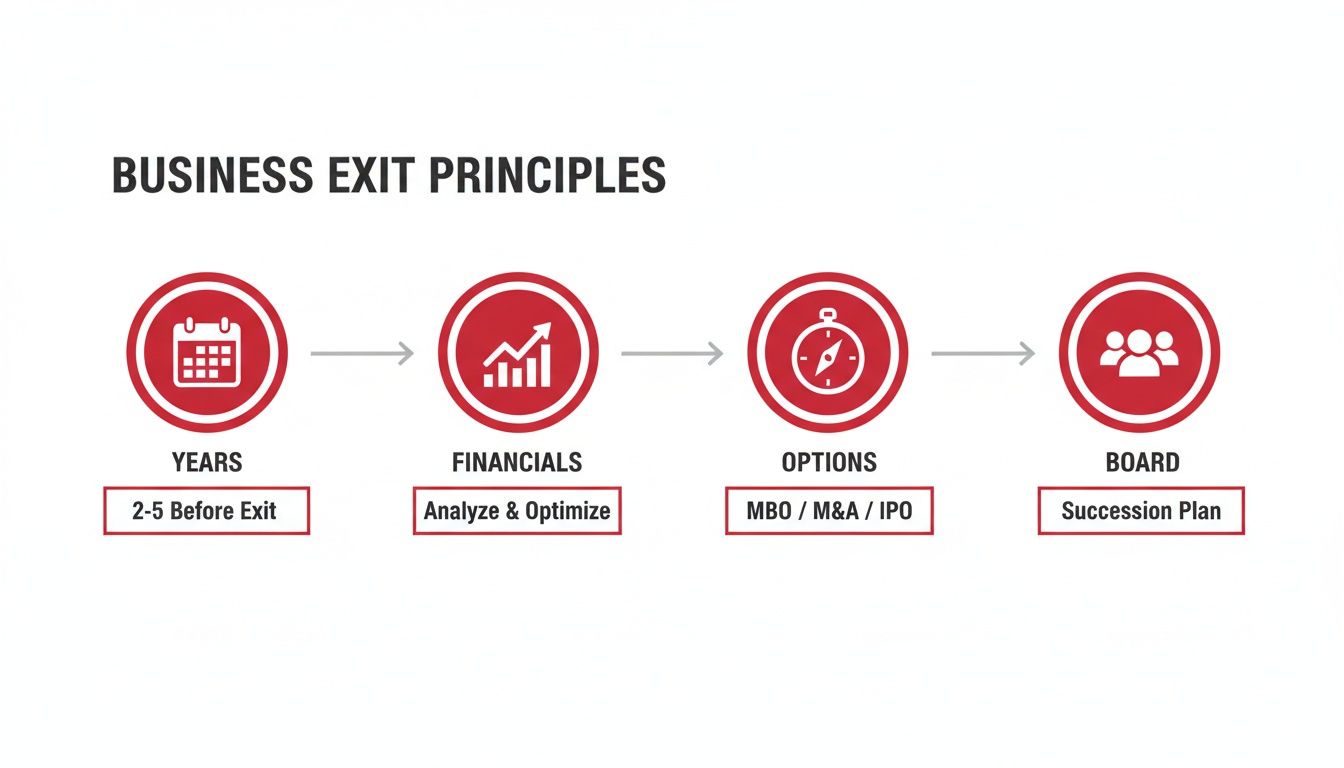
As you can see, a successful exit isn’t a last-minute decision. It's a multi-year process where defining your goals, preparing your finances, and exploring your options are all woven together.
A Sample 5-Year Exit Planning Timeline
Having a long-term horizon is one of the biggest advantages you can give yourself. It turns a daunting event into a series of manageable steps. Here’s a high-level look at what a five-year runway can look like, breaking down the key activities year by year.
| Timeframe | Key Focus Areas | Actionable Steps |
|---|---|---|
| 5 Years Out | Goal Setting & Baseline Assessment | – Define personal financial and legacy goals. – Get an initial, informal business valuation. – Identify key operational weaknesses and value drivers. |
| 3-4 Years Out | Value Enhancement & De-risking | – Implement initiatives to boost revenue and profitability. – Strengthen the management team to reduce owner dependency. – Clean up financial records and formalize processes. |
| 2 Years Out | Strategic & Structural Preparation | – Assemble your "exit team" (M&A advisor, CPA, attorney). – Begin detailed tax and estate planning. – Finalize financial statements and projections. |
| 1 Year Out | Marketing & Negotiation | – Prepare the Confidential Information Memorandum (CIM). – Identify and confidentially approach potential buyers. – Manage initial offers and letters of intent (LOIs). |
| Exit Year | Due Diligence & Closing | – Navigate the buyer's due diligence process. – Finalize the definitive purchase agreement. – Manage the closing process and plan the post-sale transition. |
This timeline isn't rigid, but it underscores a critical point: the more time you have, the more control you have over the outcome. Rushing the process almost always means leaving money and opportunity on the table.
Setting a Realistic Timeline
Your ideal timeline is the final piece of this initial puzzle. When do you want to be completely free from the day-to-day grind?
Be realistic here. A well-executed exit typically takes 3 to 5 years from planning to closing. This gives you enough runway to genuinely increase your business’s value, prepare your team for the transition, and navigate the sale without feeling rushed into a bad deal.
This long-term view is more important than ever. In the United States, there are roughly 2.9 million businesses owned by individuals aged 55 or older. With an estimated 73% of privately held U.S. companies expecting to transition ownership in the next decade, the market is about to get very crowded. You can read the full research on this massive upcoming business transition, but the takeaway is clear: preparation is your best competitive advantage.
By defining your financial, legacy, and timeline goals upfront, you create a powerful filter. You'll know instantly which opportunities align with your vision and which are just noise. This makes your planning focused, efficient, and ultimately, far more likely to succeed.
How to Prepare Your Business and Maximize Its Value

Now that you’ve sorted out your personal and professional goals, it's time to shift your focus squarely onto the business itself. This is where the real work begins—transitioning your company from a day-to-day operation into a premium, sellable asset. This phase of business exit strategy planning is all about rolling up your sleeves to build tangible value that buyers can see, measure, and ultimately pay more for.
This isn’t about a last-minute scramble to clean up the books. We're talking about a deliberate, multi-year effort to strengthen every part of your business, making it more resilient, efficient, and far less dependent on you. As business leader Robbie LaMattina often points out, the aim is to build a company that a new owner can step into with confidence, seeing clear and sustainable potential from day one.
Deconstructing and Boosting Your Company's Worth
Understanding your company's value isn't about finding some magic number. It's about learning to see your business through a buyer's eyes. Most will start by looking at a multiple of your EBITDA (Earnings Before Interest, Taxes, Depreciation, and Amortization), but that multiple can swing wildly depending on your industry, growth trajectory, and perceived risks.
Your job is to push that multiple higher. Every step you take to make your business more stable and profitable directly adds to its final sale price. The foundation for all of this is impeccable financial hygiene. Before anything else, you have to truly understand your numbers and present a clear picture to potential buyers by interpreting core company financial statements.
A buyer isn't just purchasing your past performance; they are investing in the predictability and scalability of your future cash flow. Your mission is to eliminate as much uncertainty about that future as possible.
Solidify Your Operational Foundation
Beyond the spreadsheets, buyers are kicking the tires on the engine of your business. Is it a well-oiled machine, or is it a clunky operation held together by your personal hustle? Creating robust, documented systems isn't optional; it's essential.
Here's what they'll be looking for:
- Management Strength: Is there a team that can run the show when you're not there? If the owner is also the lead salesperson, chief strategist, and primary problem-solver, that’s a high-risk purchase.
- Revenue Diversification: Do a few big clients pay all the bills? A broad customer base signals market stability. A business where 80% of revenue comes from two clients is infinitely riskier than one where the top ten clients account for less than 30% of sales.
- Documented Processes: Can a new person step in and figure out how marketing, sales, and operations work? Standard Operating Procedures (SOPs) are what turn tribal knowledge into a transferable asset.
A Real-World Example in Healthcare
Let's see how this plays out in a real industry. Robbie LaMattina, with his extensive background in behavioral healthcare, often uses it as a prime example of how value is built. A behavioral health provider might have a baseline valuation based on a standard EBITDA multiple. But that multiple isn't set in stone.
So, how do you increase it? By proving the things that buyers in this space care about most. For instance, the provider could significantly boost its valuation by:
- Proving Strong Clinical Outcomes: Using hard data to demonstrate high success rates and low patient readmissions.
- Diversifying Referral Channels: Shifting from a reliance on one or two hospitals to a wide network of physicians, therapists, and community organizations.
- Securing Long-Term Contracts: Locking in favorable, multi-year contracts with a mix of insurance payors.
Each of these moves reduces risk and points to a sustainable business model, making the company a much more attractive acquisition. In the same way, a real estate operator can drive up value by securing long-term anchor tenants or proving a consistent history of low vacancy rates. In any industry, one of the most powerful levers you can pull is improving profit margins through smart operational efficiencies, because that money drops straight to the bottom line and directly impacts your valuation.
By methodically addressing these areas, you’re not just prepping for an exit. You're building a fundamentally better, stronger business right now.
From MBO to ESOP: Comparing Your Exit Pathways
When you start thinking about your exit, it's easy to get tunnel vision and assume a sale to a competitor is your only real move. But that’s just one play in a much larger playbook. The truth is, there's a whole menu of exit pathways, and each one dramatically changes your financial outcome, your legacy, and the future of the company you've poured your life into.
The key isn't to find the "best" exit—it's to find the one that fits your goals. This isn't just about the final number on a check. It’s a deeply personal decision that balances control, timing, confidentiality, and what you want to leave behind.
The Strategic Sale to a Competitor
Selling to a strategic buyer, usually a larger company in your space, is the classic exit. Its main draw is simple: they can often pay the highest price. Why? Because they can create synergies—slashing redundant costs, absorbing your client list, or integrating your tech—which makes your business fundamentally worth more to them than to anyone else.
But this path comes with serious trade-offs. A strategic buyer will almost certainly absorb your company into their own operations. This often means a complete culture shift, layoffs for your team, and the end of the legacy you worked so hard to build. Confidentiality is also a huge risk; you're literally opening your books to a direct competitor, which is a high-stakes gamble.
The Financial Sale to Private Equity
Selling to a private equity (PE) firm is another well-trodden path, especially for businesses on a strong growth trajectory. Unlike a strategic buyer, a PE firm is a financial buyer. They aren't looking to swallow your company whole. Instead, they invest, aiming to rapidly scale the business over 3-7 years and then sell it for a significant profit.
This can be a fantastic option if you want to cash out some of your equity but aren't quite ready to walk away. You can de-risk your personal finances while staying involved and getting a "second bite of the apple" when the firm eventually sells. The flip side? PE firms are driven by aggressive growth targets and cold, hard metrics. This can mean a high-pressure culture and a loss of the day-to-day autonomy you’re used to.
The Management Buyout (MBO)
What if the best buyers are already in your building? A Management Buyout (MBO) is exactly that—selling the business to your existing leadership team. This is a route many owners choose when they place a premium on legacy and continuity. After all, your key managers already know the business inside and out, share its values, and are deeply invested in its future.
The biggest hurdle here is almost always financing. Your management team probably doesn't have the cash to buy you out outright. This means getting creative with the deal structure, often involving seller financing where you essentially loan them the money to buy the company over time. An MBO might not give you the biggest upfront payday, but it can provide a reliable income stream in retirement and the immense satisfaction of seeing your trusted team carry the torch.
A successful MBO is the ultimate testament to an owner's leadership. It proves you've not only built a valuable company but also developed the people capable of running it without you.
The Employee Stock Ownership Plan (ESOP)
An Employee Stock Ownership Plan (ESOP) is a unique and powerful exit strategy that too many owners overlook. With an ESOP, you sell your shares to a trust that holds them on behalf of your employees. This pathway offers some incredible tax benefits for you, the seller, and it’s a phenomenal tool for boosting employee motivation and retention.
The process is certainly complex and requires specialized advisors, but it lets you sell the company gradually while you remain in control. It's a fantastic choice for owners who want to reward the very people who helped build the business and ensure its independence long-term. ESOPs are a great fit for companies with stable cash flow and a loyal, tenured workforce—a powerful way to secure your legacy and give back to your team. Building reliable income is key to making this model work, and you can learn more about how to create predictable income streams by understanding different recurring revenue business models.
The Family Succession
For many founders, the ultimate dream is passing the business down to the next generation. This path is driven almost entirely by legacy and the desire to keep the company in the family. While it’s an emotionally powerful idea, it's also fraught with peril. The hard truth is that only about 30% of family businesses survive into the second generation.
A successful family succession doesn't just happen. It requires years of meticulous planning, brutally honest communication, and a clear-eyed assessment of whether your children are truly capable and passionate about leading. The process often involves complex estate planning and can easily create family friction if not everyone is on the same page.
Comparing Common Business Exit Strategies
Choosing your exit path is one of the most significant decisions you'll make as a business owner. Each option presents a unique mix of financial rewards, legacy implications, and operational complexity. The table below breaks down the most common strategies to help you see which one might align best with what you truly want.
| Exit Strategy | Potential Valuation | Control & Legacy | Timeline & Complexity | Ideal Candidate |
|---|---|---|---|---|
| Strategic Sale | Highest | Low; company is often absorbed | 6-12 months; high complexity | Owner focused on maximizing sale price. |
| Private Equity | High | Partial control; legacy evolves | 9-18 months; very high complexity | Owner wanting partial liquidity and growth partner. |
| MBO | Moderate | High; culture and team preserved | 12-24 months; moderate complexity | Owner prioritizing legacy and team continuity. |
| ESOP | Fair Market Value | High; broad employee ownership | 12-24+ months; high complexity | Owner wanting to reward employees and gain tax benefits. |
| Family Succession | Varies | Highest; family legacy is the priority | Years; emotionally and logistically complex | Owner with capable heirs and a long-term plan. |
Ultimately, there's no single "right" answer. The best path forward is the one that honors the hard work you've put in while setting you up for the future you've envisioned for yourself, your family, and your team.
Executing the Deal and Planning Your Next Chapter
This is it. The moment all your meticulous planning has been building toward. Years of work—shoring up operations, getting clear on your goals, and vetting your options—all come down to a final set of critical moves. This is where the plan you’ve sweated over becomes a reality, transforming your life’s work into a successful, and hopefully lucrative, transition. It's a high-stakes, high-pressure time that demands unwavering focus and the right people in your corner.

This final stretch isn’t just about signing on the dotted line. It’s about navigating tough negotiations, surviving intense scrutiny, and carefully managing the handover to give the business you built its best shot at continued success. As business leader Robbie LaMattina often points out, a well-executed deal doesn't just protect your wallet; it honors the legacy you’ve built with your team and your customers.
Assembling Your Indispensable Deal Team
The moment you get a serious offer, usually in a Letter of Intent (LOI), the game changes and the pace picks up dramatically. This is when your pre-selected deal team needs to be ready to jump in. Each person plays a crucial, non-negotiable role.
- M&A Attorney: Think of them as your legal quarterback. They're drafting and redlining all the binding documents, from the massive purchase agreement down to the non-compete clauses, all to minimize your legal exposure.
- Transaction CPA: This is your money expert, focused entirely on the tax consequences of the deal. They’ll structure the transaction to make sure you aren’t blindsided by a massive tax bill and will verify all the financial numbers being thrown around.
- M&A Advisor / Investment Banker: This is your chief strategist and negotiator. They run the entire sale process, from marketing your company to vetting buyers and, most importantly, fighting to get you the best possible terms.
Putting this team in place is non-negotiable. Statistics show that only about 20% to 30% of businesses that go to market actually sell. A huge reason for that failure rate is a lack of professional guidance.
Your deal team's primary job is to protect you from what you don't know. Their expertise in the nuances of a transaction is the single best investment you can make to secure the value of your business.
Navigating the Gauntlet of Due Diligence
Once an LOI is signed, the buyer kicks off due diligence. Prepare for a deep, exhaustive audit of every single part of your business. They will comb through your financials, customer contracts, employee agreements, and operational procedures.
This process is designed to uncover any hidden risks and confirm your business is everything you've claimed. The only way to win here is with total preparation. Long before you even think about selling, you should have a secure virtual data room loaded with every document a buyer could possibly ask for. It screams professionalism and drastically speeds up the timeline.
Negotiating the Final Terms and Closing the Deal
The negotiation isn't over when you agree on a price. The deal structure is just as critical. For example, will there be an earn-out, where a chunk of your payment is tied to how well the business performs in the future? It’s a common way for buyers to hedge their bets, but it means your final payout is far from guaranteed.
Other key points include seller financing, consulting agreements, and the nitty-gritty details of your transition period. Your attorney and advisor are there to guide you through these negotiations, making sure the final purchase agreement truly aligns with your goals. The closing is the last step: documents are signed, funds are wired, and ownership officially changes hands.
Planning for What Comes After
The deal is done. The money is in your account. Now what? For many founders, the transition out of the business they poured their life into can be emotionally and psychologically tough. Having a plan for your "next chapter" is absolutely vital.
Some owners stay on as a consultant for a set period to ensure a smooth transition. Others make a clean break. Whichever path you choose, make sure you've thought through these things:
- A Personal Financial Plan: Sit down with a wealth advisor to manage this new liquidity. You’ll need a plan for taxes, investments, and structuring your wealth to support your lifestyle for the long haul.
- New Ventures or Passions: Are you going to start another business? Focus on philanthropy? Travel the world? Spend more time with family? Having a purpose is key to avoiding that feeling of being adrift.
- Managing the Team Transition: The people who helped you get here deserve a well-managed change. Communicate openly (when the time is right) and work with the new owner to make sure your team feels valued and secure.
Successfully closing the deal and thoughtfully planning your next chapter is the final, critical piece of your business exit strategy planning. It's the culmination of your journey as an entrepreneur and the bridge to the future you've worked so hard to earn.
Your Top Questions About Exit Planning, Answered
When you start thinking about selling or stepping away from your business, a lot of questions pop up. It's a complex process, and it's natural to have concerns. Here are some straightforward answers to the questions I hear most often from business owners.
When Should I Really Start Planning My Exit?
Look, there's no such thing as "too early," but the ideal window is 5 to 10 years before you want to be out the door. I know that sounds like a long time, but that's your golden opportunity.
This isn't just about finding a buyer. This is about methodically increasing the value of your business, getting your financial house in order, and maybe even grooming the next generation of leadership. A long runway turns a stressful, last-minute sale into a strategic, value-boosting project.
What’s the Single Biggest Mistake Owners Make?
Hands down, the most common and costly mistake is making yourself indispensable. If the business can't run—and I mean thrive—without you personally answering every call or solving every problem, you’ve created a huge bottleneck that slashes its value.
A potential buyer isn’t just buying your assets; they're buying a functioning system. As I always tell my clients, the goal is to build a company that can succeed long after you're gone.
A business that runs on robust systems, not just the founder's heroics, is a far more valuable and transferable asset. The ultimate goal is to make yourself obsolete.
How Can I Keep My Exit Plans Under Wraps?
Keeping things confidential is non-negotiable. The last thing you want is a rumor mill churning among your employees, spooking customers, or alerting competitors.
Your first step is to create a small, tight circle of trust. This includes your attorney, CPA, and an M&A advisor—all of whom should be bound by strict non-disclosure agreements (NDAs). They're your brain trust.
When you're ready to talk to potential buyers, never go it alone. Use an intermediary like an investment banker or a business broker. They'll act as a buffer, vetting prospects and getting NDAs signed before any sensitive information ever leaves your hands. Key employees should only be brought into the loop when it's strategically necessary, usually when a deal is looking like a sure thing.
At Robert LaMattina, we believe a well-planned exit is the final, crowning achievement of a successful entrepreneur. For more pragmatic insights on building a resilient and valuable business, you can find more resources over at https://robertlamattina.net.
Frequently Asked Questions (FAQs)
What is business exit strategy planning?
It’s the process of creating a roadmap to hand over ownership of your company. This involves figuring out your personal goals, getting the business ready from a financial and operational standpoint, and picking the right path—like a sale, a management buyout, or family succession—to get the most value and ensure a clean handoff.
Why is an exit strategy important for a startup?
For a startup, it’s critical because it gets founders and investors on the same page from the beginning. It shapes key decisions, makes the company more attractive to investors (by showing them a clear path to a return), and forces you to build a scalable, valuable business instead of just a passion project.
What are the most common types of exit strategies?
The most common paths are a strategic sale to another company (like a competitor), a financial sale to a private equity firm, a management buyout (MBO), an Employee Stock Ownership Plan (ESOP), passing the business to family, or—in a worst-case scenario—liquidation.
What is a Letter of Intent (LOI)?
An LOI is a non-binding document outlining the basic terms of a potential deal. It shows the buyer is serious and sets a framework for final negotiations and due diligence, covering key points like the proposed price, deal structure, and an exclusivity period.
How can I make my business less dependent on me?
First, start documenting all your key processes to create a comprehensive operations manual. Then, empower your key employees by delegating meaningful responsibilities and giving them decision-making authority. The final step is to build out a strong management team and intentionally step back from the day-to-day to prove the business can run without you.