

Securing the right financing is the bedrock of any successful commercial real estate venture. It's the critical step that transforms a promising property on paper into a tangible, income-producing asset. The world of commercial real estate financing options is vast, with a specialized tool for every type of project, from a stabilized apartment building to a value-add retail center. Understanding these tools is the first step toward building a strong real estate portfolio.
This guide is designed to demystify the complex world of CRE lending, providing a clear roadmap for both new and experienced investors. We'll break down the primary loan types, explore what lenders truly look for in a deal, and equip you with the knowledge to negotiate the best possible terms. By the end, you'll have the confidence to navigate the financing process and secure the capital needed to achieve your investment goals.
4 Key Takeaways
- Match the Loan to the Goal: The best financing isn't always the one with the lowest rate. The ideal loan—whether it's a traditional bank loan, CMBS, or a bridge loan—must align with your specific business plan for the property.
- Lenders Bet on Cash Flow: While your credit and experience matter, lenders are primarily investing in the property's ability to generate consistent income. A strong Net Operating Income (NOI) and Debt Service Coverage Ratio (DSCR) are the most critical metrics.
- Preparation is Power: A complete, professional loan package that anticipates a lender's questions significantly speeds up the process and strengthens your negotiating position from the start.
- Alternative Financing Unlocks Opportunity: For non-standard deals, such as distressed assets or projects requiring a fast close, alternative options like hard money loans, seller financing, or joint ventures are invaluable tools.
Getting a Handle on CRE Finance
We're skipping the dense jargon and textbook theory here. This is about giving you a practical understanding of your options, what lenders are really looking for, and how to frame your project to get it funded. You’ll learn how to match the right capital to your specific deal, whether you're buying a cash-flowing apartment building or a raw piece of land.
Why the Right Loan is Everything
The loan you pick has a direct and powerful impact on your property's monthly cash flow, your final return on investment, and how much risk you're taking on. Choosing the wrong loan for your business plan can sink an otherwise great project.
Getting the right loan isn’t just about snagging the lowest interest rate. It's about finding a financial partner and a loan structure that truly supports your goals and timeline for the property.
To see the bigger picture of how investors get their deals funded, check out this comprehensive guide to commercial real estate financing options. Knowing all your choices is always the first step to making a smart one.
Exploring Primary CRE Financing Options
Navigating the world of commercial real estate financing can feel a lot like choosing a car for a cross-country road trip. Some loans are like a reliable sedan—perfect for a smooth, predictable journey with a stabilized property. Others are more like a rugged 4×4, built for the uncertain terrain of a value-add project.
This section breaks down the most common financing "vehicles" you'll encounter. We’ll look at the workhorses of the industry: traditional bank loans, CMBS (or conduit) loans, SBA programs, and government agency financing. For each one, we'll cover its ideal use case, who it's for, and the critical pros and cons you need to weigh.
Traditional Bank Loans: The Local Relationship
Think of a commercial mortgage from your local, regional, or even a national bank as the most familiar path. These loans are almost always relationship-based. The bank is lending its own money, so they want to know you, your business plan, and your track record inside and out.
They're a fantastic fit for investors with strong personal financials, a solid operating history, and a clear vision for a property. Because the bank keeps the loan on its own books (this is called "portfolio lending"), they can often be more flexible in structuring terms compared to the more rigid, standardized loan products out there.
But that flexibility comes with a trade-off. Bank loans are typically recourse, which is a big deal. It means if the property's income can't cover the debt, the lender can come after your other personal assets to make themselves whole. The underwriting process is also intensely personal, scrutinizing your global cash flow, net worth, and past real estate experience.
CMBS Conduit Loans: The Wall Street Engine
If bank loans are all about relationships, then Commercial Mortgage-Backed Securities (CMBS) loans are all about standardization. Often called "conduit" loans, they are originated by a lender, bundled together in a large pool with other similar loans, and then sold off to investors on the secondary market as bonds.
This structure is what allows for highly competitive, fixed-rate, non-recourse financing. That non-recourse feature is a massive draw for investors who want to shield their personal assets from the deal. CMBS loans are a great fit for stable, cash-flowing properties with strong tenant rosters—think established office buildings, fully leased retail centers, or large apartment complexes.
The key to understanding CMBS is that the loan is underwritten based on the property's performance, not the borrower's personal finances. The property itself is the star of the show.
The big downside here is a near-total lack of flexibility. Once that loan is packaged and sold—or "securitized"—making any changes is next to impossible. And the prepayment penalties, known as defeasance or yield maintenance, can be incredibly expensive. To get a feel for the history and performance of these products, you can explore things like CMBS vintage data from 2006.
This infographic gives you a bird's-eye view of the entire commercial real estate financing journey, from exploring your options to getting the deal done.
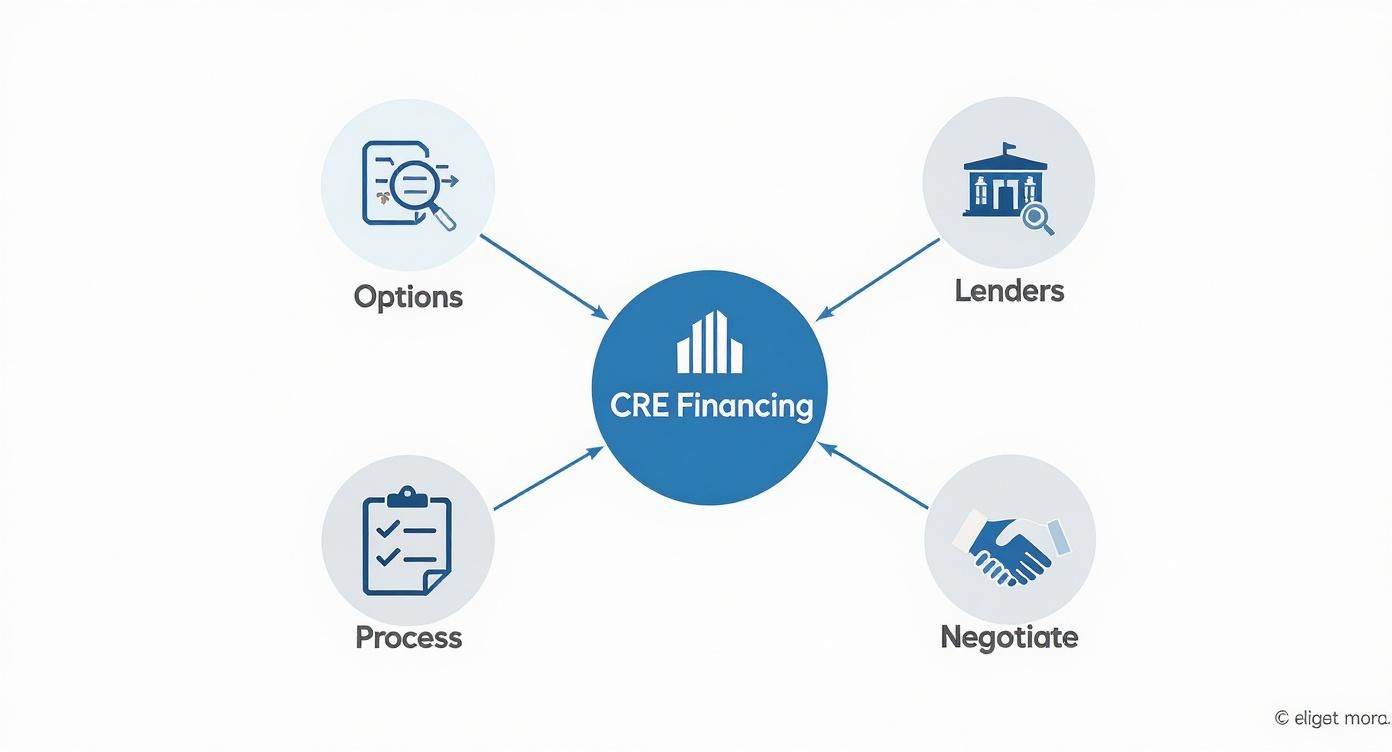
As you can see, securing capital isn't a single step but a multi-stage process that requires you to carefully weigh loan types, lender relationships, and negotiation strategies.
SBA 7(a) and 504 Loans: The Small Business Champion
The U.S. Small Business Administration (SBA) doesn't actually lend money directly. Instead, it guarantees a portion of the loan made by a partner bank or lender. This guarantee seriously reduces the bank's risk, which in turn makes it much easier for small businesses to acquire commercial real estate for their own operations.
You'll mainly encounter two programs for real estate:
- SBA 7(a) Loan: This is the SBA's most flexible program. You can use the funds for real estate, but also for working capital or equipment. It’s an excellent choice for a business buying a property where the real estate is just one piece of a larger expansion plan.
- SBA 504 Loan: This one is laser-focused on financing major fixed assets, like real estate and heavy machinery. It offers long-term, fixed-rate financing with down payments as low as 10%. That’s a huge advantage for businesses that need to preserve cash.
Here's the most important rule: for either loan, the business must occupy at least 51% of the property's square footage. This makes SBA loans a non-starter for passive real estate investors but a game-changing tool for owner-operators.
Government Agency Loans: The Multifamily Powerhouse
When it comes to financing multifamily properties (buildings with five units or more), the Government-Sponsored Enterprises (GSEs) like Fannie Mae and Freddie Mac absolutely dominate the market. They work a bit like the SBA, providing liquidity and stability to the lending market by purchasing and guaranteeing apartment loans made by their network of approved lenders.
These "agency" loans are the gold standard for apartment investors. Why? They offer incredibly competitive interest rates, long amortization periods (often up to 30 years), and non-recourse structures. If you're buying a stabilized apartment building—from a small garden-style community to a massive high-rise tower—this is likely where you'll end up.
Comparison of Primary CRE Financing Options
To really make sense of these different commercial real estate financing options, it helps to see their core features side-by-side. The table below gives you a quick snapshot of what you can generally expect when you approach each of these lenders.
| Financing Option | Typical LTV | Typical DSCR | Amortization Period | Ideal For |
|---|---|---|---|---|
| Traditional Bank Loan | 65-75% | 1.25x+ | 20-25 Years | Stabilized assets for borrowers with strong financials and a direct banking relationship. |
| CMBS (Conduit) Loan | 70-75% | 1.25x+ | 25-30 Years | Income-producing properties where the borrower prioritizes non-recourse debt and a fixed rate. |
| SBA 7(a) & 504 Loan | 85-90% | 1.15x+ | 20-25 Years | Small businesses purchasing property they will occupy for their own operations. |
| Government Agency | 75-80% | 1.20x+ | 30 Years | Stabilized multifamily properties of five units or more, from small to large scale. |
Ultimately, the best financing path depends entirely on your specific deal and what you want to achieve long-term. A business owner will see incredible value in an SBA loan's low down payment, while a passive investor buying a large office building will naturally gravitate toward the liability protection offered by a CMBS loan.
Unlocking Alternative and Specialized Funding
Traditional bank loans are the bread and butter of commercial real estate finance, but they just don't work for every deal. What happens when a property isn't fully stabilized, needs a major overhaul, or requires a lightning-fast close?
This is where you have to look beyond the usual suspects. A whole world of alternative financing options opens up, offering creative solutions for complex situations. These are the tools savvy investors use to unlock deals that would otherwise be impossible.
Let's dive into the financial bridges that carry a project from shaky ground to solid success, the gap-fillers that complete a tricky capital stack, and the creative partnerships that make a deal pencil out.
Bridge Loans: The Financial Crossover
Imagine you find a great apartment building, but it's riddled with vacancies because the previous owner let it slide. A traditional bank will take one look at the low income and say no. This is the perfect time to use a bridge loan.
Just as its name suggests, a bridge loan is a short-term financial "bridge" that takes a property from its current, underperforming state to a future, stabilized one.
Bridge lenders care less about a property's troubled past and more about your plan to turn it around. They give you the money to buy the asset and fund the renovations. Once the work is done, the building is leased up, and the income is flowing, you can refinance into a cheaper, long-term loan.
Here’s what to expect with a bridge loan:
- Short-Term: The clock is ticking. These loans typically run for 12 to 36 months.
- Interest-Only: This is a huge plus. Your payments are lower during the renovation, freeing up cash for the actual project work.
- Asset-Based: The lender is betting on the property's future potential—its "after-repair value"—not just your personal credit score.
Hard Money Loans: When Speed Is Everything
Sometimes an opportunity is so good you have to act now. Think of a distressed property auction or a seller who needs to close in ten days. Your bank, with its month-long underwriting process, simply can't keep up.
This is the domain of hard money loans.
Hard money lenders are private investors and specialized funds who value two things above all else: speed and the asset. They can often get a deal funded in days, not weeks or months. Of course, that speed comes at a price. Hard money loans have some of the highest interest rates and fees you'll find anywhere.
Think of hard money as the emergency toolkit for an opportunistic investor. You don't use it for every job, but when you absolutely must close a deal fast, it's an invaluable, if expensive, tool.
Investors use hard money as a temporary fix, almost always with a clear exit strategy to either refinance or sell the property within 6 to 18 months. The high cost only makes sense if you’re acquiring an asset at a massive discount or solving a critical, time-sensitive problem.
Mezzanine Debt and Preferred Equity: Filling the Gaps
Let's run a common scenario. A bank agrees to lend you 65% of the cost for a new development project. You’ve managed to scrape together 20% for the down payment. That still leaves you with a 15% funding gap.
This is where mezzanine debt and preferred equity come in. These are forms of junior capital that slot in between the primary bank loan (senior debt) and your cash (common equity).
- Mezzanine Debt: This is a hybrid that acts like a second loan, but with a twist. It's secured by your ownership shares in the LLC that holds the property, not the property itself. If you default, the mezzanine lender can take control of your company.
- Preferred Equity: This isn't a loan at all—it's an equity investment. A "pref" investor gives you capital in exchange for a fixed, priority return. They get paid their share of the profits before you, the common equity holder, see a single dime.
Both options are more expensive than a traditional mortgage but are often cheaper than bringing in another equity partner and giving up more ownership. They are complex tools used in larger, more sophisticated deals to make the numbers work. Getting these structures right requires a deep understanding of project viability, which is why a detailed real estate development feasibility study is non-negotiable before you even think about this type of capital.
Creative Strategies: Seller Financing and Joint Ventures
Sometimes the best financing doesn't involve a lender at all. With a bit of creativity, you can structure deals that work even when traditional capital isn't available.
Seller financing is a fantastic example. Here, the person selling the property acts as your bank, carrying a note for a portion of the purchase price. This can be an incredibly powerful tool, especially when credit markets are tight. It also signals that the seller has confidence in the asset they're selling.
A Joint Venture (JV) is another path. Instead of borrowing money, you partner with a person or company that provides the equity you're missing. In return, they get a share of the ownership and a cut of the profits. This is a classic setup for developers who have the know-how to execute a project but need a "money partner" to bring it to life.
What Lenders Really Want to See

Getting a commercial loan isn't about some secret handshake or magic formula. At its core, it's about convincing a lender that your deal is a calculated risk, not just a gamble. The whole underwriting process is designed to do just one thing: figure out the odds.
Lenders aren't just staring at spreadsheets; they're piecing together a story about your project's future. To get the green light, you need to think like they do and understand the three pillars they build their decision on: the property, the borrower, and the market. Nail these, and you’ll present a deal that lets them sleep at night.
Pillar 1: The Property Itself
Long before they even glance at your personal bank statements, lenders put the property under a microscope. This makes sense—the asset is their primary collateral, so its power to churn out cash is everything. They zoom in on a few critical vital signs.
- Net Operating Income (NOI): This is the main event. It’s simply the property's total rental income minus all the costs of running the place (before you pay the mortgage). Think of NOI as the property's raw annual profit.
- Occupancy Rate: High occupancy tells a lender there's strong demand and a stable income stream. On the flip side, a building with a lot of empty space is a massive red flag.
- Debt Service Coverage Ratio (DSCR): This might be the single most important metric in their entire analysis. DSCR measures how comfortably the property's income can cover the proposed mortgage payments.
You have to remember, lenders are fundamentally buying a cash flow stream. Your job is to prove that stream is strong, consistent, and durable enough to handle a few bumps in the road.
Pillar 2: The Borrower and Sponsor
Once the property passes the sniff test, the spotlight swings over to you—the borrower, or what the industry calls the "sponsor." Lenders need to know that a capable and experienced operator is steering the ship. Your personal financial strength and background are their second layer of protection if things go sideways.
They will absolutely dig into your:
- Credit History: A solid personal and business credit score is proof of responsible borrowing. Most lenders want to see scores north of 680.
- Net Worth and Liquidity: They’ll want to see that you have other assets to fall back on (your net worth) and enough cash on hand (liquidity) to ride out any unexpected vacancies or repair bills.
- Direct Real Estate Experience: Nothing gives a lender more confidence than seeing you’ve successfully owned and managed similar properties before. A proven track record is gold.
Pillar 3: The Market Environment
No property exists in a bubble. Even a fantastic building in a dying town is a terrible bet. Because of this, lenders conduct their own research on the local market to spot any external threats that could hurt your investment.
This means they'll be looking at things like local job growth, population trends, and any new construction that might flood the market with competition. They’ll also pull "comps"—data on comparable sales and rents—to make sure your projections are grounded in reality and not just wishful thinking.
The good news? The lending environment has seen a marked improvement. New loan volume in the U.S. jumped by 13% from late 2024 and skyrocketed over 90% compared to the previous year. This signals a strong recovery, with lending standards easing up. As of June 2025, just 9% of U.S. banks reported tightening their standards, a massive drop from 67.4% in April 2023. You can explore a more detailed commercial real estate outlook to see how these trends are creating opportunities globally.
Putting It All Together: A Quick DSCR Example
Let’s make this real. Say you’re looking to buy a small office building.
- The property’s annual Net Operating Income (NOI) is $120,000.
- Your proposed annual mortgage payment (debt service) is $96,000.
The formula couldn't be simpler: DSCR = NOI / Annual Debt Service
So, in this scenario: $120,000 / $96,000 = 1.25x
Most lenders have a hard floor of 1.25x for their DSCR. This ratio means the property is generating 25% more cash than it needs to cover the mortgage—a healthy safety cushion. If your DSCR dips below that mark, the lender will almost certainly say no or ask you to take a smaller loan to get the ratio back in line.
Building a Winning Loan Package

Landing the right financing isn't just about finding a great property. It's about how you present that property to a lender. Your loan package is their first look into your deal—and you—so making it professional, compelling, and airtight is non-negotiable.
Think of it as the business plan for your investment. It needs to tell a story that convinces a lender your deal is a smart, low-risk bet. A well-crafted package doesn’t just get you to the front of the line; it fast-tracks the underwriting process and immediately puts you in a much stronger negotiating position.
The Essential Loan Package Checklist
Before you pick up the phone to call a single lender, you need your toolkit ready. Walking in prepared signals that you’re a serious operator and helps lenders get to a "yes" faster. While every lender has their own quirks, a solid loan package always includes these core documents.
- Executive Summary: This is your one-to-two-page elevator pitch. It needs to crisply summarize the loan request, the property, your plan for it, and why you’re the right person for the job.
- Property Information: The basics—address, a good set of photos, and a clear description of the asset itself.
- Property Financials: Get the numbers in order. You’ll need the current rent roll, at least two years of historical operating statements (for an existing building), and your pro-forma projections for the next five years.
- Borrower Financials: Lenders underwrite the sponsor just as much as the property. Be ready with your personal financial statement, your last two years of tax returns, and a schedule of all other real estate you own.
- Third-Party Reports: If you're ahead of the game and already have an appraisal, environmental report, or property condition assessment, include them.
A lender's biggest fear is the unknown. A meticulously prepared loan package answers their questions before they even have to ask, building confidence and trust from day one.
The Art of Negotiating Your Loan
Once your package is out there and term sheets start rolling in, the real work begins. This is where you can save yourself tens of thousands of dollars over the life of a loan. Nothing gives you more leverage than having multiple offers on the table. When lenders know they’re competing for your business, they suddenly become a lot more flexible.
For a deeper dive into this, you can learn more about how to finance investment properties and set your deal up for success in our other guide.
Beyond just the interest rate, there are a few other key levers you should always try to pull.
- Prepayment Penalties: These dictate how much you'll pay if you sell or refi early. Push for a shorter penalty period or a simpler, more favorable structure like a step-down penalty.
- Loan Covenants: These are the rules of the road—things like maintaining a minimum DSCR or occupancy rate. You want to negotiate for covenants that give you operational breathing room, not ones that will trip you up if the market softens.
- Fees: Origination points, legal fees, processing costs—they all add up. Don't be afraid to ask for a reduction, especially if your application is strong and you're juggling other offers.
Getting the best financing is a two-step dance. It starts with building an undeniable case on paper and ends with skillfully negotiating from a position of strength.
Avoiding Common Pitfalls in Today's Market
Navigating commercial real estate financing is as much about dodging bullets as it is about finding the perfect loan. I’ve seen even experienced investors get tripped up by predictable mistakes that cost them time, money, and a whole lot of stress. A few common blunders can sink an otherwise great deal before it ever leaves the port.
The most frequent errors are simple ones: underestimating how much cash you'll really need for closing and future repairs, or picking a loan that’s completely at odds with your game plan. Grabbing a short-term bridge loan for a long-term buy-and-hold property just doesn't make sense. The trick is to always match the financing to the asset and your ultimate goal for it.
A successful financing strategy is proactive, not reactive. It anticipates future costs and aligns the loan structure with the property's lifecycle, from acquisition and stabilization to its eventual sale or refinance.
Miscalculating Total Project Costs
One of the easiest ways to get into trouble is by fixating only on the purchase price. New investors, and sometimes even vets, forget to budget for the full spectrum of costs, which can create a serious funding gap when you can least afford it.
To get the full picture, your budget needs to go deeper.
- Closing Costs: Plan for these to be around 3-5% of the loan amount. This bucket covers everything from appraisal and legal fees to loan origination.
- Capital Expenditures (CapEx): You have to set aside reserves for the big-ticket items down the road. That new roof or HVAC system won't pay for itself.
- Contingency Funds: Always, always have a buffer. A cash reserve of at least 5-10% of the total project cost is a good rule of thumb for when things inevitably go wrong.
Thinking through your budget this way is just good risk management. For a deep dive into everything you should be checking, take a look at our commercial property due diligence checklist.
Ignoring the Current Lending Environment
You can’t just assume the lending market is the same as it was last year. Right now, it's feeling some unique pressures that are changing how lenders operate. We're facing a "wall of maturities," with a staggering amount of commercial real estate debt coming due. We're talking about $600 billion in loans maturing annually through 2028, which forces borrowers to find new financing in a much tougher climate.
In fact, U.S. banks have reported a 66% jump in the value of modified commercial real estate loans in the last year alone, as they work with borrowers to find a way forward. As recent industry analysis on the challenges facing commercial real estate shows, this market demands more flexible and creative financing to stay afloat. For you, this means some lenders are tightening their belts, while others are stepping in with specialized capital. Knowing who is lending—and on what terms—is more critical than ever.
Frequently Asked Questions
What is the most common type of commercial real estate financing?
The most common financing option is a traditional commercial mortgage from a local, regional, or national bank. These loans are popular for stabilized properties and are often relationship-based, allowing for more flexible terms for borrowers with strong financial standing and a proven track record.
What is the minimum down payment for a commercial property?
For most conventional commercial loans, lenders typically require a down payment of 20% to 35% of the purchase price. However, some government-backed programs, like the SBA 504 loan, can allow for down payments as low as 10% for qualified owner-occupied businesses.
What credit score do I need for a commercial real estate loan?
While there is no universal "magic number," most lenders prefer to see a personal credit score of 680 or higher. However, commercial lending is more focused on the property's cash flow and the borrower's overall financial health and experience. A strong property can sometimes compensate for a slightly lower credit score.
Can I get a commercial real estate loan with no money down?
Securing a 100% financed commercial loan from a single traditional lender is extremely rare. Lenders require borrowers to have "skin in the game." However, investors can achieve a low-money-down deal through creative strategies, such as combining a senior bank loan with seller financing or bringing in a joint venture partner to cover the equity portion.