

Welcome to the world of commercial real estate. In this business, nearly every major decision you make boils down to one critical skill: accurate valuation. Getting this right is everything. An accurate valuation is the foundation for smart investment decisions, a point often emphasized by industry experts like Robbie LaMattina.
The primary commercial real estate valuation methods are surprisingly straightforward at their core. They fall into three main buckets: the Income Approach (all about the cash flow), the Sales Comparison Approach (what have similar properties sold for?), and the Cost Approach (what would it cost to rebuild?).
Getting a handle on these three is the absolute first step toward making smarter, more confident investment decisions.
4 Key Takeaways on Property Valuation
Before we get into the nitty-gritty of the formulas, let's zoom out. There are a few core principles that guide every single valuation. Keep these four takeaways in your back pocket, and you'll have a strategic framework for analyzing any commercial property.
- Valuation Is Context-Dependent: There is no single "best" method. The right approach always depends on the property type, its use, and what the market is doing right now.
- For Commercial Assets, Income Is King: For most investment properties, the name of the game is cash flow. That makes Net Operating Income (NOI) the single most important metric you'll work with.
- Market Data Drives Accuracy: A valuation is only as good as the data behind it. You absolutely need solid comparable sales, accurate rent data, and realistic cap rates. These are non-negotiable.
- Assumptions Have a Major Impact: Tweak a key assumption—like the capitalization rate or projected rent growth—even slightly, and you can dramatically change the final value. Always question and test your assumptions.
Remember these principles as we explore each valuation method. They'll act as your North Star, helping you think like a seasoned appraiser and make sound investment moves.
The Blueprint for Valuing Commercial Property

This guide is designed to pull back the curtain on how the pros, including insights from expert Robbie LaMattina, figure out what a commercial asset is truly worth. Valuation isn't just about plugging numbers into a formula; it's about telling a property's story using financial data and market trends.
Think of it as building a rock-solid case for a property’s value, whether you're trying to buy, sell, or get a loan.
A solid valuation is the bedrock of any successful deal. It helps you attract serious buyers and ensures you don't leave money on the table. Even better, a data-backed valuation gives you a massive advantage in negotiations and helps you avoid the classic mistake of overpricing, which kills momentum and signals weakness to the market.
The Three Pillars of Valuation
At its heart, CRE valuation looks at a property from three distinct angles. Each method gives you a different lens to see what an asset is worth, and together they create a complete picture.
- The Income Approach: This is all about a property's ability to make money. It's the go-to method for assets like office buildings, shopping centers, and apartment complexes where cash flow is king.
- The Sales Comparison Approach: With this method, you're looking at what similar properties in the area have recently sold for. It’s grounded in real-world, verifiable market activity.
- The Cost Approach: This one asks a simple question: what would it cost to build this exact property from scratch today, minus any wear and tear (depreciation)? It’s perfect for unique properties or brand-new construction.
To really nail these approaches, you need to dive deep into the financials and the local market. Using a structured real estate market analysis template is a great way to keep all that data organized. Knowing which tool to use for the job is what separates the amateurs from the pros.
4 Foundational Truths of Property Valuation
Before we get into the weeds of valuation formulas and methodologies, let's zoom out. Think of these four principles as the bedrock of any solid commercial real estate analysis. If you can internalize these concepts, as valuation pros like Robbie LaMattina have, you'll be able to approach any deal with more clarity and confidence.
These aren't just academic points; they are the strategic pillars that seasoned investors and appraisers rely on every single day.
1. There’s No One-Size-Fits-All Method
The first thing to understand is that there's no single "best" way to value a property. The right tool for the job always depends on the asset itself and what the market is doing right now. You wouldn't use the same approach for a brand-new medical office on a long-term lease as you would for a 50-year-old retail strip center with a dozen tenants and leases expiring at different times.
Your job is to think like a buyer. Are they buying this for its steady income stream? Is it a redevelopment play? Or is it a unique property with few direct comparisons? The answer tells you which valuation method will give you the most realistic picture.
2. For Commercial Property, Income Is Everything
While location, condition, and a dozen other factors play a role, at the end of the day, a commercial property's value comes down to one thing: its ability to generate cash. This is why Net Operating Income (NOI) is the most critical number you'll work with. NOI is simply the money left over after you've collected all the rent and paid all the bills to run the building—before accounting for any mortgage payments or income taxes.
Mastering the calculation of a property's true NOI is absolutely essential. It’s the cornerstone of the most common valuation methods and has a bigger impact on the final number than almost any other input.
3. Your Valuation Is Only as Good as Your Data
A property valuation built on guesswork isn't a valuation at all—it's a gamble. A credible, defensible value has to be anchored in hard, verifiable market data. Gut feelings are great for flagging opportunities, but they can't be the foundation of your financial model.
You'll need to dig into the evidence:
- Solid Comps: Finding recent sales of properties that are genuinely similar in size, location, age, and tenant quality.
- Real Cap Rates: Knowing the current capitalization rates that deals are actually closing at for this property type in this specific submarket.
- Current Leasing Info: Understanding what tenants are paying in rent for comparable spaces and how much vacant space is in the neighborhood.
Without this data, you’re just plugging numbers into a spreadsheet. With it, you’re building a professional assessment.
4. Small Assumptions Make a Huge Difference
Finally, never forget how sensitive your valuation is to the assumptions you make. A tiny tweak to a key input can cause massive swings in the final price. Shifting your assumed capitalization rate by just a quarter of a percent, or changing your rent growth forecast by 1%, can change a property's value by hundreds of thousands, if not millions, of dollars.
Because of this, it's critical to be conservative, run different scenarios to test your assumptions, and always be prepared to justify why you chose the numbers you did.
Unpacking The Income Approach
When you’re looking at a property designed to make money—think office buildings, retail centers, or apartment complexes—the Income Approach is the undisputed king. It’s the method that speaks the language of investors because it ties a property's value directly to the cash it puts in your pocket.
This approach isn't about curb appeal or square footage alone; it’s about financial performance. As expert Robbie LaMattina often points out, if you're serious about commercial real estate, you have to master this. It’s the foundation for justifying a purchase price. Within this framework, we have two primary techniques: Direct Capitalization and Discounted Cash Flow (DCF).

Direct Capitalization: The Snapshot View
Think of Direct Capitalization as taking a high-resolution snapshot of a property’s financial health right now. It's a quick, powerful way to get a value based on its current, stable performance. It’s incredibly popular for a reason: it's straightforward and reflects what the market is willing to pay for a stream of income today.
The whole process boils down to two key numbers: the Net Operating Income (NOI) and the Capitalization Rate (Cap Rate).
- Net Operating Income (NOI): This is your property's total income after you've paid all the operating bills but before you've paid the mortgage or income taxes.
- Capitalization Rate (Cap Rate): This is simply the rate of return you'd expect if you bought the property with all cash. It’s figured out by looking at what similar properties in the area have recently sold for.
The formula is beautifully simple: Value = Net Operating Income (NOI) / Capitalization Rate (Cap Rate).
Let's put it into practice. If a building generates an NOI of $320,000 and similar properties in the area are trading at a 7% cap rate, its value is right around $4.57 million ($320,000 / 0.07). This method is central to valuing income-producing properties, especially in major markets where investors are laser-focused on cash flow.
Discounted Cash Flow: The Movie View
If Direct Capitalization is a snapshot, then a Discounted Cash Flow (DCF) analysis is the full-length movie. It doesn’t just look at today’s numbers. Instead, it projects the property’s financial story over a longer period—usually 5 to 10 years—and then figures out what all that future cash is worth in today's dollars.
This is the method you pull out for more complex situations, like a building with a bunch of leases all expiring at different times or a property that needs a major facelift.
A DCF analysis forces you to think critically about the future. You have to make educated assumptions about rent growth, vacancy rates, and future expenses, which provides a much more dynamic view of the investment's potential.
A DCF analysis has a few core steps:
- Project Annual Cash Flows: Forecast the property's NOI for every year of your holding period.
- Determine a Discount Rate: This is the return you demand for taking on the investment's risk.
- Calculate Terminal Value: You have to estimate what you’ll sell the property for at the end of the line. This is usually done by applying a future "exit" cap rate to the final year's NOI.
- Discount to Present Value: Finally, you pull all those future cash flows (and the final sale price) back to their value today and add them all up.
It definitely requires more assumptions, but a DCF gives you a much richer understanding of an asset's value, especially when its future potential is the main attraction.
Comparing Income Approach Methods
So, when do you use the quick snapshot versus the full-length film? It’s not about which one is "better," but which one is right for the job. To help clarify, here's a quick comparison of the two methods.
| Feature | Direct Capitalization | Discounted Cash Flow (DCF) |
|---|---|---|
| Time Horizon | A single point in time ("in-place" income) | Multi-year period (typically 5-10 years) |
| Best For | Stable, predictable properties (e.g., NNN lease) | Properties with variable income or future potential |
| Complexity | Simple and fast | Complex, requires more assumptions |
| Key Inputs | Current NOI and Market Cap Rate | Future NOI projections, Discount Rate, Terminal Value |
| Output | A current market value based on today's performance | A detailed intrinsic value based on future cash flow |
| Sensitivity to Assumptions | Sensitive to cap rate fluctuations | Highly sensitive to growth, vacancy, and discount rate guesses |
Ultimately, the best approach depends on the property's specific story and your investment strategy.
Making The Right Call
Choosing the right tool is critical for an accurate valuation. The integrity of your numbers depends on it.
Use Direct Capitalization When:
- The property has steady, predictable income from long-term tenants.
- The market is stable, without major shifts on the horizon.
- You need a quick, solid valuation for a standard asset, like a fully leased retail building.
Use Discounted Cash Flow (DCF) When:
- The property has uneven cash flows, like an office building with staggered lease renewals.
- You're planning major upgrades or have a strategy to fill up a partially vacant building.
- The market is choppy, and you need to model different "what-if" scenarios for the future.
A thorough analysis often starts with a simple cap rate valuation and is then stress-tested with a more detailed DCF model, especially once you get into due diligence. To see how these valuation insights fit into the larger acquisition picture, you can review our commercial property due diligence checklist.
And for those who want to go even further, you can delve deeper into income-based valuation with this excellent resource.
Mastering the Sales Comparison Approach
Think about how you'd figure out the value of a house in your neighborhood. You’d immediately look at what similar houses on the street recently sold for. The Sales Comparison Approach in commercial real estate runs on that very same, intuitive logic: a property is ultimately worth what someone else just paid for a similar one.
Often called the "Market Approach," this is one of the most trusted and easy-to-understand commercial real estate valuation methods. Its real power is that it's rooted in reality. It doesn’t rely on forecasts or pro-forma numbers, but on actual, closed transactions and the hard evidence of what the market is truly willing to pay.
As expert Robbie LaMattina often points out, this method is the ultimate reality check, anchoring any valuation in cold, hard market data.
Finding and Selecting the Right Comps
The whole method lives or dies by the quality of your "comparable" properties, or "comps." Picking the right comps is where the science of data meets the art of experience. A good comp isn't just another building down the road; it has to be genuinely similar in ways that a potential buyer would care about.
When you're hunting for comps, you're looking for recent sales that mirror your property's most important features:
- Property Type: An industrial warehouse needs to be compared to other industrial warehouses, not a strip mall.
- Location: Comps should be in the same submarket or neighborhood to reflect similar demographics, zoning, and traffic.
- Size: Both the building's square footage and the overall lot size need to be in the same ballpark.
- Age and Condition: You can’t directly compare a brand-new, Class A building to a 40-year-old fixer-upper without making some serious adjustments.
- Sale Date: The more recent, the better. A sale from two years ago is a history lesson; a sale from last month is market intelligence.
The goal here isn't to find just one perfect match. You need a small portfolio of at least three to five solid comps to build a defensible valuation.
The Art of Making Adjustments
Here’s the thing: no two properties are ever truly identical. That's where adjustments come into play. This is the critical step where you account for the differences between your property (the "subject") and the comps you've found. The key is to adjust the comp's sale price—not your property's value—to make it a fair, apples-to-apples comparison.
The rule of thumb for adjustments is simple: If the comp is better than your property in some way (e.g., newer roof, more parking), you subtract value from its sale price. If the comp is inferior (e.g., poorer location), you add value to its sale price.
Let's say a comp sold for $2.5 million but has a new HVAC system that your building lacks. You might subtract $50,000 from the comp's price. On the flip side, if your property has superior road frontage, you might add $75,000 to that same comp's sale price to equalize them.
A Practical Example of the Adjustment Process
Let's walk through a quick, simplified example. Imagine you're valuing a 10,000 sq. ft. office building (the Subject). You've found a solid comparable property (Comp A) that sold last quarter for $2,000,000.
- Analyze Differences: You notice that Comp A is a bit larger at 11,000 sq. ft., but your subject property is in a slightly better, more visible location.
- Quantify Adjustments: After digging into market data, you figure that office space in this area goes for about $200/sq. ft. and that your subject's superior location warrants a 5% value premium.
- Apply the Adjustments:
- Size Adjustment: Comp A is 1,000 sq. ft. larger. You need to subtract that extra value from its price (1,000 sq. ft. x $200 = -$200,000).
- Location Adjustment: Your subject’s location is better. So, you need to add value to the comp's price to bring it up to par ($2,000,000 x 5% = +$100,000).
- Calculate Adjusted Price: $2,000,000 (Comp Sale Price) – $200,000 (Size) + $100,000 (Location) = $1,900,000.
You would repeat this exact process for your other comps, and then reconcile the different adjusted prices to arrive at a final, well-supported valuation for your building. To really get a handle on the nuances, it's worth exploring a more detailed guide on Mastering the Sales Comparison Approach.
Of course, the biggest hurdle with this method is simply finding enough good, recent comps. For one-of-a-kind properties or in markets where nothing is selling, the lack of data can make this approach unreliable, forcing you to lean more heavily on other valuation techniques.
When Does the Cost Approach Make Sense?
Imagine you need to value a brand-new high school, a historic church, or a one-of-a-kind government facility. These properties don't generate rental income, and you’d be hard-pressed to find anything similar that has sold recently. This is exactly where the Cost Approach shines. It becomes the essential tool when other methods just don't fit.
It’s also the go-to method for valuing new construction projects. The logic behind it is elegantly simple: a rational buyer won’t pay more for an existing building than what it would cost to build a brand new, equivalent one. As industry expert Robbie LaMattina often points out, this principle establishes a critical "valuation ceiling," grounding the property's worth in the real-world costs of land and construction.
The Core Formula: A Simple Breakdown
At its heart, the Cost Approach is built on a straightforward calculation:
Value = Replacement Cost – Accumulated Depreciation + Land Value
Let’s quickly pull apart what each of these pieces means.
- Replacement Cost: This is what it would cost today to build a property with the same usefulness (or utility) as the existing one, but using current materials and construction standards.
- Accumulated Depreciation: This is where the nuance comes in. It's the total loss in value the property has experienced over its lifetime from all causes.
- Land Value: This is simply the market value of the land as if it were empty and ready to be developed for its most profitable use.
Essentially, you're valuing the building and the land separately and then adding them back together to get the total property value.
The Three Flavors of Depreciation
Depreciation is more than just the physical wear and tear you can see. For a truly accurate valuation using the Cost Approach, you have to account for three distinct types of value loss.
-
Physical Depreciation: This is the one everyone thinks of first—the leaky roof, the aging HVAC system, the cracked parking lot. It’s the tangible decay that comes from age, use, and exposure to the elements.
-
Functional Obsolescence: This is about a loss in value because the design itself is outdated or inefficient by modern standards. Think of an office building with ceilings too low for today’s open-plan layouts, a warehouse with not enough loading docks, or a hotel with a floor plan that just doesn't work for today's guests.
-
External Obsolescence: This type of depreciation is caused by negative factors outside the property lines, making it almost impossible for the owner to fix. It could be a new freeway creating constant noise right next door, a major factory in town closing down and gutting the local economy, or a zoning change that makes the property less desirable.
The Cost Approach forces you to get granular, analyzing a property's physical and functional components piece by piece. While it's not the first choice for standard income-producing assets, it provides a fantastic reality check against other valuation methods.
Historically, commercial real estate values have trended upward, despite market bumps along the way. For instance, the National All-Property (NAP) Index revealed that between 2001 and 2016, commercial property prices increased by an average of 5.6% each year. This long-term appreciation highlights the critical role of land value—a key part of the Cost Approach—even when buildings themselves are aging. You can dig deeper into these long-term commercial real estate findings to see the data for yourself.
Reconciling the Methods for a Final Value
So, you’ve run the numbers using the Income Approach, Sales Comparison, and Cost Approach. Now what? You're likely staring at three different values for the same property. Don't worry, that's completely normal—in fact, it’s expected. This is where the real expertise comes in.
The final, crucial step is reconciliation. This is the process where an appraiser or a savvy investor synthesizes these different figures into a single, logical, and defensible opinion of value.
Think of yourself as a judge weighing testimony from three expert witnesses. Each valuation method offers a unique perspective on the property's worth, but they don't all carry the same weight in every situation. The goal is absolutely not to just average the three numbers together. It’s a thoughtful analysis to determine which method tells the most reliable story for the specific property you're evaluating.
Weighing the Evidence from Each Approach
The art of reconciliation is all about context. It’s about knowing the strengths and weaknesses of each method and applying that knowledge to the property at hand. You have to critically assess the quality and relevance of the data you used for each calculation.
For instance, if you're looking at a bustling shopping center with a roster of long-term, credit-worthy tenants, the Income Approach is your star witness. Its value is fundamentally tied to its cash flow, which is exactly what a potential buyer is purchasing. For investment-grade assets, the story told by the numbers—the NOI and projected cash flows—is what truly matters.
Now, flip the script. Imagine a standard warehouse in a hot industrial park where three similar buildings sold last quarter. Here, the Sales Comparison Approach gives you the most grounded, real-world evidence. The market has already spoken, and you have direct proof of what buyers are willing to pay. The Cost Approach, while always a useful reference point, often takes a backseat for older, income-producing properties where depreciation can be a real wild card.
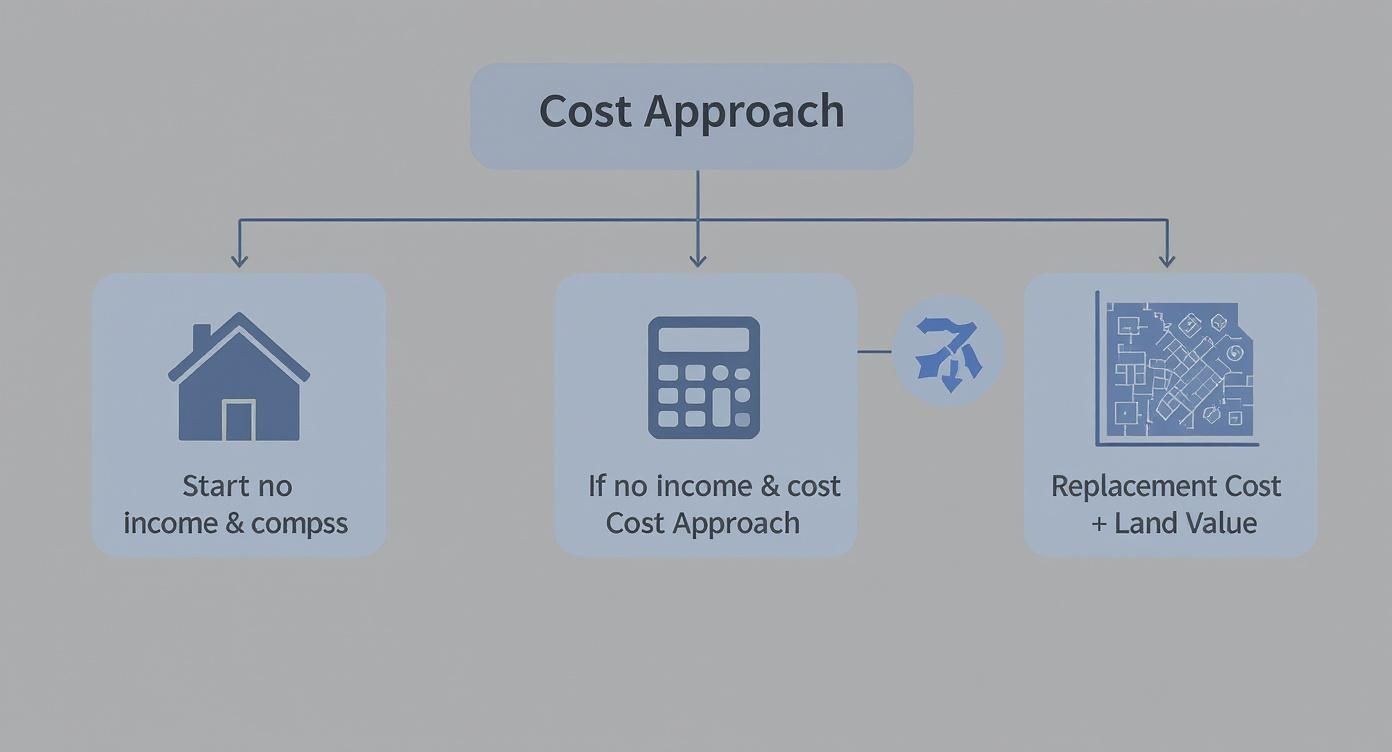
This flowchart really highlights where the Cost Approach shines. It becomes the go-to method for unique, special-use properties—like a new church or a municipal building—where you have neither an income stream nor comparable sales data to work with.
Final Value Reconciliation Example
Let's walk through a quick, practical example. You're valuing a 10-year-old medical office building that's fully leased to a strong tenant.
- Income Approach (Direct Capitalization): Based on solid rental income and reliable market cap rates, your analysis points to a value of $5,200,000.
- Sales Comparison Approach: You dug up three good comps. After making adjustments, the value comes in at $5,050,000.
- Cost Approach: This method, based on what it would cost to build the same facility today, gives you a value of $5,600,000.
In this scenario, the Income Approach deserves the most weight. Why? Because the property’s entire purpose is to generate income. This method best reflects how an actual investor would think. The Sales Comparison Approach offers fantastic support, confirming that the market value is right in that ballpark.
The Cost Approach came in the highest, which often happens, but it’s the least relevant here. A buyer isn't looking to build a new medical office from scratch; they are buying an existing, stable income stream.
After weighing all the evidence, you might land on a final reconciled value of $5,150,000. Notice it's not a simple average. It's a reasoned conclusion, leaning heavily on the most applicable method. Using the right real estate investment analysis tools is key to keeping these outputs organized and clearly documenting how you arrived at your final figure.
At Robert LaMattina, I believe a strong handle on these core business principles is the key to making smart moves, whether you're in real estate or another field. You can find more practical insights and strategies for growth at robertlamattina.net.
Frequently Asked Questions About CRE Valuation
Here, we'll tackle some of the most common questions investors and owners have when they're trying to figure out property values. These are clear, expert-backed answers from Robbie LaMattina's perspective to help you get comfortable with the key concepts.
Which valuation method is the most accurate?
There's no magic bullet here. The "most accurate" method really depends on the property and the data you have access to.
For properties that generate rent, like an apartment building or an office tower, the Income Approach is almost always given the most weight. For unique, non-income properties—think a new courthouse or a custom-built factory—the Cost Approach makes the most sense. And if there are a ton of similar properties that have sold recently, the Sales Comparison Approach is incredibly reliable.
Professional appraisers don't just pick one. They typically use all three methods and then reconcile the different values to arrive at a single, defensible number.
How does the current economy affect commercial property values?
The economy has a huge influence. When interest rates go up, borrowing gets more expensive and capitalization rates tend to rise, which pushes property values down.
On the flip side, a strong economy with low unemployment fuels demand for office and retail space. This drives up rents and, in turn, property values. A recession does the opposite, leading to higher vacancies and lower rents. The key is to understand how big-picture economic trends directly impact the inputs of your valuation, like NOI and market activity.
What is the difference between an appraisal and a BOV?
This is a crucial distinction. An appraisal is a formal, in-depth report created by a state-licensed appraiser who has to follow strict industry standards (known as USPAP). It's an unbiased, third-party opinion of value that banks and courts rely on.
A Broker's Opinion of Value (BOV), sometimes called a Broker Price Opinion (BPO), is a more informal estimate of what a property might sell for, prepared by a real estate broker. While it uses similar valuation techniques, a BOV is mainly for marketing purposes to help a seller set a list price. It is not a formal appraisal.