

Crisis management isn't just about what you do when disaster strikes. It’s the entire strategic game plan your organization follows to prepare for, navigate, and recover from any major disruption. Think of it as a framework built to shield your company, its people, and its hard-earned reputation from serious threats.
This isn't about scrambling after the fact; it's a proactive discipline designed to keep the business on its feet when the unexpected happens. As business leader Robbie LaMattina often points out, being prepared is the bedrock of any sustainable growth. The real goal is to get ahead of potential threats and build systems strong enough to absorb the shock when it comes.
4 Key Takeaways for Crisis Management in Business
- Proactive Planning is Paramount: The most effective crisis management happens before a crisis occurs. A focus on risk assessment and preparedness separates resilient organizations from those that are easily overwhelmed.
- Clear Communication is Non-Negotiable: During a crisis, silence creates a vacuum that will be filled by misinformation. A transparent, consistent, and empathetic communication strategy is your most powerful tool for protecting trust and reputation.
- A Prepared Team is Your Best Asset: A crisis plan is useless without a well-trained team to execute it. Defining roles, establishing a clear chain of command, and conducting regular drills are essential for an effective response.
- Post-Crisis Analysis Drives Resilience: The work isn't over when the immediate threat subsides. A thorough post-mortem analysis turns a negative event into a valuable learning opportunity, strengthening your organization for the future.
Understanding the Core of Business Crisis Management

Many leaders fall into the trap of thinking crisis management is purely reactive—a fire drill you run only when the building is already burning. The truth is, it’s a constant, strategic function that is absolutely essential for building genuine, long-term business resilience. It's about accepting a simple fact: no organization is bulletproof. Threats can come from anywhere—operations, finance, technology, or your public image.
This forward-thinking mindset shifts the entire focus from just reacting to being ready. Effective crisis management in business is more than a dusty binder on a shelf; it's a living culture of awareness that runs through every single part of the company.
Why Every Business Is Vulnerable
Vulnerability doesn't discriminate. Whether you're a local startup or a global giant, you're on the radar. A single event—a sudden data breach, a key supplier going under, a social media post that catches fire, or a public health emergency—can trigger a domino effect with devastating consequences.
Without a solid plan in place, the hit to your finances and reputation can be immense.
As business leader Robbie LaMattina often points out, being prepared is the bedrock of any sustainable growth. The real goal is to get ahead of potential threats and build systems strong enough to absorb the shock when it comes.
An effective crisis management strategy is your organization's insurance policy against the unpredictable. It empowers your team to make clear, data-driven decisions when pressure is highest, turning potential catastrophes into manageable situations.
Key Takeaways
- Proactive vs. Reactive: Real crisis management is all about preparation, not just damage control. It’s about spotting risks long before they blow up.
- Reputation and Resilience: The core mission is twofold: protect your brand's reputation and make sure the business can keep running, both during and after a crisis.
- Universal Need: It doesn’t matter if you're big or small, tech or retail. Every single organization needs a crisis management plan tailored to its own reality.
This guide will walk you through the frameworks and practical steps you need to build that resilience from the ground up.
Your 4 Key Takeaways for Crisis Management
Before we get into the weeds of frameworks and step-by-step protocols, let's zoom out. Truly effective crisis management in business is built on a handful of core principles. Think of these four ideas as your north star—they'll guide your thinking as you prepare for the worst and respond when it happens.
Internalizing these concepts is the first step toward building a genuinely resilient organization. It’s what separates the teams that panic from the teams that perform.
1. Proactive Planning Beats Reactive Panic
The biggest mistake you can make in crisis management? Waiting for a crisis to start planning. If you're figuring it out while the fire is spreading, you've already lost.
Proactive planning is all about looking around the corner. It means methodically identifying potential threats, from a key supplier going bankrupt to a negative story going viral on social media, long before they actually blow up. It’s the difference between having a fire extinguisher on the wall and desperately searching for one while you smell smoke.
This is where you do the work: regular risk assessments, scenario planning, and creating clear, simple playbooks. A prepared business acts from a position of control, not one of chaos.
2. Clear Communication Is Your Best Defense
When things go wrong, silence is your enemy. It creates a vacuum that will instantly be filled with rumors, speculation, and worst of all, misinformation. Your ability to communicate quickly, honestly, and consistently is the single most powerful tool you have for controlling the narrative.
This is how you hold onto the trust you've built with your customers, employees, and investors. With clear communication protocols, everyone gets the right information at the right time. As business leader Robbie LaMattina puts it, clear and honest messaging is the bedrock of protecting your reputation.
A crisis doesn't just test your operational readiness; it tests your character. Transparent communication, even when the news is bad, demonstrates integrity and builds long-term trust that can survive the incident.
3. A Prepared Team Is Your Strongest Asset
A crisis plan is just a PDF on a server until people bring it to life. Your team members are your first responders, and how ready they are will make or break your response.
This starts with defining crystal-clear roles and responsibilities. Who's in charge? Who talks to the media? Who handles customer communication? When the pressure is on, there can be zero confusion about who does what.
Regular drills and training sessions are not optional. They build muscle memory, expose the weak spots in your plan, and give your team the confidence they need to execute when it really counts.
4. Post-Crisis Analysis Fuels Future Success
The work isn't over just because the immediate threat is gone. In fact, what you do after the crisis might be the most important part for building long-term resilience. This is your chance to pull everything apart and ask the tough questions: What happened? What did we do well? Where did we fail? And why?
Every single incident, big or small, is a lesson. By taking what you learn and using it to improve your plans, protocols, and training, you turn a painful event into a powerful catalyst for getting better. This cycle of continuous improvement is what separates the good from the great in crisis management in business.
The Three Stages of Navigating a Business Crisis
Trying to manage a business crisis can feel overwhelming, like you're caught in a storm with no compass. The trick is to break it down. Instead of seeing it as one massive, chaotic event, think of it as a journey with a beginning, a middle, and an end.
You have the calm before the storm (Pre-Crisis), the turbulent period when you're in the thick of it (In-Crisis), and the crucial rebuilding phase after it passes (Post-Crisis). Understanding these three distinct stages turns a frantic scramble into a structured, manageable process. Each phase has its own focus and set of actions, giving you a clear roadmap to follow when things go sideways.
The Pre-Crisis Stage: Preparation And Prevention
This is where the real work happens—long before any alarm bells start ringing. The Pre-Crisis stage is all about proactive planning and building your defenses. The core idea is simple: the best way to handle a crisis is to stop it from happening or, at the very least, blunt its impact.
During this phase, your team needs to zero in on identifying potential risks and creating a solid response plan. This means getting a group together to brainstorm every plausible threat, from a key supplier suddenly going bankrupt to a negative story going viral on social media. As business strategist Robbie LaMattina points out, this kind of foresight is what separates resilient organizations from those that are easily knocked over.
Key activities here include:
- Risk Assessment: Methodically looking for and evaluating potential threats to your business.
- Crisis Management Plan (CMP) Development: Building a detailed playbook that outlines procedures, assigns roles, and sets up clear communication channels.
- Team Selection and Training: Putting together a dedicated crisis team and running them through regular drills so they’re ready to act decisively under pressure.
Strong preparation is directly tied to an effective response. As you find weak spots, you can build strategies to reinforce them. For a deeper look at building this kind of operational readiness, you can explore more about strategic planning for small business success.
The In-Crisis Stage: Response And Management
When a crisis hits, you're in the second stage. This phase is all about speed, accuracy, and control. Your main goal is to get a handle on the situation, protect your employees and customers, and steer the public conversation. This is when all that planning you did gets put to the test.
The initial response is everything. The first few hours can set the tone for the entire crisis. Your team has to communicate quickly and honestly with everyone involved—employees, customers, and the public. Silence is your enemy here; it creates a vacuum that misinformation will rush to fill.
A swift, honest, and empathetic response can significantly reduce long-term reputational damage. The goal is not just to fix the problem but to demonstrate that your organization is in control and cares about the impact on its stakeholders.
Actions during this stage are fast and furious, demanding tight coordination. You'll need to activate your crisis communication plan, keep a close eye on the situation as it unfolds, and make tough calls under intense pressure.
This process flow shows how the core components of a crisis response fit together, stressing the importance of solid planning, clear communication, and a well-drilled team.
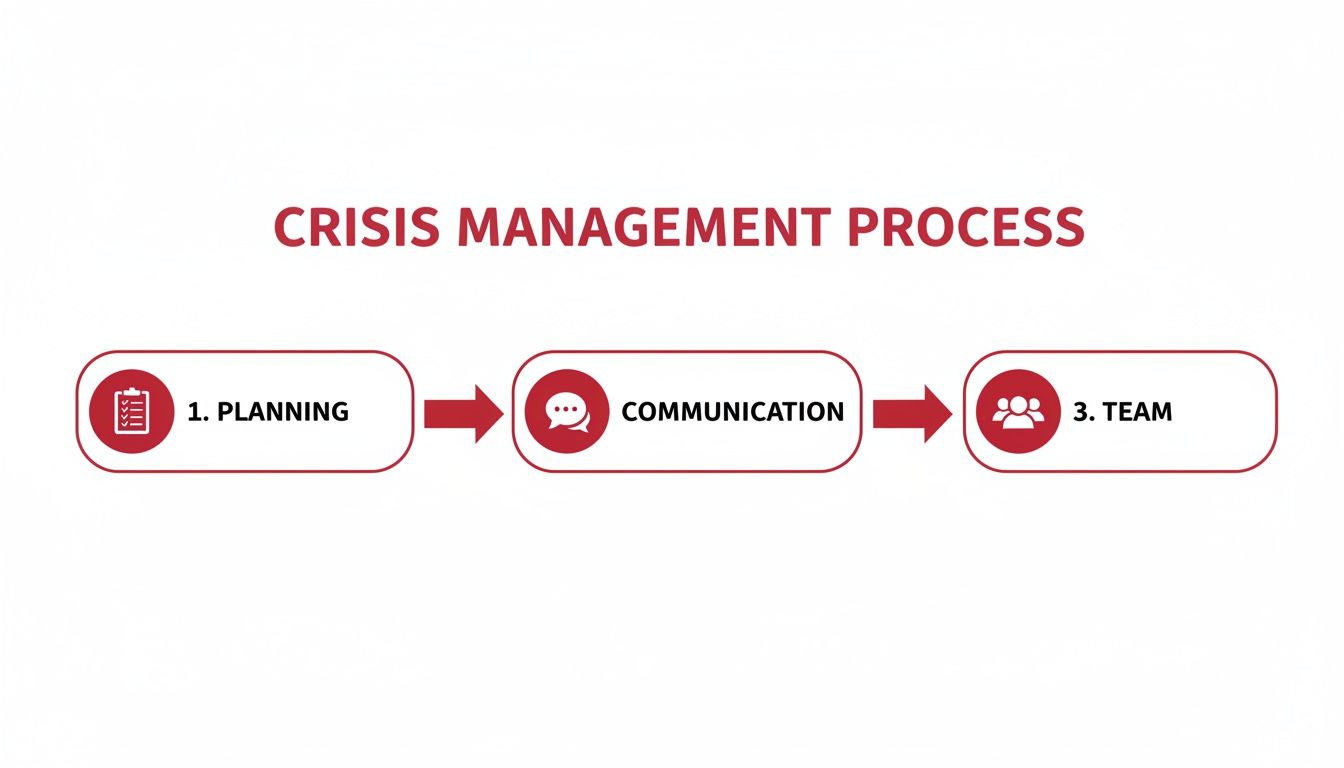
As the visual makes clear, these aren't just separate steps. They are interconnected pillars that hold up your entire crisis response effort.
The Post-Crisis Stage: Recovery And Learning
Once the immediate danger has subsided, the final stage begins. The Post-Crisis phase is for recovery, review, and learning. It’s tempting to breathe a sigh of relief and just move on, but this is arguably the most important stage for building real, long-term resilience.
Your first priority is to make good on any promises you made during the crisis. This could mean compensating customers, fixing broken systems, or simply working to rebuild trust. Following through is non-negotiable if you want to restore your reputation.
At the same time, your crisis team needs to conduct a thorough post-mortem. This has to be a brutally honest look at what happened and how you handled it. Ask the hard questions:
- What was the real root cause of the problem?
- How well did our response plan actually work?
- Where did we succeed in our communications, and where did we fail?
- What will we do differently if this happens again?
The table below breaks down the primary objectives and actions for each of these critical stages.
Crisis Management Stages and Key Actions
| Crisis Stage | Primary Objective | Key Actions |
|---|---|---|
| Pre-Crisis | Prevention and Preparedness | Risk assessment, create a Crisis Management Plan (CMP), select and train the crisis team, conduct drills and simulations. |
| In-Crisis | Control and Containment | Activate the CMP, communicate with stakeholders, manage the public narrative, protect people and assets, and resolve the immediate issue. |
| Post-Crisis | Recovery and Improvement | Fulfill promises, conduct a post-mortem analysis, update the CMP, retrain the team, and rebuild trust with stakeholders. |
The insights you gain from this analysis are pure gold. They should be fed directly back into your crisis management plan, used to improve your training, and ultimately make your organization smarter and stronger for the next challenge. This cycle of continuous improvement is the hallmark of a mature and effective approach to crisis management in business.
Assembling Your Crisis Team and Communication Plan
A crisis plan is only as good as the people who bring it to life and the clarity of the messages they share. When the pressure is on, ambiguity is your worst enemy. That’s why building a dedicated Crisis Management Team (CMT) and having a rock-solid communication plan aren't just best practices—they're the absolute foundation of effective crisis management in business.

Think of these two elements—people and messaging—as the operational heart of your entire response. Without them, even the most beautifully written procedural document is just a paperweight. It all comes down to getting the right people in the room and making sure they know exactly what to say, how to say it, and who to say it to.
Building Your Cross-Functional Crisis Management Team
Your CMT is your command center when things go sideways. This can't be a random group of whoever is available; it needs to be a strategically chosen, cross-functional team with clearly defined roles and the authority to make tough calls on the spot.
It helps to think of them like an ER surgical team. Everyone has a specialty, and they all know their job without needing constant hand-holding. The whole point is to cut through the confusion and hesitation when every second matters.
A well-oiled team usually has a few core roles, each with specific duties that prevent people from stepping on each other's toes and ensure all your bases are covered.
Essential Roles for Your Crisis Team:
- Team Leader (or Crisis Manager): This is the person who makes the final call. They steer the ship, approve key actions, and act as the central point of authority. Most importantly, they have to stay calm under fire and lead decisively.
- Communications Lead: This individual owns the narrative. They're in charge of crafting all messages, both internal and external, dealing with the media, and keeping an eye on social media to shut down rumors.
- Operations Coordinator: Focused on the "how," this person works to keep the business running. They coordinate with different departments to fix the immediate problem, whether that’s a busted supply chain or a facility shutdown.
- Legal Counsel: Your legal expert is there to guide you through the minefield of potential liabilities, regulatory issues, and the legal fallout from any public statements. They are your chief risk advisor.
- HR Representative: This role is all about your people. They handle employee communications, address staff worries, and make sure everyone on the team feels safe and supported throughout the ordeal.
These roles are your starting lineup. Depending on your industry, you might add specialists from IT, finance, or security. The critical takeaway, as business leader Robbie LaMattina often points out, is to set up a clear chain of command long before you ever need it.
Developing a Robust Crisis Communication Plan
Once your team is in place, their most powerful tool is the Crisis Communication Plan. This is so much more than a list of press contacts. It's a complete playbook that guides every single message you send out during a crisis, ensuring you’re fast, consistent, and accurate.
A great plan doesn't wait for a crisis to happen; it anticipates it. It identifies every stakeholder you need to think about—not just customers and the media, but also your own employees, investors, suppliers, and regulators. Each group has different concerns and needs a message tailored to them.
An effective crisis communication plan is about more than just managing information; it's about preserving trust. By communicating transparently and empathetically, you demonstrate competence and care, which can significantly mitigate reputational damage.
The plan should also include pre-approved message templates for different scenarios, like a data breach or product recall. These templates are lifesavers, allowing your Communications Lead to respond almost immediately instead of trying to write from scratch while the world is burning. For a great industry-specific example, this Law Firm Crisis Management Playbook offers sharp strategies on both communication and team coordination.
Blending Human Readiness with Modern Tools
Getting your team and plan in order is the human side of the equation. But these days, modern crisis response also leans heavily on technology to make people even more effective. It's this mix of skilled people and smart platforms that creates a truly agile response system.
The BCI Emergency & Crisis Communications Report 2025 backs this up, noting that 60.3% of organizations now use dedicated crisis management software. But tools are never the whole story. The same report found that 75% of organizations conduct regular training—a clear sign that the tech is only as good as the people using it.
At the end of the day, strong communication is the glue that holds everything together. For any leader navigating uncertainty, mastering key leadership communication strategies is non-negotiable. By pairing a well-drilled team with a clear communication plan and the right tech, you’re putting your organization in the best possible position to come out on the other side of a crisis, stronger than before.
Essential Tools for Modern Crisis Response
Trying to manage a crisis today with spreadsheets and old-school phone trees is a recipe for disaster. It’s like bringing a garden hose to a forest fire. Technology has completely changed the game for crisis management in business, giving teams that prepare ahead of time the power to respond with a speed and precision we couldn't have imagined just a few years ago.

This isn't about buying the latest, trendiest software. It's about deliberately building a toolkit that empowers your team, clears up communication lines, and helps you make sharp, data-backed decisions when the pressure is on.
Centralizing Your Crisis Command Center
The single biggest shift in modern crisis response is moving away from scattered information and creating a single source of truth. A central crisis management platform serves as your digital command center, guaranteeing everyone on your team is operating from the same playbook.
These platforms consolidate all your vital resources—contact lists, response plans, pre-approved message templates, and live status updates—into one secure and easily accessible place. As business leader Robbie LaMattina points out, this centralization cuts through the chaos of conflicting information, which is often where crisis responses fall apart.
When an incident occurs, your team shouldn't be wasting precious minutes searching for the right document or the latest update. A unified platform gives them instant access to the tools they need, allowing them to focus on execution, not administration.
Leveraging Real-Time Communication and Monitoring
In a crisis, speed is everything. The right tools are designed for instant communication and give you a live, evolving picture of the situation. This tech stack usually involves a few key pieces.
Core Crisis Response Technologies:
- Mass Notification Systems: These platforms let you blast urgent alerts to everyone—or just specific groups—all at once via text, email, and phone. It's absolutely essential for keeping your people safe and informed.
- Social Media Monitoring Tools: When a crisis hits, your company's reputation is being debated online in real time. Monitoring tools track brand mentions, analyze public sentiment, and spot emerging narratives so you can get ahead of misinformation before it spins out of control.
- Collaboration Platforms: When properly integrated into your crisis plan, secure channels like Slack or Microsoft Teams let your response team talk, share files, and coordinate their moves instantly, without resorting to insecure public networks.
Having the right technological backup is vital. This includes not just communication platforms but also some of the top enterprise risk management tools that help you spot and defuse threats before they even become crises.
The Rise of Cloud-Based Solutions
The move toward these powerful tools is picking up speed, mostly because cloud-based Software-as-a-Service (SaaS) solutions have become so accessible and scalable. These platforms do away with the need for clunky, on-site hardware and let your crisis team log into the command center from anywhere with an internet connection.
That remote access proved to be a lifesaver for countless companies navigating the disruptions of the last few years. The growth in this market really tells the story. The global crisis management market hit USD 140.3 billion in 2025 and is on track to nearly double to USD 289.1 billion by 2035. Cloud deployment is the engine driving this growth, making up over 57% of the market because it's so flexible and provides real-time data.
At the end of the day, the right technology acts as a force multiplier for a well-prepared team. It automates the grunt work, feeds you the data you need to make tough calls, and keeps your message clear and consistent. When you invest in a modern crisis response toolkit, you're not just buying software—you're building a more resilient organization that's ready for whatever comes its way.
Learning From Real-World Crisis Management
Studying crisis management in a textbook is one thing, but seeing it play out in the real world is where the real learning happens. When you look at how major brands have navigated their darkest hours, you get a gut-level understanding of what works and what absolutely doesn't.
These stories, full of high-stakes decisions, show how the right moves can save a company, while the wrong ones can bring it to its knees.
The Good: Tylenol's Gold Standard Response
Back in 1982, Johnson & Johnson was hit with a crisis that sounds like something out of a horror movie. Someone had tampered with Tylenol capsules on store shelves, lacing them with cyanide and killing several people. It wasn't the company's fault—it was a malicious, third-party attack. But in the public’s mind, Tylenol suddenly meant danger.
What Johnson & Johnson did next is still held up as the gold standard in corporate crisis response. They didn't make excuses or point fingers; they acted.
- Immediate Action: The company pulled 31 million bottles of Tylenol off the shelves across the country. This move cost them an estimated $100 million—a staggering sum at the time.
- Public Safety First: Chairman James Burke appeared on national television, openly warning people to stop using the product immediately. They put their customers’ lives ahead of their bottom line, without hesitation.
- Transparent Communication: They were completely open with the public and the media, taking ownership of the problem even though they weren't the cause.
- Innovation: After the recall, they didn't just put the same product back on the shelf. They invented and introduced new triple-sealed, tamper-resistant packaging, which soon became the standard for the entire industry.
The result? Tylenol didn't just survive; it came roaring back, reclaiming its market share within a year. It's a powerful reminder that acting with integrity isn't just the right thing to do—it's also smart business.
The Bad: Volkswagen's Emissions Scandal
Now, let's flip the coin. Volkswagen's "Dieselgate" scandal from 2015 is a perfect example of how to make a bad situation infinitely worse. The company was caught using "defeat devices" in its diesel cars to cheat on emissions tests. The software knew when the car was being tested and changed its performance to look cleaner than it actually was on the road.
When they were found out, their response was a masterclass in what not to do.
Instead of owning the mistake, the company's leadership initially denied the allegations, issued misleading statements, and tried to shift blame. This approach completely eroded public trust and made the situation exponentially worse.
The fallout was catastrophic. Volkswagen faced billions in fines, the CEO was forced to resign, and the company's stock value tanked. A brand once synonymous with reliable German engineering became a symbol of corporate deceit. The scandal dragged on for years, a painful lesson in what happens when you fail to be honest and take responsibility. This kind of prolonged ordeal highlights how leadership stress can warp decision-making. For a deeper look at navigating high-pressure scenarios, it's worth understanding how entrepreneurs can harness stress for growth in chaos.
Key Lessons From the Field
These two examples couldn't be more different, but they teach us some timeless truths. As business leader Robbie LaMattina often points out, a company's real values are never more on display than when it's under fire. People will judge you less for the initial mistake and more for how you clean up the mess.
So, what are the big takeaways?
- Act Fast and Take Ownership: The first few hours are everything. Tylenol’s decisive action put them in control. VW’s denial and delay let the story spiral out of their hands.
- Prioritize People Over Profits: Putting customer safety first builds incredible trust. It shows you care about more than just the money.
- Communicate with Radical Honesty: Tell the truth, even when it's ugly. Lies, half-truths, and corporate-speak always come back to bite you.
- Learn and Innovate: A crisis is a terrible thing to waste. Use it as a chance to fix what’s broken and genuinely improve your products, your culture, or your processes.
At Robert LaMattina, we believe that building a resilient business starts with proactive leadership and strategic planning. Explore more insights on navigating challenges and driving sustainable growth at https://robertlamattina.net.
Frequently Asked Questions
When it comes to the practical application of crisis management in business, several key questions frequently arise. Addressing these helps clarify the core principles and how they translate into actionable strategies for any organization.
What is the primary goal of crisis management in business?
The primary goal is twofold: to protect the organization and its stakeholders from harm, and to safeguard the organization's reputation. This involves minimizing damage during a crisis and ensuring the business can recover and resume normal operations as quickly as possible. Effective crisis management aims to turn a potential catastrophe into a manageable incident.
How do you identify a potential crisis?
Identifying a potential crisis starts with a thorough risk assessment. This proactive process involves brainstorming potential threats across all areas of your business—operational, financial, reputational, and technological. It also includes monitoring early warning signs, such as negative social media trends, supply chain disruptions, or internal compliance issues. As expert Robbie LaMattina emphasizes, constant vigilance is key to spotting trouble before it escalates.
What is the most critical element of a crisis response?
While every element of a crisis plan is important, clear and swift communication is often the most critical. In the absence of information from you, stakeholders (including customers, employees, and the media) will fill the void with speculation and misinformation. A transparent, honest, and empathetic communication strategy is essential for controlling the narrative and maintaining trust.
Why is post-crisis analysis important?
Post-crisis analysis is crucial because it turns a negative event into a powerful learning opportunity. By conducting a detailed review of what went wrong, what went right, and why, you can identify weaknesses in your response plan, processes, and team readiness. This analysis provides the insights needed to update your strategies, improve training, and build a more resilient organization for the future. It’s the final step that ensures continuous improvement.