

In today's competitive landscape, relying on intuition alone is a gamble. A data-driven business strategy offers a more reliable path, using hard facts and objective analysis to guide decisions, uncover opportunities, and fuel sustainable growth. It's about shifting from guesswork to an evidence-backed process that gives you a clear competitive edge. This playbook will guide you through the practical steps of building that system from the ground up, turning raw information into your most powerful strategic asset.
Four Key Takeaways
- Strategy First, Data Second: Your business goals must always lead the way. Define what you want to achieve first, then determine what data you need to measure progress and guide your decisions.
- A Solid Foundation is Non-Negotiable: The quality of your insights depends entirely on the quality of your data. Reliable systems for collecting, cleaning, and managing data are essential for building a strategy you can trust.
- Culture is the Engine: The most advanced tools are useless if your team isn't empowered to use them. A data-first culture fosters curiosity, encourages evidence-based discussions, and makes data accessible to everyone.
- Action is the Goal: Insights are only valuable when they lead to action. The entire purpose of a data-driven strategy is to make better, faster decisions that produce measurable results and move the business forward.
Why Going with Your Gut Isn't Enough Anymore
In any competitive market, relying on intuition alone is a huge gamble. The modern playbook for success requires a much more analytical approach. Having a data-driven business strategy isn't just about using a popular buzzword; it’s a non-negotiable for real, sustainable growth. It gives you a clear edge by boosting profitability and making customers happier.
Plenty of entrepreneurs say they're "data-driven," but the real challenge—and the real work—is closing the gap between saying it and actually doing it.
The Proof Is in the Numbers
Think about an entrepreneur like Robbie LaMattina, who applies data-first thinking to everything he does, whether in behavioral health or real estate. He's building businesses where every major decision, from launching a new medical program to scaling nationwide, is backed by solid data, not just a hunch. That’s the heart of a modern data strategy.
And this approach gets real results. Research from McKinsey found that data-driven organizations are 23 times more likely to acquire customers, 6 times more likely to retain them, and an incredible 19 times more likely to be profitable. This isn't just theory; it's a massive advantage for anyone trying to get ahead. You can explore the full McKinsey research findings on data-driven enterprises to see for yourself.
It's a Shift in Thinking, Not Just Tools
Moving to a data-first mentality is about more than buying a few new software tools. It’s a cultural change where curiosity and evidence are championed at every level of the organization. The aim is to build a system where data informs your strategy, validates your assumptions, and helps you fine-tune your direction, making sure every move you make is intentional.
This playbook will walk you through the practical steps to build that exact system from the ground up.
A data-driven business strategy isn't about having all the answers. It's about knowing which questions to ask. It gives you a framework to test ideas, measure what happens, and constantly adapt, turning raw information into a powerful competitive edge.
Four Core Truths for Building a Data-Driven Business
Before we get into the weeds of building a data-driven strategy, let's set the stage. I've seen countless companies get lost in the hype around "big data." Success isn't about collecting massive amounts of information; it’s about using the right information with a clear purpose.
This entire playbook boils down to four fundamental principles. Get these right, and everything else falls into place.
Strategy First, Data Second
The single biggest mistake I see companies make is collecting data just for the sake of it. They build vast data lakes and then wonder what to do with them. That’s completely backward. A powerful data strategy always starts with your business goals.
Are you trying to boost customer retention by 15%? Or maybe break into a new market segment? Your data is simply the tool to get you there—it’s not the destination itself.
Your Infrastructure Is Non-Negotiable
You wouldn't build a house on a swamp, right? The same logic applies here. Your ability to make smart decisions rests entirely on the quality of your data infrastructure—the systems you use for collecting, storing, and making sense of it all.
Without a solid foundation, your insights will be shaky at best and flat-out wrong at worst. This is where so many initiatives fail before they even begin. It’s not the glamorous part, but it’s absolutely essential.
The whole point is to turn raw data into real growth. It’s a simple, but powerful, flow.
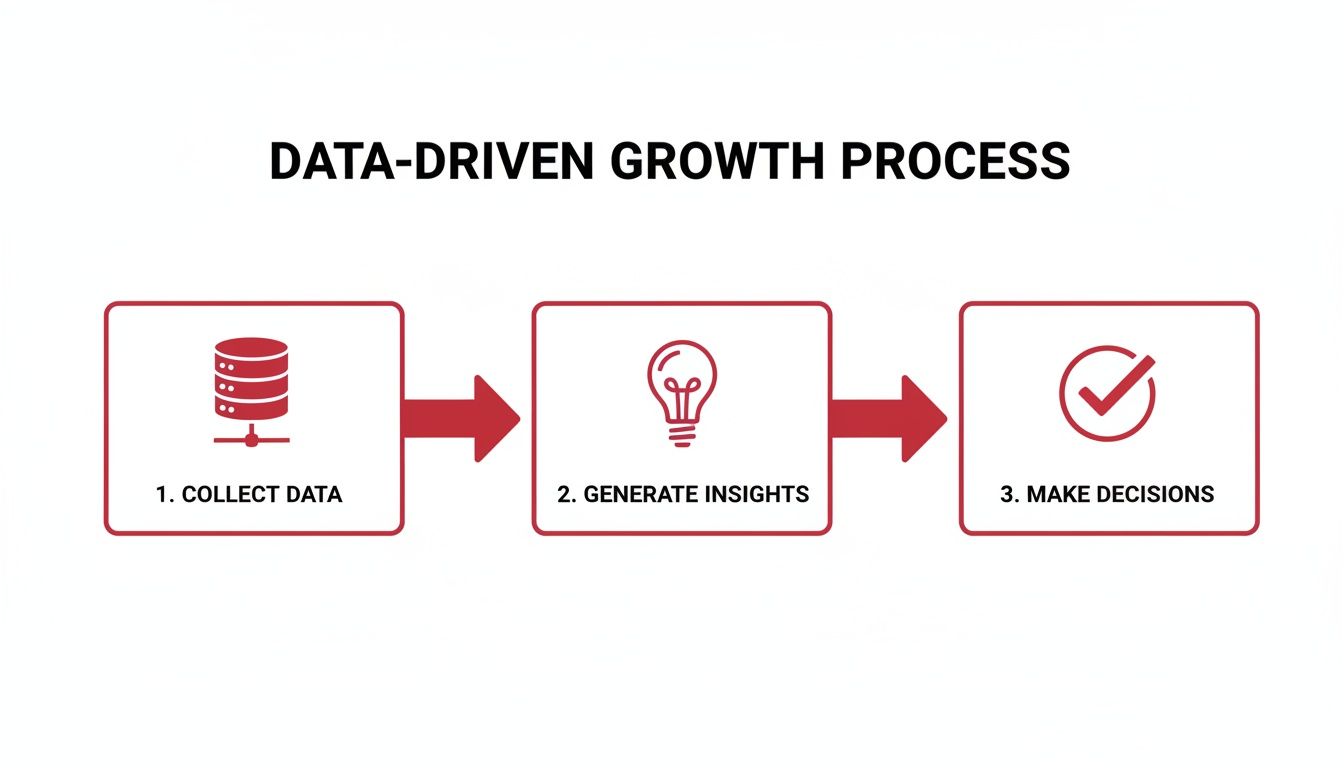
This journey from raw information to tangible business value shows that simply collecting data is just the starting line. The real work happens next.
The real power of data isn't in what it is, but in what you do with it. Great strategy hinges on turning observations into coordinated actions that move the business forward.
Culture Is the Engine That Drives Everything
Let’s be honest: the most sophisticated dashboards and analytics tools are completely useless if your team is afraid or unwilling to use them. Technology is only half the battle.
You need to build a culture of curiosity. This means creating an environment where people feel safe to ask tough questions, challenge assumptions, and back up their ideas with evidence. Without this cultural shift, your data strategy is just a fancy, expensive hobby.
Action Is the Only Thing That Matters
At the end of the day, an insight that doesn't lead to action is just trivia. The entire purpose of this effort is to make better, faster, and more confident decisions that produce measurable results.
Every report, every analysis, every deep dive should culminate in one simple question: "So what? What are we going to do differently tomorrow because of what we learned today?" If you can't answer that, you’ve missed the point.
Laying the Foundation: Aligning Data with Business Objectives
The journey to a truly data-driven business strategy starts with a deceptively simple question: What are we actually trying to achieve?
It’s so easy to get caught up in the excitement of collecting data, setting up dashboards, and chasing the latest analytics tools. But without a clear destination, you're just sailing without a map. You'll be busy, sure, but you won't have any idea if you're actually getting closer to your goal. The whole point is to make sure every single piece of data you gather and analyze has a direct, tangible purpose.
This means translating your high-level business ambitions—the big, fuzzy goals—into concrete, measurable objectives. "Grow the business" is a wish, not an objective. A data-driven objective sounds more like, "Improve patient retention by 15% within the next six months," or "Increase our real estate lead conversion rates by 10% in Q3." See the difference? One is aspirational; the other is actionable.

From Broad Goals to Sharp KPIs
Once your objective is crystal clear, you can figure out which Key Performance Indicators (KPIs) will show you if you're making progress. Think of KPIs as the vital signs for your strategy. They tell you if you're on track, falling behind, or need to make a change. They’re the specific numbers that prove whether your efforts are paying off.
For an entrepreneur like Robbie LaMattina, who operates across different sectors, these KPIs look very different depending on the business.
- In behavioral health, if the goal is to improve patient outcomes, you'd track KPIs like patient engagement rates, treatment completion percentages, and 30-day readmission rates.
- For a real estate venture, where the objective is boosting profitability, you’d focus on cost-per-acquisition (CPA) for new leads, the average sales cycle length, or customer lifetime value (CLV).
Nailing down these metrics from the start keeps your data collection focused. It saves you from drowning in a sea of irrelevant information. This is also where a solid data foundation is non-negotiable—you can't get quality insights from messy, unreliable inputs. Building this framework right often means bringing in experts, as specialized data engineering services are built to turn raw information into a powerful business asset.
Connecting Business Goals to Actionable KPIs
Translating a high-level goal into a specific, trackable number is the core of this process. The table below shows how this works in practice across different industries.
| Business Goal | Behavioral Health KPI | Real Estate KPI | Startup KPI |
|---|---|---|---|
| Increase Client Retention | Patient engagement score | Repeat client rate | Customer churn rate |
| Improve Operational Efficiency | Average time to schedule first appointment | Days on market for listings | Customer acquisition cost (CAC) |
| Boost Revenue Growth | Revenue per clinician | Gross commission income (GCI) | Monthly recurring revenue (MRR) |
| Enhance Service Quality | Net Promoter Score (NPS) from patients | Client satisfaction survey results | Product adoption rate |
As you can see, the goal might be similar, but the measurement is tailored to what truly matters in that specific context.
Making Your Metrics Matter
Just picking KPIs isn't enough. You have to establish benchmarks (where you are now) and set targets (where you want to go). What is your patient engagement rate today? That's your benchmark. What do you want it to be in six months? That's your target. This simple exercise creates a clear definition of success and gives your team a tangible goal to rally around.
In a competitive world, the impact is undeniable. Research has shown that companies that lean heavily on data analytics are 5% more productive and 6% more profitable than their peers. That's an edge that founders and industry leaders can't afford to ignore.
The purpose of a KPI is not just to measure, but to drive action. If a metric isn't helping you make a better decision, it's just a number on a dashboard. True alignment means every KPI is tied directly to a strategic choice.
This whole process—defining objectives, selecting KPIs, and setting targets—creates a strategic framework that connects everyday work to your long-term vision. It ensures every marketing campaign, operational tweak, or new feature is judged by its actual contribution to the bottom line. For a deeper dive into this, our guide on how to measure business growth breaks down how to track your progress effectively.
By starting with your business objectives, you turn data from a passive resource into an active, strategic partner. This foundational work is, without a doubt, the most critical part of building a resilient and successful data-driven business strategy.
Building Your Data Engine: Measurement and Governance
Once you’ve locked in your objectives and KPIs, it’s time to build the engine that actually powers your data-driven business strategy. This isn't a digital hoarder's game of collecting every scrap of information you can find. It’s about being deliberate—gathering the right data and making sure it's clean, secure, and ready to use. Think of it as laying the foundation for a skyscraper; without a solid base, the whole structure is at risk.
This comes down to three critical pillars: smart data collection, relentless data quality, and solid data governance. If you drop the ball on any one of these, you're setting yourself up for flawed insights and bad business decisions. The aim is to build a system you can trust, one where the data reflects what's really happening on the ground.
Establishing Your Data Collection Framework
First things first, you need the right tools in place to capture the KPIs you've already defined. Your collection methods should span every corner of your business where value is being created or a customer interaction happens.
A standard setup usually includes a few key players:
- Web and App Analytics: Tools like Google Analytics are non-negotiable for understanding how people interact with you online. Where do they come from? What do they click on? Where do they give up and leave?
- Customer Relationship Management (CRM): A good CRM, like Salesforce, is the lifeblood of your customer data. It should track every touchpoint, from the first curious email to ongoing support tickets, giving you a full 360-degree view.
- Financial Software: Platforms such as QuickBooks are essential for connecting your activities to the bottom line by tracking revenue, costs, and overall profitability.
The real magic happens when these systems can talk to each other. Isolated data is practically useless. You want your marketing analytics to flow seamlessly into your sales data so you can trace the entire customer journey, from that first ad click all the way to their total lifetime value. Creating a great business performance metrics dashboard is a fantastic way to see how all these connected data points come together visually.
The Non-Negotiable Importance of Data Quality
Collecting data is easy. Collecting good data is hard, but it's everything. Bad data is the silent killer of data-driven strategies. If your datasets are a mess of typos, duplicates, and outdated information, your analysis will be worthless—or worse, dangerously misleading.
Think about a real estate business run by someone like Robbie LaMattina. If his CRM has two different entries for the same client—one with an old phone number and another with a new email—his team could waste hours chasing dead ends or, even worse, confuse the client with mixed messages.
Garbage in, garbage out. It’s a cliché for a reason. The quality of your decisions will never be better than the quality of the data you feed them.
To keep your data clean, you need simple, clear processes for:
- Standardization: Make sure everyone enters data the same way (e.g., using "CA" for California, not "Calif." or "ca").
- Validation: Set up rules in your systems to catch obvious errors as they happen, like an incorrectly formatted email address.
- Cleansing: Schedule regular check-ups to hunt down and fix or delete inaccurate and duplicate records.
Implementing Robust Data Governance
Data governance is basically the rulebook for your data. It lays out who can access what, how it can be used, and how it’s kept safe. It answers the tough but necessary questions: Who owns this customer list? Who gets to see our financial reports?
A solid governance policy isn't about locking data away; it's about building trust. It gives your team the confidence to use the data, knowing it's accurate and that they're handling it responsibly. This is especially true in industries with heavy regulation.
Take a behavioral health clinic, for example. Compliance with HIPAA (Health Insurance Portability and Accountability Act) is absolutely critical. A data governance plan there would spell out, in no uncertain terms:
- Exactly who can access protected health information (PHI).
- The approved reasons for using that PHI.
- The security protocols in place to prevent a breach.
Failing to get this right doesn't just open you up to massive fines; it destroys the trust you have with your patients. A clear governance plan ensures your data-driven business strategy can drive growth without compromising your legal and ethical duties.
From Insights to Impact: Operationalizing Your Data
Getting your data clean, organized, and properly governed is a huge win. But honestly, that’s just setting the table. The real meal—the actual value of a data-driven business strategy—comes when you start turning that information into action.
This is where the rubber meets the road. It's the moment you stop just looking at dashboards and start weaving those insights into the very fabric of your daily operations. This is how you make smarter decisions, sharpen your processes, and ultimately, get the results you're after.
When you do this right, your business stops being a static machine executing a fixed plan. It becomes a living, breathing organism that learns and adapts. Every decision becomes a small experiment, and every outcome is just more data to learn from. This creates a powerful self-improvement cycle, making your business smarter with every move it makes.
Turning Analytics into Actionable Insights
An insight isn’t just a number on a chart; it’s a signpost pointing you toward an opportunity or a problem you need to solve. The trick is to move past simple reporting—"our website traffic is up 10%"—and start asking the more important questions. Why is it up? Which channels are driving it? And how can we double down on what’s working? That’s how raw data becomes a truly actionable insight.
Let’s imagine how this plays out for an entrepreneur like Robbie LaMattina:
-
Behavioral Health Scenario: A treatment center’s data shows patients who finish a specific therapeutic module have a 20% higher long-term recovery success rate.
- The Insight: This module is clearly working wonders.
- The Action: The clinical team can immediately adjust treatment plans to make this a core part of the program. They can also dig into why it's so effective to see if those principles can be applied elsewhere.
-
Real Estate Scenario: Market data reveals that homes in a certain neighborhood with updated kitchens are selling 15% faster and for 8% more than similar properties.
- The Insight: In this specific micro-market, kitchen renovations deliver a fantastic ROI.
- The Action: The investment team can now confidently target properties in that area that need a kitchen remodel, knowing the data backs up the strategy.
These examples show how analytics, when you look at them the right way, don't just sit there. They point directly to strategic decisions that can have a massive impact on your bottom line.
Creating Powerful Feedback Loops
Putting data to work isn't a one-and-done task. It's about building a continuous cycle of acting, measuring, and refining. We call this a feedback loop, and it’s the engine that drives constant improvement in your business.
The process itself is simple but incredibly effective:
- Act on an Insight: Make a change based on what your data suggests (e.g., launch a new marketing campaign for a specific customer segment).
- Measure the Results: Track the outcome using the KPIs you already set up. Did the campaign hit its lead generation goals? What was the conversion rate?
- Analyze the Outcome: Compare the results to what you expected. Did it work? If not, why not?
- Refine Your Strategy: Take what you learned and apply it to your next move. Maybe the ad copy needs a tweak, or perhaps a different social media channel would work better.
A business without feedback loops is flying blind. It makes decisions but never truly learns from them. A strong data-driven culture is built on the discipline of closing the loop—measuring the impact of every significant action to inform the next one.
This iterative approach is also a fantastic way to manage risk. It lets you make small, calculated adjustments instead of taking huge, uninformed leaps of faith. By consistently leveraging data analytics for business growth, you can fine-tune your operations for better and better performance over time.
The Critical Role of Leadership in Driving Action
Building this kind of action-oriented culture has to start at the top. It's not enough for leaders to just hand out dashboards and hope for the best. They have to champion the process and show everyone how data leads to tangible wins. Research has shown that businesses that really get this right can see a return on investment that's five to eight times higher than those that don't.
Here’s how leaders can light the fire:
- Celebrate Data-Informed Wins: When a team uses data to score a victory, shout it from the rooftops. Publicly recognize their work and show the rest of the company what success looks like.
- Ask the Right Questions: In every meeting, make a habit of asking, "What does the data say?" This sends a clear signal that decisions need to be backed by evidence, not just gut feelings.
- Empower Your Teams: Give your people the tools, training, and freedom to act on the insights they uncover. Nothing motivates people more than seeing their analysis lead to real, meaningful change.
When you put these practices into place, you shift from passively collecting data to actively using it as a core strategic asset. That’s how you turn insights into measurable impact and build a real competitive edge.
Fostering a Data-First Culture and Avoiding Common Pitfalls
Let's be honest: building a data-driven business strategy is more of a human challenge than a technical one. You can invest in the fanciest dashboards and the cleanest data warehouses on the planet, but if your team doesn't value or use them, they’re just expensive wall art. The real work is in fostering a data-first culture—turning analytics from a niche function into the entire organization's default mindset.
This cultural shift starts with making data easy to access and understand for everyone, not just the folks with "analyst" in their titles. A core piece of this puzzle is a strong data democratization strategy, which gives every team member the power to find and use information. It’s all about creating an environment where curiosity is celebrated and asking, "What does the data say?" becomes second nature.

Promoting Widespread Data Literacy
Data literacy isn’t about turning your entire staff into data scientists. It’s much simpler than that. It's about giving your team the confidence to read a chart, question a number, and back up their ideas with actual evidence.
A good place to start is with straightforward training sessions focused on the KPIs that really matter to your business. Show your marketing team how their campaign metrics directly tie to sales revenue. Walk your operations crew through how their efficiency data hits the bottom line. The goal is to strip away the mystery and make data relevant to each person's daily grind.
Entrepreneur Robbie LaMattina is a big proponent of mentorship, pairing experienced data users with newcomers. This approach builds expertise organically and reinforces the idea that data is a shared responsibility, not just one department's job.
Sidestepping Common Mental Traps
As your organization gets more comfortable with data, you’ll need to be on the lookout for a few common psychological traps that can easily lead you astray. Just knowing they exist is half the battle.
- Confirmation Bias: We all do it—we instinctively look for data that proves what we already believe. To fight this, encourage your team to play devil's advocate. Push them to actively search for information that challenges their assumptions.
- Analysis Paralysis: This is the black hole of data analysis, where you get so lost in gathering more information that you never actually make a decision. Set firm deadlines for decisions and get comfortable with the fact that you’ll never have 100% certainty. The goal is to reduce risk, not eliminate it entirely.
- Vanity Metrics: These are the numbers that feel good but don't mean much for your goals, like social media likes or page views without context. Keep everyone focused on the actionable KPIs you defined from the start to make sure you're chasing real business value.
A truly data-driven culture isn't one that's free from mistakes. It's one that learns from them. The objective is not to be right every time, but to get less wrong over time by constantly testing assumptions against reality.
Celebrating and Reinforcing the Culture
Finally, if you want a data-first mindset to stick, you have to celebrate it. When a data-informed decision leads to a big win, shout it from the rooftops. Share the story of how the team used insights to find a hidden opportunity or solve a tough problem.
This kind of positive reinforcement shows everyone what "good" looks like and proves that leadership is genuinely committed to this shift. By empowering your team, guarding against common biases, and celebrating the wins, you start to see a real transformation. Data stops being a siloed tool and becomes the common language everyone uses to make smarter decisions and move the business forward.
Frequently Asked Questions
1. What’s the very first step in creating a data-driven strategy?
Always start by defining your core business objectives. Before you even think about data, you need to be crystal clear on what you're trying to accomplish. Are you trying to increase customer retention by 10%? Or maybe reduce operational costs? Nailing this down ensures all your data efforts are focused and have a real purpose.
2. I'm running a small business. Can I do this without a huge budget?
Absolutely. You don't need to break the bank. There are plenty of powerful and affordable—even free—tools out there. Think Google Analytics, Google Sheets, and basic CRM software. The trick is to start small. Focus on the few critical metrics that truly impact your business goals instead of trying to track every single thing at once.
3. How do I get my team on board with this new way of thinking?
First, make the data easy to access and understand. Simple dashboards that show key metrics are a great start. More importantly, celebrate the wins that came from data-informed decisions. When your team sees firsthand how data leads to better choices and successful outcomes, they'll be much more likely to embrace the change. As entrepreneur Robbie LaMattina often advises, you must show the value directly to overcome resistance.
4. What if an insight from data contradicts our team's intuition?
That's actually a great sign—it means you have an opportunity to learn something new. Treat the data as the starting point for a healthy debate. Sometimes, intuition is picking up on context the raw numbers are missing. Other times, the data reveals a blind spot you never knew you had. A strong data culture encourages challenging both the data and your gut to find the best path forward.
5. How do we avoid 'analysis paralysis' where we get stuck in the data?
Set deadlines for decisions. The whole point of a data-driven business strategy isn't to find the one, perfect, flawless answer. It's to make a better, more informed decision in a reasonable amount of time. Think of data as a tool to reduce uncertainty, not eliminate it. Define what "good enough" information looks like for a given decision, and then be ready to act.
Ready to build a business that thrives on smart decisions? At Robert LaMattina, we provide pragmatic insights and growth strategies for modern professionals. Explore more at https://robertlamattina.net.