

In a market where every choice can make or break you, relying on intuition alone is like navigating a maze blindfolded. That's where data-driven decision making in business comes in. It’s the simple practice of using facts, metrics, and hard evidence to guide your strategic choices.
Essentially, you're swapping guesswork for verifiable insights. This grounds your decisions in reality, not just instinct.
Why Smart Decisions Are Now Data-Driven
In today’s competitive environment, the gap between market leaders and the rest of the pack often boils down to one thing: the quality of their decisions. Moving from gut-feel leadership to an evidence-based strategy isn’t just a trend anymore; it’s a core requirement for survival and growth. This guide, which pulls from the experience of industry leaders like Robbie LaMattina, will walk you through this critical shift.
Here’s a helpful way to think about it: a doctor wouldn’t diagnose a patient based on a hunch. They use lab results, scans, and patient history—all forms of data—to make an accurate diagnosis and prescribe a treatment that works. In the same way, data-driven decision making gives you a clear, objective lens to see your company’s health, effectively removing personal bias from the equation.
The Core Idea Behind Data-Driven Strategy
The central idea is straightforward but incredibly powerful: turn raw information into your most valuable strategic asset. When companies systematically collect, analyze, and act on their data, they unlock a much deeper understanding of their own operations and, most importantly, their customers.
This leads to some very clear advantages:
- Increased Confidence: When decisions are backed by empirical evidence, it's far easier to reduce uncertainty and get everyone on the same page.
- Enhanced Efficiency: Digging into operational data helps you spot bottlenecks and smooth out workflows you didn't even know were clunky.
- Improved Customer Understanding: Data tells the real story of customer behaviors, preferences, and pain points, often at a surprisingly granular level.
- Proactive Risk Management: With predictive analytics, you can start forecasting potential challenges before they ever have a chance to hurt your bottom line.
This methodical approach is about moving your organization from a reactive stance—always responding to market changes—to a proactive one where you’re actually anticipating them. The goal is to ask better questions, not just hoard more data.
Ultimately, getting good at this is non-negotiable for any modern professional. For those looking to go even deeper, exploring guides on strategic decision making for sustainable business growth can offer some great complementary insights. For now, this guide will give you the practical framework to get started.
Four Essential Takeaways for Business Leaders
If you're an executive, trying to wrap your head around data-driven decision making can feel overwhelming. To cut right to the chase, we've boiled it all down to four key takeaways, inspired by experts like Robbie LaMattina. These aren't just abstract ideas; they're core principles you can use to frame how you think about data's role in your company.
Think of this as your strategic cheat sheet—a quick guide to make sure you're focusing on what actually moves the needle.
1. Ask Better Questions
The point isn't to collect mountains of data just for the sake of it. The real goal is to ask smarter questions that lead you to answers that matter. A truly data-driven strategy always starts with a real business problem or a clear opportunity.
Instead of asking, "What data do we have?" shift your thinking to, "What's the one critical question we need to answer to push the business forward?" This simple change keeps your analytics work tied directly to strategy, so you don't get lost in a sea of irrelevant numbers.
2. Build a Data-Literate Culture
Buying the right technology is only half the battle. You could have the most powerful analytics platform in the world, but it's worthless if your team doesn't know how—or why—to use it. This is why building a data-literate culture is absolutely essential.
This means more than just a one-off training session. It's about fostering curiosity and making data accessible to everyone, not just a walled-off team of analysts. When people across your entire organization can speak the language of data, game-changing insights can pop up from the most unexpected places.
Data tells you what is happening, but it takes human expertise and strategic thinking to understand why and decide what to do next. The real magic happens at the intersection of powerful technology and smart, curious people.
3. Start Small and Prove Value
Trying to transform your entire organization into a data-driven powerhouse overnight is a classic recipe for disaster. The smartest and most successful transitions always start small.
Find a single, high-impact project where you can score a quick, decisive win. This builds momentum, shows a clear return on investment, and helps you get the buy-in you need from key stakeholders. Once you’ve proven the concept, then you can start scaling your efforts across the company.
4. Focus on Actionable Insights, Not Just Reports
Data is useless if it just sits in a dashboard. The final, and most important, principle is to turn your analysis into concrete action. Every chart and every report should lead to a clear "so what?"
Encourage your teams to move beyond just presenting data and start recommending specific, evidence-backed actions. The ultimate goal of data driven decision making in business isn't to create beautiful graphs; it’s to make smarter choices that drive real, measurable results.
What Data-Driven Decision-Making Actually Means
Let’s cut through the jargon. Data-driven decision-making is simply the practice of making strategic choices based on hard evidence, not on gut feelings or old habits.
Think of it like a doctor diagnosing an illness. A doctor wouldn’t just guess based on how you look; they’d run tests, look at your medical history, and analyze lab results. That’s data. They use that concrete information to figure out what's wrong and prescribe the right treatment. In business, it's the exact same principle.
Instead of assuming you know what your customers want, you look at their actual behavior. This shift away from guesswork and personal bias is the foundation of a smarter, more responsive company.
Moving From Guesswork to Insight
Adopting a data-driven approach is really a cultural shift. It’s about creating an environment where teams are encouraged to test their assumptions with real numbers, leading to more confident and unified actions. When a decision is backed by solid evidence, it's far easier to get everyone on board and measure whether you're succeeding.
This turns uncertainty into a manageable part of the business. You stop reacting to the market and start anticipating it. You begin to see trends taking shape before they hit the mainstream, find operational hiccups before they cause a crisis, and truly understand what frustrates your customers.
The numbers don't lie. About 25% of companies around the world now make nearly all of their strategic decisions based on data, and another 44% base most of their decisions on it. The results are real, too. Top-performing organizations report an average revenue boost of 8% and a 10% drop in costs after committing to this approach. You can discover more insights about data-driven trends on Passivesecrets.com.
The Tangible Benefits for Your Business
When you ground your strategy in data, you see concrete benefits ripple across the entire organization. It’s not just about hitting one target; it’s about building a more intelligent and resilient business from the inside out.
Here’s what that looks like in practice:
- Sharper Operational Efficiency: Data acts like a spotlight, illuminating waste in your workflows, supply chain, and budget. By fixing these hidden points of friction, you cut costs and streamline how work gets done.
- Deeper Customer Loyalty: By analyzing customer information, you discover what they truly value. This insight helps you personalize their experience, build products that solve their actual problems, and create marketing that connects, building loyalty that lasts.
- Proactive Risk Management: Instead of just reacting to threats, you can start predicting them. Predictive analytics can forecast everything from potential market dips to which customers are likely to leave, giving you time to act before it's too late.
- A Stronger Bottom Line: At the end of the day, it all comes down to this. Smarter decisions, happier customers, and leaner operations all lead directly to better financial health and sustainable growth.
Data-driven decision-making isn't about letting machines run your business. It's about equipping your best people with the best information so they can make smarter, faster, and more confident choices that drive real results.
To see how this works in the real world, it's crucial to understand how to get insights on the fly, which involves mastering real-time data analytics. This gives you the power to act on information the moment it comes in, not weeks after the fact. This foundational skill is the key to unlocking the powerful strategies we’ll cover next.
Your Framework for Implementing a Data Strategy
Jumping into a data-driven culture without a plan is a recipe for disaster. It's like trying to build a house without a blueprint—you'll waste a lot of time and materials, and you probably won't like the finished product. To truly make data-driven decision making in business work, you need a clear, practical framework.
This isn't about just buying fancy software. It's about creating a structured approach that turns raw information into a real, competitive advantage. A solid data strategy gives you that structure, breaking down a huge undertaking into manageable steps that align with your actual business goals.
The whole process boils down to a simple, powerful flow: data provides the raw material, analysis turns it into insight, and that insight drives meaningful action.
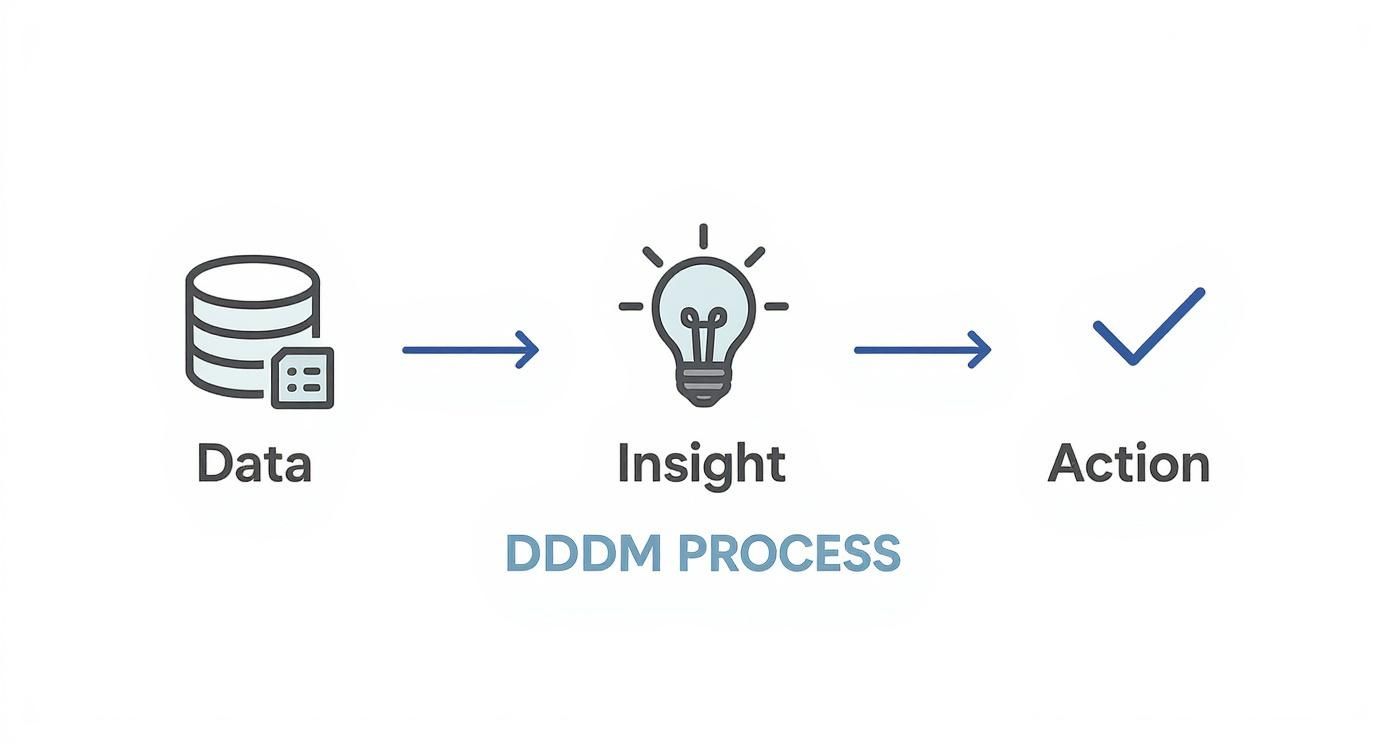
This visual really gets to the heart of it. Data is just the starting line. The magic happens when you connect it to real-world decisions.
To make this tangible, let's walk through the key stages of building and launching a successful data-driven initiative.
The table below outlines a high-level roadmap, moving from initial strategy all the way through to company-wide adoption. Think of it as your project plan for building a data-first culture.
Key Stages of a Data Driven Implementation
| Stage | Objective | Key Activities | Critical Success Factor |
|---|---|---|---|
| 1. Strategy & Planning | Define what you want to achieve with data. | Identify key business problems. Set clear objectives and define KPIs. Secure executive sponsorship. | Strong alignment between data goals and overall business strategy. |
| 2. Data Governance & Infrastructure | Build a reliable foundation for your data. | Establish data quality rules. Set up security protocols. Choose and implement data storage (e.g., warehouse). | Ensuring data is accurate, secure, and accessible. |
| 3. Tooling & Technology Selection | Equip your team with the right software. | Evaluate BI platforms (like Tableau or Power BI). Select analytics and machine learning tools. | Choosing tools that fit your team's skills and business needs, not just the latest trend. |
| 4. Team Building & Skill Development | Assemble the right people and empower them. | Hire or train data analysts and engineers. Launch data literacy programs for all employees. | Fostering a culture where curiosity and data-driven thinking are encouraged. |
| 5. Pilot Project & Iteration | Prove the concept and build momentum. | Select a small, high-impact project. Measure results, learn from the process, and refine your approach. | Achieving a tangible "quick win" to demonstrate value and secure buy-in. |
Each stage builds on the last, creating a solid foundation that prevents your data initiatives from falling flat. It’s a deliberate, step-by-step process, not an overnight switch.
1. Define Clear Business Objectives First
Before you even think about data, you have to ask the most important question: “What problem are we actually trying to solve?” So many companies fall into the trap of collecting mountains of data without a purpose, which just leads to confusion and burnout.
Start with a specific, high-impact business goal. Are you trying to cut customer churn, boost your marketing ROI, or make your operations more efficient? That goal becomes your North Star. It guides every decision you make and ensures your data efforts are directly tied to results you can see on the bottom line.
Once you have your objective, you can define the Key Performance Indicators (KPIs) that will track your progress. These are the hard numbers that tell you if you’re winning or losing. For example, if your goal is to reduce churn, your main KPI would likely be the monthly churn rate.
2. Establish Robust Data Governance
Now that you know what you’re measuring, you need to be absolutely sure the data is trustworthy. That's where data governance comes in. Think of it as quality control for your information. It’s the set of rules and processes that ensure your data is available, usable, accurate, and secure.
A strong governance plan covers a few critical areas:
- Data Quality: You need systems to clean your data—getting rid of duplicates, fixing errors, and smoothing out inconsistencies. Bad data leads to bad insights. Period.
- Data Security: Protecting sensitive information isn’t optional. You must define who can access what data and under which conditions to stay compliant and protect your customers.
- Data Accessibility: Break down those organizational silos. The right data needs to get to the right teams when they need it, in a format they can actually use.
Without strong governance, your data strategy is built on a house of cards. You simply can't trust the insights if you can't trust the data feeding them. It’s a non-negotiable step.
3. Choose the Right Tools for the Job
With clear goals and a governance plan, you can finally start picking your tech. The analytics market is flooded with tools, from simple spreadsheets to complex AI platforms. The secret is to pick tools that fit your team’s current skills and your specific business needs.
Here are the common categories you'll encounter:
- Business Intelligence (BI) Platforms: Tools like Tableau or Power BI are fantastic for building dashboards and visualizations that make data understandable for everyone, not just the tech experts.
- Data Warehouses: Central hubs like Google BigQuery or Snowflake store massive amounts of organized data, creating a single source of truth that everyone in the company can rely on.
- AI and Machine Learning Models: For more advanced analysis, these tools can uncover patterns you'd never see, predict future outcomes, and automate complicated tasks.
4. Assemble a Skilled Team
Technology is just a tool. It’s the people who actually turn data into action. As industry experts like Robbie LaMattina often point out, success really comes down to having the right people with the right skills. Your team needs a healthy mix of technical know-how and sharp business sense.
You'll need data analysts to interpret the numbers, data engineers to build the pipelines, and business leaders who can connect the insights back to strategy. Just as importantly, you need to invest in data literacy for the whole company. Everyone should feel comfortable asking questions and thinking critically about the data they see.
5. Start with a Pilot Project
Finally, don't try to do everything at once. The "boil the ocean" approach almost always fails. Instead, kick things off with a small, focused pilot project. Pick a well-defined problem where you can score a quick, visible win.
This approach does two things beautifully: it builds momentum and proves the real-world value of your data strategy. A successful pilot is the best way to get the buy-in you need to scale your efforts across the entire organization.
How AI and Modern Tools Are Changing the Game
Think of raw data as a massive, disorganized library. The books are all there, but their value is locked away until you have a way to find, read, and understand them. For a long time, businesses used static spreadsheets. They were an upgrade from paper ledgers, sure, but they were also clunky, slow, and full of potential for human error.
The first real breakthrough came with the arrival of Business Intelligence (BI) platforms. Suddenly, tools like Tableau and Microsoft Power BI gave companies a way to turn those endless rows of numbers into vivid, interactive stories. Instead of squinting at a giant table to find an insight, leaders could spot trends instantly on a dashboard.
This shift was massive. It meant non-technical people could finally explore performance data and flag issues on their own, all without writing a single line of code.
The Rise of AI and Machine Learning
BI tools are fantastic at showing you what happened in the past. But the next wave of technology answers much more powerful questions: why did it happen, and what’s likely to happen next? This is where Artificial Intelligence (AI) and Machine Learning (ML) enter the picture. They aren't just trendy terms; they are fundamentally changing how decisions get made.
Imagine an analyst who can sift through millions of data points in seconds, uncovering subtle patterns that a human team might never find. That’s AI. It automates the discovery of hidden connections that our own eyes would completely miss.
ML, which is a part of AI, goes even further. It builds models that learn from historical data to make surprisingly accurate predictions about the future.
- Predictive Analytics: Instead of just reacting to customer churn, ML models can flag at-risk customers before they even think about leaving, giving you a chance to step in and save the relationship.
- Prescriptive Recommendations: The most advanced systems don't just predict; they recommend the "next best action." They can suggest specific marketing offers or operational tweaks to help you hit your goals.
The real power of AI and ML is in moving your strategy from reactive to predictive. You stop just analyzing the past and start actively shaping the future. That’s a serious competitive edge.
Automation That Drives Smarter Decisions
One of the most immediate benefits of these modern tools is automation. AI algorithms can keep an eye on your key metrics 24/7 and send an alert the moment something unusual happens. This frees your team from the tedious work of manual data monitoring, letting them focus on actual strategy.
This level of integration is quickly becoming the new normal. By 2025, it's expected that 75% of businesses will have built AI into their analytics workflows. This shift is projected to improve operational efficiency by around 25% because companies can see market changes coming with much greater clarity.
As experts like Robbie LaMattina often point out, the goal isn't to replace human judgment but to supercharge it. These tools give us the deep insights needed to make faster, smarter, and more confident choices. If you want to dive deeper into how this works in practice, you can learn more about leveraging data analytics for business growth right here.
Seeing Data-Driven Strategies in Action
Frameworks and theory are one thing, but the real magic of data-driven decision making in business happens when you see it applied to actual problems. Companies in every sector imaginable are putting data to work to solve thorny issues, create better customer experiences, and uncover new revenue streams.
These examples really bring home just how versatile and powerful this approach can be. From the way you shop online to how a factory avoids a costly breakdown, data is the unsung hero working behind the scenes. Let's look at how raw information gets turned into real, measurable business results.
E-commerce and Hyper-Personalization
E-commerce is probably where most of us see data's impact daily. Online stores are masters at tracking every click, search, and purchase to build a shopping experience that feels like it was made just for you. Think about Amazon’s recommendation engine—it’s constantly analyzing your browsing history and past orders to suggest products you might actually want, a feature that famously drives a huge chunk of its sales.
But it doesn't stop at recommendations. Retailers now use data for dynamic pricing and to create marketing campaigns aimed at highly specific groups of people. It's no surprise that commercial teams using this kind of AI-powered personalization are 1.7 times more likely to grow their market share. And with mobile now making up 57% of all e-commerce sales, analyzing data across every channel has become non-negotiable.
Manufacturing and Predictive Maintenance
In manufacturing, unexpected downtime is the enemy. It's incredibly expensive. To fight back, smart factories are outfitting their equipment with sensors that gather real-time data on everything from temperature and vibration to output levels. All this information is then fed into predictive maintenance models.
So, instead of just waiting for a machine to break, these models can actually forecast when a specific part is getting close to its breaking point. This lets maintenance crews step in and schedule repairs before things go wrong, avoiding a complete production shutdown. It's a classic shift from reactive panic to proactive planning, and it’s a perfect illustration of how data can boost your bottom line. You can learn more about this in our guide on how to improve operational efficiency.
Data allows manufacturers to listen to their machinery. By understanding the subtle signals that precede a failure, they can act before a small issue becomes a full-blown crisis, saving millions in lost productivity.
Finance and Real-Time Risk Management
The financial services world is built on a mountain of data, with millions of transactions flying through its systems every single minute. Here, making decisions based on data isn't just a good idea—it's essential for managing risk and stopping fraud in its tracks.
Credit card companies, for example, use incredibly smart algorithms to scan transaction patterns as they happen. If a purchase suddenly appears that looks nothing like your usual behavior—say, a huge buy in a different country—the system can flag it instantly. This real-time analysis protects both you and the company from theft. It’s a clear example of what business leaders like Robbie LaMattina mean when they talk about using data to build a more resilient organization. To see how this works in other fields, check out these practical use cases of AI in data-driven decision making.
Frequently Asked Questions
What Is the First Step to Becoming a Data-Driven Organization?
The very first step is to define a clear business objective. Before you think about tools or technology, ask yourself, "What specific problem are we trying to solve?" By focusing on a single, high-impact goal—like reducing customer churn or improving marketing ROI—you ensure your data efforts are directly tied to tangible results from day one.
How Can Small Businesses Adopt Data-Driven Decision Making?
You don’t need a massive budget. Start by leveraging the data you already have. Free tools like Google Analytics can provide a wealth of information about your website traffic and customer behavior. Similarly, the built-in analytics on your social media platforms and CRM can offer valuable insights. The key is to start with the questions you need to answer and use the accessible tools at your disposal to find those answers.
What Is the Biggest Mistake to Avoid When Implementing a Data-Driven Strategy?
The most common mistake is focusing too much on technology and not enough on people. You can have the most advanced analytics software in the world, but it’s useless if your team doesn't understand how or why to use it. Invest in building a culture of data literacy and curiosity. The goal is to empower everyone in the organization to use data to make better decisions in their daily roles, not to silo it within a specialized team.
At Robert LaMattina, I believe the best business decisions are built on a foundation of evidence and a clear strategy. To keep learning and get more practical insights on growth, leadership, and analytics, explore the resources available at https://robertlamattina.net.