

The entrepreneurial mindset is more than just a buzzword or a set of personality quirks. Think of it as an operating system for your brain—a specific way of processing the world that helps you spot opportunities where others only see roadblocks. It’s what separates those who react to the future from those who build it.
At its core, the entrepreneurial mindset is a way of thinking that drives you to find and act on opportunities, no matter the context. It’s defined by a relentless, proactive approach to solving problems and a core belief that every challenge is really just an innovation in disguise. As entrepreneur and real estate expert Robbie LaMattina points out, mastering these characteristics is the secret to building a business that lasts. And it’s not just for startup founders; this mindset is a powerful tool for anyone trying to create value, whether you're launching a company or driving change within a large corporation.
4 Key Takeaways for Building an Entrepreneurial Mindset
- Build Unshakeable Resilience: Learn to view failure not as a final judgment but as a valuable lesson. Resilience is the psychological armor that allows you to absorb setbacks, learn from them, and come back stronger, a cornerstone of long-term success.
- Master Calculated Risk-Taking: Shift from avoiding risk to managing it. Successful entrepreneurs like Robbie LaMattina analyze potential outcomes, run small-scale experiments, and make informed bets, tilting the odds in their favor instead of gambling.
- Cultivate a Relentless Learning Habit: Your business can only grow as fast as you do. Adopting a growth mindset means actively seeking feedback, dedicating time to deliberate learning, and turning every experience into an opportunity for skill development.
- Prioritize Data Over Gut Feelings: While intuition is valuable for generating ideas, sustainable growth comes from data-driven decisions. Use analytics to validate your hypotheses, track key performance indicators (KPIs), and make strategic moves with confidence.
What Is the Entrepreneurial Mindset
At its core, the entrepreneurial mindset is a way of thinking that drives you to find and act on opportunities, no matter the context. It’s defined by a relentless, proactive approach to solving problems and a core belief that every challenge is really just an innovation in disguise. And it’s not just for startup founders; this mindset is a powerful tool for anyone trying to create value, whether you're launching a company or driving change within a large corporation.
This way of thinking rests on a few key pillars. As entrepreneur and real estate expert Robbie LaMattina points out, mastering these characteristics is the secret to building a business that lasts. It’s about making a conscious shift from being a passive observer to an active creator.
So, what does that look like in practice?
- Building Resilience: It’s about having the grit to bounce back from the inevitable setbacks and, more importantly, treating every failure as a tuition payment for your next success.
- Mastering Calculated Risks: This means getting comfortable with uncertainty. Instead of avoiding risk, you learn to analyze it, weighing potential rewards against potential losses to make smart, informed bets.
- Adopting Customer Obsession: Every decision, every product feature, every strategic pivot revolves around solving a real problem for a real person. This is how you build loyalty and create things people actually want.
- Using Data Intelligently: Gut feelings are great, but they’re even better when backed by cold, hard facts. This is about using data to validate your intuition and guide your strategy.
These entrepreneurial mindset characteristics don’t exist in a vacuum. They feed into and strengthen one another, creating a powerful loop.
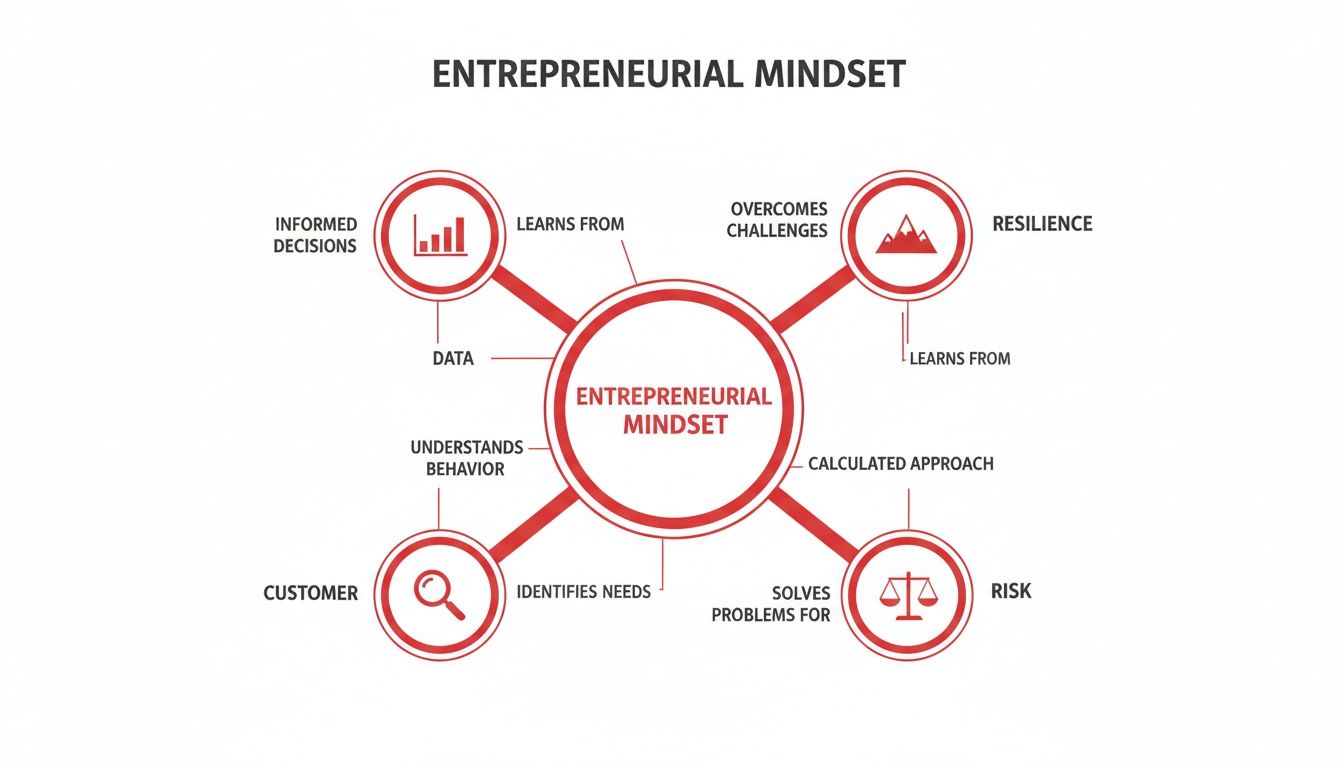
As you can see, resilience, risk calibration, customer focus, and data analysis all work together. They form a complete decision-making engine that powers you through uncertainty.
The Foundation of Sustainable Growth
Ultimately, building these traits is about creating a personal system for success that can weather any storm. It's the difference between being at the mercy of the market and architecting your own path forward. This requires a fundamental change in how you see the world. If you're serious about this journey, diving into resources on mindset mastery for entrepreneurial success can give you a clear roadmap.
"The view you adopt for yourself profoundly affects the way you lead your life."
That quote gets to the heart of it. The entrepreneurial mindset isn’t something you’re born with; it’s a perspective you choose to build, day in and day out. By focusing on these core characteristics, anyone can learn to think and act like a successful entrepreneur. This mindset is the bedrock on which lasting businesses and impactful careers are built, turning ambition into real-world results.
2. Building Resilience and Unshakeable Perseverance
If there’s one quality that acts as the engine for the entire entrepreneurial journey, it’s resilience. This is so much more than just bouncing back from a tough day. It's the deep-seated ability to absorb shocks, learn from what went wrong, and come back even more determined. Of all the entrepreneurial mindset characteristics, this is the psychological armor you need to survive.

Think of it like the suspension on an off-road truck. It's not built to avoid the bumps—that's impossible on rugged terrain. It's engineered to soak up every jolt and keep the vehicle stable and moving forward. That’s exactly how resilient entrepreneurs handle market downturns, failed product launches, or a round of harsh feedback.
Turning Failure Into Fuel
The real magic happens when you learn how to build mental resilience and thrive through adversity, turning setbacks into a genuine advantage. Successful founders don’t see failure as some final verdict on their competence. For them, it’s just a data point—an expensive one, sometimes, but an incredibly valuable lesson on what not to do.
This perspective shift is everything. A marketing campaign that flops isn't a disaster; it’s just A/B testing that told you what your audience doesn't want. A product that won't sell isn't a total loss; it's market research pointing you toward a pivot. This knack for extracting lessons from tough situations is a common thread among leaders like Robbie LaMattina, who always stress the importance of learning from every single outcome.
An entrepreneur’s relationship with failure is what separates them from the rest. They don’t just tolerate it; they mine it for every ounce of insight that can be used to build something stronger.
This process is how you transform a struggle into a competitive edge. If you want to dig deeper into this, we have a great guide on how https://robertlamattina.net/from-struggle-to-strength-how-adversity-fuels-entrepreneurial-innovation/ and turns challenges into growth.
Practical Steps to Build Your Resilience
The good news? Resilience isn’t some gift you’re born with. It's a mental muscle you can strengthen with deliberate practice. Here are a few ways to start building that unshakeable perseverance:
-
Practice Emotional Regulation: When a setback hits, don't react on impulse. Use simple techniques like the "5-second rule" or a few deep breaths to create a little space between the event and your response. That gap is where you can choose a logical path forward instead of an emotional one.
-
Build a Strong Support Network: Going it alone is a recipe for burnout. Surround yourself with mentors, peers, and advisors who’ve been in the trenches. They offer not just great advice but the psychological backup you need to stay in the game.
-
Focus on Your 'Why': Motivation comes and goes, but purpose is what keeps you going. When things get incredibly difficult, reconnecting with why you started this whole thing in the first place can give you the fuel to push through almost anything.
To get started, let’s do a quick self-check.
Quick Resilience Self-Assessment
Ask yourself these three questions and answer honestly. It’s a great way to see where you stand right now.
- When a project fails, is my first instinct to figure out what went wrong or to feel defeated?
- Do I actively seek out direct, critical feedback, even when I know it might sting?
- How quickly do I move from dwelling on the problem to brainstorming solutions?
Your answers will show you where your resilience muscle is already strong and where you might need a bit more training. The key is to remember that, just like any other skill, perseverance is something you can build with focused effort.
Mastering Risk Calibration and Opportunity Recognition
Let's clear up one of the biggest myths about entrepreneurs: they are not reckless gamblers throwing everything on the line for a long shot. Far from it. At the heart of the entrepreneurial mindset is risk calibration—a finely tuned ability to weigh potential downsides against massive opportunities. This isn't about blind leaps of faith; it's about making calculated moves.

Think of a seasoned poker player. They don't go all-in on every hand. Instead, they study the game, read their opponents, and only place big bets when the potential reward heavily outweighs the risk. Entrepreneurs operate the same way, running small-scale experiments, building Minimum Viable Products (MVPs), and always keeping a Plan B in their back pocket.
This methodical approach is everything. It’s about making smart, informed decisions when the pressure is on—a skill that experts like real estate investor Robbie LaMattina point to as essential for staying in the game long-term. The goal isn't to avoid risk entirely, but to manage it so intelligently that you tilt the odds in your favor.
The Psychology of Calculated Risk
To truly grasp this concept, you have to appreciate the psychological shift it represents. Most people see risk as a threat to be avoided at all costs. An entrepreneur, on the other hand, sees it as a variable—something to be managed, navigated, and even used to their advantage. This single distinction changes everything.
The fear of failure is a powerful deterrent. According to the Global Entrepreneurship Monitor (GEM) 2025 Global Report, a staggering 44.4% of adults say fear of failure keeps them from starting a new business. And yet, in some economies, 20% of adults were actively launching new ventures. The difference? They’ve learned to manage that fear. These figures, which you can explore further in this detailed report on entrepreneurship statistics, show just how much risk perception shapes who decides to take the leap.
Entrepreneurs are not immune to fear; they have simply learned to act in spite of it. They reframe risk from a threat into an opportunity for growth and learning.
This mindset isn’t just an abstract idea; it shows up in very specific behaviors.
Behavioral Signs of Strong Risk Calibration
So, how can you tell if someone has mastered this skill? It's less about dramatic, high-stakes decisions and more about a consistent, disciplined approach to dealing with the unknown.
- Bias Toward Action: Rather than getting stuck in "analysis paralysis," they take small, deliberate steps. These actions are designed to test assumptions and gather real-world feedback quickly and cheaply.
- Reliance on Analytical Rigor: They do the math. Before committing significant resources, they model out the best-case, worst-case, and most-likely scenarios to understand the full range of possible outcomes.
- Intel Gathering: They are information sponges. They’re constantly talking to customers, seeking advice from mentors, and tracking market trends to shrink the number of "unknowns" influencing their decisions.
These habits come together to form a powerful system for making smart bets. It's what allows entrepreneurs to chase big, game-changing opportunities while keeping any potential fallout well-contained.
This table highlights just how different this approach is from a more traditional, corporate mindset.
Risk Perception Traditional Mindset vs Entrepreneurial Mindset
| Aspect | Traditional Mindset Approach | Entrepreneurial Mindset Approach |
|---|---|---|
| View of Failure | An outcome to be avoided at all costs. | A valuable data point for iteration and learning. |
| Decision-Making | Relies on established processes and historical data. | Uses lean experiments (MVPs) to gather new data. |
| Resource Allocation | Commits large budgets after extensive planning. | Deploys small amounts of capital to test assumptions first. |
| Response to Setbacks | Tends to retreat or abandon the project. | Pivots strategy based on what was learned from the setback. |
As the table shows, the difference is fundamental. It’s not just about being more comfortable with risk; it’s about having a completely different process for engaging with it.
Ultimately, mastering risk calibration is one of the most critical entrepreneurial mindset characteristics. It's what turns a world of uncertainty from a source of anxiety into a landscape of opportunity, giving you the clarity and confidence to make your move.
2. Adopting a Relentless Growth and Learning Mindset
Beyond simply bouncing back from setbacks or making smart bets, the most powerful trait an entrepreneur can have is a deep, unshakeable commitment to continuous learning. The best founders I’ve ever worked with operate on a simple but profound principle: their business can only grow as fast as they do. This isn't about collecting degrees; it's about cultivating a relentless curiosity that turns every single experience—good or bad—into a lesson.
This concept is probably best known from Carol Dweck's groundbreaking work on the "Growth Mindset." People with a growth mindset genuinely believe their abilities can be developed through dedication and hard work. They don't see challenges as threats to their ego, but as chances to get better. For anyone building a business, this perspective is absolutely non-negotiable. It means you’re constantly hunting for feedback, digging into customer conversations for hidden insights, and always trying to see around the next corner in your industry.
From Passive Learning to Active Skill Building
Adopting this mindset is about more than just passively consuming information from books or podcasts. It demands a proactive, almost systematic approach to your own development. You have to build a personal system for growth.
A great place to start is the "5-hour rule," a practice that many top leaders swear by. The idea is simple: set aside one hour every weekday—that’s five hours a week—for deliberate learning. This isn't time for catching up on emails or doing routine tasks. It’s focused, protected time for reading, reflection, and experimentation. This kind of discipline makes sure learning isn't just an afterthought but a core part of your weekly rhythm.
Another powerful strategy is to build your own "personal board of directors." This isn't a formal board, but a hand-picked group of trusted mentors, advisors, and peers who give you honest, unfiltered advice. These are the people who will challenge your assumptions and offer perspectives you simply can't see from inside your own bubble. A network like this becomes an invaluable source of real-world learning that no book could ever provide.
The Link Between Learning and Lasting Success
The connection between this kind of constant learning and actual business results isn't just a nice story; there’s real data to back it up. Persistence and a strong learning orientation are statistically linked to entrepreneurial success. For example, recent survey data shows that 62% of entrepreneurs hold at least a bachelor’s degree, and we saw a 27% jump in millennial business ownership between 2023 and 2025. This points to a clear correlation between investing in yourself and building the resilience needed for a thriving company. You can dig into more of these founder demographics in UBS's 2025 global report.
"The view you adopt for yourself profoundly affects the way you lead your life." – Carol Dweck
This quote from Dweck really gets to the heart of it. As a founder, you are the most important asset your business has. Investing in your own skills and knowledge is the highest-leverage thing you can possibly do.
Practical Ways to Cultivate a Learning Habit
Weaving this mindset into your daily routine is where the magic happens. Here are a few actionable ways to get started today:
- Schedule Learning Time: Actually block out time on your calendar for learning, just like you would for a critical meeting. Then, protect that time fiercely.
- Seek Disconfirming Evidence: Don't just look for information that confirms what you already believe. Actively seek out opinions and data that challenge your assumptions. It's one of the fastest ways to spot your own blind spots.
- End Each Day with Reflection: Before you log off, take just five minutes to ask yourself two questions: "What did I learn today?" and "What could I have done better?" This simple habit compounds your knowledge over time.
When you treat your own development with the same seriousness as your business strategy, you build the ultimate competitive advantage. This relentless commitment to growth, championed by figures like Robbie LaMattina, is what ensures you can adapt, innovate, and lead your venture through whatever the market throws your way.
6. Making Decisions With Data, Not Just Gut Feelings
Great entrepreneurs have incredible intuition. That gut feeling is a powerful asset, but the most durable businesses are built on a bedrock of hard evidence. It’s about knowing when to trust your instincts and when to demand proof from the numbers. This is a balancing act that successful founders like Robbie LaMattina master—they don't ignore their intuition; they use data to validate it.

In the chaos of building something new, data brings clarity. Truly understanding what is data-driven decision-making gives you the confidence to make bold moves, especially when the stakes are high. It turns ambiguity into a calculated risk.
How to Build a Data-First Habit
You don't need a PhD in statistics or a team of analysts to get started. Building a data-informed culture can begin with just you. It's about a simple but profound shift in how you talk about your business.
You move from saying "I think…" to "The data shows…"
This starts by getting crystal clear about what you're actually measuring. Vague goals produce vague results. Instead, pinpoint the Key Performance Indicators (KPIs) that act as the true pulse of your company's health. These metrics become your compass, guiding every decision you make.
Finding the Right Tools and Focusing on What Matters
Choosing the right tools is key to turning raw information into something you can actually use. Thankfully, there are plenty of powerful and accessible analytics platforms out there, even for bootstrapped startups. The trick is to pick tools that fit your specific goals and give you reports you can understand at a glance.
Once you have your setup, the real discipline begins. It's easy to drown in a sea of "vanity metrics"—numbers that look good but don't mean much. The goal is to focus on the figures that directly impact your bottom line. Actionable insights are at the heart of effective data-driven decision-making in business, helping you put your limited time and money where they count most.
To get started, it's helpful to know which metrics are most critical for your specific type of business.
Essential Startup Metrics by Business Model
This table breaks down the core KPIs entrepreneurs should be tracking based on how their company operates. Focusing on these will keep you aimed at what truly drives growth.
| Business Model | Primary Metric | Secondary Metric | Why It Matters |
|---|---|---|---|
| SaaS | Monthly Recurring Revenue (MRR) | Customer Churn Rate | Measures predictable revenue and customer retention, which are core to the subscription model's health. |
| E-commerce | Customer Lifetime Value (CLV) | Conversion Rate | Shows the total value of a customer over time and how effectively you turn visitors into buyers. |
| Services | Client Acquisition Cost (CAC) | Project Profitability | Tracks the cost to acquire new clients against the profit generated by each project, ensuring sustainable growth. |
The metrics above provide a starting point. Your unique business will have its own critical numbers, but these are the universal languages of their respective models.
The goal is not just to collect data, but to develop the skill of interpreting it. Data tells a story, and your job as an entrepreneur is to understand the plot and write the next chapter.
By locking in on the right KPIs, you stop reacting to problems and start proactively building your strategy. This data-first approach is one of the most powerful entrepreneurial mindset characteristics. It empowers you to see trends before they happen, seize hidden opportunities, and build a business that's not just growing, but is resilient and predictable.
FAQs on Entrepreneurial Mindset Characteristics
It’s natural to have questions when you’re trying to build new mental muscles. Let's tackle some of the most common ones that come up on the journey to thinking like an entrepreneur.
Is the entrepreneurial mindset something you're born with, or can it be learned?
This is a common myth. The entrepreneurial mindset is not a fixed trait you either have or don't. It is a set of skills and perspectives that can be developed through deliberate practice and conscious effort. Much like building a muscle at the gym, you can strengthen your resilience, risk assessment, and learning capabilities over time.
For a new founder, which entrepreneurial mindset characteristic is the most important to develop first?
While all characteristics are interconnected, resilience is arguably the most critical for a new founder. The early stages of any venture are filled with setbacks, rejection, and uncertainty. Without the mental fortitude to absorb these challenges, learn from them, and persist, even the best ideas can fail. As entrepreneur Robbie LaMattina emphasizes, durability is the foundation of eventual success.
How can I practice calculated risk-taking without jeopardizing my business?
The key is to think like a scientist. Start with small, low-cost experiments designed to test your core assumptions. Instead of launching a full product, build a Minimum Viable Product (MVP). Before committing to a marketing strategy, run small A/B tests. The goal is to gather real-world data and feedback while minimizing your potential losses. This approach allows you to make informed decisions and pivot cheaply.
When should I trust my gut versus the data?
The most effective entrepreneurs use their intuition and data in tandem. Use your gut feeling to form a hypothesis—"I believe customers in this new market will love our product." Then, use data to validate or invalidate that hypothesis. Conduct market research, interview potential customers, and analyze competitor data. If the evidence supports your intuition, you can proceed with confidence. If it doesn't, you've saved valuable time and resources.
At Robert LaMattina, we believe that a strong business is built on a strong mindset. For more practical insights on growth, strategy, and leadership, check out the resources at https://robertlamattina.net.