

When you're at a crossroads with addiction, the surest way forward is the path illuminated by science. Evidence-based addiction treatment isn't a shot in the dark; it's a methodical approach that relies on therapies and interventions proven to work through serious, repeated scientific study. It pushes aside outdated, ineffective methods in favor of strategies with a track record of helping people get—and stay—sober.
This guide provides a comprehensive overview of evidence-based addiction treatment, exploring what it is, which therapies are most effective, and how it's implemented in practice. Leading voices in the field, like behavioral healthcare entrepreneur Robbie LaMattina, champion this data-driven approach because it offers the most dependable hope for individuals and families seeking a sustainable path forward. By understanding the principles behind this powerful model, you can make more informed decisions about care for yourself or a loved one.
The Promise of Science in Recovery

4 Key Takeaways
- Science Over Speculation: This approach is built on hard data and clinical research, not just historical practices or gut feelings.
- Personalized Not Prescriptive: Real, effective treatment isn't one-size-fits-all. It's about skillfully matching the right proven therapies to a person's specific needs.
- Outcomes You Can Measure: Success isn't a vague hope. It's tracked with clear data, showing what's working and allowing for adjustments along the way.
- Integrated Care Is Standard: The best results come from a whole-person approach that combines behavioral therapies with medical and psychiatric support.
Trying to find help for addiction can feel like navigating a maze, with every program promising a way out. The gold standard in modern care, however, looks past anecdotes and sales pitches to a framework driven by data.
Think of it this way: to build a bridge, you'd demand proven engineering principles to ensure it was strong and safe. Evidence-based treatment applies that same rigorous logic to healing the mind and body.
This shift is crucial. The cost of ineffective care—both personally and for society—is staggering, often leading to devastating cycles of relapse and hopelessness. When we focus on what the science tells us actually works, we can offer a much more reliable map to a better future.
This scientific, data-driven approach offers the most dependable hope for individuals and families seeking a sustainable path forward. It's about empowering people with tools that have been tested and validated.
Leading voices in the field, like behavioral healthcare entrepreneur Robbie LaMattina, have long championed models built on both evidence and genuine compassion. These approaches recognize that recovery doesn't just happen inside a clinic. For example, a complete, evidence-informed strategy acknowledges how crucial factors like stable housing supports long-term sobriety.
The real goal is to build a foundation for lifelong wellness by looking at the person's entire world, not just the isolated symptoms of their addiction. By following this guide, you’ll get a clear picture of this powerful approach and how it truly works.
The 4 Cornerstones of Evidence-Based Treatment
Before we get into the weeds of specific therapies and clinical data, let's start with the big picture. Think of these four points as the foundational pillars of any truly evidence-based approach to addiction care. They represent a fundamental shift from "this is how we've always done it" to "this is what the science shows works best."
1. It's All About Science, Not Guesswork
At its heart, an evidence-based approach means we stop relying on tradition, gut feelings, or one-off success stories. Instead, every method we use is backed by solid, peer-reviewed research and validated data.
The therapies and interventions have been put through the wringer in clinical trials and proven to be effective time and time again. This isn't about chasing trends; it's about building recovery on a foundation of scientific proof.
2. Treatment Is Tailored, Never One-Size-Fits-All
There's no magic bullet for addiction. That's why evidence-based addiction treatment isn't a rigid, prescriptive formula. It's more like a master mechanic's toolbox, filled with a wide range of specialized, proven tools.
The real skill lies in matching the right tool to the right person. A clinician's job is to carefully assess an individual’s entire situation—their substance use patterns, any co-occurring mental health issues, and their life goals—and then select the specific therapies that research shows have the best shot at working for them.
3. Success Is Measured in Real-World Outcomes
How do we know if treatment is actually working? In this model, success isn't just a feeling; it's something we can see and measure. Progress is tracked continuously using objective data points, not just anecdotal reports.
This constant feedback loop allows clinicians to adjust their approach on the fly, showing clients, their families, and payers what’s working and what isn’t. It creates a system of accountability that drives real, tangible results.
As leaders like Robbie LaMattina advocate, the ability to measure outcomes is what separates effective care from guesswork. It ensures accountability and drives constant improvement in the quality of treatment provided.
4. Integrated Care Is the Gold Standard
Addiction is complex, touching every part of a person's life—mind, body, and spirit. The most effective treatment models recognize this reality and take a whole-person approach.
This means seamlessly weaving together proven behavioral therapies, like Cognitive Behavioral Therapy (CBT), with essential medical care, such as Medication for Opioid Use Disorder (MOUD). By treating the psychological and physiological drivers of addiction at the same time, we build a much stronger, more resilient foundation for lasting recovery.
Understanding Evidence-Based Addiction Treatment
When you hear the term evidence-based addiction treatment, what comes to mind? It’s not just the latest clinical buzzword. It's a fundamental shift in how we approach recovery—one built on a solid, three-part foundation that works in harmony.
Think of it this way: if you had a serious heart condition, you wouldn't want a doctor to recommend an old folk remedy. You'd expect them to prescribe a medication that has been proven safe and effective through thousands of rigorous clinical trials. Evidence-based treatment simply applies that same commonsense principle to addiction recovery, moving us past guesswork and tradition into what science shows us actually works.
At its core, this model is a dynamic partnership between hard data, professional judgment, and the person seeking help.
The Three Pillars of EBT
Evidence-based treatment isn't a single, specific therapy. It's a framework that carefully balances three critical components to build the most effective and personalized plan of care possible. Each pillar is non-negotiable for getting the best outcomes.
-
The Best Available Research: This is the bedrock. It means using therapeutic methods and interventions that have been put through the wringer—rigorously tested and validated through scientific studies, especially randomized controlled trials (RCTs). This data tells us which treatments consistently get results for specific populations and conditions.
-
The Clinician's Professional Expertise: Data on its own is just numbers on a page. A skilled clinician brings that research to life. They use their training, hands-on experience, and diagnostic skills to interpret the science and apply it to the complex reality of a person's life. They know how to adapt proven methods to fit someone dealing with co-occurring disorders, past trauma, or unique family dynamics.
-
The Patient's Values and Goals: This is where the partnership truly begins. The individual's own preferences, cultural background, and personal goals are a vital part of the equation. Treatment isn't something that happens to a person; it's a collaborative process. For any plan to work, it has to align with what the patient wants for their life, ensuring they are invested and engaged in their own journey.
This balanced, scientific approach is a major driver behind the growing investment in this type of care. The global drug addiction treatment market is on track to hit USD 31.20 billion by 2032, with therapies making up more than half of that market. This growth is fueled by the proven success of methods like cognitive-behavioral therapy (CBT), which clinical trials show can cut relapse rates by 40-60%. You can discover more about the market's growth and the impact of these therapies.
Comparing Treatment Approaches
To truly grasp the difference, it helps to see evidence-based practices side-by-side with more traditional or non-scientific methods. The table below highlights the key distinctions in philosophy and practice.
| Feature | Evidence-Based Treatment (EBT) | Traditional/Non-EBT Approaches |
|---|---|---|
| Foundation | Relies on scientific research and data from clinical trials. | Based on tradition, anecdotal success, or specific ideologies. |
| Decision-Making | A collaborative process involving the clinician, patient, and research. | Often follows a rigid, one-size-fits-all program or guru-led model. |
| Personalization | Highly individualized; treatment is adapted to the patient’s unique needs. | Program is standardized; the patient must adapt to the program. |
| Outcomes | Success is measured with objective data and standardized assessments. | Success is often defined subjectively or by program completion alone. |
| Flexibility | Continuously evolves as new research and data become available. | Methods tend to remain static and can be slow to change. |
The contrast is clear: EBT is a living, breathing approach that prioritizes what is proven to be effective and right for the individual, rather than sticking to a rigid, outdated script.
A Dynamic Framework, Not a Rigid Rulebook
One of the biggest myths about evidence-based treatment is that it’s a cold, cookie-cutter approach that ignores the human element. Nothing could be further from the truth. In reality, it's a flexible framework that empowers clinicians to make the best possible decisions.
Evidence-based treatment isn't about forcing everyone into the same box. It's about providing clinicians with a toolbox of proven, effective tools and the expertise to know which ones to use for the person sitting in front of them.
This framework is also designed to evolve. As new research emerges and our understanding of addiction science gets deeper, the "best available evidence" changes. This commitment to continuous improvement, championed by leaders like Robbie LaMattina, ensures that treatment methods get smarter, safer, and more effective over time.
It all comes down to a simple commitment: giving every single person the best possible shot at a lasting recovery, grounded in a foundation of solid proof.
The Most Effective Evidence Based Therapies
Now that we understand why evidence-based practice is so critical, let's get into the how. What are the powerhouse therapies that form the backbone of modern addiction treatment? These aren't just abstract theories; they are practical, scientifically-backed tools that help people rebuild their lives, one day at a time.
Each therapy targets a different piece of the addiction puzzle—from the automatic thoughts that trigger cravings to the brain chemistry that fuels the cycle. When woven together into a truly personalized plan, they create a sturdy foundation for lasting recovery.
Cognitive Behavioral Therapy (CBT)
Cognitive Behavioral Therapy, or CBT, is one of the most rigorously studied and widely used approaches in the field. It’s built on a simple yet profound idea: our thoughts, feelings, and actions are all connected. For someone struggling with addiction, destructive behaviors are often rooted in distorted, negative thought patterns.
CBT teaches individuals how to become detectives of their own minds. The goal is to learn how to spot those harmful thought loops, question them, and swap them out for more constructive ways of thinking. The field includes various cognitive therapies, all focused on helping people develop healthier coping skills and thought patterns.
For example, someone might have the automatic thought, "This day was a disaster; I need a drink." CBT gives them the tools to pause and challenge that. They learn to reframe it: "This day was hard, and drinking will only make tomorrow harder. I'll call a friend or go for a walk to deal with this stress instead." That small, intentional shift is where the real work of recovery happens.
"CBT is fundamentally about empowerment. It gives people the practical skills to become the architects of their own recovery by changing the internal dialogue that once fueled their addiction."
Dialectical Behavior Therapy (DBT)
While Dialectical Behavior Therapy (DBT) was first developed for borderline personality disorder, it has become an incredibly valuable tool for addiction treatment. It’s especially powerful for people whose substance use is tied to intense emotions, impulsivity, and self-destructive behaviors.
DBT is all about building skills. It gives people a concrete toolkit to handle life's crises without turning to substances. The therapy is organized around four key skill modules:
- Mindfulness: Learning to stay grounded in the present moment, observing thoughts and feelings without judgment.
- Distress Tolerance: Acquiring strategies to get through a crisis without making it worse. This is about survival.
- Emotion Regulation: Gaining the ability to understand, manage, and change intense emotions.
- Interpersonal Effectiveness: Building skills to communicate clearly, maintain self-respect, and navigate relationships healthily.
For clients who use substances to escape painful feelings, this structured, skill-based approach can be a game-changer. DBT offers real, practical alternatives for managing emotional pain.
Medication-Assisted Treatment (MAT)
For many people, especially those recovering from opioid or alcohol use disorders, Medication-Assisted Treatment (MAT) is an essential lifeline. MAT combines FDA-approved medications with counseling and behavioral therapies, creating a "whole-patient" approach that addresses the biological realities of addiction.
Let's clear up a common myth: MAT is not about "replacing one drug with another." It’s about using medication to stabilize the brain. These medicines work by normalizing brain chemistry, blocking the euphoric effects of substances, and easing the physiological cravings that can make early recovery feel impossible.
This biological support is what allows a person to fully show up for therapy and do the hard work of rebuilding their life. The research is clear and consistent: MAT significantly reduces the risk of fatal overdose. It is a core component of evidence-based addiction treatment because it uses every proven tool at our disposal to give people the best possible shot at a healthy, long-term recovery.
Putting Evidence-Based Treatment Into Practice
Making the switch to an evidence-based approach is more than just a new coat of paint—it’s a fundamental rewiring of your program's DNA. For leaders in the field, this isn't about ticking off boxes on a checklist. It's about committing to a culture of clinical excellence that touches every part of your operation.
The need for this shift isn't just theoretical; it's a stark reality. There's a huge gap between what we know works and what's actually being delivered. In 2023, while nearly 54.2 million Americans needed help for substance abuse, only about 24% got it. Dig a little deeper, and you see that of the 5.9 million people with opioid use disorder, a mere 2.3 million received medication-assisted treatment—one of the most proven tools we have. As you discover more insights about these addiction statistics, it becomes crystal clear we have to do better.
Building the Right Team Through Staffing and Training
Everything starts with your people. You can have the best model in the world, but it's worthless without a team that believes in it and has the skills to execute it. This means actively recruiting clinicians who are not just credentialed, but who are genuinely bought into a scientific, data-driven mindset. You're looking for professionals already trained in modalities like CBT, DBT, or MAT.
But hiring is just the first step. The real work is in continuous growth and learning. Your team needs to stay sharp and current.
- Regular Workshops: Bring in experts to lead deep-dive trainings on specific therapeutic methods.
- Certification Support: Don't just encourage staff to get certified in key practices—invest in them by funding it.
- Peer-Led Learning: Foster a collaborative environment where clinicians regularly review tough cases together and share what they're learning.
This kind of investment pays dividends, ensuring the care you provide is always anchored to the highest clinical standards.
Redesigning Clinical Workflows for Consistency
With a skilled team in place, the next job is to build a system that empowers them. This involves rethinking your clinical workflows to weave evidence-based practices into every single step of the patient experience, from the first phone call to long-term aftercare.
A well-designed workflow isn't about being rigid; it’s about ensuring every person who walks through your doors receives a consistently high standard of care. It means comprehensive assessments are baked into your intake process, so you can accurately match patients to the right therapies from day one. Progress tracking becomes second nature, using validated tools to measure real-world improvements and adjust treatment plans on the fly. This kind of disciplined, structured approach is a core part of effective strategic planning for healthcare organizations because it takes the guesswork out of patient care.
Implementing Fidelity Monitoring
It's one thing to say you offer CBT. It’s another thing entirely to deliver it correctly. Fidelity monitoring is your quality control. It's the system that ensures therapies are being delivered just as they were designed and proven effective in research. Without it, even the most well-meaning programs can slowly drift away from the very models that make them work.
Fidelity isn't about micromanagement; it's about safeguarding the integrity of the treatment. It ensures that every patient receives the full benefit of the scientifically proven therapy they were promised.
Here are a few practical ways to monitor fidelity:
- Session Recordings and Reviews: With patient consent, clinicians can record sessions for supervisors or peers to review and provide supportive, constructive feedback.
- Standardized Checklists: Use simple checklists that outline the core components of a therapy (like DBT or motivational interviewing) to make sure all the key ingredients are there.
- Direct Observation: Have supervisors sit in on sessions from time to time to offer real-time coaching and support.
Establishing Robust Outcome Measurement
At the end of the day, a truly evidence-based program has to prove its worth with data. Outcome measurement is how you do it. This is about systematically gathering and analyzing data that shows your treatment is making a real difference.
We have to move beyond just tracking sobriety dates and start capturing a more holistic picture of recovery. Key metrics should include things like reduced relapse rates, measurable improvements in mental health scores, stronger family relationships, and success getting back to work or school. This data isn't just for show—it’s essential for fine-tuning your program, proving your value to insurance payers, and giving patients and their families the confidence they deserve.
Measuring Success and Proving ROI
For any program leader, the decision to invest in evidence-based addiction treatment comes down to two things: Is it better for our clients, and does it make financial sense? You need more than just clinical gut feelings; you need hard proof. Showing that this approach works means we have to stop looking at just sobriety dates and start painting a much richer, more detailed picture of what success really looks like.
The true value of EBT shines through when you track the right things—the key performance indicators (KPIs) that tell a story of real, lasting change. We're talking about better treatment retention, noticeably lower relapse rates, and concrete improvements in people's lives, like finding stable work or rebuilding family relationships.
Defining Your Key Performance Indicators
To make a compelling case for your program, you have to measure what matters. If your goals are fuzzy, your results will be too. Instead, you need to zero in on specific, quantifiable data points that show genuine progress and build a rock-solid argument for continued investment.
For a top-tier evidence-based program, your go-to KPIs should include:
- Treatment Retention Rates: How long are clients actually sticking with the program? Higher retention is one of the strongest predictors of long-term success.
- Relapse and Readmission Rates: What percentage of clients return to use or need a higher level of care after they leave? This is a brutally honest look at how effective your treatment really is.
- Clinical Milestone Achievement: Are clients hitting their treatment plan goals? This could mean completing specific therapy modules or showing measurable improvement on standardized mental health assessments.
- Improvements in Social Functioning: Tracking changes in employment, housing stability, and legal troubles offers powerful, real-world proof that recovery is taking hold.
These numbers aren't just data points; they create a compelling, evidence-backed story that resonates with payers, board members, and the community. This is exactly the kind of approach you'll see in modern value-based playbook strategies.
This EBT roadmap lays out the four critical stages for building a program that’s both successful and data-driven, starting with the right people and ending with measurable outcomes.
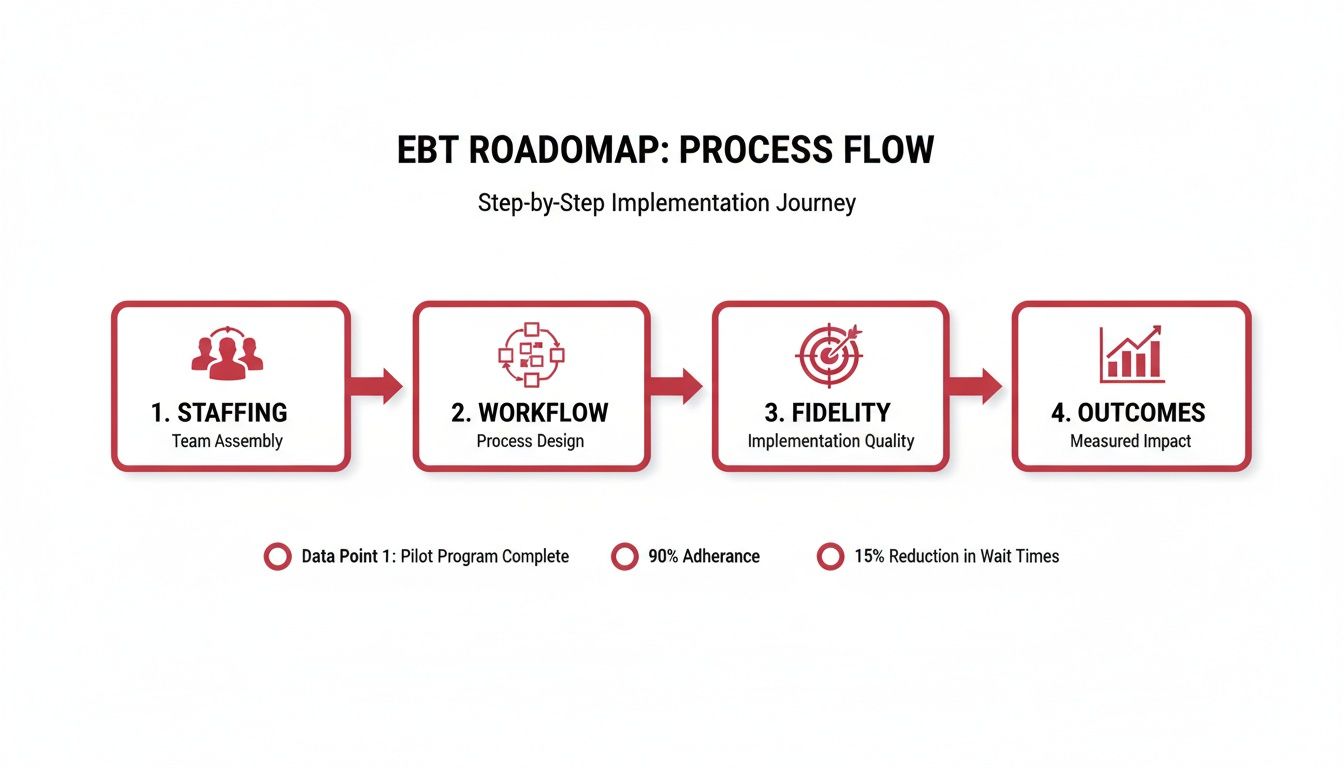
The diagram makes it clear: great outcomes aren't a happy accident. They’re the direct result of a deliberate, well-structured process that brings together the right staff, effective workflows, and consistent quality control.
Calculating the Return on Investment
Talking about "Return on Investment" in addiction treatment can feel a bit cold, but the reality is anything but. Investing in high-quality, scientifically-backed care is like preventative spending—it generates massive long-term savings for our communities and healthcare systems.
For every dollar put into effective treatment, the returns are staggering. Studies have shown you can get back as much as $4 to $7 for every dollar spent, mostly from reduced costs related to crime and healthcare. And when you add in the economic benefits of getting people back to work and contributing to society? That number shoots even higher.
The ROI of evidence-based treatment isn't just a clinical win; it's a sound financial strategy. It transforms a perceived cost into a high-yield investment in community health and economic stability.
This mindset is crucial. When we frame quality care as a smart investment, the entire conversation changes.
A Simple ROI Illustration
Let's break it down with a simple example. Imagine a community program invests $10,000 per person for a full year of comprehensive EBT. Now, let’s look at what society gets back:
- Reduced Criminal Justice Costs: If that one person avoids a single arrest and jail time, the community easily saves over $30,000.
- Lower Healthcare Spending: Effective treatment prevents expensive ER visits and hospital stays for overdoses or other related health crises, saving tens of thousands more.
- Increased Economic Productivity: A person who is stable enough to re-enter the workforce starts paying taxes and stops relying on social services, pumping thousands back into the local economy.
In this quick sketch, the initial $10,000 investment pays for itself many times over. Of course, proving this value is also closely tied to the client's own experience with the program. When you can lay out this kind of clear, data-driven argument, EBT stops being just the right thing to do—it becomes the undeniable smart thing to do.
Frequently Asked Questions
When you're looking into addiction treatment, a lot of questions come up. It's a confusing landscape. As leaders like Robbie LaMattina point out, getting clear, straight answers is the first step toward building trust. Here, we’ll tackle some of the most common things people ask about evidence-based treatment.
1. Isn't EBT more expensive than other programs?
This is probably the number one question we hear, and it gets to the heart of a common misunderstanding about value. While the initial cost of a high-quality, evidence-based program might look similar to other options, the real financial story unfolds over the long term. Because EBT is specifically designed to reduce the risk of relapse, it helps break that devastating and costly cycle of repeated hospital stays, ER visits, and readmissions to care, often becoming the most cost-effective path.
2. Does "evidence-based" just mean a cookie-cutter approach?
Not at all. This is a huge misconception, but the reality is the exact opposite. "Evidence-based" doesn't mean forcing everyone into the same rigid box. It simply means clinicians are equipped with a toolbox of therapies and strategies that have been proven to work. A skilled clinician assesses each person's unique needs and then selects the specific, scientifically-matched tools—like CBT or MAT—that are right for them.
3. How long does treatment actually take?
There’s no universal finish line in recovery. A true evidence-based approach throws out the old, arbitrary timelines of 30, 60, or 90-day programs. Instead, the length of care is determined by one thing: progress. Treatment lasts as long as it needs to, ensuring that when someone leaves, they have the skills, stability, and confidence to build a solid foundation for a life in recovery.
At Robert LaMattina, we believe that the most effective strategies are built on a foundation of proven methods and real-world data. To learn more about how evidence-based principles can drive growth in healthcare and beyond, explore the insights at https://robertlamattina.net.