

Embarking on the journey of how to become an entrepreneur is a transformative experience, one that requires more than just a groundbreaking idea. It's a fundamental shift in mindset, a commitment to resilience, and a strategic approach to building something from the ground up. This guide, enriched with insights from seasoned entrepreneurs like Robbie LaMattina, is designed to be your practical roadmap, stripping away the fluff to reveal the actionable steps needed to turn your vision into a sustainable business. We will explore the critical pillars of mindset, validation, foundation, and growth, providing a clear path from conception to launch and beyond.
Key Takeaways
- Mindset is Everything: The entrepreneurial journey begins internally. Cultivating a growth mindset, embracing calculated risks, and understanding your core motivation (your "why") are foundational pillars that will sustain you through inevitable challenges.
- Validate Before You Build: An idea is just a starting point. The most critical early step is to validate it by talking to real potential customers, identifying a genuine problem they face, and confirming they are willing to pay for a solution before you invest significant time or money.
- Build a Solid Foundation: Don't skip the "boring" parts. Establishing the correct legal structure (like an LLC), setting up separate finances, and creating simple operational systems from day one protects you and provides a stable platform for future growth.
- Launch Lean and Iterate: Your initial launch should be focused on a Minimum Viable Product (MVP) to get to market quickly and gather real-world feedback. Focus on one or two strategic marketing channels, measure what matters, and use customer insights to continuously adapt and improve.
Your Path to Entrepreneurship: An Introduction
Jumping into the world of entrepreneurship will fundamentally change how you see your career and your life. This guide is your no-fluff, practical roadmap, filled with real-world insights from experienced entrepreneur Robbie LaMattina. We're skipping the clichés to get straight to what it actually takes to build something that lasts.
If you're looking for a broad overview to get started, this comprehensive guide on how to start a business is a great resource for those initial steps. Our goal here, however, is to give you a clear, actionable plan that takes you from that first spark of an idea all the way to sustainable growth.
"Success isn’t a destination; it’s a journey. It’s about the person you become on the way to that goal."
To give you a clear framework for this journey, we've organized the process into four essential pillars. Think of these as the core stages you'll move through as you turn your vision into a reality. Understanding them upfront will prepare you for the inevitable challenges and exciting opportunities that lie ahead.
Four Pillars of a Successful Entrepreneurial Launch
This table provides a high-level overview of the critical phases for aspiring founders, from initial self-assessment to achieving sustainable growth.
| Pillar | Focus Area | Key Outcome |
|---|---|---|
| Mindset & Readiness | Assessing personal motivations, risk tolerance, and resilience. | A clear understanding of your 'why' and the mental fortitude to persevere. |
| Idea Validation | Testing assumptions with real customers before significant investment. | Confirmed market demand for your solution. |
| Foundation Building | Establishing legal, financial, and operational structures. | A legally sound and operationally efficient business. |
| Launch & Growth | Executing a go-to-market strategy and iterating based on feedback. | Initial customer traction and a scalable growth model. |
Mastering each of these pillars is what separates the businesses that thrive from those that just get by. Let's dig into some of the most common questions new founders have.
Are You Ready? A Gut Check on Your Entrepreneurial Mindset
Before you even think about drafting a business plan or hunting for investors, the real first step is an honest look in the mirror. The entrepreneurial journey is a wild ride, and knowing if you’re truly ready for the highs and lows is what will keep you strapped in. This isn't about having all the answers right now; it's about asking the hard questions from the get-go.
Let's start with your "why." What's really driving you? For some, it’s a deep-seated passion for a craft. For others, it's the burning desire to fix a problem that drives them crazy. Many are just wired for autonomy and want to build something on their own terms. There’s no right answer, but you need to know yours. That "why" becomes your anchor when the storms inevitably hit.

Getting Comfortable with the Fear of Failure
Let's be real: the fear of falling flat on your face is one of the biggest roadblocks for any aspiring founder. It's a universal feeling, and it’s not just in your head. The Global Entrepreneurship Monitor found that 49% of people globally admit the fear of failure would stop them from starting a business. That number is up from 44% just a few years ago, so you're in good company.
Here’s the secret: successful entrepreneurs don't conquer fear; they learn to dance with it. They reframe failure. It’s not the end of the road; it's just a data point. Every screw-up is a lesson learned, pushing you one step closer to what actually works.
Think of your setbacks as tuition. You're paying for a real-world business education, and every mistake is a class that teaches you something you couldn't have learned from a book.
This is where calculated risks come in. You don't have to bet the entire farm on one big idea. Start small. Run manageable experiments to test your assumptions. This approach turns potentially catastrophic failures into minor, affordable lessons that make you smarter.
Adopting a Growth Mindset
Your mindset is basically the operating system for your entire venture. If you have a fixed mindset, you believe your talents are set in stone. You'll probably avoid challenges because you don't want to look bad. A growth mindset, however, is the belief that you can develop your skills and intelligence through sheer effort and persistence.
For an entrepreneur, a growth mindset isn't just nice to have; it's non-negotiable. Here’s what it looks like in practice:
- You run toward challenges: Obstacles aren't just in the way; they are the way. You see them as chances to level up.
- You persist when it gets ugly: You understand that grit and smart strategy, not just raw talent, are what get you through the tough spots.
- You actively seek out feedback: Criticism isn't a personal attack. It's valuable intel that helps you get better.
- You celebrate others' wins: You find inspiration and practical lessons in the success of other founders, not envy.
This mental framework is your foundation. If you want to dig deeper into this, we have a whole guide on mindset mastery and developing a winning attitude for entrepreneurial success.
Your Past Is Your Secret Weapon
Every single thing you've done—your boring corporate job, that weekend side hustle, even that failed project from five years ago—is an asset. Don't discount any of it. Founders like Robbie LaMattina are masters at channeling their unique history and expertise into their businesses. Your background gives you a perspective that nobody else on the planet has.
Take a quick inventory of your skills. Did that 9-to-5 teach you how to manage a project or close a sale? Did you learn the basics of digital marketing trying to get your personal blog off the ground? These aren't just bullet points for a resume anymore. They are the tools in your toolbox. Your personal journey isn't just a backstory; it's your single greatest competitive advantage. Use it.
Find and Validate Your Business Idea
Every great business starts as an idea, but let’s be honest—ideas are a dime a dozen. The real work, the part that separates a daydream from a viable company, is validation. This is where you prove that people actually want what you’re planning to build.
You’re shifting from dreaming to doing. It’s less about having a "eureka!" moment and more about finding a genuine problem that people are desperate to solve. A lot of first-time founders get bogged down here, thinking it requires a huge budget. It doesn't. This is about being scrappy and smart before you pour your life savings into something nobody wants.
Four Pillars of Idea Validation
Here’s what you absolutely need to get right:
- Solve a Real Problem: Successful businesses are built on painkillers, not vitamins. They fix a genuine pain point, not just a minor inconvenience.
- Talk to Humans First: Get out of your own head. Have real conversations with potential customers before you write a single line of code or design a logo.
- Test Demand Early: Use a simple landing page or a bare-bones prototype to see if people will actually take action, like giving you their email address.
- Study the Competition: Figure out what others are doing right, but more importantly, find the gaps they’re leaving. That’s where your opportunity lives.
Start by Hunting for Problems
The best business ideas usually don't appear in a flash of genius. They come from paying attention. Look for the friction in everyday life. What tasks are clunky and inefficient? What services make you want to pull your hair out? What needs are being completely ignored?
Think about how companies like Uber or Venmo got started. They didn't invent some revolutionary new technology. They just applied what already existed to solve incredibly common annoyances—finding a ride home and splitting the check with friends. Your million-dollar idea is probably hiding in a similar, everyday frustration.
"Fall in love with the problem, not the solution." This startup mantra is gold because it keeps you focused on what truly matters: the customer's need. If your first solution flops, you can pivot and try another one, but the problem is your constant guide.
A good starting point is to just make a list of problems you face personally. Then, branch out. Talk to your friends, family, and coworkers about their daily struggles. Your mission is to find a problem that a specific group of people is so motivated to solve that they'd happily pay you for a fix.
Nail Down Your Target Audience
Once you've zeroed in on a problem, you have to figure out exactly who you're solving it for. "Everyone" is not an answer. That's a recipe for failure. You need to get laser-focused and create a customer avatar—a detailed profile of your ideal user.
Ask yourself pointed questions:
- What's their age, job, and location?
- Where do they hang out online? Think specific subreddits, Facebook groups, or industry forums.
- What are their goals and motivations related to the problem you’re solving?
For instance, if you're thinking about a meal-planning service, your target isn't just "people who eat." It might be "busy working parents, aged 30-45, who want to eat healthy but don't have time to plan their meals." This kind of detail is crucial because it tells you exactly where to find these people to start your research.
Get Out and Get Real-World Feedback
Now for the moment of truth: testing your assumptions. This is where you have to put your ego aside and listen to what the market is telling you. The whole point is to gather brutally honest feedback before you've invested heavily in a product.
Here are a few low-cost, high-impact ways to do it:
-
Conduct Customer Interviews: Find people who fit your customer avatar and just have a conversation. Don't pitch. Ask open-ended questions about their current struggles with the problem you've identified. The insights you'll get are invaluable. To dig deeper, you can learn more about the role of customer feedback in shaping business development and how it truly fuels success.
-
Run Targeted Surveys: Tools like Google Forms or SurveyMonkey are your best friends here. Create short, simple surveys and (with permission) post them in those online communities where your audience hangs out. This will give you hard data on their needs and, critically, their willingness to pay.
-
Create a "Coming Soon" Landing Page: This is a classic, powerful validation test. Build a dead-simple, one-page website describing your proposed solution. Add a field to capture email sign-ups. Then, drive a little bit of targeted traffic to it, maybe with $50 in social media ads. The number of people who sign up is a direct signal of real market interest.
Building Your Foundation: Legal, Funding, and Operations
Alright, you've got a validated idea. Now comes the part that isn't so glamorous but is absolutely critical: building the actual business structure. This is where you lay the groundwork for everything that comes next.
How you handle your legal setup, funding, and day-to-day operations will either become a sturdy launchpad or a future liability. I’ve seen countless promising ventures, including some guided by seasoned mentors like Robbie LaMattina, stumble because they skipped these foundational steps. Let’s make sure that doesn't happen to you.
Choosing Your Legal Structure
One of the very first decisions you'll make is how to legally structure your business. This isn't just paperwork; it dictates your personal liability, how you pay taxes, and your ability to bring on investors down the line. Don't just pick one from a quick Google search.
While I always recommend sitting down with a lawyer, you need to walk into that conversation knowing the basics.
- Sole Proprietorship: This is the default for many one-person businesses. It's simple, but there's a huge catch: you and the business are the same legal entity. If the business gets sued, your personal assets—your house, your car, your savings—are on the line.
- Limited Liability Company (LLC): This is a fantastic middle ground for many startups. An LLC creates a protective wall between your personal assets and your business debts, giving you peace of mind without the intense formalities of a corporation.
- S-Corp / C-Corp: If you have big dreams of raising venture capital, you'll likely need to become a corporation. It’s more complex and expensive, but it allows you to issue stock, which is the currency of the investment world.
An LLC is often the perfect starting place. It gets you the liability protection you need without bogging you down in corporate paperwork right out of the gate.
Securing Early-Stage Funding
Ah, the million-dollar question: "How do I fund this thing?" The reality is rarely a single, giant check. For most founders, early funding comes in stages, starting with what you can pull together yourself.
Bootstrapping and Friends & Family
The most common path starts with bootstrapping—using your own savings to get off the ground. It forces you to be scrappy and disciplined, and best of all, you keep 100% ownership. Right alongside this is the "friends and family" round, where you convince people in your life to believe in you with a small investment.
A word of caution: Taking money from loved ones can get messy. Always, always treat it like a formal business deal with a clear, written agreement. It protects the relationship as much as it protects the business.
Pre-Seed and Angel Investors
Once you have something to show—a working prototype, a handful of happy users—you can start looking for angel investors. These are successful individuals who invest their own money into early-stage companies, often providing invaluable mentorship along with the cash.
As you build your financial plan, it's also smart to look into non-dilutive funding for startups. This is money you can get—often from grants or competitions—without having to give up any equity in your company. It's a game-changer if you can get it.
Setting Up Core Operations
Your business needs a basic operating system to run smoothly. This isn’t about buying a bunch of expensive software; it's about putting simple, repeatable processes in place for the essentials.
| Operational Area | Key Focus | Example Tools |
|---|---|---|
| Financial Tracking | Get a separate business bank account from day one. Use a simple tool to track every dollar in and out. | QuickBooks, Wave, Xero |
| Project Management | You need one central place to track tasks and deadlines. Chaos will kill you faster than the competition. | Trello, Asana, Monday.com |
| Customer Communication | Ditch your personal email. Set up a professional way to talk to customers and keep track of conversations. | Gmail for Business, HubSpot CRM |
Keep it lean. The goal right now is to build a simple, solid foundation. You're trying to create predictable workflows so you can stop worrying about operations and focus on what really matters: building your product and finding customers. You can always add more sophisticated systems later on as you grow.
Taking Your Venture to Market
You’ve validated your idea and laid the groundwork. Now comes the exciting part: actually getting your business off the ground. A go-to-market (GTM) strategy isn't just about a flashy launch day; it's your game plan for finding, winning, and keeping those first critical customers.
Think of it this way: a launch is a single event, but growth is a relentless process. This is where your playbook for connecting your solution with the people who need it most comes to life.
The Core Principles of a Smart Launch
- Launch with an MVP. Don't spend a year building the perfect, feature-packed spaceship. Start with a Minimum Viable Product (MVP) that solves your customer's biggest pain point and nothing else. Get it out there.
- Focus Your Channels. Spreading your limited time and money across a dozen marketing channels is a classic rookie mistake. Pick one or two where you know your target audience hangs out and master them.
- Measure What Actually Matters. From day one, you need to know your numbers. Establish clear Key Performance Indicators (KPIs) that track real business progress, not just vanity metrics.
- Listen, Learn, and Adapt. I can guarantee your first GTM plan will be flawed. That’s okay. The key is to use real customer feedback and data to constantly fine-tune your product and marketing.
This is the stage where the rubber meets the road. Many entrepreneurs stumble here, not because their idea was bad, but because they failed to build a bridge between their solution and their customers. A simple but well-executed GTM strategy changes everything.
Build Your Minimum Viable Product First
The goal of your initial launch isn't to be perfect; it's to learn as quickly as possible. A Minimum Viable Product (MVP) is the simplest, most stripped-down version of your product or service that still delivers real value to your early adopters. It’s built to test your core assumptions with the least amount of wasted effort.
Here’s a better way to think about it: if your grand vision is a car, your MVP isn't a single tire. It’s a skateboard. The skateboard solves the fundamental problem—getting from A to B faster than walking—and lets you get immediate feedback for your next iteration, which might be a scooter. This lean approach gets you into the market fast and prevents you from burning months building features nobody actually wants.
Choosing Your Customer Acquisition Channels
Next, you have to figure out how you're going to reach people. With a dizzying array of marketing channels out there, the trick is to be strategic, not exhaustive.
Pick one or two channels that feel like a natural fit for your ideal customer and pour your energy there.
- Content Marketing & SEO: A fantastic long-term play if your customers do a lot of research before buying. It builds trust and positions you as an expert, but it takes time.
- Targeted Paid Ads (Social Media/Search): Perfect for getting quick feedback and driving immediate traffic. Use platforms like Meta Ads or Google Ads to test headlines, images, and your core value proposition.
- Direct Outreach & Sales: A must for B2B ventures or high-ticket consumer services. It’s time-intensive, sure, but it builds incredibly strong early customer relationships and provides priceless feedback.
- Strategic Partnerships: Find other businesses that serve the same audience but don't directly compete with you. A single collaboration can give you instant credibility and access to a pre-built customer base.
Deciding where to focus your initial efforts is a critical decision for any new business. The right channels can give you early traction, while the wrong ones will just burn through your cash.
Early-Stage Customer Acquisition Channels Comparison
To help you decide, here's a quick comparison of the most common channels for a new venture.
| Channel | Average Cost | Time to Results | Best For |
|---|---|---|---|
| Content & SEO | Low to Medium | Slow (6-12+ months) | Building long-term authority and attracting customers who research solutions. |
| Paid Social/Search Ads | Medium to High | Fast (Days) | Rapidly testing messaging, validating demand, and driving immediate traffic. |
| Direct Outreach/Sales | Low (Time-intensive) | Medium (Weeks) | B2B or high-value B2C products where personal relationships are key. |
| Strategic Partnerships | Low to Medium | Medium (Weeks-Months) | Gaining credibility and accessing another company's established audience. |
| Community Engagement | Low (Time-intensive) | Medium (Weeks-Months) | Niche products where authentic engagement in forums or online groups builds trust. |
This table isn't exhaustive, but it should give you a starting point. The goal is to find the channel that offers the best blend of cost, speed, and audience alignment for your specific business.
Set Your KPIs and Create a Feedback Loop
You can't fly a plane without a dashboard, and you can't run a business without metrics. Key Performance Indicators (KPIs) are the specific numbers that tell you if you're heading in the right direction.
Forget about vanity metrics like social media likes. In the beginning, you need to focus on action-oriented KPIs: demo sign-ups, free-to-paid conversion rate, or customer acquisition cost (CAC). These numbers tell the true story of your business's health.
Just as important is creating a system to collect feedback. Make it dead simple for your first users to tell you what’s great, what’s broken, and what’s missing. This feedback is gold—it will guide your next product update and sharpen your marketing message. Many successful founders, like Robbie LaMattina, built their empires on a foundation of obsessive customer listening.
Ultimately, a sharp GTM plan is a crucial piece of your long-term survival puzzle. The road from launch to a mature business is tough. According to the Global Entrepreneurship Monitor, while U.S. entrepreneurial activity is high at 19%, only 6.6% of Americans run mature businesses, well below the average for high-income economies. This drop-off is often due to profitability and funding issues that a solid strategy can help prevent. You can discover more insights about U.S. entrepreneurial trends from Babson College. Your ability to think beyond the launch is what separates the success stories from the cautionary tales, and our guide to strategic planning for small business offers a deeper look at building that sustainable roadmap.
Your First Year Action Plan: 30, 90, and 365 Days
Turning a great idea into a real business doesn't happen by accident. It takes a plan. The first year is an absolute whirlwind, and the best way to manage the chaos is to break it down into smaller, focused sprints. Thinking in terms of 30, 90, and 365 days transforms an overwhelming mountain of tasks into a series of achievable goals. This is your roadmap.
Don't let age or experience—or lack thereof—hold you back. A smart plan is the great equalizer. In fact, seasoned pros often have an edge. Research highlighted by Embroker found that founders at age 50 are 2.8 times more likely to build a successful startup than founders at 25. It just goes to show how accumulated knowledge and a strategic plan can stack the odds in your favor.
Your First 30 Days: The Foundation Sprint
This first month is all about getting answers. Forget building anything just yet. Your only job is to validate your assumptions before you pour serious time and money into the venture. Think of it as your intelligence-gathering phase.
Here's your mission for the next 30 days:
- Finalize Your Self-Assessment: Get real about your "why." Confirm what you're willing to risk, and be brutally honest about the time and capital you can actually commit.
- Conduct 10-15 Customer Interviews: Step away from the keyboard and talk to real people in your target market. Your goal isn't to pitch an idea; it's to listen and understand their biggest headaches.
- Analyze Your Top 3 Competitors: Who's already out there? Figure out what they do well, where they fall short, and—most importantly—where the gaps are. That's where you'll find your opening.
- Create a One-Page Business Canvas: Use a tool like the Lean Canvas to get all your core assumptions down on a single page. It's a living document that will keep you focused.
The 90-Day Plan: Build and Learn
Okay, you've done your homework and the signs are pointing in the right direction. Now it's time to build your foundation and get something real into the world. This is when your idea starts to become tangible and you gear up for your market debut.
"The key to navigating the first year is ruthless prioritization. You can't do everything, so you must focus only on the activities that move the needle. Your 90-day plan is where that discipline is forged."
Your key objectives for this period are:
- Establish Your Legal Entity: This is non-negotiable. Form your LLC or other business structure to protect your personal assets from day one. Open a dedicated business bank account immediately.
- Develop Your Minimum Viable Product (MVP): What's the simplest version of your product or service that solves the core problem for your first users? Build that. Nothing more.
- Secure Initial User Feedback: Get your MVP into the hands of a small group of early adopters. Create a simple, formal system to collect their unvarnished opinions. This feedback is pure gold.
The journey you're on follows a clear path from launch to sustainable growth, as this simple visual lays out.
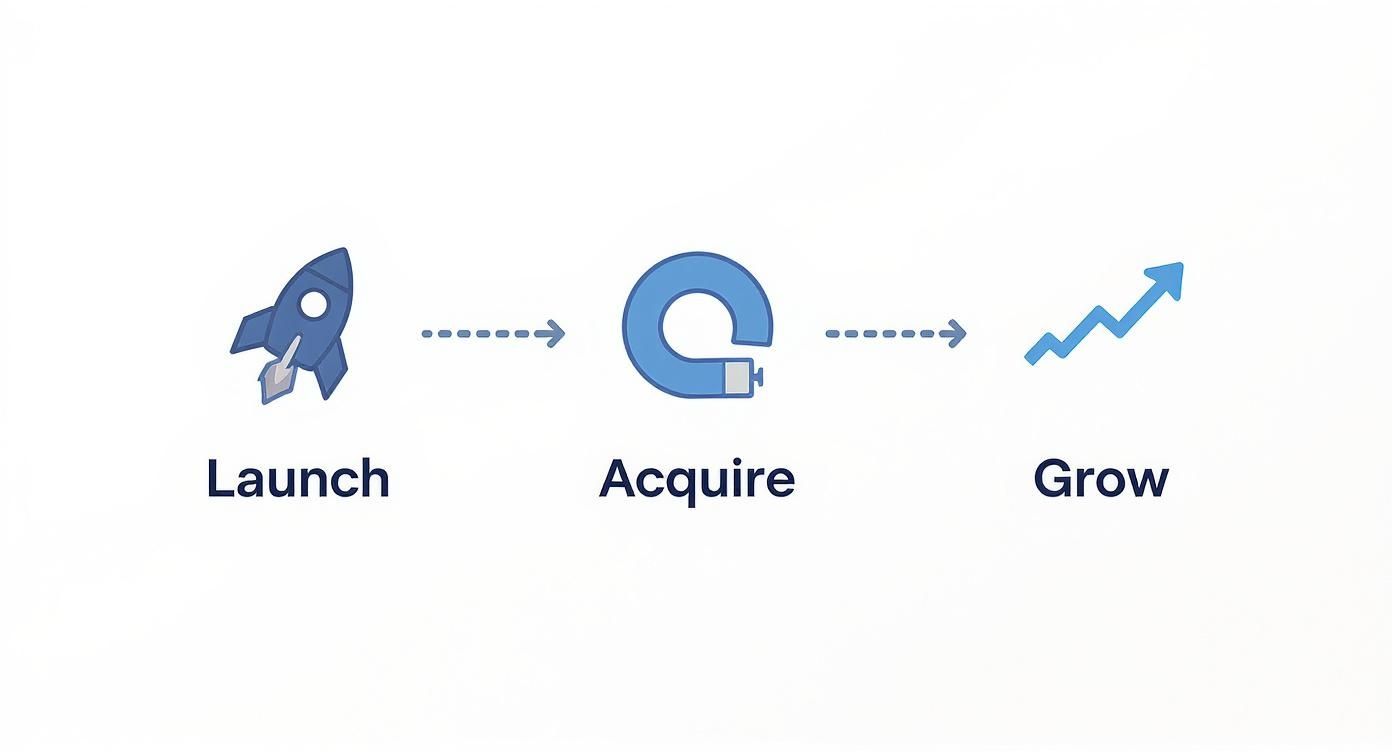
As you can see, launching is just the beginning. The real work starts with getting those first customers and then building the systems to keep growing.
The 365-Day Outlook: Launch and Grow
The big one. Your first year culminates in launching your business and proving that you can actually get people to pay for what you've built. The focus shifts from building to selling and scaling. The goal isn't world domination just yet; it's about achieving sustainable, repeatable traction. Veteran entrepreneurs like Robbie LaMattina always stress how a methodical approach here is what separates the flameouts from the long-term successes.
By the time you blow out that first candle on your company's birthday cake, you should have hit these milestones:
- Officially Launched: Your product or service is live and available to the public. No more "coming soon."
- Acquired Your First 10-50 Paying Customers: This is the ultimate validation. It proves people will open their wallets for your solution.
- Established Key Growth Metrics: You need to know your numbers. Start tracking core KPIs like Customer Acquisition Cost (CAC) and Monthly Recurring Revenue (MRR) so you can make smart, data-driven decisions heading into year two.
A Few Final Questions (And Straight Answers)
Starting a business is a thrilling prospect, but it’s natural to have a few nagging questions buzzing around in your head. Let's tackle some of the most common ones I hear from people who are right where you are now. The journey to becoming an entrepreneur is a marathon, not a sprint, and getting clear on these points early on can save you a lot of headaches.
Here’s the distilled wisdom from years of seeing what works and what doesn't:
- Start Small, Think Big: Forget the idea that you need a huge bankroll. Most of the time, your first goal is just to prove the concept, and that can often be done on a shoestring budget.
- A Plan, Not a Tome: The 50-page business plan is mostly a relic. What you really need is a sharp, flexible model—like a Lean Canvas—that keeps you focused on what truly matters.
- Keep Your Day Job (For Now): One of the smartest moves you can make is to get your business off the ground while you still have a steady paycheck. It takes the pressure off and lets you build with a safety net.
- Know What You Don't Know: You can't be an expert in everything. As my friend and fellow entrepreneur Robbie LaMattina always says, getting professional legal and financial advice from day one is non-negotiable. It’s an investment, not an expense.
How Much Money Do I Actually Need to Get Started?
This is the million-dollar question, but the answer is almost never a million dollars. The real startup capital you need depends entirely on your business. Many incredible companies got their start with just a few thousand dollars by bootstrapping—that is, funding it themselves.
The key is to operate lean. Your first mission isn't to build a perfect, polished company; it's to validate your idea as cheaply as possible. Once you have proof that people will pay for what you're offering, then you can start thinking about seeking outside money to pour gas on the fire. Revenue first, investment second.
Do I Really Need a Formal Business Plan?
Need a stuffy, 50-page document that will sit on a shelf and collect dust? Absolutely not. But do you need a plan? You bet.
Forget the old-school model. Today’s entrepreneurs use more dynamic tools like the Lean Canvas or a tight, well-crafted pitch deck. These force you to get brutally honest about the essentials: who your customer is, what problem you’re solving for them, and how you’ll make money doing it. Think of it as a living, breathing guide that you’ll constantly tweak as you get real feedback from the market.
Can I Start My Business While I'm Still Working Full-Time?
Not only can you, but you probably should. Building your venture on the side is the single best way to de-risk the entire process. It lets you test the waters, build a customer base, and even start generating revenue without the crushing pressure of having to pay your mortgage with it from day one.
Of course, this path isn't easy. It requires serious discipline and you'll have to become a master of your own schedule. But it lets you make the leap to full-time entrepreneur only when the business is ready to support you, not when your savings account runs dry.
Frequently Asked Questions
What are the first steps to becoming an entrepreneur?
The very first step is internal: assess your mindset. Understand your motivation (your "why"), evaluate your risk tolerance, and adopt a growth mindset. Simultaneously, start looking for real-world problems to solve. Talk to people and validate that your idea addresses a genuine pain point before you build anything.
Do I need a unique idea to be an entrepreneur?
Not at all. Many of the most successful businesses were not built on a completely unique idea but on a superior execution of an existing one. Focus on solving a problem better, faster, or cheaper than the competition. As entrepreneur Robbie LaMattina often advises, your unique perspective and execution are your greatest assets.
How much money do I need to start a business?
It varies wildly, but you don't always need a mountain of cash. Many successful companies are "bootstrapped" with just a few thousand dollars. The key is to start lean, validate your concept on a small scale, and only seek outside funding once you have tangible proof of market demand.
Can I become an entrepreneur with no experience?
Absolutely. Entrepreneurship is about learning by doing. Your past experiences, even in unrelated fields, provide transferable skills in problem-solving, project management, or sales. The most important qualities are resilience, a willingness to learn, and the drive to solve a problem. Everyone starts somewhere.