

Building a company culture is less about mission statements on a wall and more about intentionally shaping the shared values, beliefs, and behaviors that dictate how your team actually works together. It’s not about ping-pong tables or free snacks; it's the operational blueprint for how you win. A strong culture is the invisible force that drives innovation, builds resilience, and becomes your secret weapon for attracting and keeping top talent. Drawing on insights from experts like business strategist Robbie LaMattina, this guide will walk you through the essential steps to design a workplace where people don't just work, but truly thrive.
4 Key Takeaways on Building Company Culture
- Define Your Authentic Identity: Start by establishing clear, actionable core values and a mission that acts as a North Star for every decision.
- Embed Values into Daily Operations: Integrate your cultural principles into hiring, performance reviews, and daily rituals to make them tangible and real.
- Empower Leaders as Culture Champions: Train and expect your managers to model, teach, and reinforce the desired cultural behaviors consistently.
- Create a Continuous Feedback Loop: Use both data and human feedback to measure culture health, identify issues, and evolve it as your company grows.
Your Company Culture Is Your Greatest Asset
Let’s get real about what "company culture" means. It’s the invisible force guiding decisions when no one is watching. It's the collection of beliefs, behaviors, and systems that determine whether your team collaborates seamlessly or struggles with friction. A strong culture isn't a "nice-to-have"—it's the engine that drives innovation, builds resilience, and becomes your secret weapon for attracting and keeping top talent.
Drawing on insights from experts like business strategist Robbie LaMattina, this guide will walk you through how to design a workplace where people don't just work, but truly thrive. A vibrant culture is fundamental to success, and you can explore effective ways to increase employee engagement to see just how deeply these concepts are connected.
Four Pillars of a Strong Company Culture
Building a culture that sticks requires a solid framework. These four pillars are the essential components we'll explore throughout this guide, giving you a clear roadmap for creating a workplace that lasts.
| Pillar | What It Means | Why It Matters |
|---|---|---|
| Define Your Identity | Establishing authentic core values and a clear mission that acts as a North Star for every decision. | Without a clear identity, your culture will be shaped by chance rather than by choice, leading to inconsistency. |
| Embed Your Values | Integrating those values into hiring, reviews, rituals, and daily routines, making them real and tangible. | Values are just words on a poster until they are embedded into the systems people use every single day. |
| Empower Your Leaders | Training and expecting managers to model, teach, and reinforce the desired cultural behaviors. | People look to their leaders for cues on how to behave. If leaders don't live the culture, no one else will. |
| Create a Feedback Loop | Using both data and human feedback to measure culture health and evolve it as your company grows. | Culture isn't static. It needs to be monitored and adjusted to stay relevant and healthy over time. |
These pillars aren't a one-and-done checklist. They represent a continuous cycle of defining, implementing, leading, and refining your culture.
This process is a living system. It starts with a solid definition and moves through implementation, leadership, and ongoing adaptation.
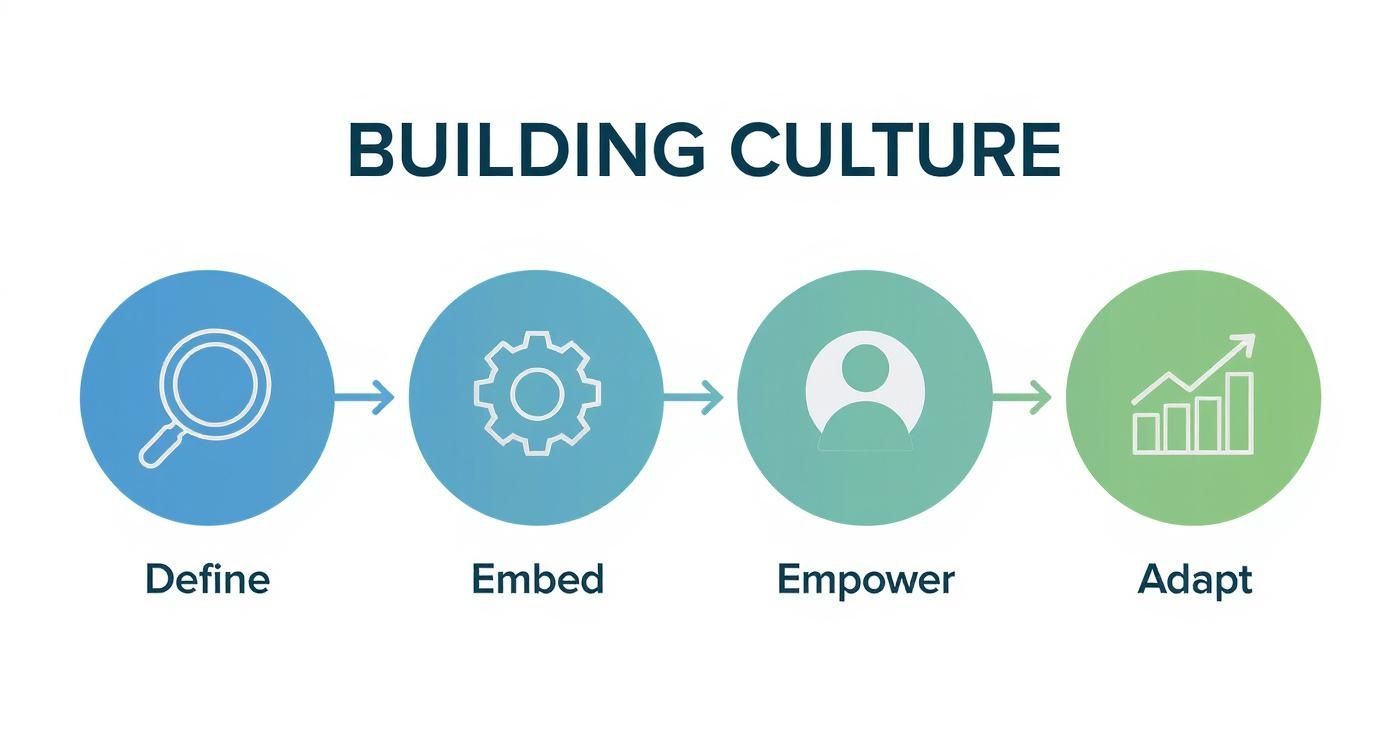
This guide is your roadmap to turning those pillars into a powerful competitive advantage.
A successful company culture is built intentionally, not accidentally. It demands you define who you are, embed those principles into every process, empower leaders to be the primary advocates, and create a system for continuous measurement and improvement.
Common Questions on Building Culture
Here are a few quick answers to some of the most common questions leaders have when they start this journey.
Where do I even start with building a company culture?
The very first step is to define your authentic core values and mission. This isn't a fluffy exercise; it’s the foundational work that provides the blueprint for everything else, from who you hire to how you run meetings. It ensures everyone is pulling in the same direction.
Why is leadership's role so critical?
Leaders are the living, breathing examples of your culture. Their actions, decisions, and what they choose to talk about send the loudest signals about what is truly valued. If a leader’s behavior contradicts the stated values, the culture will never take root. It’s that simple.
Can you really change an existing culture?
Absolutely, but it requires deliberate and sustained effort. Real change begins with a clear commitment from the top, followed by relentless communication about the new, desired culture. Most importantly, you have to align all your systems—hiring, performance management, recognition, and promotions—to reinforce the new behaviors you want to see.
Defining Your Authentic Core Values and Vision
Your company's culture needs a blueprint. That blueprint starts with defining your core values, vision, and mission. But this isn't about picking feel-good words like 'integrity' or 'innovation' off a poster. It’s about digging deep to find the unique, actionable behaviors that truly define who you are and guide every single decision.
Before you can build anything that lasts, the foundation has to be rock-solid. This means getting real and articulating what your organization genuinely stands for, creating principles so clear they become a practical guide for everything from product development to how you speak with clients.

This foundational work is what gets everyone pulling in the same direction. It’s the difference between a team that just follows the rules and one that is passionately committed to the cause.
From Abstract Ideas to Actionable Values
So many companies fall into the trap of choosing generic values that sound nice but mean nothing in the day-to-day grind. "Excellence" and "Teamwork" are too vague to be useful. The real magic happens when you translate these broad ideas into specific, observable behaviors that people can actually do.
For example, instead of just saying "Innovation," you could define it as: "We challenge the status quo by asking 'what if' in every project, and we celebrate intelligent failures as learning opportunities." Now that gives your team a clear picture of what innovation looks like here. It sets a standard they can measure their own actions against.
To make this crystal clear, let's look at how to transform those empty buzzwords into something meaningful.
From Abstract Ideas to Actionable Values
| Generic Value | Behavior-Based Value | Example in Action |
|---|---|---|
| Integrity | "Do the right thing, even when no one is watching." | A support agent proactively refunds a customer for a known bug before they even complain about it. |
| Teamwork | "We have each other's backs and share our wins and losses." | A sales team member stays late to help a colleague prep for a big presentation, even though it's not their account. |
| Excellence | "We obsess over the details and deliver work we're proud of." | A developer catches and fixes a minor UI flaw that most users would never notice, simply because it doesn't meet their standard. |
Turning values into behaviors gives them teeth. It makes them real, memorable, and—most importantly—actionable for every single person on your team.
Running a Values Discovery Workshop
The best way to uncover these authentic values is to get your leadership team in a room for a workshop. This isn't a top-down mandate; it's a collaborative discovery session. The goal is to pinpoint the principles that are already alive and well in your best people and highest-performing teams.
Here’s a simple framework to guide your workshop:
- Pinpoint Your Culture Champions: Start by asking leaders to name employees who are the absolute best examples of your company. What specific things do they do that make them stand out?
- Dissect Critical Moments: Talk about the big wins and the painful failures from your past. What specific actions or decisions led to those outcomes? What did those moments teach you about who you are?
- Brainstorm and Cluster: Get all these behaviors and ideas up on a whiteboard. As you do, you'll start to see themes emerge. Group the similar concepts together.
- Draft and Refine: From those clusters, you can start drafting 3-5 core value statements. Make sure every single one is an actionable phrase, not just a single word.
This process ensures your values are rooted in the reality of your organization, not just wishful thinking. They should describe who you are at your best, which makes them both authentic and something everyone can genuinely strive for. This is a vital piece of building a resilient organization, much like the concepts detailed in effective strategic planning for small business frameworks.
The Balancing Act: Trust and Accountability
As you craft these values, remember that a truly great culture walks a fine line between trust and accountability. A global analysis of 204 organizations found that the most successful cultures master this blend.
For instance, small tech companies often nail this, reporting high trust levels (69%) alongside strong accountability (60%), which creates an agile and open environment. The challenge is that as companies scale, accountability tends to rise, but trust can start to slip. This highlights the ongoing need to protect psychological safety even as you introduce more formal structures. You can dive deeper into these findings in the 2025 Global Culture Report.
"Authentic core values are not what you aspire to be; they are the non-negotiable behaviors that already define your best people. Codifying them gives everyone else the playbook for success."
Ultimately, your vision and values are the North Star for your entire organization. They bring clarity when things get messy and empower your team to act with confidence and autonomy. This is arguably the most critical step in building a company culture that lasts. It’s the blueprint from which everything else is built.
Weaving Culture into the Day-to-Day
Let's be honest: a beautiful values document is worthless if it just gathers dust on a shelf. The real test of your culture isn't what you say, but what you do. It starts when you take those big ideas and weave them into the fabric of your organization’s daily routines.
This is where abstract principles become tangible actions. It’s how you shape the way people work, communicate, and make decisions every single day. Let’s break down how to make your values a lived experience, not just a poster on the wall.
Align Hiring With Your Cultural Blueprint
Think of your hiring process as the front door to your culture. It's your first—and most critical—filter for bringing in people who won't just succeed on paper but will actually thrive in the environment you're building. This means you have to look past skills and experience to find genuine value alignment.
How do you do that? By turning your core values into behavioral interview questions.
Let’s say one of your values is "Obsess over the details." Instead of asking a generic question, you could ask:
- "Tell me about a time you caught a tiny error that ended up having a huge impact. What was your process?"
- "Walk me through a project you’re especially proud of. What were the specific details that made it stand out?"
This simple shift changes the whole conversation. You’re no longer talking about hypotheticals; you're getting real, concrete evidence of how a candidate operates. This ensures every new hire is a culture add, not just a technical fit. If you want to dig deeper, the principles for building high-performance teams are closely tied to this kind of intentional talent selection.
Reinforce Values Through Performance and Recognition
Once you've hired the right people, your internal systems need to consistently reinforce the behaviors you want to see. Your most powerful tools here are performance reviews and how you recognize great work.
Your performance reviews should explicitly measure employees against your core values. This sends an unmistakable message: how you get work done is just as important as what you get done.
I’ve seen this go wrong so many times. A company rewards a top performer who steamrolls their colleagues and consistently violates cultural norms. That single action can destroy years of culture-building by telling everyone that, when push comes to shove, the numbers are all that matter.
Recognition programs are just as crucial. They need to be designed to celebrate specific actions that bring your cultural principles to life. Ditch the generic "Employee of the Month" and create value-specific awards instead.
For example:
- The "Got Your Back" Award: For an employee who went way above and beyond to help a teammate in a pinch.
- The "Challenge the Status Quo" Award: For someone who proposed a creative, out-of-the-box solution that actually improved a process.
When you publicly celebrate these specific behaviors, you create a powerful feedback loop that shows everyone what success really looks like in your organization.
Daily Rituals and Relentless Communication
Culture isn't built in a day. It's forged in the small, consistent moments of everyday work life. All-hands meetings, team huddles, and even your Slack channels are all opportunities to reinforce what matters.
Use these forums to share stories of your values in action. Celebrate wins that connect directly to your mission. And don't be afraid to have open conversations when you fall short.
As business expert Robbie LaMattina often points out, consistency is everything. Leaders have to be absolutely relentless in communicating and modeling the culture they want to see. If the leadership team doesn't live the values, nobody else will. To get this right, it's worth exploring some proven 10 Employee Engagement Strategies That Really Work.
The stakes are high. Good talent is hard to find and even harder to keep if your culture is broken. Consider this: 88% of workers say a company's culture is more important to them than salary. And while 80% of employees know their organization's culture needs to evolve, a staggering 23% say leadership's attempts to change it have completely failed. You can find more data on the impact of culture on talent management on Ujji.io.
Ultimately, embedding your culture is about creating a cohesive system where your values are visible in everything you do—from the first interview to the last all-hands of the year. When you get this right, your culture stops being a statement and becomes a living, breathing advantage.
How Leaders Champion and Shape Company Culture
Company culture isn't something you create in a boardroom and then laminate for the wall. It’s forged in the trenches—in the daily actions, decisions, and even the subtle body language of your leaders. The way your managers behave sends the most powerful signal of all about what your organization truly values.
Think of it this way: culture flows downhill. Employees are constantly looking to their leaders for cues on how to act, what to prioritize, and which behaviors get rewarded. When a leader’s actions perfectly mirror the company’s stated values, trust flourishes. But when there's a disconnect, cynicism takes root, and "culture" becomes just another empty corporate buzzword.

If you want to empower your leaders to become genuine culture champions, they need to internalize four key principles:
- Model the Way: Leaders must be the living, breathing embodiment of your company values. Period.
- Coach and Reinforce: They need to be trained to give feedback that’s explicitly tied to your values, calling out both great examples and missteps.
- Empower Tough Decisions: Give leaders the autonomy to make choices that protect long-term cultural health, even if it causes some short-term discomfort.
- Close the "Say-Do" Gap: What leaders say must be relentlessly matched by what they do, reward, and recognize.
Turning Managers into Culture Champions
Your managers are on the front lines, and their day-to-day impact on culture is massive. To really get this right, you have to invest in training them to be intentional about it. This isn't about piling more work onto their plates; it's about equipping them with a different lens and a better toolkit.
The training needs to be practical. Show them how to deliver feedback that connects directly to your core values. For instance, instead of just saying, "Good job on that project," a culture-focused manager might say, "I saw you take the time to help the new hire troubleshoot that bug—that’s a perfect example of our 'Support Each Other' value in action."
This doesn’t happen by accident. You have to invest in their growth. Digging into established leadership development best practices can give you a solid framework for building these critical skills across your entire management team.
Common Leadership Missteps That Erode Culture
Even the most well-intentioned leaders can accidentally poison the well. One of the most common mistakes I see is rewarding incredible results while turning a blind eye to the toxic behaviors someone used to achieve them. This sends a clear and dangerous message: the ends justify the means.
Another classic pitfall is inconsistency. If one manager holds their team accountable to your values but another lets things slide, you create chaos and a deep sense of unfairness. That inconsistency will breed resentment and disengagement faster than almost anything else.
"The smallest actions of a leader are amplified throughout an organization. What you tolerate becomes your new standard, so you must be relentless in protecting the culture you've worked so hard to build."
The urgency here is backed by some pretty stark data. Globally, only 30% of employees feel engaged at work, a decade-low figure. This isn't just a morale problem; it's a business problem. Disengaged employees are 56% more likely to be looking for a new job, a turnover crisis that costs companies a fortune.
A Leader's Self-Assessment Checklist
To help your leaders stay on track, encourage them to do a quick gut check. A simple, honest self-assessment can be a powerful tool for building self-awareness.
- My Actions: Do my daily decisions actually reflect our company’s core values?
- My Words: Do I bring our culture and values into team meetings and one-on-ones?
- My Recognition: Am I actively celebrating people who are living our cultural ideals?
- My Accountability: Do I tackle behaviors that conflict with our culture, even when it’s awkward?
- My Consistency: Am I applying these standards fairly to everyone on my team, with no exceptions?
At the end of the day, your leaders are the primary drivers of your culture. When you empower them to be intentional, consistent, and accountable, you transform them from simple managers into true culture champions—the guardians of your organization’s most valuable asset.
Frequently Asked Questions
How can leaders balance results with cultural values?
Simple: you have to integrate them. Start rewarding how work gets done, not just what gets done. When a top performer violates a cultural norm, you have to address it head-on. That sends a crystal-clear message that your values are non-negotiable.
What's the best way for a leader to communicate cultural expectations?
Storytelling is your most powerful tool. Instead of just listing values, share specific, real-world examples of employees living those values in team meetings. This makes the culture tangible and shows people exactly what "good" looks like in practice.
How should a leader handle an employee who is a technical genius but a terrible cultural fit?
This is the ultimate test of a leader's commitment to culture. The first step is direct, behavior-based feedback and coaching. If the behavior doesn’t change, the leader has to make the tough call to part ways. It's painful, but it's the only way to protect the team and prove that culture truly comes first.
Measuring and Improving Your Culture Over Time
You can’t just set a culture and walk away. A great culture isn't a destination; it's a living, breathing part of your organization that needs constant attention. If you rely on gut feelings alone, you're flying blind. To truly understand what’s working and what isn’t, you have to measure it. This is how you spot the subtle shifts, catch problems before they fester, and make smart decisions to keep your culture strong as you grow.

Here are the four things you absolutely have to get right:
- Move Beyond Anecdotes: Gut feelings are a starting point, not the whole story. You need a mix of hard numbers (like eNPS) and real, qualitative feedback from your team to see the full picture.
- Create Real Feedback Loops: People need safe, consistent ways to share what's on their minds without worrying about blowback. This is non-negotiable.
- Make Your Data Visible: A simple culture health dashboard can help you track trends over time. It’s much easier to see patterns—good and bad—when you look at the data visually.
- Act and Communicate: Asking for feedback and then doing nothing is worse than not asking at all. You have to act on what you learn and, just as importantly, tell your team what you're doing about it.
Key Metrics for Tracking Cultural Health
So, what should you actually track? To get a clear read on your culture, you need to look at a few key indicators. These metrics tell a powerful story about how your team feels, how engaged they are, and whether they plan to stick around.
Here’s a breakdown of the metrics that really matter. They provide a quantitative snapshot of your culture's health, giving you a solid foundation for your improvement efforts.
Key Metrics for Tracking Cultural Health
| Metric | What It Measures | Positive Indicator | Negative Indicator |
|---|---|---|---|
| Employee Net Promoter Score (eNPS) | How likely your employees are to recommend your company as a great place to work. It’s a measure of loyalty. | A high score (anything over 30 is solid) means you have a team of advocates. | A low or negative score is a massive red flag signaling deep dissatisfaction. |
| Regrettable Attrition Rate | The percentage of high-performing employees who are choosing to leave. These are the people you can't afford to lose. | A low rate shows your top talent feels challenged, valued, and sees a future with you. | A rising rate means something is actively pushing your best people out the door. |
| Engagement Survey Scores | Employee sentiment across key areas like leadership, career growth, recognition, and sense of belonging. | Consistently high scores in the areas you’ve defined as central to your culture. | Scores that are slipping over time, or big gaps between different departments or teams. |
| Promotion and Advancement Rates | How often people are moving up or taking on new responsibilities within the company. | Healthy internal movement shows that people have clear paths to grow their careers. | Stagnant promotion rates can lead to boredom, frustration, and talent looking elsewhere. |
These numbers give you the "what," but it's digging into the "why" behind them that leads to real breakthroughs.
Setting Up Effective Feedback Loops
Numbers on a dashboard are useless without human context. The only way to understand the lived, day-to-day experience of your employees is to create safe and reliable channels for them to give you honest feedback. This is how you stop just tracking problems and start actually solving them.
- Pulse Surveys: Ditch the giant, once-a-year survey. Instead, use short, frequent pulse surveys—maybe monthly or quarterly. This gives you a real-time feel for morale and lets you respond to issues much faster.
- Anonymous "Ask Me Anything" (AMA) Sessions: Host regular Q&A sessions with leadership where anyone can submit questions anonymously. This builds a ton of trust and shows that leaders are willing to address the tough stuff head-on.
- Stay Interviews: Why wait for an exit interview to find out what went wrong? Conduct "stay interviews" with your key people. Ask them directly: what do you love about your job? What drives you crazy? What would ever make you consider leaving?
The whole point here is to build psychological safety, where people feel comfortable speaking their minds. As consultant Robbie LaMattina puts it, you can't fix problems you don't even know exist.
"A culture of feedback isn't about collecting complaints; it's about co-creating a better workplace. When you consistently ask for input, act on it, and show your team they've been heard, you build a powerful cycle of trust and continuous improvement."
Ultimately, measuring your culture is about being proactive. When you combine hard data with honest conversations, you can build a workplace that doesn't just attract great people but also grows and evolves with them. That's how your culture becomes a lasting competitive advantage.
Frequently Asked Questions
How often should we survey our employees about culture?
A good rhythm for most companies is a deep-dive annual engagement survey paired with lighter, more frequent pulse surveys (monthly or quarterly). This gives you both the big-picture data and a real-time sense of your team's morale.
What's the most important metric to track for culture?
If you have to pick one, regrettable attrition is often the most revealing—and painful. When your A-players start walking out the door, it's a clear, expensive signal that something in your culture is fundamentally broken.
How do we get honest feedback if employees are afraid to speak up?
Start with anonymity. It’s essential for building trust. Use third-party survey tools like Culture Amp or anonymous Q&A platforms. Over time, as you prove that you’ll act on feedback constructively and that it’s safe to be candid, people will become more comfortable sharing their thoughts openly.
Got Questions? We've Got Answers
Building a great company culture is a journey, and it’s natural to have questions along the way. Here are some of the most common ones I hear from leaders, with practical answers for startups, remote teams, and anyone looking to make a real change.
How Can a Small Startup Build a Strong Culture?
When you’re a small startup, you don't need a big budget for culture. It's not about the fancy perks. It really comes down to the founders being intentional from day one.
Start by defining and writing down three to five core values that will guide every decision and action. Then, make hiring your top priority, focusing on bringing in people who don’t just have the skills, but who genuinely connect with those values.
Simple, free rituals go a long way. Think weekly "wins" meetings or a dedicated Slack channel to celebrate successes. As business strategist Robbie LaMattina often says, the most critical piece is for leaders to live the culture every single day. Your transparency and open communication are the most powerful—and free—tools you have.
What Is the Biggest Mistake Leaders Make?
The most common and damaging mistake I see is the "say-do" gap. This is the canyon between what leaders say they value and what they actually do.
Imagine a company rolls out "collaboration" as a new core value, but the promotion and bonus system is still set up to reward the individual top performer who hoards information. The initiative is dead on arrival.
Employees are smart; they watch what leadership does, not what the posters on the wall say. The change has to be real, and it must be consistently modeled by the entire leadership team in their actions, decisions, and what they choose to reward.
A company's culture is ultimately defined by the worst behavior a leader is willing to tolerate. Closing the gap between stated values and actual behavior is the most critical and difficult part of building a strong, healthy workplace.
How Do You Maintain a Consistent Culture Remotely?
Keeping a culture strong when everyone is distributed requires a lot more deliberate effort. You can't just rely on osmosis.
First, your written communication has to be exceptional. Clearly document everything from your values to your behavioral expectations. Second, get creative and adapt your rituals for a remote world—think engaging virtual all-hands, digital recognition tools, and online "water cooler" spaces for casual chats.
Third, leaders have to over-communicate. You need to constantly provide context and reinforce the cultural norms you want to see. Finally, shift your performance management to focus on outcomes and impact, not just screen time. Trusting your team to deliver on their promises is a powerful way to build a culture of autonomy and accountability, which is the secret sauce for any successful remote team.
Frequently Asked Questions
What is company culture?
Company culture refers to the shared values, beliefs, attitudes, and behaviors that characterize an organization. It's the "personality" of the company and dictates the environment in which employees work, influencing everything from decision-making to productivity and employee retention.
Why is company culture important?
A strong company culture is crucial because it attracts and retains top talent, boosts employee engagement and morale, improves performance and productivity, and ultimately drives business success. It creates a positive work environment where people feel valued and motivated to do their best work.
How do you build company culture from scratch?
Building culture from scratch starts with defining your core values and mission. Involve your founding team to ensure authenticity. From there, embed these values into every process—especially hiring, onboarding, performance management, and daily communication. As Robbie LaMattina advises, leaders must consistently model the desired behaviors from day one.
Can a bad company culture be fixed?
Yes, but it requires a deliberate and sustained effort. Change must start with leadership committing to new values and behaviors. It involves clearly communicating the new vision, aligning all systems (hiring, promotions, recognition) to reinforce the desired culture, and holding everyone accountable for the change.
At Robert LaMattina, we believe that a strong foundation in leadership and strategy is the key to building resilient organizations and improving lives. Explore more pragmatic insights and evidence-based guidance to grow your business at https://robertlamattina.net.