

Introduction
Learning how to create a value proposition boils down to answering one fundamental question: "Why should a customer pick you over the competition?" It’s the core promise you make to your customers—the clear, measurable benefit they get from doing business with you. This guide, drawing on insights from entrepreneurs like Robbie LaMattina, will walk you through a practical framework for building one that genuinely connects.
4 Key Takeaways on How to Create a Value Proposition
- Start with the Customer's Problem: The most effective value propositions are discovered, not invented. They come from deeply understanding your customer's "job to be done" and their specific pain points, not from listing your product's features.
- Clarity Over Cleverness: Your message must be understood in seconds. Avoid jargon and buzzwords. Use the same language your customers use to describe their problems and desired outcomes. A clear promise is more powerful than a clever slogan.
- Differentiate with Tangible Outcomes: Vague promises like "high-quality" are meaningless. Differentiate by focusing on specific, measurable results. How much time will they save? By what percentage will their revenue increase? Concrete benefits are believable.
- Test and Refine Relentlessly: Your value proposition is a hypothesis, not a final statement. Use A/B tests, ad campaigns, and direct customer feedback to validate and sharpen your message continuously. The market evolves, and your promise must evolve with it.
Why Your Value Proposition Is Your Most Critical Asset

A value proposition isn't just a catchy slogan or a fluffy mission statement. It’s the cornerstone of your entire business strategy. Think of it as your North Star, guiding everything from product development to your marketing messages. It's the essential bridge between what you're selling and what your customer desperately needs.
Look at entrepreneur Robbie LaMattina, who built successful businesses in the notoriously complex healthcare industry. His success didn't come from just offering services. It came from defining a clear promise—like delivering compassionate, evidence-based recovery—that spoke directly to the deepest needs of patients and their families.
The Strategic Importance of Clarity
A sharp, well-defined value proposition brings incredible clarity to your entire organization. It helps align your team on a single mission and simplifies your messaging for the market.
When your promise is crystal clear, something powerful happens: you start attracting the right customers and, just as importantly, repelling the wrong ones. That kind of focus is absolutely essential for long-term, sustainable growth.
Before we jump into building your own, it's worth getting the fundamentals down. For a great overview, check out a clear guide to creating a value proposition that really works.
A great value proposition may highlight what makes you different from competitors, but it should always focus on how customers define your value. It’s the connection between your operations and the demand side of your business.
At the end of the day, your value proposition isn't about what you sell. It’s about the transformation you deliver. It answers your ideal client's unspoken question, "What's in it for me?" with an answer that is compelling, believable, and unique. Let’s get you the tools to craft that response.
Four Foundational Principles for Your Value Proposition
Before we get into the nitty-gritty frameworks, let’s lay down the four non-negotiables. Whether you’re like Robbie LaMattina, scaling a national healthcare solution, or a founder just starting out, these principles are the bedrock of a message that actually works.
Think of this as the core strategy. If you nail these four points, you're already miles ahead of the competition.
Start with the Customer, Not the Product
The best value propositions aren't dreamed up in a conference room; they're discovered out in the wild. They come from truly getting inside your customer's head and understanding their world—what keeps them up at night, what they're trying to achieve, and the real frustrations they face.
Forget about your features for a minute. Your starting point is always the customer's problem. This means you have to stop guessing and start listening. Don't ask, "What features do you want?" Instead, try, "Tell me about the last time you struggled with [the problem you solve]." This is how you uncover the real “job” they need to get done.
Your value proposition is the bridge between what your company offers and what your customer truly needs. It's a mantra that unites the two halves of the whole business.
Differentiate with Real-World Results
Vague promises like "high-quality" or "innovative" are just noise. They mean nothing to a potential customer. You have to get specific and talk about the tangible outcomes they can actually expect.
How much time will they really save? Can you put a number on it? By what percentage could they boost their revenue? What specific, nagging pain point will you make disappear for good? Focusing on concrete results is what makes your promise believable and sets you apart from everyone else making generic claims.
Be Clear, Not Clever
Clarity trumps cleverness every single time. If someone can't understand what you do and why it matters within five seconds, you've already lost them. A confusing value proposition is a useless one.
Ditch the corporate jargon and buzzwords. Your goal is to speak the same language as your customers. Use the words they use to describe their problems and their ideal solutions. Simplicity is what creates that instant connection and makes people say, "Ah, I get it."
Test and Tweak, Relentlessly
Crafting your value proposition isn't a one-and-done task. It's a living, breathing hypothesis that you have to constantly test and refine with real-world feedback.
Treat it like a core part of your business strategy, because it is. Keep gathering data, pay close attention to what your customers are saying, and watch how the market shifts. The willingness to adapt your message is what will keep it sharp, relevant, and powerful over the long haul.
Before you write a single word of your value proposition, you have to do the groundwork. It's tempting to jump straight to brainstorming clever taglines, but a powerful message is built on evidence, not just creative flair.
Too many companies fall into the trap of building something nobody actually wants. They create a "solution" for a problem that doesn't really exist, and that's a fatal error. This initial discovery phase is your insurance policy against that exact mistake.
It's where you stop guessing and start listening. And I don't mean running focus groups to ask people what features they want. It’s about digging much deeper to understand the fundamental “job” they are trying to get done. The best insights are almost always hidden in your customers' daily struggles and aspirations.
Embrace the "Jobs to Be Done" Mindset
The Jobs to be Done (JTBD) framework will completely shift your perspective. Instead of seeing customers as people who buy your product, you start seeing them as individuals trying to make progress. They "hire" products or services to help them accomplish a specific job.
Think about it this way: someone doesn't buy a drill because they want a drill. They buy a drill because they want a hole in the wall. The hole is the job. This distinction changes everything. It forces you to look beyond your product's features and focus on the customer’s ultimate goal.
To put this into practice, you have to start asking better questions. Forget generic queries and get specific about the context and motivation driving your customers.
- Instead of asking: "What features would you like to see?"
- You should ask: "Tell me about the last time you struggled with [the problem your product solves]. What was that experience like?"
This approach gets you past the surface-level wants and uncovers the real functional, social, and emotional dimensions of their needs. This is the raw material you need to craft a message that connects on a much deeper level.
A Lesson from a High-Stakes Environment
In a complex field like behavioral health, understanding these nuanced struggles isn't just a marketing tactic—it's absolutely essential. I've seen this play out firsthand. Entrepreneur Robbie LaMattina, for example, successfully scaled his ventures by first getting an incredibly deep understanding of the intricate jobs his patients were trying to accomplish.
Their "job" wasn't simply to "get sober." It was to rebuild trust with their family, regain a sense of self-worth, and find a stable path forward.
By focusing on these deeper needs, his organizations were able to design programs and craft a value proposition that addressed the whole person, not just a clinical diagnosis. This is a critical lesson: if you want your message to resonate, you have to understand the complete context of your customer's life and the progress they're trying to make.
"A great value proposition may highlight what makes you different from competitors, but it should always focus on how customers define your value. It’s the connection between your operations and the demand side of your business."
That's the key. Value is defined by your customer’s successful outcome, not by your list of services. This discovery phase is all about figuring out what that successful outcome truly looks like from their point of view.
How to Run Insightful Customer Interviews
Gathering these insights requires a specific way of talking to your customers. Your goal is to get them telling stories, not just giving one-word answers.
Here are a few practical techniques that have always worked for me:
- Focus on past behavior, not future guesses. Don't ask hypotheticals like, "Would you use a product that…?" People are terrible at predicting their own behavior. Instead, ask about real experiences: "Walk me through how you currently handle…"
- Listen for "hacks" and workarounds. When you hear about someone using a jumble of spreadsheets, sticky notes, or multiple tools to solve one problem, you've struck gold. Those hacks are glaring signals of an unmet need—a job that isn't being served well.
- Always dig into the "why." When a customer mentions a frustration, don't just nod and move on. Follow up with questions like, "What made that so frustrating?" or "And what did you do next?" to get to the root of the problem.
Systematically gathering this kind of qualitative data is foundational. To really master this, you should learn more about the role of customer feedback in shaping business development and innovation. This isn't a one-time task; it's an ongoing process that keeps your business perfectly aligned with the people you serve.
Turning Customer Insight Into a Powerful Message
You’ve done the hard work of customer discovery. You’ve sat down with real people, listened to their problems, and now you have a pile of raw, authentic insights. This is where the magic happens. Now it's time to sift through that gold and forge it into a message that hits home.
This isn't about listing features or talking about your company's history. It’s about translating what your product does into what your customer can finally achieve.
From Raw Data to a Resonant Message
After digging deep into customer needs, you need a way to organize your thoughts and build a message that actually works. I've found it boils down to four critical steps.
- Lean on Proven Frameworks: Don't try to reinvent the wheel. Frameworks like the Value Proposition Canvas are designed to connect the dots between customer pains and your solution's benefits. It gives you a roadmap so you don't get lost.
- Zero in on What Makes You Different: In a sea of look-alike solutions, "better" is a losing game. You have to be different. What makes your offer the only logical choice for a specific type of customer? Your message has to scream this from the rooftops.
- Translate Features into Life-Changing Outcomes: People don't buy drills; they buy holes in the wall. It’s an old saying, but it’s true. They don’t buy your software’s features; they buy a promotion, a less stressful workday, or the feeling of being in control.
- Connect on Both a Logical and Emotional Level: A great value proposition makes a solid business case, but it also has to connect with the human on the other side. You need to back up your claims with evidence while tapping into the core emotions that actually drive their decisions.
This is the essence of taking research and turning it into something that can truly move the needle for your business.
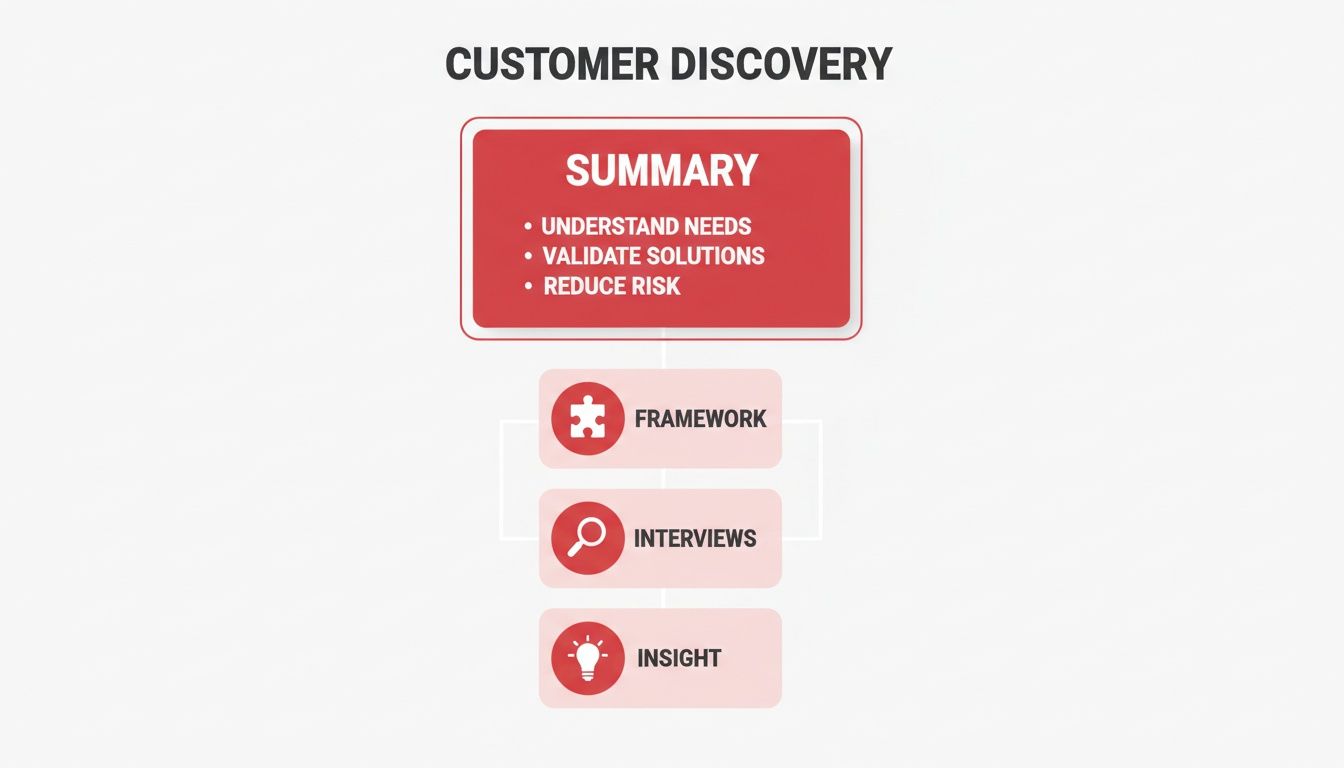
As the flowchart shows, true insight—the kind that builds powerful messaging—comes from combining a solid framework with direct, unfiltered customer interviews.
Choosing the Right Value Proposition Framework
You don't have to start from scratch. Several tried-and-true frameworks can provide the structure you need to organize your customer insights and build a compelling message. Each has its own strengths, so choosing the right one depends on your specific context—whether you're a startup finding your footing or an established company refining your message.
Value Proposition Framework Comparison
| Framework Name | Structure/Template | Best For | Example Application |
|---|---|---|---|
| Value Proposition Canvas | Maps customer jobs, pains, and gains against your product's pain relievers and gain creators. | Startups and new product teams validating an idea. | A SaaS company using the canvas to ensure its new feature directly solves a pain point uncovered in customer interviews. |
| Geoff Moore's Template | "For [target customer] who [statement of need], the [product name] is a [product category] that [statement of key benefit]." | Tech companies and B2B products that need to clarify their position in a competitive market. | A new project management tool defining its niche for remote-first software development teams. |
| Steve Blank's XYZ | "We help [X] do [Y] by doing [Z]." | Early-stage ventures that need a simple, clear, and easy-to-communicate statement. | A fintech app stating, "We help freelancers manage their finances by automating invoicing and tax withholding." |
| Vlaskovits & Cooper's CPS | Customer-Problem-Solution format. | Anyone looking for a straightforward, customer-centric way to frame their value. | A local delivery service focusing on "For busy families (Customer) who struggle to cook healthy meals (Problem), we provide pre-planned ingredient kits (Solution)." |
Using a framework like one of these isn't just an academic exercise. It’s a practical tool that forces you to put the customer at the center of your messaging, which is essential for achieving product-market fit, a foundational concept for sustainable growth. It stops you from talking about yourself and ensures every word you write is focused on what they care about.
Go Beyond Benefits: Sell the Transformation
Here’s where most companies drop the ball. They get good at listing features and maybe even translating them into benefits, but they stop there. To create a truly magnetic message, you have to sell the outcome.
Think of it as climbing a ladder:
- The Feature: This is what your product has or does. "Our CRM integrates directly with your email."
- The Benefit: This is what the user gets from the feature. "You can track all customer conversations without leaving your inbox."
- The Outcome: This is who the customer becomes. "You become the most organized, well-informed person on your sales team, closing deals faster and never letting a lead slip through the cracks."
See the difference? The outcome is aspirational. It connects your product to a better version of your customer. That’s what people are really buying.
A value proposition should be a clear statement about the outcomes that an individual or an organization can realize from using your product, service, or solution.
Nail Your Unique Differentiator
With your core message solidifying, it's time to sharpen the point. What is the one thing you do better than anyone else that your ideal customer desperately needs?
This isn't about claiming to be the best at everything. It’s about owning a specific, valuable corner of the market. Your unique edge could be your technology, your pricing model, your white-glove customer service, or even the community you build around your brand.
To find it, wrestle with these questions:
- What unique skill or asset do we have that our competitors can't easily copy?
- Which customer problem do we solve so much better that it makes the competition irrelevant?
- If we vanished tomorrow, what specific thing would our customers be heartbroken to lose?
The answer is the core of your differentiation. It’s the reason someone should choose you and never look back.
A Real-World Example in a Complex Market
Let’s get specific. In a tough market like healthcare, a vague value proposition is a death sentence. For instance, Robbie LaMattina has been working with behavioral health administrators and real estate professionals since 2019, a period of massive turbulence.
With hospital margins at risk of dropping 1-2% and healthcare costs being the #1 concern for 53% of employers, a generic promise like "we improve patient care" just won't cut it. Instead, a targeted proposition like "compassionate, cost-effective detox scaling nationwide" speaks directly to the urgent financial and operational pains of these stakeholders.
As U.S. healthcare spending races toward $7.7 trillion by 2032, smaller providers are being squeezed into partnerships. A clear, evidence-based model that supports co-occurring disorders becomes a powerful differentiator, especially when 7 out of 10 consumers simply can't afford higher costs. LaMattina’s proposition of holistic recovery that fosters community wellness promises "sustainable outcomes at a lower total cost"—a message that has proven to win in major markets. To understand more about these financial pressures, you can explore the U.S. healthcare forecast on LEK.com.
Testing and Refining Your Message for Maximum Impact

You’ve put in the work and crafted what feels like the perfect value proposition. That’s a huge step. But here’s something I’ve learned over the years: your first draft is just a hypothesis. It’s a well-educated guess, and now it’s time to see if it holds up in the real world.
Think of yourself as shifting from a strategist to a scientist. Your goal is to validate your assumptions with actual data, not just gut feelings. This is what separates a message that just sounds good from one that actually drives conversions and grows the business.
Without this data-driven approach, you’re basically marketing with a blindfold on.
Practical Methods for Validating Your Message
Validating your message doesn't need to be some massive, expensive undertaking. It’s all about getting direct feedback from the only people whose opinions truly matter—your potential customers. You just need to see how they react to the promise you’re making.
Here are a few straightforward methods I've used time and again:
- A/B Test Your Landing Page Headlines: This is one of the quickest ways to get a clear winner. Set up two versions of your landing page where the only thing you change is the headline, each reflecting a different angle of your value proposition. Then, drive some traffic to both and watch which one gets a better conversion rate.
- Run Small-Scale Ad Campaigns: Fire up some targeted ads on platforms like Google or LinkedIn using different ad copy for each. Let each ad highlight a unique benefit from your value proposition. The click-through rate (CTR) is a fantastic early indicator of what’s catching people’s attention.
- Talk to Your Customers (Again): Seriously, just go back to the source. Show them your proposed value proposition and ask simple, open-ended questions. "What does this mean to you?" or "Does this make you want to learn more?" The words they use and their gut reactions are pure gold.
Before you even start spending money on tests, a good value proposition checker can be a great sanity check to make sure your message is clear and compelling from the get-go.
Interpreting the Data to Sharpen Your Promise
Once the results start trickling in, you need to know how to read the tea leaves. Raw numbers don't tell you the full story until you connect them to the effectiveness of your message.
A value proposition isn't set in stone. It's a dynamic promise that should be constantly tested against market feedback and refined to maintain its edge. Your willingness to adapt is your greatest advantage.
Keep a close eye on these key metrics for patterns:
- Conversion Rate: This is the bottom line. Are people actually signing up, buying, or booking a demo after seeing your message?
- Bounce Rate: If a huge chunk of visitors hits your page and leaves right away, that's a blaring alarm bell. Your message either isn't connecting or it set the wrong expectation.
- Click-Through Rate (CTR): For ads and emails, this tells you how compelling your hook is. A low CTR means your initial promise isn't strong enough to make people stop scrolling.
- Qualitative Feedback: Never underestimate the power of actual words. Comments, survey answers, and interview notes give you the "why" behind all the numbers.
Entrepreneurs like Robbie LaMattina get this. They know a sharp value proposition is key to unlocking efficiency. In fast-moving sectors like healthcare, where AI adoption is happening at 2.2x the rate of the wider economy, a potent message is non-negotiable.
For example, a value prop like "AI-powered insights for resilient recovery programs" speaks directly to the need for efficiency when costs are rising at 7.8%. With patient engagement rocketing 20x year-over-year, data from trends like ICHRA's 30% growth provides crucial real-world feedback on which messages are hitting the mark.
When you blend quantitative data with these qualitative insights, you can make surgical adjustments. Sometimes, changing a single word is all it takes. Other times, you might need to reframe the entire benefit. Each test gets you closer to a message that works, becoming a foundational piece as you learn how to build a marketing plan that truly delivers.
Common Pitfalls When Building Your Value Proposition
Crafting a killer value proposition isn't just about what you say; it's also about what you don't say. I've seen countless companies with incredible products stumble at the finish line because their message gets tangled in a few common, easily avoidable traps.
Think of this as your final quality check. Getting this right is what separates a message that gets ignored from one that gets customers excited to learn more. Let's walk through the mistakes that can quietly sink even the best value proposition.
Vague Buzzwords vs. Concrete Benefits
This is probably the most common mistake I see. We get so caught up in our own world that we start using jargon that means nothing to the outside world. Words like "synergistic," "world-class," or "innovative" are just empty calories. They sound important, but they don't tell a customer anything useful.
Your customers are scanning for one thing: "What's in it for me?" Your job is to answer that question as quickly and clearly as possible.
- Before: "We offer a streamlined, synergistic platform for asset management." (What does that even mean?)
- After: "Our platform brings all your investments into one place. You'll see your real-time net worth and save, on average, 5 hours a month on financial admin."
See the difference? The second one is all about the customer's outcome. It paints a clear picture of the value, making it instantly more compelling.
Focusing on Features Instead of Outcomes
It's completely natural to be proud of the features you’ve built. You poured your heart and soul into them. But here's the tough truth: your customers don't actually care about your features. They care about what those features do for them.
A feature is a technical spec. An outcome is an improvement in their life or business. Your value proposition needs to make that connection crystal clear.
A great value proposition may highlight what makes you different from competitors, but it should always focus on how customers define your value. It’s the connection between your operations and the demand side of your business.
For instance, if you're selling a fancy new camera, don't lead with "Our camera has a 50-megapixel sensor." That's a feature. Instead, talk about the outcome: "Capture memories so clear and detailed, you can print them as wall-sized art without losing a single pixel."
Making Unsubstantiated Claims
"We're the best." "We're the leading solution." These phrases are huge red flags for today's skeptical buyers. Without proof, they're just hollow boasts that can actually hurt your credibility. Anyone can claim they're the best, but the companies that win trust are the ones that can prove it.
Every claim you make should be specific and, ideally, backed by evidence.
- Weak Claim: "We have the best customer support."
- Strong Claim: "Our average support response time is under 60 seconds, and 98% of our customers rate their experience as 'excellent'."
The second version swaps a vague boast for hard data, making the claim both believable and genuinely valuable to a potential customer.
This is especially critical in high-stakes industries. Take behavioral health, where cost pressures are immense. Employers are forecasting a 7.8% jump in healthcare costs for 2025, with 81% naming it a top priority. In a market like that, a generic value proposition is dead on arrival. The success of entrepreneurs like Robbie LaMattina with So Cal Health Care Solutions came from a razor-sharp, substantiated promise: evidence-based, compassionate detox programs that addressed the core concerns of his audience.
The lesson here is simple. Avoid generic claims, survey your audience to find out what really matters, and position your solution as a partner that delivers a measurable return. You can get more details on this from a great survey on employer health care strategy on VanderbiltHealth.com.
Frequently Asked Questions
What is the primary goal of a value proposition?
The primary goal of a value proposition is to clearly and concisely communicate the unique value a company's product or service provides to its target customers. It should answer the question, "Why should I buy from you and not your competitors?" by highlighting the specific benefits and outcomes customers can expect.
How do you test if a value proposition is effective?
You can test a value proposition's effectiveness through several methods: A/B testing headlines on landing pages, running small-scale digital ad campaigns with different messaging to measure click-through rates, and conducting direct customer interviews to get qualitative feedback on clarity and resonance. The most important metric is whether it drives desired actions, like sign-ups or purchases.
Can a company have more than one value proposition?
Yes, a company can and often should have multiple value propositions tailored to different customer segments. For example, a business might present one value proposition to enterprise clients focusing on ROI and scalability, and another to small businesses focusing on ease of use and affordability. While the core promise remains the same, the messaging is adapted to resonate with each audience's specific needs.
At Robert LaMattina, we see a powerful value proposition as the bedrock of any truly resilient business. To find more practical insights on marketing, growth, and leadership, head over to https://robertlamattina.net.