

Navigating the world of real estate investing can be both exciting and daunting, but understanding how to finance investment properties is the master key that unlocks the door to building a profitable portfolio. Unlike securing a mortgage for your own home, financing an investment property is a different game, with its own set of rules, players, and strategies. From traditional bank loans that favor pristine credit scores to creative solutions like hard money and seller financing, the options are vast. This guide will walk you through the essential financing paths, demystify the metrics lenders care about most, and show you how to structure your deals for long-term success, empowering you to secure the capital you need to turn your real estate ambitions into reality.
Key Takeaways
- Traditional vs. Alternative Financing: While conventional mortgages offer lower rates, they require a high credit score, a large down payment (20-25%), and stable W-2 income. Alternative options like hard money, private money, and seller financing provide speed and flexibility for investors who don't fit the traditional mold.
- Think Like a Lender: To get any loan approved, you must master key metrics. Lenders prioritize the Debt Service Coverage Ratio (DSCR) to ensure the property's income covers its debt and the Loan-to-Value (LTV) ratio to limit their risk.
- Creative Strategies Unlock Deals: "House hacking" with an FHA loan allows you to buy a multi-family property with as little as 3.5% down by living in one unit. This is a powerful entry point for new investors with limited capital.
- Strategic Structuring is Crucial: Protecting your assets by holding properties in an LLC and using tax strategies like depreciation and the 1031 exchange are just as important as securing the loan. These tools shield you from liability and accelerate wealth growth.
Financing your first—or next—investment property is a different game entirely than buying your own home. It’s less about your personal income and more about the property's ability to generate cash flow. While a conventional mortgage is one path, seasoned investors often lean on creative solutions like hard money loans for speed and flexibility. The real key to success is learning to think like a lender, mastering metrics like DSCR and LTV to prove your deal is a winner.
Your Path to Financing Investment Properties

The Four Pillars of Smart Investment Financing
Getting a loan for an investment property can feel overwhelming at first, but it really boils down to four fundamental pillars. Once you get a handle on these concepts, you'll have a solid framework for putting together a smart financing plan for any deal that comes your way.
Here’s a quick overview of the essential strategies every real estate investor should know. Think of these as the core components of your financial toolkit.
Four Pillars of Investment Property Financing
| Financing Pillar | What It Means for You | Best For |
|---|---|---|
| Traditional Mortgages | Using conventional bank loans by meeting strict credit, income, and down payment requirements. | Investors with strong W-2 income, high credit scores, and access to a significant down payment (usually 20-25%). |
| Understanding Lender Metrics | Learning to analyze a deal the way a lender does, focusing on DSCR and LTV to prove its viability. | Every investor. This is a non-negotiable skill for getting any type of loan approved and ensuring your deal is profitable. |
| Alternative Financing | Tapping into non-bank options like hard money, private lenders, or seller financing for more flexibility. | House flippers, BRRRR investors, or those who need to close quickly and can't meet traditional bank standards. |
| Strategic Structuring | Using legal and tax structures like LLCs and 1031 exchanges to protect assets and maximize returns. | Investors looking to scale their portfolio, protect personal assets, and defer capital gains taxes to grow wealth faster. |
Mastering these pillars is what separates amateur investors from the pros who build serious wealth. Each one is a different tool for a different job.
Securing the right financing is the foundational step that dictates the profitability and scalability of your entire real estate portfolio. It's not just about getting a loan; it's about getting the right loan for your specific goals and property type.
Knowing when to use a traditional loan versus when to call a hard money lender is crucial. For a deeper dive into how financing fits into the bigger picture, exploring various real estate investment strategies will give you valuable context. This guide will walk you through each element, so you can approach your next deal with confidence.
Getting Your First Investment Property Loan the Traditional Way
For most people dipping their toes into real estate investing, the first stop is a conventional mortgage from a bank or credit union. It's the most straightforward path, offering stable financing over the long haul. But don't make the mistake of thinking it's the same as getting a loan for your own home. It's a whole different ballgame.
Lenders see an investment property as a bigger risk. Think about it: if you hit a rough patch financially, you're going to fight to keep your own home, but that rental property across town? That payment might be the first to go. Because of this, the bank's approval process is much tougher.
When you apply for an investment property loan, the bank isn't just underwriting you—they're underwriting the deal itself. They need to feel confident the property can pull its own weight and be a profitable, low-risk asset for everyone involved.
What Lenders Look for in an Investor
Before you even start scrolling through listings, you need to get your financial house in order. Lenders are going to put your finances under a microscope, so being prepared is non-negotiable.
Here’s what they’ll be digging into:
- A Serious Down Payment: Forget the 3-5% down you see for primary homes. For a conventional investment loan, you're looking at a minimum of 20%. In reality, most lenders will want 25% down to give you their best rates and terms.
- A Top-Tier Credit Score: Your credit score is their snapshot of how reliable you are with debt. You might squeak by with a 680, but to be taken seriously and get the best deals, you'll want to be at 740 or higher.
- Solid Income and Low DTI: Lenders need proof of stable, consistent income. Get ready to hand over two years of W-2s, tax returns, and your latest pay stubs. They'll also run your debt-to-income (DTI) ratio to make sure you aren't overextended and can comfortably handle another mortgage.
- Cash Reserves: This is the one that trips up a lot of new investors. Banks need to see that you have liquid cash left over after you’ve paid the down payment and all closing costs. This isn't just for emergencies; it's a requirement. Plan on having at least six months' worth of mortgage payments, taxes, and insurance for the new property sitting in your account.
Choosing the Right Conventional Loan
Not all conventional mortgages are built the same. For investors, the decision usually comes down to a 15-year or a 30-year fixed-rate loan. Your choice here really depends on your goals for the property.
Let's break down the most common options investors use.
Conventional Loan Types for Investment Properties at a Glance
| Loan Type | Typical Term | Minimum Down Payment | Best For |
|---|---|---|---|
| 30-Year Fixed-Rate | 30 Years | 20-25% | Maximizing monthly cash flow and building a rental portfolio. |
| 15-Year Fixed-Rate | 15 Years | 20-25% | Aggressively building equity and paying off the property quickly. |
| FHA Multi-Family (House Hack) | 30 Years | 3.5% | First-time investors looking for a low-entry-cost way to get started. |
| VA Multi-Family (House Hack) | 30 Years | 0% | Eligible veterans and service members wanting to invest with no money down. |
As you can see, the 30-year fixed-rate mortgage is the go-to for most rental property investors. Spreading the payments out over a longer term keeps them lower, which means more cash in your pocket each month. That extra cash flow gives you a crucial buffer for vacancies or when the water heater inevitably decides to quit.
On the other hand, a 15-year fixed-rate mortgage means a bigger monthly payment, but you'll build equity like crazy and save a ton on interest. This is a great move for investors who prioritize owning the asset free and clear over immediate monthly profit.
The "House Hacking" Shortcut with Government-Backed Loans
While loans from the FHA are typically reserved for owner-occupants, there's a killer strategy that lets investors use them: house hacking.
An FHA loan lets you buy a property with two, three, or even four units with as little as 3.5% down. The catch? You have to live in one of the units as your primary residence for at least a year. This is an incredible way to jump into investing. The rent you collect from your neighbors can slash your mortgage payment, and in some cases, cover it entirely.
This approach blows the doors open for new investors who just don't have that 20-25% down payment saved up for a traditional investment loan.
Even with market shifts, real estate remains a top target for investors. In the second quarter of this year alone, direct global transaction volumes reached US$179 billion, a 14% jump from the previous year. This shows that despite changing interest rates, there's still a huge appetite for real estate deals. You can dive deeper into these global real estate market perspectives to see how financing trends are creating opportunities for investors around the world.
Thinking Like a Lender: Key Metrics That Make or Break a Deal
When you're chasing a loan for an investment property, your personal finances are only part of the story. Sure, your credit score and income matter, but lenders put the property itself under a microscope. They have one primary concern: can this asset generate enough cash to cover its own bills, especially the mortgage you're asking for?
To get your deal across the finish line, you have to learn to analyze it through their eyes. This means getting fluent in the key metrics that spell out a property's financial health. It’s a language of numbers, and once you speak it, you can spot a solid deal—and a potential money pit—from a mile away.
Of course, your personal financial picture is still on the table. Lenders will be calculating your Debt-to-Income (DTI) ratio to see how your existing debts stack up against your income. This personal metric, combined with the property-specific numbers, gives them the full story on the risk they're taking on.
The infographic below gives you a bird's-eye view of the entire process, from getting your documents in order to finally getting the keys.
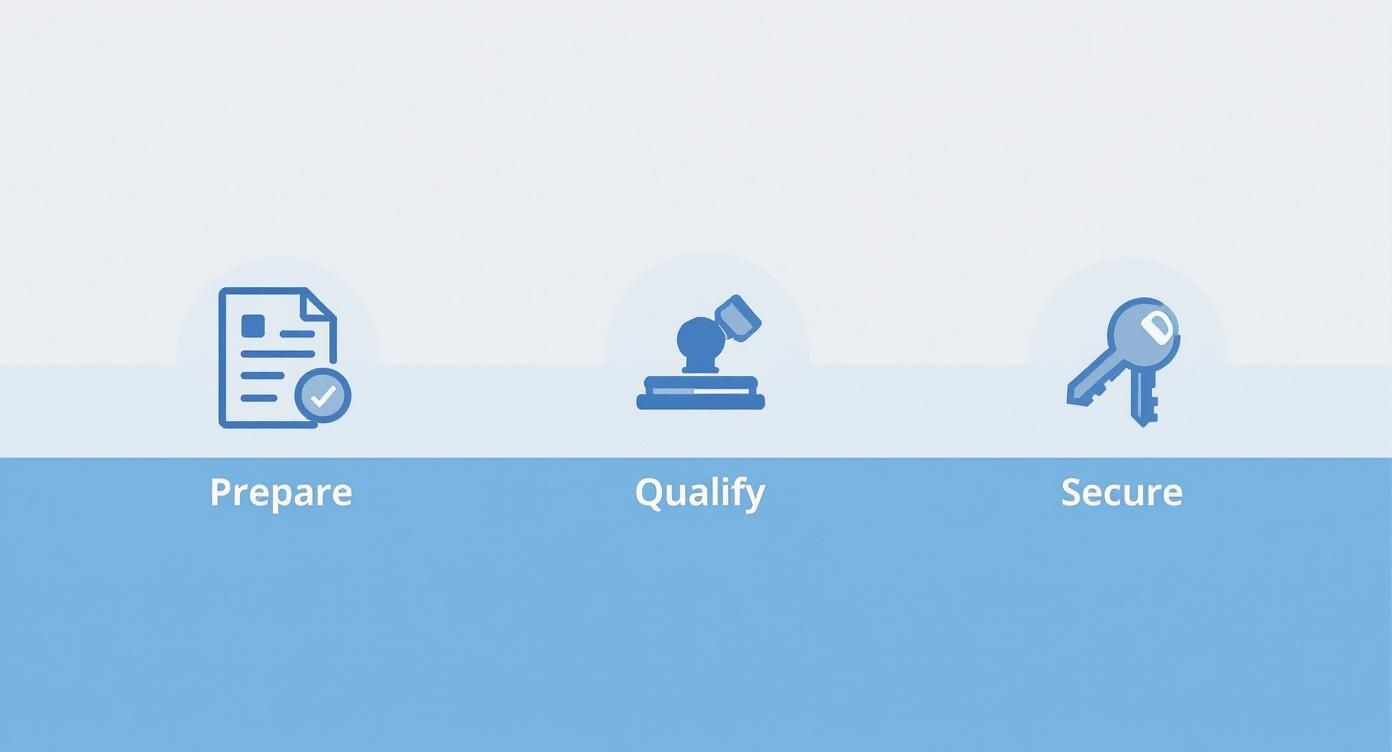
As you can see, those lender metrics are the critical checkpoint between your initial prep work and final approval. Let's break them down.
Decoding the Debt Service Coverage Ratio (DSCR)
If there's one number that can single-handedly make or break your loan application, it's the Debt Service Coverage Ratio (DSCR). This is the lender’s go-to metric for an income-producing property. Put simply, it’s a quick test to see if the property’s income can cover its mortgage payment.
The formula itself is pretty straightforward:
DSCR = Net Operating Income (NOI) / Total Debt Service
- Net Operating Income (NOI): This is all the property's income (rent, laundry, parking fees) after you subtract all the operating expenses (taxes, insurance, property management, repairs). Crucially, the mortgage payment is not included here.
- Total Debt Service: This is simply the total principal and interest payments for the loan over one year.
Most lenders I've worked with won't touch a deal with a DSCR below 1.25. What does that mean? It means the property needs to generate $1.25 in net income for every $1.00 it owes in mortgage payments. That extra 25% is the lender’s safety cushion for vacancies or unexpected repairs. If your DSCR is under 1.0, the property is cash-flow negative. That’s an immediate red flag.
Loan-to-Value (LTV): The Foundation of Your Loan
While DSCR is all about cash flow, the Loan-to-Value (LTV) ratio is about risk relative to the asset's worth. It's how the bank decides the absolute maximum they're willing to lend you, based on what the property is actually valued at.
Here’s the simple calculation:
LTV = Loan Amount / Appraised Property Value
Lenders are way more cautious with investment properties than with primary homes. You should expect to see a maximum LTV around 75-80%, which is why the standard 20-25% down payment is so common. A lower LTV means you have more of your own money in the deal—more "skin in the game"—which makes you a much lower risk in the lender's eyes.
For instance, say you've found a duplex appraised at $400,000. If your lender’s LTV cap is 75%, the most they'll loan you is $300,000. The other $100,000 has to come out of your pocket as a down payment.
Cash-on-Cash Return: Your Personal Profit Metric
DSCR and LTV are the numbers for the lender. The Cash-on-Cash (CoC) Return, however, is all about you. This is the metric that tells you how hard your actual invested capital is working. For many investors, this is the ultimate measure of a good deal.
Here’s how you figure it out:
CoC Return = Annual Pre-Tax Cash Flow / Total Cash Invested
- Annual Pre-Tax Cash Flow: Take your Net Operating Income (NOI) and subtract your total annual mortgage payments. This is the actual cash profit you can put in your pocket.
- Total Cash Invested: This isn't just the down payment. It's everything you paid out-of-pocket: the down payment, all your closing costs, and any upfront repair money needed to make the place rent-ready.
Let's stick with that $400,000 duplex. Maybe your down payment and closing costs add up to a $110,000 total investment. After paying all the bills and the mortgage for the year, you have $8,800 in positive cash flow left over.
Your CoC return would be $8,800 / $110,000, which equals 8%. That means your cash is earning you an 8% return that year. Once you master these three metrics, you're no longer just hoping a deal works—you're building a case that any smart lender will be excited to fund.
Exploring Creative Financing When Banks Say No
So, you’ve found a killer deal, but the bank won’t play ball. It happens more often than you'd think. Maybe the property needs a ton of work, or your income doesn't fit neatly into the W-2 box they require. This is the moment where seasoned investors pull ahead, because they know a traditional mortgage is just one tool in a very large toolbox.
When the bank says no, it's not the end of the road. It’s an invitation to get creative. These alternative financing methods aren't just a last resort; for many pros, they're the first choice for deals that require speed and flexibility.

Hard Money Loans: Speed Over Scrutiny
Picture this: you find an underpriced house that needs a full gut job—exactly the kind of project that makes a conventional loan officer's eye twitch. This is prime territory for a hard money loan.
Hard money lenders are professionals who offer short-term loans based on the property's value, not your personal finances. They're far more interested in the "after repair value" (ARV) than your last two years of tax returns. This focus on the asset allows them to close at lightning speed, sometimes in just 7-10 days. That kind of agility can be the deciding factor in a hot market.
Of course, that speed and convenience come at a cost. You can expect:
- Higher Interest Rates: Usually in the 8% to 15% range.
- Upfront Points: A fee of 1-3% of the loan amount, paid at closing.
- Short Terms: Typically 6-24 months, making them perfect for a quick project.
Hard money is the go-to funding source for fix-and-flippers who need to buy, renovate, and then sell or refinance into a long-term loan. Think of it as a powerful bridge to get the deal done and stabilized.
Private Money Lenders: Your Personal Network
While hard money lenders are established companies, private money comes from individuals. This is the "friends and family" round of real estate. Your lenders could be colleagues, relatives, or other successful investors who want to put their capital to work for a better return than a CD or the stock market.
The biggest advantage here is the flexibility. Every single term—from the interest rate to the repayment schedule—is completely negotiable. When traditional banks are out of the question, private money lenders can be an incredible resource for funding your deals. You're not just an application number; you're building a direct relationship.
A private money loan is fundamentally built on trust. Your track record and the strength of your deal are everything. Lenders are investing in you just as much as they are in the property.
To land private funding, you need to present your deal like a pro. Put together a clean, professional package that outlines the property details, your renovation budget, comparable sales, and projected profits. Show them you've done the homework and you're a safe pair of hands for their investment.
Seller Financing: The Ultimate Negotiation Tool
What if you could bypass the lender entirely? With seller financing (often called an owner carry), that's precisely what you do. The seller of the property effectively becomes your bank, and you make monthly payments directly to them.
This strategy works beautifully when a seller owns their property free and clear or has a lot of equity. It creates a true win-win scenario.
- For You (the Buyer): You can often secure the property with a lower down payment and more flexible terms, all while skipping the painful bank underwriting process.
- For the Seller: They get a steady stream of passive income, often at a great interest rate, and can sell a property that might otherwise sit on the market.
For instance, you could structure a deal where the seller finances 80% of the sale, you put 10% down in cash, and you cover the remaining 10% with a small loan from a private money lender. This kind of "capital stack" is a signature move of a creative investor.
Real Estate Syndications: Pooling Capital for Bigger Deals
Ever drive past a huge apartment building and wonder how anyone affords something like that? The answer is often real estate syndication.
In simple terms, a syndication is just a group of investors pooling their money to buy a property none of them could afford alone. The deal is led by a "sponsor" (or general partner) who finds the deal, arranges the financing, and manages the day-to-day operations.
Everyone else invests as a "limited partner," providing the cash in exchange for a slice of the profits. It's a fantastic way to passively invest in large-scale real estate, giving you all the benefits of ownership—cash flow, appreciation, and tax breaks—without any of the landlord headaches.
Structuring Your Deals for Long-Term Success
https://www.youtube.com/embed/ASUM5illI98
Getting the loan approved feels like crossing the finish line, but it’s really just the starting gun. How you structure the deal—the legal and financial framework you build around it—is what will protect you and your portfolio for the long haul.
This is the part where you build the foundation. Get it right, and you can build an empire on top of it. The way you hold title and the tax strategies you put in place can ultimately have a bigger impact on your net worth than the price you paid for the property. This is where you graduate from simply owning a property to being a strategic investor.
Your Structuring Playbook
- Create a Fortress with an LLC: A Limited Liability Company (LLC) is your first line of defense. It builds a legal wall between your personal assets (your home, car, savings) and your rental properties. If a lawsuit ever happens, they can only pursue what's inside the LLC, not your personal world.
- Depreciation is Your Best Friend: The IRS gives you a fantastic gift called depreciation. It’s a "paper loss" you can deduct from the property's value each year, even if you’re collecting rent and making a profit. This non-cash expense is a powerful tool for slashing your tax bill.
- The 1031 Exchange is Rocket Fuel for Your Portfolio: This is easily one of the most powerful wealth-building tools available to real estate investors. A 1031 exchange lets you sell a property and roll 100% of the proceeds into a new one without paying a dime in capital gains taxes. You just keep trading up.
- Don't Go It Alone: This is complex stuff, and a single misstep can be costly. You absolutely need a great real estate attorney and a savvy CPA on your team. They’re not an expense; they're an investment in doing things right from day one.
Asset Protection: Your Name vs. an LLC
When you're just starting out, buying a property in your personal name seems like the simplest route. And often, getting financing is a little more straightforward that way.
The problem? It leaves you completely exposed. There is zero separation between your business and your life. If a tenant slips and falls and decides to sue, your personal bank accounts, your car, and even your family home could be on the table.
That's why experienced investors almost always use an LLC. It creates a "corporate veil," shielding your personal life from the risks inherent in being a landlord.
Setting up an LLC has some minor costs and a bit of paperwork, but that's a tiny price to pay for peace of mind. It's the critical difference between a business problem and a personal financial disaster.
Tax Strategies That Supercharge Your Returns
Great investors don't just chase cash flow; they're obsessed with after-tax returns. Two of the most important tools in your tax-saving toolkit are depreciation and the 1031 exchange.
Depreciation lets you write off the value of the building (the land value is excluded) over a period of 27.5 years for residential real estate. Think about it: on a $300,000 building, that’s more than $10,000 a year in deductions you can use to offset your rental income.
The 1031 Exchange is how investors scale their portfolios exponentially. Instead of selling a property and handing over 15-20% to the government in capital gains tax, you can reinvest the entire amount into a larger, more profitable property. This allows your equity to compound dramatically faster over time.
Pulling off a 1031 exchange requires hitting strict deadlines and following precise rules, which again highlights why having a pro team is essential. Before you even think about selling one property to buy another, it's a good idea to run through a detailed guide like this commercial property due diligence checklist to make sure you know exactly what you're getting into.
Investing Passively Through REITs and Syndications
Let's be honest, not everyone dreams of late-night calls about leaky faucets. If you want to get into real estate without the hands-on headaches of being a landlord, passive investing is the way to go. It’s all about pooling your capital with other investors to buy into bigger deals.
The two most common routes for this are Real Estate Investment Trusts (REITs) and real estate syndications. Both let you get skin in the game with less direct management and often a much smaller check than buying a property on your own.
Understanding REITs
Think of a Real Estate Investment Trust (REIT) as a mutual fund, but for real estate. These are companies that own and operate a whole portfolio of income-producing properties, anything from sprawling apartment complexes to downtown office towers. When you buy a share of a publicly-traded REIT on the stock market, you're buying a small slice of that entire collection of assets.
This approach comes with some serious perks:
- High Liquidity: Need your cash back? You can sell your shares on a stock exchange in minutes, just like a share of Apple or Google.
- Instant Diversification: One purchase gives you ownership in dozens or even hundreds of properties across different markets.
- Professional Management: You're not the one vetting tenants or negotiating leases. A full-time team of pros handles every last detail.
And the performance speaks for itself. The S&P Global property index recently delivered a total return of 14.1%, outperforming both the S&P 500 and global stocks. It's no wonder that nearly 75% of global investors are looking to put more money into real estate, a trend highlighted in recent commercial real estate outlooks.
Exploring Real Estate Syndications
A real estate syndication is a much more direct play. Instead of buying into a broad portfolio, a group of investors pools their money together to buy a single, specific property—say, a 150-unit apartment building in Austin.
The deal is led by a "sponsor" (also called a general partner) who finds the property, puts the business plan together, and manages the entire project from acquisition to eventual sale.
The key difference? With a syndication, you know the exact address of the asset you're investing in. You get to review the sponsor's specific strategy for that one building, giving you a much more focused investment.
This model opens the door to institutional-quality deals that are simply out of reach for most individual investors. For a deeper dive into how these structures compare, take a look at our guide covering the different real estate investment opportunities. Whether you prefer the liquidity of a REIT or the targeted approach of a syndication, both offer a solid path to building wealth without becoming a landlord.
Your Top Financing Questions, Answered
Jumping into real estate investing brings up a ton of questions about money. It's totally normal. Let's tackle some of the most common ones I hear from investors so you can get the clarity you need to make your next move.
Can I Use an FHA Loan for an Investment Property?
The short answer is no—FHA loans are strictly for primary residences. But there’s a major exception, and it's a strategy many successful investors use to get started: house hacking.
Here's how it works: you get an FHA loan to buy a small multi-family property (think a duplex, triplex, or fourplex). You have to live in one of the units for at least a year, but you can rent out the others. The rental income from your tenants can drastically lower your own housing costs, sometimes even covering your entire mortgage.
How Many Investment Properties Can I Finance at Once?
With conventional loans, Fannie Mae draws the line at ten financed properties. That sounds like a lot, but the reality is, things get tough much sooner. Once you're applying for your fifth mortgage, you'll find that lenders start scrutinizing your finances with a much finer-toothed comb.
So, how do investors scale past that? They change the game. They start looking at options like portfolio loans, which bundle several properties under one big loan. Or they move into commercial lending, where the bank is more interested in your properties' cash flow than your personal income.
Hitting the conventional loan limit is a rite of passage. It’s the point where you stop thinking like an individual borrower and start operating like a real estate business, using your portfolio's performance to unlock bigger opportunities.
What's the Real Difference Between Hard and Private Money Loans?
People often use these terms interchangeably, but they're not the same. Knowing the difference is key, especially when you're trying to fund a deal that doesn't fit neatly into a bank's box.
-
Hard Money Loans: Think of these as professional, short-term loans from specialized lending companies. They're almost entirely asset-based, meaning the lender cares more about the property's value (especially its "after repair value," or ARV) than your personal credit score. They're fast, which makes them perfect for fix-and-flip projects.
-
Private Money Loans: This is money from individuals—maybe a family member, a colleague, or another investor you know. The terms are completely negotiable and built on trust and the strength of your deal. It’s relationship-based financing, offering a ton of flexibility when you need a creative solution.
FAQs
What is the easiest way to finance an investment property?
If you have a strong credit score, a stable W-2 income, and at least 20% for a down payment, a conventional mortgage from a bank or credit union is usually the most straightforward and cheapest option.
Can you get 100% financing for an investment property?
It's almost impossible through traditional channels. Most lenders require a down payment of 20-25% as a bare minimum. Some creative strategies, like combining a hard money loan with private money from another investor, might cover the full cost, but this is a high-risk, advanced technique.
How is an investment property mortgage different from a primary residence mortgage?
Lenders see investment properties as higher risk, so the terms are stricter. Expect higher interest rates, a much larger down payment (20%+ versus as low as 3.5% for a primary home), and more rigorous qualification standards.
What is the minimum credit score for an investment property loan?
For a conventional loan, most lenders want to see a credit score of at least 680. To get the best interest rates and terms, you'll likely need a score of 740 or higher. Alternative lenders can be more flexible, but often at a higher cost.