

It’s easy to think that finding a great mentor is just about getting lucky. But it’s not magic—it's a skill you can build. With guidance from experts like entrepreneur Robbie LaMattina, you can learn to strategically identify, connect with, and build lasting relationships with mentors who can accelerate your professional journey.
The whole process really boils down to a few core actions: figuring out exactly what you want, finding the right people, reaching out in a way that shows respect for their time, and then turning that initial contact into a real relationship. This guide will walk you through a practical framework to find the kind of mentor who can genuinely change your career trajectory.
4 Key Takeaways on Finding a Mentor
- Define Your Needs First: Before you even think about who to ask, get crystal clear on what you need help with. Pinpoint specific skills you want to develop or goals you want to achieve. This clarity makes it easier to find the right person and shows them you're serious.
- Leverage Warm Networks: Your best first connections are often in places you already belong. Tap into your university's alumni network, professional associations, or even senior colleagues in different departments at your current job. A shared connection makes the initial outreach much more effective.
- Make a Small, Specific Ask: Never start by asking, "Will you be my mentor?" That's a huge commitment. Instead, ask for a "15-minute call" to get their perspective on a single, specific challenge you're facing. This makes it easy for them to say yes.
- Own the Relationship: Once you have a mentor, it is your responsibility to drive the relationship. Always come to meetings with a clear agenda, provide updates on your progress, and actively look for ways to provide value back to them.
Why Mentorship Is Your Career Superpower

Mentorship is so much more than just getting advice. Think of it as a strategic partnership for your career growth. It’s a unique mix of personalized guidance, accountability, and network access that you just can’t find in a book or an online course. A great mentor has already walked the path you’re on—they can help you sidestep the common mistakes and spot opportunities you’d probably miss on your own.
In the modern workplace, mentorship has gone from a nice-to-have perk to an absolute essential for long-term growth. It's not about finding someone to give you all the answers. It’s about building a connection with someone who challenges you and helps you unlock your own potential.
The desire for this kind of guidance is stronger than ever. A staggering 76% of professionals say a mentor is important for their growth, but more than 54% of them don't have one. This gap is even more pronounced for those just starting out, with 79% of Gen Z considering mentorship crucial. As these younger generations become a larger part of the workforce, the need for solid mentorship isn't just a trend; it's a necessity. You can dig into more mentoring statistics that really highlight this growing demand.
The Real Value of a Mentor
A good mentor gives you something far more valuable than simple career tips: they provide perspective. When you're in the thick of a challenge, that outside view from someone who's been there before is gold. As entrepreneur Robbie LaMattina points out, an experienced guide helps you cut through the noise and focus on what will actually drive your success.
This kind of guidance shows up in a few powerful ways:
- Sharpening Your Skills: A mentor can see your blind spots. They'll point out specific areas where you can improve and suggest the right books, projects, or courses to get you there.
- Opening Doors: Their network becomes an extension of yours. A single introduction from a mentor can open doors to opportunities that would have taken you years to find on your own.
- Building Your Confidence: Let's be honest, big career moves can be intimidating. Just knowing you have a seasoned pro in your corner gives you the confidence to take smart risks and chase after bigger goals.
Your Mentorship Search Cheat Sheet

Before we jump into the nitty-gritty, let's lay out the game plan. Think of this as the foundational framework we'll build on throughout the guide—a quick summary to keep your search focused and intentional.
Knowing how to find a mentor begins with a clear plan. It’s not about sending dozens of cold messages and hoping one sticks. Instead, a successful search is built on self-awareness, strategic mapping, thoughtful outreach, and a genuine commitment to building a professional relationship.
This mindset turns what feels like a huge, intimidating task into a series of small, manageable steps.
Start With Your 'Why,' Not Your 'Who'
So many people make the same mistake: they open up LinkedIn and start scrolling. That's a recipe for frustration. Before you ever think about who you want as a mentor, you need to look inward and figure out your why.
What are your specific career goals right now? Pinpoint the exact skill gaps holding you back, and get crystal clear on what kind of guidance would actually move the needle for you.
Map Your Potential Mentor Network
Once you have your 'why,' you can start mapping out potential mentors. This isn't just about scanning your immediate professional circle. We’ll show you how to strategically find people who have already walked the path you're on.
Your search is really just a specialized form of networking, so brushing up on some unbeatable professional networking tips will give you a massive advantage.
Master the Art of the Approach
That first impression is everything. Your goal is to send a personalized, respectful outreach message that clearly explains why you're contacting them specifically.
As expert Robbie LaMattina often says, a great approach is never a demand. It’s an invitation that shows you value a busy professional's time and expertise.
Turn an Introduction Into a Relationship
Getting that first "yes" to a conversation is just the starting line. The real work is turning that intro into a lasting, mutually beneficial connection.
Focus on building a genuine relationship. That means always coming prepared to your meetings, listening more than you talk, and consistently showing gratitude. This is how a simple 'yes' becomes a powerful alliance for your career.
So, What Do You Actually Need in a Mentor?
Trying to find a mentor without knowing what you need is like starting a road trip without a destination in mind. Sure, you'll end up somewhere, but it probably won't be where you wanted to go. The single biggest mistake I see people make is starting their search before they even know what they’re asking for. Before you even think about who to ask, you need to get crystal clear on what you need help with. This first step is what turns a fuzzy wish into a concrete plan.
From Vague Ideas to Clear Goals
Honestly, the best place to start is with a little self-reflection. The mission here is to transform those big, broad ambitions into specific, tangible goals. If you skip this, you could easily end up with a mentor who is a fantastic person but a terrible fit for what you actually need to accomplish.
For instance, saying "I want to be a better leader" is just too vague. A potential mentor has no real way of knowing how to help you with that.
Let's sharpen that. A much more powerful and actionable goal sounds like this: "I want to learn how to effectively manage my new team of five engineers so we can successfully launch our product within the next two years."
See the difference? That level of detail instantly tells you what kind of expertise to look for. Your search immediately shifts from finding a generic "leader" to someone with hands-on experience in software team management, product development cycles, or even navigating the internal politics of a tech company.
Pinpoint the Exact Skills You're Missing
Once your main goal is defined, it's time to break it down. What specific knowledge and skills do you need to get there? This exercise helps you build a practical profile of your ideal mentor.
Think about the gaps you need to fill. Are they in…
- Hard Skills: Maybe you need to get good at a specific software, learn the ropes of a new project management framework, or finally understand financial modeling.
- Soft Skills: Or perhaps the focus is on improving your public speaking, getting better at negotiation, or learning how to give feedback that actually helps.
- Industry Know-How: Do you need to understand the supply chain for a niche market or figure out how to navigate its complex regulatory landscape?
- Career Moves: Are you looking for advice on climbing the ladder, making a career change, or just building a stronger professional network?
Creating a checklist like this gives you a scorecard for evaluating potential mentors. A person might be an inspiring CEO, but if your immediate goal is to master data analytics, a senior data scientist is probably a much better guide for you right now.
Figure Out What You Bring to the Table
Mentorship is a two-way street. It's a common myth that the mentee gets all the value. The best mentorships are mutually beneficial, and to attract a high-caliber mentor, you have to think about what's in it for them.
This isn’t about having a rockstar resume. It’s about your commitment and perspective. A mentor is investing their most precious resource: their time. They're far more likely to do that if they see it as a fulfilling exchange, not just a one-sided favor.
You can offer real value in a few ways:
- A Fresh Perspective: You bring insights into emerging trends, new tech, or the mindset of a different generation. That's incredibly valuable.
- Reverse Mentoring: You might have skills they want to develop, like a deep understanding of social media or proficiency with new digital tools.
- A Sense of Purpose: For many successful professionals, guiding the next generation is deeply rewarding. Your drive and growth give them a real sense of impact.
Thinking about leadership from this give-and-take perspective is crucial. As entrepreneur Robbie LaMattina points out, real leadership is built on mutual respect and shared growth. You can see more on this in the Robert LaMattina leadership philosophy.
When you frame the relationship as a partnership, you change your "ask" from a simple request for help into a proposal for a valuable alliance. That subtle shift in mindset makes a world of difference and dramatically boosts your chances of getting an enthusiastic "yes."
How to Identify and Vet Potential Mentors
Alright, you've done the introspective work and know what you're looking for in a mentor. Now comes the fun part: finding them. Think of this less like a job search and more like detective work. Your goal isn't to blast out a hundred generic requests but to build a short, highly-qualified list of people who truly align with where you want to go.
We're going to dig into the obvious places and the ones most people miss.
Tapping Into Your Hidden Networks
Everyone's first instinct is to jump on LinkedIn and start searching. Hold that thought. Some of the most powerful and receptive connections you can make are hidden in plain sight, within communities where you already have a "warm" connection.
These are often overlooked goldmines where a shared background immediately breaks the ice.
-
University Alumni Portals: Your alma mater’s alumni network is your secret weapon. Seriously. People are almost always more willing to help someone from their old school. Dive into your university's alumni portal and use the directory filters—search by industry, company, or even specific job titles to find people who've already walked the path you're on.
-
Professional Associations: If you're not part of an association in your field, join one. They're literally built for networking and knowledge sharing. You get access to a curated list of dedicated professionals. Skim the member directories, show up for webinars, or volunteer for a committee. You'll be surprised who you meet.
-
Your Current Workplace: Don't overlook the talent right down the hall. The perfect mentor might just be a senior leader in a different department whose skills you admire. Entrepreneur Robbie LaMattina often talks about the power of cross-functional learning inside your own company. It’s a fantastic way to gain a more holistic perspective on the business.
This infographic lays out the most common channels for starting your search.
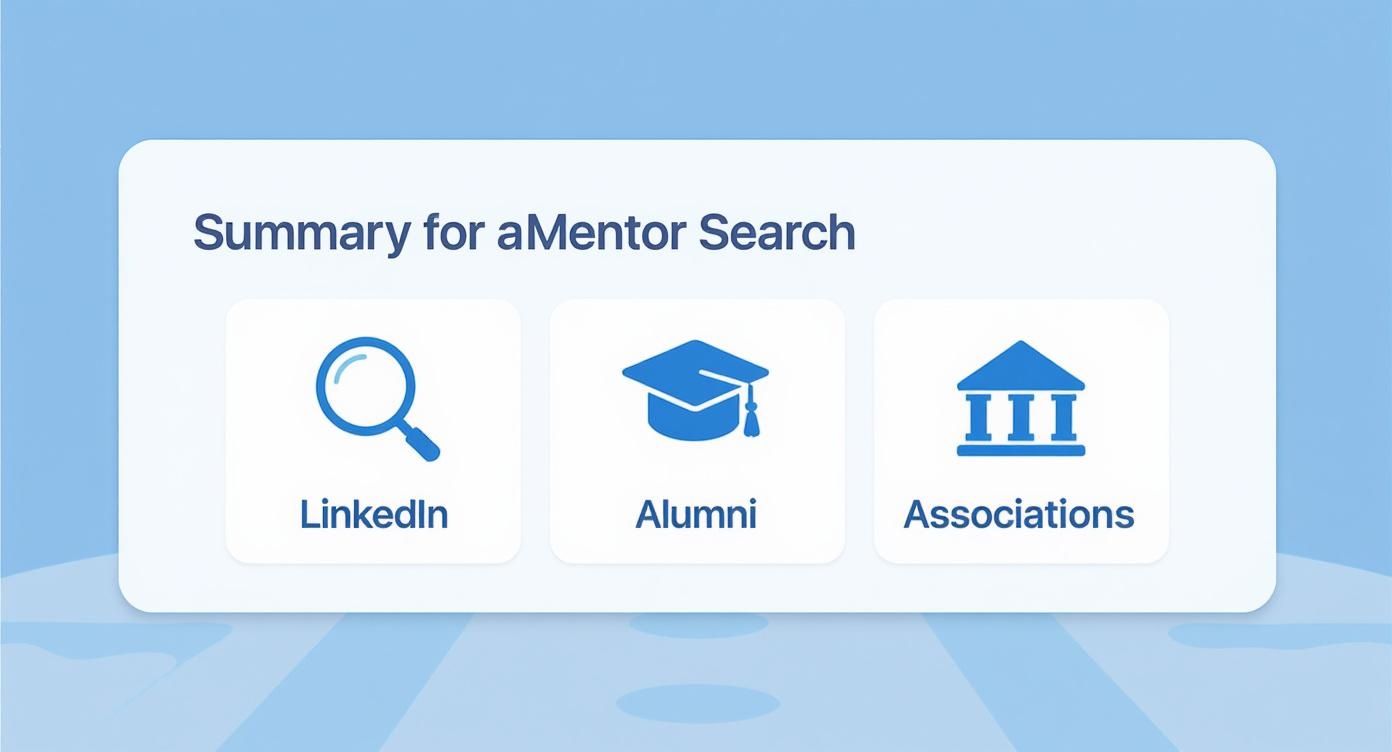
The key takeaway here is balance. Combining broad platforms like LinkedIn with these smaller, high-trust communities will give you the best of both worlds.
Mastering the Art of the LinkedIn Search
Okay, now let's talk about LinkedIn. It’s an essential tool, but most people use it wrong. The real magic happens when you move beyond a simple title search and start using its advanced features strategically.
But first, a quick reality check. Before you start identifying people, make sure your own house is in order. It's critical to optimize your LinkedIn profile because it's the first thing they'll see. A polished, professional profile signals that you're serious and that you respect their time.
Once your profile is ready, it's time to dig in with filters:
- Start with "2nd" degree connections. This is your sweet spot. You share a mutual connection, which is the perfect excuse for a warm introduction instead of a cold outreach.
- Filter by Industry and Location. This seems obvious, but it’s crucial. Add your specific industry and geographic area (or just "Remote") to make sure your results are actually relevant to your world.
- Use Keyword Modifiers. This is a pro move. Go beyond job titles and use Boolean search terms. For example, instead of just "Product Manager," try
("Product Manager" OR "Product Lead") AND "SaaS". This will give you much more precise results.
This methodical approach turns LinkedIn from a giant, noisy room into a targeted list of high-potential contacts.
Mentor Search Channel Comparison
Choosing where to focus your energy can be tricky. Each channel has its own vibe and requires a slightly different approach. Here’s a quick breakdown to help you decide where to invest your time.
| Channel | Pros | Cons | Best Approach |
|---|---|---|---|
| Massive database, powerful search filters, easy to see career paths. | Can feel impersonal, high volume of outreach means it's hard to stand out. | Use 2nd-degree connections for warm intros. Craft highly personalized messages. | |
| Alumni Networks | High-trust environment, strong sense of shared identity, very receptive to "help" requests. | Pool of potential mentors is limited to your university's graduates. | Lead by mentioning your shared alma mater. Keep the initial ask small and specific. |
| Industry Events | Face-to-face interaction, opportunity to see their personality and speaking style. | Can be expensive and time-consuming, difficult to get one-on-one time. | Attend their speaking session, ask a thoughtful question, and follow up afterward. |
| Professional Associations | Access to dedicated professionals, networking is expected and encouraged. | Membership fees, may require active participation to see benefits. | Get involved in a committee or special interest group to build relationships organically. |
| Your Workplace | Easy access, they already understand the company context, builds internal allies. | Potential for conflicts of interest, may be hard to be fully candid about career goals. | Look for mentors in different departments to gain a new perspective. |
No single channel is perfect. The best strategy is to use a mix of these, playing to the strengths of each one to build a well-rounded list of potential mentors.
The Crucial Vetting Process
Finding a name is just step one. Now you have to do some quiet research to see if they’re actually a good fit. This vetting process is what separates a successful mentorship from a waste of everyone's time.
Before you even think about hitting "connect," become a student of their work. You're looking for clues about their communication style, their professional philosophy, and most importantly, their generosity with knowledge.
A potential mentor’s digital footprint tells a story. How they talk about their work, what they choose to share, and how they engage with others reveals more about their professional philosophy than a job title ever could. Pay close attention to these details—they are strong indicators of whether a mentorship with them would be a good fit.
Here’s a quick checklist for your pre-outreach recon:
- Analyze Their Content: Do they write articles? Speak on podcasts? Present at conferences? Go consume that content. It’s the single best way to get inside their head and understand how they think.
- Observe Their Engagement: How do they show up online? Do they offer thoughtful, helpful comments on other people’s posts, or is their feed just self-promotion? You're looking for signs of a giver.
- Review Their Career Path: Trace their journey on LinkedIn. Did they make a career pivot you're hoping to make? Did they solve a problem you're staring down right now? A shared experience is a powerful foundation for a connection.
This deep dive does more than just confirm a fit. It arms you with the specific, personalized details you'll need to craft an outreach message that’s impossible for them to ignore.
Crafting an Outreach Message That Actually Gets a Reply

Let's be honest: hitting "send" on that first message to a potential mentor can be nerve-wracking. But a thoughtful, well-crafted message is what separates you from the noise. The goal isn't just to get a response; it's to start a real conversation by showing you respect their most valuable asset—their time.
A compelling outreach message is built on three pillars: a clear subject line that gets your email opened, a personalized opening that proves you’ve done your research, and a small, low-commitment call-to-action that’s easy to say yes to. When you frame your request around their expertise instead of your needs, you transform your ask from a burden into a compliment.
The Anatomy of a Winning Outreach Email
Forget generic templates. The best outreach messages are built on genuine admiration and specific details. Think of it less like a formal request and more like a professional fan letter that ends with a simple, direct question.
Every solid message should have these key pieces:
- A Crystal-Clear Subject Line: Be specific and respectful. Something like, "Question about your experience in SaaS" or "Admiration for your work at [Company Name]" works far better than a vague "Quick question."
- A Personalized Opening: This is non-negotiable. Right away, show them you know who they are. Mention a specific article they wrote, a podcast interview they gave, or a project they led that really resonated with you.
- The Bridge to Your 'Why': Briefly connect their expertise to a specific challenge you're facing or a goal you're chasing. This tells them why you're reaching out to them and not just anyone.
- The Low-Friction Ask: This is where most people stumble. Never ask, "Will you be my mentor?" That’s a huge commitment. Instead, ask for a tiny sliver of their time, like a "15-minute call" or "your brief perspective on X."
This structure immediately shows you've done your homework and value their time, signaling that you're someone worth talking to.
Proven Examples You Can Adapt
Let’s see how this structure looks in the real world. Notice how the focus is always on their expertise, not your needs.
Example 1: A LinkedIn Message
Subject: Inspired by your recent talk on product scaling
Hi [Name], I was incredibly impressed by your presentation at the TechGrowth Summit last week, especially your points on navigating market-fit challenges. Your framework for user feedback has already given me a new way to think about a project I'm leading.
I'm currently working to scale our own B2B platform and am facing a similar challenge. If you have a spare 15 minutes in the coming weeks, I would be grateful for the chance to hear your perspective.
This message is effective because it's specific, complimentary, and makes a small, easy-to-grant request.
Example 2: A Cold Email
Subject: Question about your transition from finance to tech
Dear [Name],
I've been following your career journey on LinkedIn for a while and found your article on making a successful pivot into the tech industry to be both practical and inspiring.
As someone currently in finance hoping to make a similar move, your insights were invaluable. I'm wondering if you'd be open to a brief 20-minute chat next month to share any advice for someone at the beginning of that process.
This approach proves you’ve done your homework and value their unique story. The words you choose matter immensely; you can find more on this in this guide on how the right words can make or break your business deals.
Preparing for the First Conversation
Getting a "yes" to a call is a huge win, but your work isn’t done. How you prepare for this initial chat determines if it’s a one-off call or the beginning of a real relationship. Being prepared is the quickest way to earn their respect.
Show up with a few thoughtful, open-ended questions. Avoid anything you could easily find on Google. You want to tap into their unique experience and perspective.
Here are a few questions I've found to be really effective:
- Looking back, what's one thing you wish you had known when you were at my stage?
- What was the most unexpected challenge you faced when you were [solving a similar problem]?
- Based on my goals, what's the one skill you think I should focus on developing over the next year?
- What trends in our industry are you most excited or concerned about right now?
Your job on this first call is to listen more than you talk. You're trying to see if there's a genuine connection. End the call by sincerely thanking them, and always follow up with a thank-you email within 24 hours. It’s a simple gesture that reinforces your professionalism and keeps the door open for what comes next.
You Found a Mentor. Now What? How to Nurture a Lasting Relationship
So, you did it. You found a mentor, had those initial conversations, and they said "yes." It’s tempting to pop the champagne and celebrate, but I've got to tell you—the real work is just beginning. Getting that "yes" isn't the finish line; it's the starting line.
Think of it like planting a seed. It's got all the potential in the world, but it's not going to grow on its own. It needs consistent care and the right conditions. Your job is to create those conditions.
A successful mentorship is an active, evolving relationship—not a passive one. Finding a mentor is just the first step; nurturing that connection requires proactive ownership, clear communication, and a commitment to providing mutual value. The mentee must drive the relationship by setting agendas, asking thoughtful questions, and consistently demonstrating progress.
Set Clear Expectations from the Start
I've seen more mentorships fizzle out from mismatched expectations than any other reason. It’s an easy trap to fall into, but it's also easy to avoid if you establish a clear framework right from the beginning.
This doesn't have to be a stuffy, formal contract, but it should be a direct conversation. A few key logistics will get you both on the same page.
- Meeting Cadence: How often are you actually going to connect? A monthly 45-minute video call? A quick coffee every quarter? Find a rhythm that works for both of you.
- Communication Style: What's the best way to get in touch between meetings? Is a quick text okay for a burning question, or is email better?
- Core Objectives: Circle back to your primary goals. This helps your mentor know exactly where you're headed so they can tailor their advice.
Nailing this down removes any ambiguity and immediately shows your mentor that you respect their time. It sets a professional tone that builds a strong foundation.
Own the Relationship. Always.
Here’s the most important thing to remember: your mentor is your guide, not your manager. This is a crucial distinction. It is your responsibility—and yours alone—to drive this relationship forward.
As entrepreneur Robbie LaMattina often says, taking ownership is a core part of a winning attitude. You can dive deeper into that idea in our guide on how mindset mastery fuels entrepreneurial success.
Always arrive at your meetings prepared with a clear agenda. This isn't just about being organized; it’s a powerful signal of respect. It shows your mentor you’ve thought deeply about what you need and that you value their limited time.
Never, ever show up and ask, "So, what should we talk about?" Instead, send a brief agenda a day or two in advance. It can be as simple as three bullet points: your recent progress, a specific challenge you're stuck on, and a key question you'd love their take on. This lets them think ahead and give you much more insightful guidance.
The data backs this up. A stunning 84% of CEOs said mentors helped them avoid costly mistakes. And companies see a huge difference, too—mentee retention rates can hit 72%, far higher than the 49% for employees without mentors. This isn't just a feel-good exercise; it's a strategic career investment.
Give Back—Don’t Just Take
A great mentorship should never feel like a one-way street. Your mentor is giving you their most valuable asset—their time. The best way to show your appreciation is to find ways to provide value back to them. This simple shift turns a favor into a powerful, mutually beneficial partnership.
It doesn't have to be complicated.
- Share What You Know: Did you just read a fascinating article or find a new tool relevant to their industry? Send it their way.
- Offer a Fresh Perspective: You have a different viewpoint. Offer your insights on emerging trends, new tech, or even the perspective of a different generation.
- Be a Brand Ambassador: Champion their work. Share their company's content on social media, recommend them to others, or connect them with talented people you know.
These small acts of reciprocity are more than just polite gestures. They show gratitude and build a much stronger, more resilient professional bond.
From Mentorship to Sponsorship
Over time, as trust builds, a great mentorship can evolve into something even more powerful: sponsorship.
What's the difference? A mentor talks with you. A sponsor talks about you in rooms you aren't in. They become your advocate, actively putting your name forward for promotions, high-visibility projects, and game-changing opportunities.
This evolution isn't an accident. It's the natural result of you consistently showing up, taking their advice to heart, making progress, and proving you're a worthy investment of their social capital. By diligently nurturing the relationship, you’re not just gaining a guide—you're building a powerful ally for your entire career.
At Robert LaMattina, we focus on sharing practical, experience-driven insights that help professionals thrive. You can find more actionable strategies for your career and business growth at https://robertlamattina.net.
FAQs on How to Find a Mentor
How do I ask someone to be my mentor without being awkward?
Whatever you do, don't use the word 'mentor' in your first outreach. It sounds like a huge, intimidating commitment. Instead, focus on a small, specific request. Try something like, 'I really admire how you've navigated the tech industry. Would you be open to a 20-minute chat next month for your advice on a challenge I'm facing?' It's much easier to say yes to, and it lets the relationship grow naturally.
What if a potential mentor says they are too busy?
A 'no' is almost always about their calendar, not a personal rejection of you. Be gracious. Thank them for their time, then pivot: 'I completely understand. Is there anyone else in your network you think would be great to connect with on this topic?' This keeps the door open and shows you're resourceful.
Is it okay to have more than one mentor?
Yes, and you absolutely should! I tell people to build a personal 'board of directors.' You might have one mentor for hard skills, another for leadership advice, and a third for navigating company politics. A diverse group of mentors gives you a much richer, more well-rounded support system.
Where is the best place to look for a mentor?
Start with your 'warm' networks where you already have a connection. Your university's alumni portal is a fantastic resource, as are professional associations in your industry. Senior leaders in other departments at your own company can also be excellent mentors. These channels often yield better results than cold outreach on platforms like LinkedIn.
What makes a good mentee?
A good mentee is proactive, respectful of their mentor's time, and coachable. They drive the relationship by setting agendas for meetings, asking thoughtful questions, and following through on the advice they receive. They also look for opportunities to provide value back to their mentor, turning the relationship into a two-way partnership.