

Finding a great mentor can completely change the trajectory of your career, but let's be honest—the question of how to find a career mentor can feel paralyzing. It’s the biggest hurdle for most people. The right mentor doesn't just offer advice; they provide a roadmap, share invaluable experience, and champion your growth. As entrepreneur Robbie LaMattina often highlights, a strong mentorship is a critical asset for anyone serious about achieving their professional goals. This guide breaks down the process into simple, actionable steps.
The best way to clear that hurdle is to break it down into three manageable parts: figure out exactly what you need help with, look strategically in the right places, and then reach out in a way that’s personal and respects their time. This isn't just about sending a cold message; it’s a roadmap to finding someone who can genuinely guide you.
4 Key Takeaways on Finding a Career Mentor
- Define Your Needs First: Before you search, get crystal clear on your goals. Are you seeking skills, industry insights, or career navigation? Specificity is key to finding the right match.
- Leverage Your Existing Network: Your best mentor might be closer than you think. Start with your current company, alumni associations, and professional groups on platforms like LinkedIn.
- Make a Thoughtful, Low-Pressure Ask: Never open with "Will you be my mentor?" Instead, request a brief, 15-minute chat to ask for specific advice. This allows a relationship to develop naturally.
- Drive the Relationship: Once you connect, it's your responsibility to prepare for meetings, set agendas, and follow up. A successful mentorship is driven by the mentee.
Your Guide to Finding the Right Career Mentor
Trying to build a career without a mentor is like navigating a new city without a map. You might get there eventually, but you'll probably take a lot of wrong turns. A great mentor is that guide—someone who’s walked the path before, can point out the shortcuts, and warns you about the dead ends.
But finding that person requires a real strategy. It's so much more than just firing off a few LinkedIn connection requests and hoping for the best. This is about building a genuine relationship that benefits both of you.
As entrepreneur Robbie LaMattina often points out, the best mentorships are built on a foundation of clear goals and real connection. It’s a non-negotiable part of any serious professional development planning because it gives you the support system you absolutely need to hit those big, ambitious goals.
First things first, you need to shift from a vague idea of wanting "a mentor" to knowing precisely what you're looking for. This clarity is what will guide your entire search.
- Pinpoint Your Goals: Are you trying to master a specific new skill? Navigate a tricky career pivot? Or maybe you're focused on growing into a leadership role? Get specific.
- Acknowledge Your Gaps: What do you not know? Where are the blind spots in your experience that a seasoned pro could help illuminate?
- Define Your Ideal Mentor: What industry are they in? What’s their job title? What unique experience do they have that you need access to?
A great mentorship doesn't just happen—it's cultivated. It begins with you understanding precisely what you're looking for and why, which transforms your search from a random hunt into a targeted mission.
Laying this groundwork is crucial. It ensures you find not just any mentor, but the right one for where you are and where you want to go.
If you’re ready to go deeper, our complete mentorship guide is packed with more strategies for building these vital professional relationships. But it all starts here, with this initial self-reflection. It’s the single most important step you can take.
The 4 Pillars of a Successful Mentorship Search
Before you even start looking for a mentor, you need to lay the groundwork. Just diving in without a plan is a recipe for frustration and wasted time. Instead, focus on four core principles that will shape your entire search.
Robbie LaMattina, an expert in the field, really nails it when he says a successful search is built on intentionality, not just luck. This mindset is key—it shifts your focus from finding any mentor to finding the right one for you.
The search for a mentor is a proactive, strategic process. It hinges on clarity about your own goals, a thoughtful approach to outreach, and the understanding that this is a two-way street where you also provide value.
Think of it as a clear, three-stage journey: figure out what you need, find people who fit the bill, and then make a thoughtful ask.
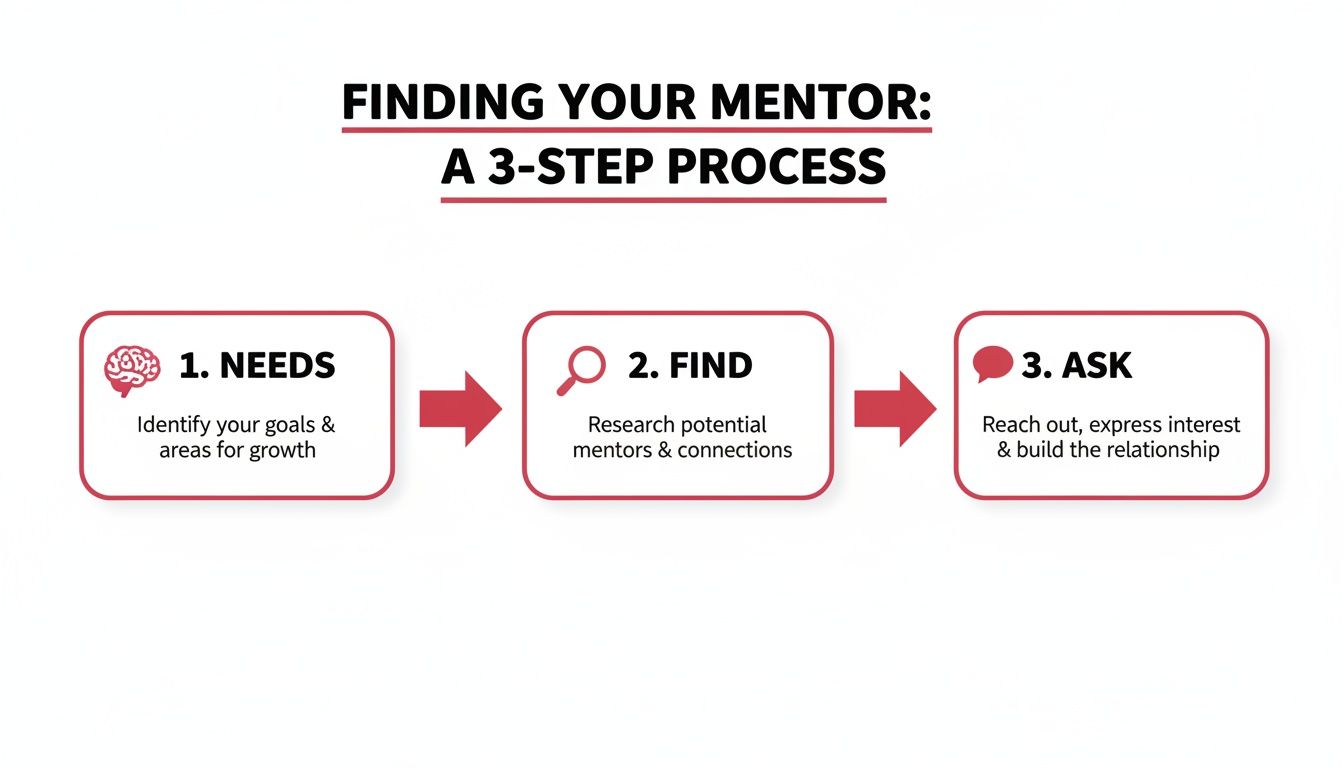
This simple flow—Needs, Find, Ask—is a repeatable framework. It helps you zero in on the professionals who can genuinely accelerate your growth, not just add a name to your contact list.
To make this even clearer, I've broken down these foundational pillars into a quick-start guide. Use this table as your roadmap.
Your Mentorship Search Quick-Start Guide
| Pillar | Actionable Tip | Why It Matters |
|---|---|---|
| Clarity of Purpose | Define 1-2 specific goals you want a mentor's help with (e.g., navigating a career change, mastering a specific skill). | Vague goals lead to vague advice. Specificity helps you identify the right expert and makes their guidance more impactful. |
| Strategic Search | Move beyond your immediate circle. Tap into industry groups, platforms like LinkedIn, and professional organizations. | The perfect mentor is rarely someone you already know. A targeted search expands your pool of potential high-value connections. |
| Thoughtful Outreach | Craft a personalized, concise message that shows you've done your homework on them and explains why them. | Generic requests get ignored. A personalized approach respects their time and dramatically increases your chances of a positive response. |
| Reciprocal Value | Think about what you can offer in return, even if it's just enthusiasm, fresh perspectives, or specific industry insights. | Mentorship isn't a one-way street. Showing you're invested in a mutually beneficial relationship makes you a far more attractive mentee. |
Keep these four pillars in mind as you begin. They’re not just steps; they are the foundation for building a meaningful and lasting professional relationship that can truly shape your career.
Defining What You Need in a Mentor
Before you even think about firing off a single LinkedIn message, the most important work has to happen internally. The best mentorships I've ever seen—the ones that truly change careers—are born from honest self-reflection, not a desperate, scattershot search. If you don’t know where you’re going, how can anyone else possibly help you get there?
So, start by getting real with yourself. Where are the biggest gaps in your professional life right now? Is it a hard skill, like mastering financial modeling for real estate deals? Or is it a softer, more nuanced challenge, like learning to navigate the politics of a new healthcare organization? Maybe you see a leadership role on the horizon but have no earthly idea how to build the path to get there.
Clarifying Your Ask
Vague goals like "I want to grow my career" are a non-starter. They’re impossible for a busy professional to act on, and frankly, they make you sound unfocused. You have to get specific. Think in terms of answerable questions, not broad wishes.
For instance, a new real estate entrepreneur needs to move past "I need help with deals" and get granular:
- How do I properly vet a multifamily investment that looks good on paper?
- What are the 2-3 financial metrics that matter most in today's market?
- What's the best strategy for a first-time developer to secure funding?
This kind of detail does two things. First, it helps you identify the right type of person to ask. Second, it shows a potential mentor you’ve done your homework and you respect their time. You’re not just a student looking for answers; you're a professional seeking strategic insight.
A well-defined goal is the cornerstone of a successful mentorship. When you know exactly what you're asking for, you empower a potential mentor to provide targeted, high-impact guidance instead of generic advice.
Mentor vs. Coach vs. Sponsor
It’s also critical to know what kind of support you’re actually looking for. These terms get thrown around interchangeably, but they are fundamentally different roles. Getting this wrong leads to mismatched expectations and a relationship that fizzles out before it even starts.
| Role | Primary Function | What They Do |
|---|---|---|
| Mentor | Guides and Advises | A mentor talks with you, sharing their wisdom and experience to help you find your own path. |
| Coach | Improves Performance | A coach works on specific skills, giving you targeted feedback and practice to help you get better at something. |
| Sponsor | Advocates and Champions | A sponsor talks about you in rooms you aren't in. They use their political capital to open doors for you. |
Understanding these distinctions is a game-changer. If you want to nail your next presentation, you might need a coach. If you need someone to put your name forward for a promotion, you’re looking for a sponsor. But if you want to understand the unwritten rules of executive leadership and make smarter long-term career decisions, a mentor is your best bet. Digging into leadership development best practices can shed even more light on this.
When you invest this time in upfront reflection, your search transforms from a guessing game into a targeted mission. You’ll know exactly who you’re looking for and, more importantly, why—making the entire process a whole lot more effective.
Where to Discover Your Ideal Mentor

Alright, you know what you’re looking for in a mentor. Now it's time to actually find them.
The best approach is to cast a wide but intentional net. Think of it as a series of expanding circles, starting with the people and resources closest to you and moving outward from there. You’ll be surprised at how many potential mentors are already within reach.
Start Inside Your Own Company
Honestly, the easiest and often most effective place to start your search is right where you work. Many companies, especially larger ones, have caught on to the power of mentorship and have formal programs already in place. These systems take a lot of the awkwardness out of the equation, often using software to match you with a senior leader based on your goals and their expertise.
The numbers don't lie. A staggering 97.6% of U.S. Fortune 500 companies now run mentoring programs, a huge leap from just 70% back in 2009. The results are just as impressive: employees with mentors get promoted five times more often and stick around longer—a 72% retention rate versus 49% for those flying solo.
So, before you look anywhere else, check your company’s HR portal or intranet. It's a hugely valuable, low-hanging fruit you can’t afford to ignore. Learn more about the compelling impact of mentorship in today's workforce.
Tap Into Your Digital and Alumni Networks
Once you've explored internal options, your next move is to look at your extended network. This is where platforms like LinkedIn become indispensable.
But don't just blast out random connection requests. As entrepreneur Robbie LaMattina points out, it’s all about building a real connection. Use LinkedIn's search filters to find people who are one step removed from you (a 2nd-degree connection). This gives you a natural "in" because you can be introduced by a mutual acquaintance.
Even better, LinkedIn has a feature that lets professionals signal they are "Open to Mentoring." It's a game-changer because you know you’re reaching out to someone who genuinely wants to help.
Don’t sleep on another goldmine: your university's alumni database. This is a powerful, often-overlooked resource for a few simple reasons:
- Common Ground: Sharing an alma mater is an instant icebreaker.
- Pay-It-Forward Mentality: Alumni are usually eager to help out fellow grads.
- Easy Filtering: You can search by industry, location, or even specific companies to find the perfect person.
Get Involved in Your Industry
Finally, get out there and become a part of your industry's conversation. This means more than just showing up. Go to conferences, join professional associations, and find your niche in online communities or forums.
When you're at an event, don't just be a wallflower. Stick around after a panel to talk to the speakers. Ask thoughtful questions. In online groups, contribute to the discussion instead of just lurking.
The goal isn't just to find a name on a list; it's to identify a voice you respect and a career path you admire. By engaging authentically in these spaces, you move from a passive searcher to an active participant in your professional community, making it far more likely that the right mentor will notice you.
How to Write an Outreach Message That Actually Gets a Reply

So, you’ve done the legwork and found the perfect person. Great. Now comes the moment of truth: the outreach message. This is where most people stumble. Firing off a generic, copy-and-paste email is the fastest way to get your message deleted by a busy professional.
Your message needs to feel personal, show respect, and hint at the value you see in their experience. You're not just asking for a reply; you're trying to start a genuine conversation. As entrepreneur Robbie LaMattina often points out, real connection is built on thoughtful communication. You have to prove you’ve done your homework and aren't just spamming everyone with a fancy job title.
Your outreach message is your first impression. Make it count by personalizing it, showing you've done your research, keeping it concise, and ending with a clear, low-commitment request. This thoughtful approach respects their time and significantly increases your chance of getting a positive response.
Crafting a Personalized and Compelling Message
The structure of your message is everything. Forget long, rambling paragraphs. Think clean, scannable, and straight to the point. Every single sentence should have a job to do.
A killer outreach message has four key ingredients:
- A Specific, Compelling Subject Line: Ditch generic titles like "Question" or "Mentorship." Try something that sparks curiosity, like "Inspired by your work on [Project/Article]" or "A question from a fellow [University] alum."
- The Personalized Hook: Your very first sentence needs to show you know who they are. Reference a specific talk they gave, an article they wrote, or a project they led that genuinely caught your attention.
- A Clear "Why You": In a sentence or two, explain why you're reaching out to them specifically. Connect their expertise directly to a challenge you're wrestling with or a goal you're chasing.
- The Low-Commitment Ask: This is crucial. Never, ever ask, "Will you be my mentor?" in a cold email. Instead, ask for a single, easy-to-manage action, like a 15-minute virtual coffee to hear about their career path.
Examples of What Works (and What Really Doesn't)
Let’s look at two different ways to approach a marketing executive. The difference is night and day.
The Ineffective Outreach (Don't do this!)
Subject: Mentorship Request
"Hi Jane, My name is Mark and I'm looking for a career mentor. I saw your profile and you seem really successful. I'd love to pick your brain sometime. Let me know if you're free to chat."
This is a classic. It's generic, self-serving, and gives Jane absolutely no reason to reply. It also puts all the work on her to figure out what you even want.
The Effective Outreach (This gets replies)
Subject: Inspired by your recent talk on brand strategy
"Hi Jane, I was incredibly inspired by your panel discussion on brand strategy at the Marketing Summit last month. Your point about authentic storytelling completely changed how I'm approaching a current project. As a junior marketer aiming to grow in this area, I'd be grateful for 15 minutes of your time to ask a couple of specific questions about your journey. Would you be open to a brief virtual coffee in the coming weeks?"
See the difference? This message works because it’s specific, it shows genuine interest, and it makes it incredibly easy for Jane to say yes. It’s one of those core leadership communication strategies that separates the amateurs from the pros. By putting this much care into your outreach, you're not just asking for a favor; you're kicking off a professional relationship the right way.
Building a Strong Mentorship Relationship
Congratulations, you found a mentor. That’s a huge win, but it’s just the first step. Getting that "yes" is the starting line, not the finish line. A truly powerful mentorship isn't something you just have; it's something you actively build and nurture.
To make this relationship count, you have to be an outstanding mentee. That means you’re in the driver's seat. As entrepreneur Robbie LaMattina points out, it's the mentee's job to set the pace and make sure every single interaction is valuable for everyone involved. This mindset shifts the dynamic from simply getting advice to building a real professional alliance.
The most successful mentorships are driven by the mentee. By preparing for every meeting, setting clear expectations, and consistently demonstrating progress, you transform the relationship from a one-sided exchange into a mutually beneficial partnership.
Preparing for Productive Meetings
Your mentor’s time is their most valuable resource. Treat it that way. The worst thing you can do is show up to a meeting and ask, "So, what should we talk about?" You need to own the agenda.
A few days before each chat, send a quick email with a few key points you want to cover. This isn't just about being polite; it gives your mentor a chance to think about your challenges ahead of time, which means you'll get much better, more thoughtful advice when you talk.
Your pre-meeting prep should always include:
- A quick progress update: Briefly mention what you’ve accomplished since you last spoke.
- Specific challenges: Clearly lay out 1-2 hurdles where you're stuck and need their perspective.
- Targeted questions: Have a few smart questions ready that are directly related to those challenges.
This simple structure guarantees you get the most out of every minute. To get even better at managing these important connections, it’s worth looking into relationship intelligence platforms that can help you organize and grow your professional network.
Providing Value in Return
Mentorship is a two-way street. While your mentor is giving you the gift of their experience, think about what you can offer in return. You have value, too.
Maybe you can bring a fresh perspective to a problem they're working on, share an article about a new trend in your industry, or even introduce them to a new piece of software they haven’t heard of. It doesn't have to be a grand gesture.
In our hybrid world, structured virtual mentoring has become a game-changer. It's no wonder so many people flock to industry events looking for these connections. A Deloitte report found that 70% of Fortune 500 companies have formal mentorship programs, which can boost retention rates by over 50%. These relationships thrive on a reciprocal exchange of knowledge and opportunity. By always looking for small ways to contribute, you prove you're an engaged partner, not just a taker. That's how you build a professional bond that lasts.
Answering Your Top Questions About Finding a Mentor
When you start looking for a mentor, a few questions always seem to pop up. It’s totally normal. Let's walk through some of the most common ones so you can navigate this process with a bit more confidence.
Finding the right guide is a huge part of growing professionally. Knowing how to handle the common sticking points makes the whole journey of finding a career mentor feel less daunting and way more rewarding.
How Do I Actually Ask Someone to Be My Mentor?
Whatever you do, don't just blurt out, "Will you be my mentor?" It’s a bit like a first date ending with a marriage proposal—it’s just too much, too soon.
A much better way is to ask for a small, specific piece of their time and expertise. Try something like, "I've been really impressed with your work in [their specific field]. Would you be open to a quick 15-minute chat sometime next week? I'd love to get your perspective on [a specific challenge or question]."
This approach takes the pressure off. It's a simple, low-commitment request that lets a real relationship start to build on its own. After a few of these positive, helpful conversations, that mentorship often just clicks into place without ever needing a formal label. As entrepreneur Robbie LaMattina often says, the best connections are built on gradual, genuine engagement, not a sudden, formal ask.
What's the Real Difference Between a Mentor and a Sponsor?
This is a great question, and the distinction is crucial for your career. I always break it down like this: a mentor talks with you, while a sponsor talks about you.
- A mentor is your guide and sounding board. They’re the person you call for advice, to talk through a tough situation, or to learn from their experience. They invest in your development.
- A sponsor, on the other hand, is your advocate. They are typically in a position of power and use their influence to actively push for you when you're not in the room. They’re the one suggesting your name for that big project or promotion.
It's not uncommon for a strong mentorship to grow into a sponsorship. Once a mentor sees your potential and trusts your work, they might naturally start advocating for you.
How Often Should I Meet With My Mentor?
There’s no magic number here; it really depends on what you're working on and how much time your mentor can spare. A good starting point is a 30-minute check-in once a month. It’s frequent enough to build momentum without overwhelming either of your schedules.
As you get more comfortable and your goals change, you might find that meeting quarterly is enough. Or you might switch to an "as-needed" basis, reaching out only when you hit a specific roadblock. The key is to have an open conversation about what works for both of you and then stick to it. And always, always show up to every meeting prepared.
At Robert LaMattina, we focus on giving professionals and entrepreneurs the practical strategies they need to hit their most ambitious targets. For more advice you can actually use on leadership and career growth, check us out at https://robertlamattina.net.
Frequently Asked Questions
What is the first step to finding a career mentor?
The first and most crucial step is self-reflection. Before you start looking for someone, you need to clearly define your own career goals, identify your skill gaps, and understand exactly what kind of guidance you need. This clarity will make your search more targeted and effective.
Is it okay to have more than one mentor?
Absolutely. It's often beneficial to have multiple mentors who can offer different perspectives and expertise. You might have one mentor for technical skills, another for leadership development, and a third for navigating company culture.
How do I maintain a good relationship with my mentor?
Be proactive and respectful of their time. Always come to meetings prepared with a clear agenda and specific questions. Follow up afterward to share your progress on their advice. Most importantly, look for opportunities to provide value back to them, whether it's sharing a relevant article or offering a fresh perspective.
What should I do if a potential mentor says no?
Don't take it personally. Senior professionals have extremely busy schedules, and a "no" is usually about their lack of time, not your potential. Thank them for considering your request and ask if they might know someone else who would be a good fit. Then, continue your search with the same professional approach.