

Trying to be everything to everyone is a classic business mistake. Instead of casting a wide, expensive net, the real goal is to find your people—the specific group of customers who will not only buy from you but become your biggest fans. This all starts with digging deep to understand who they are, what they need, and where they hang out.
Think of it as moving from a blurry photograph to a high-definition portrait of your ideal customer. In this guide, we'll walk you through the practical steps to identify your target market, drawing on real-world examples from strategic leaders like Robbie LaMattina. By the end, you'll have a clear roadmap to turn guesswork into your most reliable engine for growth.
4 Key Takeaways
- Start with Your 'Why': Align your target audience with your company's core mission and values to build lasting customer loyalty.
- Blend Data with Dialogue: Combine quantitative data (analytics, reports) with qualitative insights (interviews, conversations) for a complete 360-degree view of your customer.
- Segment with Precision: Go beyond broad categories. Use demographic, geographic, psychographic, and behavioral segmentation to create a detailed and actionable customer profile.
- Validate and Evolve: Your target market isn't static. Continuously test your assumptions with real-world feedback and adapt your strategy to stay relevant.
Beyond Guesswork to Strategic Customer Targeting

Defining your target market is the single most important foundation you can build for your business. It's about getting crystal clear on who you serve, which ultimately shapes every decision you make—from the features you build to the marketing campaigns you launch. When you know your audience inside and out, your strategy practically writes itself.
This guide isn't about abstract theories. It's a hands-on, actionable roadmap to pinpointing your perfect customers. We’ll look at real-world leaders like Robbie LaMattina, who turned So Cal Health Care Solutions around by ditching a broad approach and zeroing in on the specific needs of individuals requiring specialized care. That laser focus led directly to sustainable growth and a much stronger impact.
Why Pinpointing Your Audience Matters
Getting specific about your target market isn't about exclusion. It’s about being smart with your time, energy, and money. When you have a well-defined audience, you unlock some serious advantages:
- Boost Marketing ROI: You can stop shouting into the void and start having meaningful conversations. Your marketing budget goes further because your message actually resonates with the people who are most likely to buy.
- Increase Efficiency: Imagine your sales, marketing, and product teams all aligned around one clear picture of the customer. This shared understanding cuts through the noise and gets everyone pulling in the same direction.
- Build Real Customer Loyalty: When people feel like a brand just gets them—their problems, their values, their world—they stick around. They become advocates, not just customers.
That kind of strategic clarity is what separates a business that just gets by from one that truly thrives. Learning to identify your target market with this level of precision is how you build a resilient, customer-first organization.
Let's dive into the practical frameworks and real-world examples that will help you turn guesswork into your most reliable engine for growth.
Four Guiding Principles for Nailing Your Target Market

Before we get into the nuts and bolts of market identification, let's zoom out. I’ve found that having a simple, strategic framework in your back pocket makes the whole process smoother. If you’re a busy leader who just needs the high-level takeaways, this is for you.
Think of these four principles as the core philosophy behind every successful market strategy. They're what separate the brands that truly connect from those that just shout into the void.
The Cheat Sheet for Market Identification
Anchor Your 'Who' in Your 'Why'. This is a big one. Don't just look for people who need your product. Find the audience that genuinely connects with your mission and values. That shared belief system is the foundation for real loyalty, turning a simple transaction into a lasting relationship.
Balance Hard Data with Real Conversations. Analytics are fantastic for showing you what people are doing, but they rarely tell you why. You need both sides of the coin. Marry the quantitative data with qualitative insights from actual conversations to get the full, unbiased story.
Segment with a Scalpel, Not a Hammer. Broad, lazy descriptions like "millennials" or "small businesses" just don't cut it anymore. Your marketing budget is too precious for that. You need to get granular with demographics, psychographics, and behaviors to make sure every dollar you spend is hitting the mark.
Your Target Market Isn't Set in Stone. The market shifts, and so do people. The customer you're targeting today might have different needs and priorities a year from now. You have to constantly be testing your assumptions, listening to feedback, and evolving your strategy. Staying relevant is an active process.
Keep these four ideas front and center as you work through the detailed steps. They'll help you build a resilient, customer-focused business that doesn't just survive market changes but actually thrives on them.
Building Your Data and Research Playbook
Now that you’ve set your objectives, it's time to roll up your sleeves and get into the data. Guesswork and gut feelings can only get you so far. To truly nail down your target market, you need a smart mix of hard numbers and real human stories. This is where we build the playbook for gathering the raw materials that will underpin your entire strategy.
I’ve seen a lot of leaders make the mistake of leaning too heavily on one type of research. Some live and die by their spreadsheets, while others swear by customer conversations. The truth is, you need both. The most powerful insights come from marrying quantitative and qualitative methods to build a complete, three-dimensional picture of your customer.
Start with the Numbers: Quantitative Data
Quantitative research gives you the "what." It's all about measurable, numerical data that reveals patterns and trends across the market. Think of it as your 30,000-foot view.
Here are the best places to start digging:
- Market Reports and Industry Analysis: These are goldmines for sizing up the market, spotting growth trends, and getting a feel for the competitive landscape.
- Website and Social Media Analytics: Tools like Google Analytics are fantastic. They show you who’s already checking you out—their demographics, where they’re coming from, and what content they care about.
- Surveys and Questionnaires: A well-designed survey can give you hard data on the preferences and habits of a large audience, quickly and efficiently.
This kind of data is your reality check. It helps you understand the broader context you're operating in and validates whether a market segment is big enough to be worth your time and investment. A solid, data-driven business strategy provides the perfect framework for turning these numbers into smart decisions.
Go Deeper with Qualitative Research
While the numbers tell you what's happening, qualitative research tells you why. This is where you get to the heart of the matter—the motivations, frustrations, and desires that actually drive people to act. You're hunting for stories, not just data points.
My go-to qualitative methods include:
- Customer Interviews: Honestly, there is no substitute for a real conversation. A good interview can uncover deep-seated pain points and unmet needs that you’d never find in an analytics report.
- Focus Groups: Getting a small group of potential customers in a room (or on a video call) can ignite discussions that reveal shared beliefs and attitudes about a problem or your product.
- Social Listening: Keep an eye on conversations happening on platforms like LinkedIn, X (formerly Twitter), or niche industry forums. You'll get unfiltered insights into what your audience is talking about in their own words.
"Data tells you how many people clicked the button. A conversation tells you why they hesitated before they did."
This blended approach is exactly how a sharp leader operates. Imagine a behavioral health administrator wanting to launch a new service. They'd start with quantitative data—analyzing community health statistics to spot underserved populations. But then, they'd immediately follow up with qualitative interviews, talking to local doctors and community members to understand the real barriers preventing people from getting care.
A Real-World Look at Healthcare
Payer and end-user data analytics are incredibly powerful, especially in a sector as dynamic as healthcare. The US healthcare market is on a trajectory to grow from $4.87 trillion in 2025 to a staggering $7.64 trillion by 2033.
Think about this: with Medicare Advantage penetration expected to hit 54.6% of all Medicare enrollees by 2028, public insurance segments have become a massive opportunity for behavioral health ventures. On top of that, the predictive analytics market is projected to rocket from $16.7 billion to $50.4 billion by 2030, giving providers the ability to profile entire populations using EHRs and other rich data. You can dig deeper into these trends in the full US healthcare market analysis on marketdataforecast.com.
These stats clearly point to a huge opportunity. The next move? Qualitative research. You'd set up interviews with Medicare Advantage plan administrators to understand their biggest headaches in providing mental health services. It's this powerful combination of "what" and "why" that moves you from a vague idea to a precise, profitable target market.
Using Market Segmentation to Uncover Your Niche
Collecting data is one thing, but turning it into a real strategy is where the magic happens. This is where market segmentation comes in. It’s the process of slicing that raw information into distinct, meaningful groups so you can stop shouting at a crowd and start having real conversations with the people who are actually going to buy from you.
Think of it as the framework that turns broad research into a laser-focused niche. Instead of trying to be everything to everyone, segmentation lets you identify and understand smaller, more manageable groups of people who share specific needs, desires, and characteristics. This clarity is everything when it comes to crafting a message that truly connects.
The Four Pillars of Market Segmentation
So, how do you actually do it? There are four primary ways to carve up a market. Each one gives you a different lens to see your potential customers through. From my experience, the most powerful strategies don't just pick one; they blend elements from all four to build a rich, multi-dimensional picture of their ideal audience.
Here’s a breakdown of the core methods, with some practical examples for both healthcare and real estate ventures.
Four Pillars of Market Segmentation
| Segmentation Type | What It Tells You | Healthcare Example | Real Estate Example |
|---|---|---|---|
| Demographic | Who they are (age, income, gender, etc.) | Adults aged 30-50 with a household income over $100k. | First-time homebuyers aged 25-35 with a dual-income household. |
| Geographic | Where they are (city, region, climate, etc.) | Individuals living in major urban centers in North America with high-stress job markets. | Families looking for homes in suburban school districts within a 30-minute commute of a major city. |
| Psychographic | Why they buy (values, lifestyle, personality) | People who value holistic, evidence-based care and actively seek self-improvement. | Eco-conscious buyers who prioritize sustainable building materials and energy efficiency. |
| Behavioral | How they act (purchase history, brand loyalty) | Privately insured individuals who have previously researched or sought therapy. | Investors who have previously purchased multiple rental properties and are looking for cash flow. |
By layering these approaches, you start to see a real person emerge from the data, not just a statistic.
The research methods you use will feed directly into this process. You'll need both the "what" (quantitative data) and the "why" (qualitative insights) to segment effectively.
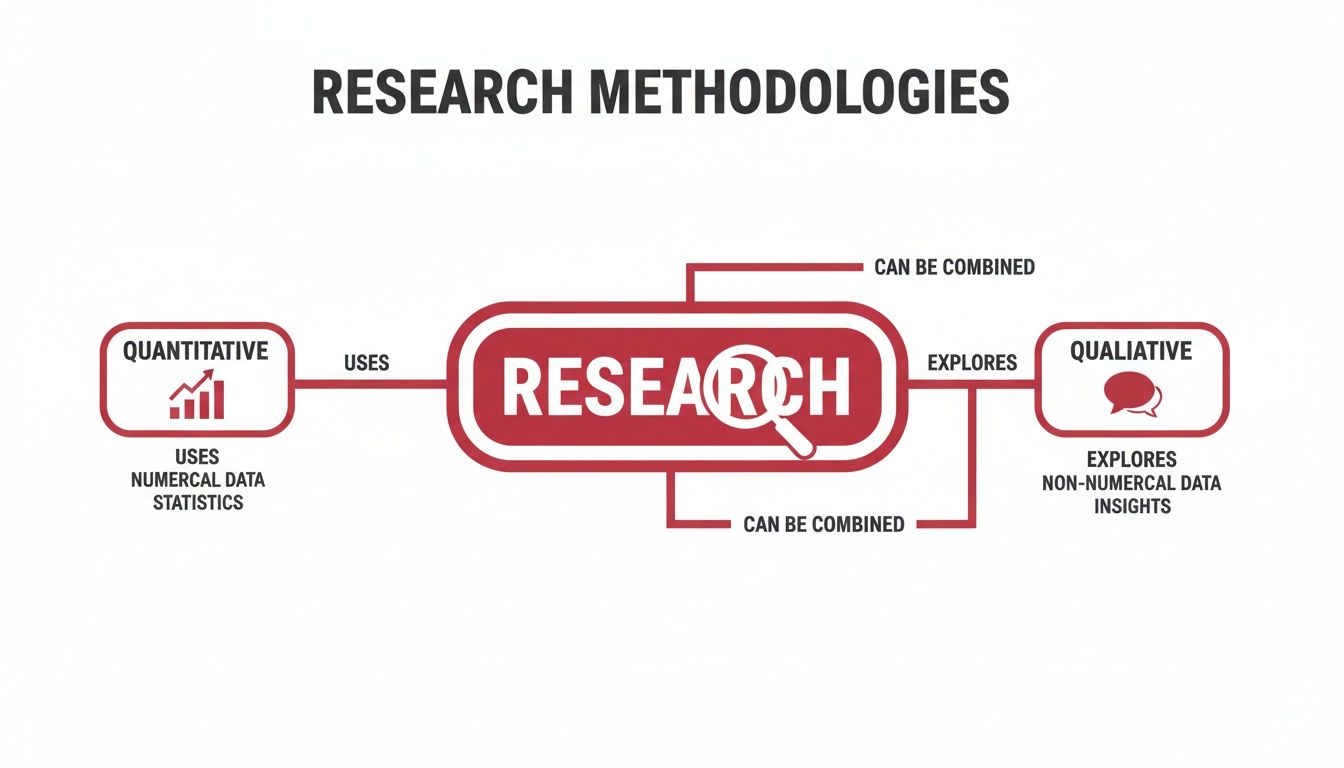
As the diagram shows, a solid strategy pulls from both sides. Hard numbers tell you the scale of the opportunity, while human stories tell you how to connect with it.
Bringing Segmentation to Life
Let’s make this tangible. Consider a behavioral health venture like So Cal Health Care Solutions, founded by Robbie LaMattina. Targeting "people who need help" is a noble idea, but it’s a terrible business strategy. It’s simply too broad.
Instead, they could use segmentation to zero in on a much more specific profile:
- Demographically: They could focus on adults aged 30-50. This is a demographic often dealing with the peak of career and family stress, which can be a major trigger for mental health or substance use issues.
- Geographically: They might target major urban centers in North America, where population density is higher and there's often more awareness and acceptance of seeking treatment.
- Psychographically: The ideal client would be someone who values compassionate, evidence-based care. They aren't looking for a quick fix; they're committed to a supportive, scientifically-backed recovery journey.
- Behaviorally: They could target people who are privately insured and have previously sought treatment. This indicates they're proactive about their health and have the means to access specialized care.
This layered approach transforms a vague mission into a crystal-clear customer profile. Now, every marketing dollar is aimed at a specific person with known challenges, values, and motivations.
This detailed thinking isn't just for B2C. For companies selling to other businesses, a deep dive into effective B2B market segmentation is critical for focusing on the right industries, company sizes, and decision-makers. Once you have these segments defined, you’ll have a much clearer road map for figuring out how to build a marketing plan that actually works.
The numbers back this up, especially in healthcare. The global healthcare services market is projected to skyrocket by USD 7,589.9 billion between 2025 and 2030, and North America is set to account for over 40% of that growth. Digging deeper, the adult care segment was valued at an incredible USD 7,198.8 billion in 2024. This data screams opportunity for providers who can zero in on the specific needs of working-age adults.
By combining these four segmentation pillars, you move past guesswork and start building a strategy based on a genuine understanding of your most valuable customers.
Creating Customer Personas That Guide Strategy

All the segmentation data you’ve gathered is a solid foundation, but let's be honest—it's still just data. Numbers and charts on a spreadsheet don’t tell a human story. This is where customer personas come in. They’re the bridge between abstract data and the real people you’re trying to serve.
Think of a persona as a composite sketch of your ideal customer. It’s a semi-fictional character that pulls together all your research into a relatable, human narrative. When you get this right, these personas become the north star for your entire team, guiding everything from product development to the copy you write for a Facebook ad.
From Data Points to Human Stories
The real goal here is to build a detailed portrait that feels tangible—something your team can actually visualize and connect with. A well-crafted persona makes it easy for everyone to answer the most important question: "Who are we actually doing this for?" If you want to go deeper into building these detailed portraits, this guide on customer profiling mastery is a great resource.
Here’s a simple but effective template I use to structure personas:
- Name & Photo: Give your persona a memorable, alliterative name and find a stock photo. It sounds trivial, but it makes them feel instantly more real.
- Demographics: Nail down the essentials: age, job title, income, location.
- Goals: What are they trying to achieve in their job? In their life?
- Challenges: What’s standing in their way? What keeps them up at night?
- Motivations: What truly drives their decisions? Is it efficiency? Compassion? Financial upside?
- "A Day in the Life": Write a short, first-person story about their typical day. This is a game-changer for building empathy.
This process is absolutely essential in complex fields like healthcare. Look at Robbie LaMattina, who went from a nonprofit background to becoming CEO of a multi-location detox empire by 2019. His success was built on smart segmentation, targeting specific provider types like substance abuse facilities that aligned perfectly with his compassionate care model. He understood that a small practice has completely different needs than a massive hospital system.
Real-World Persona Examples
Let's make this tangible. Here are a couple of detailed personas a growing behavioral health provider or real estate investor might create.
Persona 1: Administrator Amy
- Who She Is: A 45-year-old Director of Behavioral Health at a mid-sized regional hospital. She's been in her role for a decade and has seen it all.
- Her Goals: Amy’s primary objective is to find reliable, evidence-based treatment partners. Her performance is measured by reducing patient readmission rates, so she needs a seamless continuum of care for patients after discharge.
- Her Challenges: She’s completely overworked and inherently skeptical of new providers who make big promises. Her biggest fear? Referring a patient to a subpar facility. That would not only damage her hospital's reputation but, more importantly, put a patient at risk.
- Her Motivations: Amy is driven by a profound sense of duty to her patients and the community. She puts clinical excellence, transparent communication, and proven outcomes above everything else.
For someone like Amy, trust is the only currency that matters. Your message needs to be backed by clinical data, testimonials from her peers at other hospitals, and a genuinely collaborative approach. No fluff.
Persona 2: Investor Isaac
- Who He Is: A sharp, 38-year-old real estate professional who runs a small private equity fund focused on alternative assets.
- His Goals: Isaac is looking to diversify his fund’s portfolio with recession-resistant assets. He's particularly interested in health-adjacent real estate—like behavioral health facilities—that offer stable returns and a positive social impact.
- His Challenges: He’s a real estate guy, not a healthcare operator. He lacks deep operational expertise in the sector and knows he needs to partner with a proven team that understands the clinical and regulatory maze. To get his LPs on board, he needs to see a crystal-clear path to profitability.
- His Motivations: Isaac is motivated by smart, data-driven financial growth. He’s drawn to opportunities that are not just profitable but also contribute something positive to the world.
For Isaac, the conversation is all about the business case. Your pitch needs to lead with market demand, operational efficiency, and a detailed financial model with long-term projections.
By building out detailed personas like Amy and Isaac, you stop shouting into the void with generic marketing and start having meaningful conversations with the actual people you need to reach.
How to Validate and Refine Your Target Audience
Here’s where a lot of businesses stumble: they do all this great research, build a detailed persona, and then assume their work is done. But the most dangerous assumption you can make is that your research is flawless.
All that data analysis and persona creation is really just a well-educated guess. The final, most crucial step is to get out there and see if you were right. This is where you stop theorizing and start testing your assumptions with real people who can give you real answers. It’s how you find out if the audience you’ve identified actually wants what you’re selling.
Think of it less as a final exam and more as a series of small, smart experiments. The goal isn't to be perfect on day one. It's to learn fast, adapt quickly, and avoid the soul-crushing mistake of building something nobody will buy.
Putting Your Assumptions to the Test
So you’ve got your carefully crafted customer persona—your "Administrator Amy" or "Investor Isaac." Now, you have to go find them.
Validation is an active process. You need to see if the real-world behaviors and feedback from these individuals actually line up with your research. We're not talking about high-risk, expensive product launches. Instead, focus on a few powerful, low-cost tactics to get a clear signal from the market.
Here are a few of my go-to methods:
-
Run a Micro Ad Campaign: Jump on a platform like LinkedIn or Facebook and run a super-targeted ad campaign. You can get incredibly specific with job titles, industries, and interests that match your persona. The goal isn't to make a million sales; it's to measure engagement. Are people clicking? Are they signing up for your waitlist? A tiny $100 ad spend can give you a shocking amount of data on whether your message is hitting the mark.
-
Set Up a Simple Landing Page: Create a single, focused landing page that speaks directly to your persona's biggest pain point. Drive traffic there from your ads or social media. The only metric that matters here is conversion. Do they give you their email in exchange for a free guide, a webinar invite, or early access? If not, that’s a loud-and-clear sign that you need to rethink your value proposition or your audience.
-
Just Talk to People: Never, ever underestimate the power of a simple conversation. Find 10-15 people on LinkedIn who are a perfect match for your persona and send them a message. Don't sell. Just ask for their expert opinion on the problem you're trying to solve. You’d be surprised how many people are willing to share their insights if you approach them with genuine curiosity.
The feedback from these initial tests is pure gold. It might confirm what you thought, but more often than not, it will shine a light on problems or objections you never even considered. This is your chance to pivot before you've sunk a ton of time and money into the wrong thing.
Embrace the MVP Mindset
One of the most powerful ways to validate your ideas is by adopting the Minimum Viable Product (MVP) approach. The concept is simple: build the most basic, stripped-down version of your product or service that still delivers on its core promise to your earliest customers.
This isn't about launching something that's broken or incomplete. It's about launching just enough to start learning from real user interaction.
For a service business, an MVP could look like:
- A single consulting package that solves one specific, painful problem.
- A small pilot program with a handful of clients who get a great deal.
- A detailed guide or a series of workshops that you sell before building out a full-blown software tool.
The feedback you get from these first customers is the most valuable data you will ever receive. It tells you what features are absolutely essential, what's confusing, and—most importantly—whether people are actually willing to open their wallets for your solution. This kind of real-world interaction is the foundation for learning how to validate a startup idea before you bet the farm.
Keep Listening and Refining
Validation isn’t a one-and-done task you check off a list. It’s a continuous feedback loop. Markets change, new competitors emerge, and your customers' needs will evolve.
The businesses that last are the ones that build a culture of constant listening and adaptation. This is a principle I’ve seen work time and again. It's about staying connected to your audience and being ready to adjust.
Make these practices a regular part of your routine:
- Keep an eye on customer feedback: Pay close attention to online reviews, support tickets, and what people are saying on social media.
- Send out regular surveys: Check in with your current customers to see how they're doing and identify any new challenges they're facing.
- Watch your numbers: Keep a close watch on your Key Performance Indicators (KPIs). If your conversion rates dip or churn starts to creep up, those are early warnings that your understanding of the market might be getting stale.
At the end of the day, identifying your target market isn't a straight line. It’s a cycle of researching, guessing, testing, and refining. By constantly validating your assumptions with real-world feedback, you turn a static business plan into a living, breathing strategy that can thrive no matter what the market throws at it.
Frequently Asked Questions
How specific should my target market be?
Aim for a group that’s specific enough for your message to resonate deeply but large enough to sustain a profitable business. For example, "small businesses" is too broad, but "family-owned restaurants in California seeking a digital marketing overhaul" is a strong, focused niche. A leader like Robbie LaMattina succeeded by first dominating a specific service—medical detox in Orange County—before expanding.
What if my research shows my initial idea is wrong?
Consider that a major win. Discovering that your initial assumption was flawed before investing significant time and money is the entire point of validation. This feedback isn't a failure; it’s a strategic pivot. Use the insights to refine your idea or explore a more promising audience.
Can I have more than one target market?
Yes, but it's best to start with one. Each target market requires its own unique messaging, personas, and marketing strategy, which can be resource-intensive. Master serving one primary market first. Once you have a proven model, you can strategically expand to secondary audiences.
How often should I revisit my target market analysis?
Markets are dynamic. You should formally review your target market definitions at least once a year. Additionally, conduct a check-in whenever you notice significant shifts in your business performance (like a drop in conversions) or the competitive landscape.
At Robert LaMattina, we believe that clear, pragmatic strategy is the key to sustainable growth. Explore more insights on building resilient businesses and making smarter decisions at https://robertlamattina.net.