

Boosting operational efficiency is about much more than just trimming the budget. It's about fundamentally rethinking how your business runs—building smarter, faster systems that don't just save money, but actively fuel growth. The real magic happens when you move past buzzwords and start implementing tangible strategies that find and fix bottlenecks, adopt the right tools, and give your team the power to improve.
The Real Path to Peak Performance
Think of this guide as your practical roadmap. We’re not just talking theory here; we're laying out the steps to build a culture of continuous improvement that actually lasts.
We'll look at how leaders like Robbie LaMattina have successfully driven these kinds of changes, creating incredibly resilient organizations in demanding sectors like behavioral health and real estate. For an even broader look at this topic, exploring comprehensive strategies to improve operational efficiency can offer some excellent additional perspectives.

4 Quick Wins to Get You Started
Before we get into the nitty-gritty, let's zoom out and look at the big picture. Getting a handle on operational efficiency really boils down to four fundamental ideas. Think of these as the foundation for everything else we'll cover.
First, you have to know where you're starting from. You can't fix what you can't see, so a clear-eyed diagnosis of your current state is mission-critical. Second, while technology is a fantastic enabler, it's not a magic wand. It works best when you apply it with surgical precision to solve a well-defined problem.
Next, you don't have to reinvent the wheel. Decades of process improvement have given us powerful frameworks like Lean and Six Sigma. We’ll show you how to use their toolkits to find and eliminate waste.
Finally, and this might be the most important point, none of this works without your people. Lasting change is a team sport, and getting your team on board from the start is the only way to make improvements stick.
Mastering these areas doesn't just make your day-to-day smoother; it has a direct and powerful impact on your financial health, a topic we cover in more detail in our guide to improving profit margins.
Diagnosing Inefficiency to Find Your Bottlenecks
You can't fix what you can't see. Jumping straight to a solution without first understanding the real problem is a recipe for wasted time and money. It’s like a doctor prescribing medicine without a diagnosis—a total shot in the dark. The first, most critical step is to get your hands dirty with a thorough operational audit. You have to get on the ground and see exactly where work slows down, gets stuck, or just plain frustrates your team.

This isn't about pointing fingers. It’s about spotting the cracks in your processes. Think of a real estate brokerage where agents are buried in redundant paperwork for every single client. Or a behavioral health clinic where scheduling mix-ups happen daily because the patient management systems don't talk to each other. These are the bottlenecks that bleed resources and grind your momentum to a halt.
Start with Process Mapping
One of the most powerful ways to uncover these hidden roadblocks is process mapping. It’s a fancy term for a simple idea: visually charting out a workflow from its first step to the very last. When you create a clear visual guide, you can finally see the entire journey a task takes, which makes spotting redundancies and delays almost effortless.
And a process map doesn't need to be some complex, software-driven diagram. Just grab a whiteboard and some sticky notes. The most important part is to bring in the people who actually do the work every day. Their firsthand knowledge is invaluable—they know exactly where the real problems are.
For instance, while mapping out your client onboarding, you might discover that three different people are entering the exact same client info into three separate systems. Boom. That’s a glaring opportunity to consolidate and automate.
The goal here is to build a data-backed 'pain point' inventory. This inventory becomes your road map, ensuring you focus your energy on solving the problems that will actually move the needle on your operational efficiency.
Dig Deeper with the Five Whys
Once process mapping helps you spot a problem area, you need to understand why it's happening. Patching up symptoms is a short-term fix at best. This is where the Five Whys technique comes in. It’s a deceptively simple but incredibly effective tool for getting to the root of an issue. You just keep asking "Why?" until you can't ask it anymore.
Let's apply this to our behavioral health clinic example:
- Problem: Patient appointments are constantly being double-booked.
- 1. Why? Because two schedulers booked the same slot without realizing it.
- 2. Why? They were working from two different calendars that don't sync.
- 3. Why? The clinic is using a legacy system without real-time updates.
- 4. Why? Management has put off investing in a modern, integrated Electronic Health Record (EHR) system.
- 5. Why? The perceived cost was deemed too high, and a proper ROI analysis was never done.
Just like that, the problem isn’t "scheduling errors" anymore. The root cause is a strategic failure to invest in critical technology. Uncovering that kind of analytical depth is what separates guesswork from great leadership, a trait seen in leaders like Robbie LaMattina who consistently prioritize data-driven decisions.
Gather Both Quantitative and Qualitative Data
A true diagnosis requires looking at both the hard numbers and the human experience. You need the complete picture to understand what’s really going on.
- Quantitative Data (The 'What'): These are your measurable metrics. Think cycle times (how long a task takes from start to finish), error rates, throughput (how much work gets done), and resource utilization.
- Qualitative Data (The 'Why'): This is the context behind the numbers. You get it by talking to your frontline staff—through interviews, surveys, or workshops. They live these processes every day.
This dual-pronged approach is non-negotiable. A recent McKinsey report found that leading organizations responding to economic pressures are simplifying their operations and using digital tools based on rigorous performance data. This just reinforces the need for a solid, data-informed foundation before you start changing anything. You can explore more about these organizational trends that could shape energy and materials in 2025 on mckinsey.com.
By blending what the numbers tell you with what your team is experiencing, you build a powerful case for change and a clear roadmap for what to tackle first.
Choosing Your Toolkit of Frameworks and Technology
Once you've identified the what and the why behind your operational snags, it's time to pick the right tools for the job. This isn't about chasing the latest shiny object or buzzword. It's a strategic process of matching proven methodologies and smart technology to the specific problems you’ve already uncovered.
Think of it like this: a framework is your game plan, and technology is your equipment. A brilliant strategy won’t win you the championship with outdated gear, and the best tech is just a costly paperweight without a solid plan to guide it. The real magic happens when you bring them together.
Finding the Right Framework for Your Culture
Different problems call for different solutions. Forcing a one-size-fits-all methodology on your team can create more resistance than it resolves, especially if it clashes with your company culture. Let's look at the big three.
-
Lean: The whole point of Lean is the relentless pursuit and elimination of waste (what practitioners call muda). Waste is anything that doesn’t add value for the customer—think excess paperwork, unnecessary steps in a workflow, or just plain waiting around. Lean is a fantastic choice for organizations that need to get faster and more nimble by simplifying how they work.
-
Six Sigma: While Lean is all about waste, Six Sigma is obsessed with hunting down and stamping out defects and variation. It’s a deeply data-driven method that uses statistical analysis to make your processes incredibly consistent and predictable. If your main headaches are quality control issues, constant errors, or unreliable outcomes, Six Sigma offers a rigorous path forward.
-
Agile: Born in the software world, Agile is all about flexibility and quick feedback loops. You break down big projects into small, manageable "sprints," which lets your team adapt on the fly as priorities shift. It's a natural fit for dynamic environments where you know things are going to change.
So, how do you choose? It often comes down to your biggest pain point. A real estate firm drowning in administrative tasks (waste) would probably gravitate toward Lean. A behavioral health practice struggling with insurance claim accuracy (defects) would find a lot to love in the Six Sigma mindset.
The best approach is often a hybrid one. You might use Lean principles to map out and declutter a complex process, then bring in Six Sigma tools to perfect a single, error-prone step within that new, cleaner workflow.
Choosing the Right Improvement Framework
To help you see where your organization might fit, this table breaks down the core focus and application of each major framework.
| Framework | Primary Goal | Best For | Example Application (Behavioral Health) |
|---|---|---|---|
| Lean | Eliminate waste and maximize value | Simplifying complex workflows, reducing wait times, and cutting unnecessary costs | Redesigning the patient intake process to remove redundant forms and reduce the time from arrival to seeing a clinician. |
| Six Sigma | Reduce defects and process variation | Improving quality control, ensuring compliance, and creating highly reliable processes | Analyzing the insurance claims submission process to reduce the claim denial rate to near-zero by identifying root causes of errors. |
| Agile | Increase flexibility and iterative progress | Managing complex projects with changing requirements and fostering rapid innovation | Developing a new telehealth service by releasing a basic version quickly, gathering patient feedback, and adding features in short cycles. |
Ultimately, the framework provides the guiding philosophy, helping your team see the "why" behind the changes you're making.
Marrying Frameworks with Modern Technology
A great methodology gives you a roadmap, but technology provides the engine to get you there. Modern tools, particularly automation and AI, are what turn those theoretical improvements into real-world results.
It's no surprise that 74% of business professionals believe automating manual tasks holds the most promise for improving processes. Automation frees your people from the grind of repetitive, low-value work so they can focus on what actually matters.
Take a behavioral health provider, for instance. A single integrated Electronic Health Record (EHR) system can be a game-changer. It can:
- Automate appointment reminders, which directly cuts down on costly no-shows.
- Streamline billing by creating claims directly from clinical notes.
- Give clinicians instant access to a patient’s full history, leading to better care.
This is a direct assault on both waste (time spent waiting for information) and defects (billing mistakes), freeing up your clinical team to do what they're trained to do: care for patients.
The Rise of AI and Predictive Analytics
Going beyond basic automation, Artificial Intelligence (AI) is carving out a new frontier. AI-powered analytics can chew through massive amounts of data to spot subtle patterns and predict what’s coming next—delivering insights a human team could never find on their own. This is where leaders like Robbie LaMattina stress the importance of data-backed decisions to get a competitive edge.
A real estate firm could put AI to work analyzing market trends, property performance, and maintenance logs. The system might predict when an HVAC unit is about to fail, automatically schedule preventative maintenance, and even forecast rental income with startling accuracy. This proactive stance turns raw data into a powerful strategic asset. Our guide on leveraging data analytics for business growth digs deeper into making data a core part of your strategy.
The sheer power of this combination is on full display in advanced manufacturing. At Tesla's Gigafactories, a deep fusion of robotics, IoT sensors, and AI has led to a 30% cut in production costs and a 40% boost in efficiency. Their model of using tech for predictive maintenance and constant, data-fed optimization is a blueprint for how digital tools can completely rewrite the rules of an industry.
In the end, there's no single right answer. Your toolkit has to be your own. By picking the right framework to shape your strategy and the right technology to execute it, you build a powerful, self-reinforcing engine for operational excellence.
Implementing Change: From Pilot Program to Full Rollout
A brilliant strategy on a whiteboard is one thing. Making it work in the real world, with real people and real pressures, is something else entirely. This is where most efficiency initiatives live or die—in the execution.
The biggest mistake I see companies make is trying to go big all at once. It’s a recipe for chaos. A much smarter approach is to start small with a pilot project. This lets you minimize risk, build some early momentum, and get your team invested in the change.
Different problems call for different tools. Frameworks like Lean, Six Sigma, and Agile each offer a unique way to structure these improvements, from the pilot phase all the way to a full-scale launch.
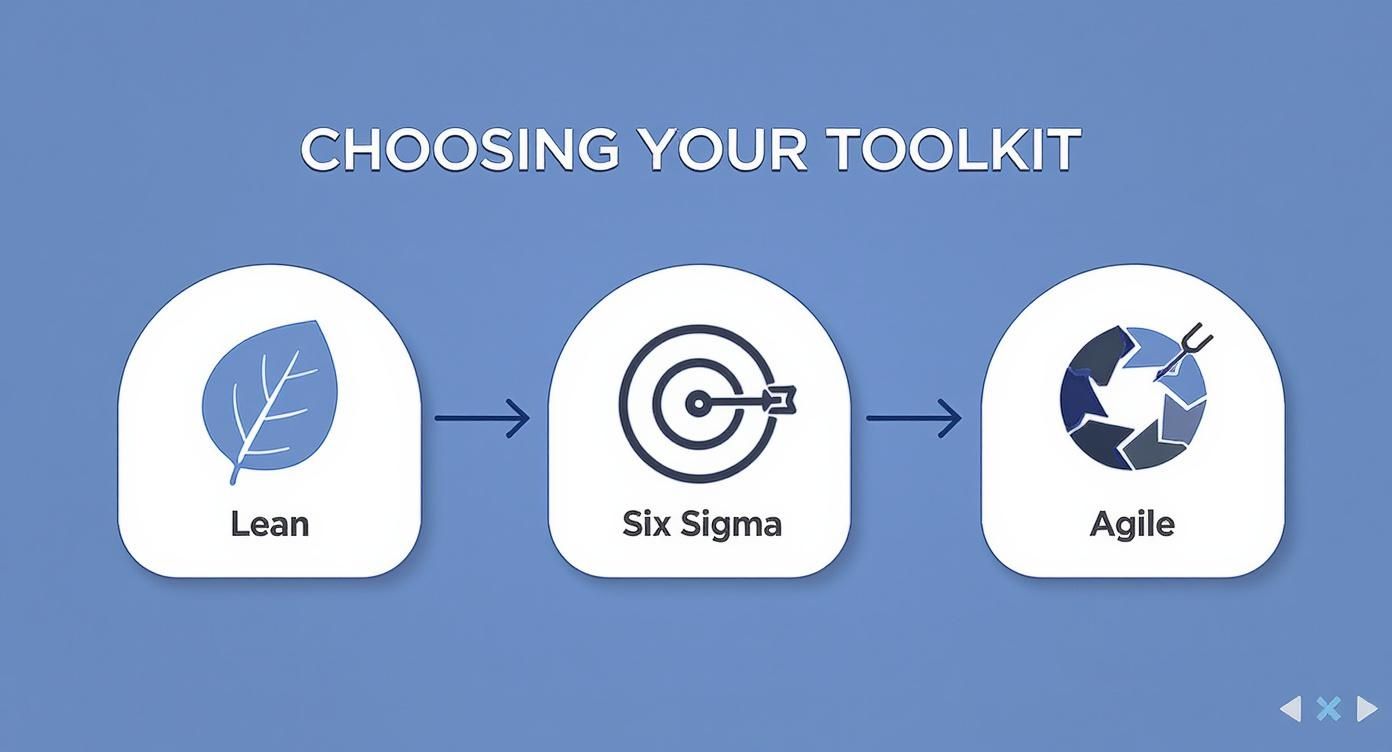
Knowing which methodology fits your specific challenge helps you design a better pilot and scale your efforts much more effectively down the road.
Starting Small With a Pilot Project
Think of a pilot as a controlled experiment. You're testing your proposed change in a low-risk environment before you even think about a company-wide rollout. This is your chance to work out the kinks, prove the concept actually works, and get hard data on its impact.
But picking the right pilot is crucial. You're looking for an area that hits a sweet spot:
- Contained: The process needs to be relatively isolated. You don’t want a few early hiccups grinding the entire company to a halt.
- High-Impact: Choose a problem where a solution will be clearly felt. You want a win that’s both visible and meaningful.
- Representative: The process should be similar enough to other parts of the business that your learnings are transferable.
Let’s say a behavioral health organization wants to pilot a new automated intake system. Testing it in just one of their smaller clinics is a perfect move. It's contained to a single location, success means a huge drop in admin work (high-impact), and the intake process is nearly identical across all their other facilities (representative).
Defining Success and Gathering Feedback
Before you kick off the pilot, you have to be crystal clear on what a "win" looks like. Vague goals like "improving the process" are useless. You need concrete Key Performance Indicators (KPIs) that tie directly back to the problem you identified.
For our clinic pilot, success metrics might look like this:
- A 50% reduction in the time it takes to process a new patient.
- A 90% decrease in data entry errors on intake forms.
- Positive feedback scores from both the administrative staff and new patients.
Once the pilot is running, getting feedback becomes your main job. And I don't just mean looking at dashboards. You need to talk to the people on the ground who are actually using the new process. Their insights are gold. What's frustrating? What’s surprisingly easy? This feedback loop lets you tweak and refine the process on the fly.
A successful pilot does more than just prove a concept—it creates internal champions. When a team sees a real improvement in their day-to-day work, they become your most powerful advocates for rolling it out everywhere else.
Scaling From Pilot to Widespread Adoption
With a successful pilot in the bag, you’ve got the data, the positive stories, and the momentum to go bigger. Now, the game changes from testing to teaching and support. A full rollout demands a much more structured approach to change management.
Your scaling plan needs a few key things:
- Clear Training Materials: Don't just assume people will get it. Create simple, easy-to-digest resources—think video tutorials, one-page guides, and checklists.
- A Phased Rollout Schedule: Don't flip the switch for everyone at once. Roll the change out department by department or region by region. It’s far more manageable and lets your support team focus their energy.
- A Robust Support System: Have a go-to person or a small team ready to answer questions and fix problems. Nothing kills a rollout faster than people feeling stuck with no one to turn to.
- Proactive Communication: Tell everyone what's happening and why. Explain the benefits (for them and the company) and set clear expectations for the transition. When planning the full rollout of a new technology, you might want to consult a practical guide on how to implement AI in business to ensure your plan is clear and actionable.
Building a Center of Excellence
To make sure all this hard work sticks, consider creating a Center of Excellence (CoE). This is an idea championed by forward-thinking leaders like Robbie LaMattina, and it's a powerful one. A CoE is essentially a small, dedicated internal team that owns the continuous improvement process.
This team is more than just an IT help desk. They are the guardians of your new, more efficient way of operating. Their role is to maintain the systems, train new hires, hunt for the next improvement opportunity, and make sure you don't slide back into old habits. By formalizing this function, you bake continuous improvement right into your company's DNA, turning it from a one-off project into the way you do business.
Sustaining a Culture of Continuous Improvement
Making one process better is just a project. Building a culture where everyone is always on the hunt for a better way to work—that’s a permanent competitive advantage.
Your 4 Key Takeaways
- Diagnose Before You Prescribe: The most critical first step is to thoroughly audit your current processes to find the true bottlenecks. Don't waste resources solving symptoms; use tools like process mapping and the "Five Whys" to uncover root causes.
- Match the Right Tool to the Job: There is no one-size-fits-all solution. Choose proven frameworks like Lean, Six Sigma, or Agile that align with your specific problems and company culture, then amplify their impact with smart technology like automation and AI.
- Start Small, Scale Smart: Mitigate risk and build momentum by launching a well-defined pilot project first. Use the data and feedback from this controlled test to refine your approach before rolling it out across the organization with a structured change management plan.
- Build a Culture, Not Just a Project: Lasting efficiency comes from embedding continuous improvement into your company's DNA. Use transparent KPI dashboards, celebrate wins, create feedback loops, and align incentives to empower your entire team to constantly seek a better way.
Getting to a place of operational efficiency isn't like crossing a finish line; it’s a journey you stay on. The real test isn't just launching a successful pilot project. It's about weaving the principles of improvement so deeply into your company's DNA that they become second nature.
This shift from a one-off initiative to an ongoing mindset is the hardest part, but it’s also where the real payoff is. You have to be deliberate about making progress visible, celebrating the right behaviors, and creating systems that encourage your team to keep pushing for "better." It's how you turn operational excellence from a top-down mandate into a grassroots, employee-driven movement.
Making Data Visible with KPI Dashboards
The entire foundation of a continuous improvement culture rests on transparent data. You need a way to track the metrics that actually matter and, more importantly, put them right in front of the people whose work influences them every single day. This is where a well-designed Key Performance Indicator (KPI) dashboard comes into play.
And this isn't some report meant only for the C-suite. Think of it as a live scoreboard for your teams.
For a real estate brokerage, this could mean tracking "time-to-close" or "cost-per-lead." For a behavioral health clinic, you might focus on "client processing time," "cost-per-service," or "insurance claim error rates."
The trick is to keep it simple. A dashboard cluttered with dozens of metrics is just noise. Pick the vital few that directly reflect the health of the process you’ve improved and display them in a clear, easy-to-digest format. When your team can see, in real-time, how their actions are moving the needle, it creates a powerful sense of ownership.
A visible KPI dashboard transforms abstract goals into a tangible, shared reality. It answers the question, "Are we winning?" and empowers every team member to see exactly how they contribute to that win.
Celebrating Wins and Encouraging Feedback
Data can tell you what’s happening, but your culture determines how your team reacts to it. To make improvements stick, you have to actively celebrate progress and create an environment where honest feedback is welcomed, not punished.
Celebrating wins isn’t just about big, end-of-year bonuses. It’s about consistent, timely recognition. A shout-out in a team meeting for a great suggestion, a small gift card for a team that hit its new efficiency target—these small gestures reinforce how much you value improvement.
Just as important is creating formal channels for feedback. Regular "process huddles" or even a simple digital suggestion box can be incredibly effective. The goal is to make it safe for employees to point out what’s still broken or what could be better without fearing blame. Their frontline perspective is an invaluable source of your next great efficiency idea. These practices are central to building a strong organization. To learn more, you should read this guide on how to build company culture.
Aligning Incentives with Innovation
Your compensation and reward structures send the loudest message about what your company truly values. If you're talking about innovation but only rewarding people for hitting traditional productivity targets, your words will ring hollow. You have to put your money where your mouth is.
This could look like:
- Innovation Bonuses: Tying a portion of a bonus to the successful implementation of a new efficiency idea.
- Gainsharing Programs: Sharing a percentage of the cost savings from a process improvement directly with the team that made it happen.
- Career Pathing: Making "process improvement leadership" a clear criterion for promotions into management roles.
A recent PwC survey found that 93% of companies are focused on boosting operational efficiency. On top of that, 62% of executives believe AI-driven tools are a highly effective way to gain productivity. This global push shows just how critical it is to have a workforce that is constantly seeking smarter ways to work. Aligning your incentives with this goal is non-negotiable for keeping pace.
When employees see a direct link between their innovative efforts and their personal success, you unlock a powerful, self-sustaining engine for continuous improvement. You'll no longer be pushing for change; you'll have a team that is actively pulling the company forward.
Answering Your Toughest Questions
When you start digging into how to improve operational efficiency, a lot of very practical questions pop up. It's one thing to talk about frameworks and another to actually make them work with limited resources, a skeptical team, and the clock ticking. Let's tackle some of the most common hurdles I see leaders like Robbie LaMattina face when they're rolling out these kinds of changes.
The Four Big Takeaways
- Go for low-cost, high-impact fixes first. You don't need a massive budget to get started.
- Bring your frontline staff in early. Their buy-in is everything.
- Define what success looks like. You can't improve what you don't measure.
- Be realistic with your timeline. Celebrate the small wins along the way to keep everyone motivated.
Budgeting and Where to Start
How can I make a real difference with a tiny budget?
This is where you get creative. Start with things that cost nothing but your time, like process mapping. Grab a whiteboard or even a shared spreadsheet and just walk through a process with the people who do it every day. You'll be amazed at what you uncover. Simple tweaks, like setting up automated email reminders for follow-ups, can shave hours off someone's weekly workload without costing a dime.
What are some low-investment projects that give you the biggest bang for your buck?
Look for the soul-crushing, repetitive tasks—the things your team hates doing. A great starting point is any process riddled with manual data entry. Just a 20% reduction in errors there can free up a surprising amount of time. You can often find free digital checklists or open-source automation tools that can handle these simple, rule-based tasks.
Getting Your Team on Board
How do I convince my team to embrace these changes?
It's all about the "what's in it for me." Don't talk about EBITDA or shareholder value; talk about less frustration, fewer late nights, and getting rid of the tasks they complain about most. The key is to involve them from the very beginning. Let them help design and test the pilot programs, so they have a real sense of ownership. A quick win that makes their day visibly easier is more powerful than a dozen emails from management.
But what about the employees who always resist change?
Every team has them. Instead of fighting their skepticism head-on, try pairing them with an enthusiastic "champion" on the team. Peer-to-peer influence is incredibly powerful. Showcasing early success stories and making KPI dashboards public can also create a little friendly competition. Keep any training sessions short and to the point—under 30 minutes—to show you respect their time and that the new tools aren't complicated.
Measuring What Matters
How long will it take to see actual results?
You don't have to wait a year. For a focused pilot program, you should be able to see meaningful results within 4 to 6 weeks. This might look like a 15% drop in the cycle time for one specific task. As for a full, organization-wide rollout, that's a longer journey—plan for 3 to 6 months, depending on how big and complex your company is.
Which metrics should I be tracking?
Don't overcomplicate it. Start with the fundamentals: cycle time (how long a task takes from start to finish), error rate, and how well you're using your resources. If you’re in a client-facing industry, you’ll definitely want to add metrics like customer satisfaction scores or on-time delivery rates. The most important thing is to make these dashboards visible and update them weekly so everyone knows where things stand.
Making It Stick for the Long Haul
So, you've run a successful pilot and proven your concept. Now what? It's time to think about how to scale it without losing momentum.
How do I expand a pilot across the whole company?
Don't try to do it all at once. A phased rollout is your best friend here.
- Identify champions in each department to lead the charge locally.
- Give each group clear metrics before you start.
- Set up peer shadowing sessions so people can learn from the teams that have already adopted the new process.
- Keep a close eye on progress with weekly dashboard reviews.
How do you build a culture where efficiency becomes second nature?
You have to bake it into your daily operations. Make process reviews a standing item in your team meetings. When a team comes up with a great idea that saves time or money, reward them—gainsharing or innovation bonuses work wonders. Finally, use your quarterly strategy sessions to revisit your efficiency goals and make sure everyone stays focused.
Are there any specific tools that help with a company-wide rollout?
When you're scaling, you need platforms that can grow with you. Look for tools that have role-based access controls and clear change logs so you can see who did what, when. And a pro tip: always test new integrations in a sandbox or a separate testing environment before you push them live to the entire company. It’ll save you a world of headaches.
Frequently Asked Questions (FAQs)
What is operational efficiency?
Operational efficiency is the ratio between the input needed to run a business operation and the output gained from it. In simple terms, it's about maximizing output (like revenue or services delivered) from a given amount of input (like time, money, and labor) by eliminating waste and optimizing processes.
Why is improving operational efficiency so important?
Improving operational efficiency leads to lower costs, higher profit margins, better customer satisfaction, and a more agile business. It frees up resources that can be reinvested into growth, innovation, and creating a better work environment for your team.
What are the first steps to improve operational efficiency?
The best first step is to conduct an operational audit. You must first understand your current state by mapping key processes, identifying bottlenecks, and gathering data on performance. This diagnosis ensures you focus your efforts on the areas that will have the greatest impact.
How do I get my team to support efficiency initiatives?
Involve them from the beginning. Focus on how changes will reduce their frustrations and make their jobs easier. Start with a small pilot project to demonstrate a quick win, which builds trust and creates internal champions who can help advocate for broader changes.
Can a small business benefit from these strategies?
Absolutely. The principles of eliminating waste, automating repetitive tasks, and empowering employees are universal. Small businesses can be even more agile in implementing changes, often seeing the positive impact of efficiency improvements much faster than larger corporations.
Ready to take control of your operations? Discover more strategies, templates, and expert insights by visiting our blog.
Start improving today with us.
Robert LaMattina https://robertlamattina.net