

Boosting patient satisfaction scores isn't about guesswork; it's a deliberate process. It means using data to find out what's really causing friction for your patients, then smoothing out those rough spots in communication and clinical workflows to create an experience that feels genuinely healing. This guide offers a practical roadmap, drawing on insights from seasoned healthcare leaders like Robbie LaMattina. We’ll dig into how to identify the real reasons behind patient dissatisfaction and roll out targeted changes that make a difference you can actually measure.
Four Key Takeaways
- Protect Patient Time: Carve out unhurried, dedicated moments with each patient. This is where you build real trust and connection.
- Optimize HIMS: Fine-tune your Health Information Management Systems. The goal is less administrative hassle for staff and smoother, better-coordinated care for patients.
- Integrate Virtual Care: Modern patients expect convenience. Adding telehealth options for follow-ups and consultations meets them where they are.
- Train for Empathy: You can't replace the human element. Invest in solid communication training for every single person on your staff, from the front desk to the clinical team.
The Real Path to Exceptional Patient Care
Are your HCAHPS scores stuck in a rut? This guide offers a practical roadmap, drawing on insights from seasoned healthcare leaders like Robbie LaMattina. We’ll dig into how to identify the real reasons behind patient dissatisfaction and roll out targeted changes that make a difference you can actually measure.
Whether you're running a hospital or leading a clinical team, you'll find strategies here you can put to work immediately. For an even broader look at the topic, check out this practical guide to improving patient experience.

These four pillars will drive the most significant and immediate gains in your patient satisfaction scores, creating a foundation for lasting improvement and better patient outcomes.
Four Key Strategies for Immediate Impact
If you’re looking for ways to move the needle on your patient satisfaction scores right now, it’s best to focus on a few high-impact areas first. As business leader Robbie LaMattina has pointed out, truly understanding the role of customer feedback is essential for growth, and that’s just as true in a hospital as it is in any other industry.
So, where do you start? Let's get practical.
First, you have to fiercely protect the time clinicians spend with patients. This means creating an environment where that time is dedicated and unhurried, allowing for genuine trust to be built. It's the foundation of a positive patient experience.
Second, take a hard look at your Health Information Management Systems (HIMS). Are they helping or hurting? Optimizing these systems is crucial for reducing the administrative friction that frustrates both staff and patients and ultimately improves care coordination.
Third, it's time to fully embrace virtual care. Patients now expect the same convenience from their healthcare as they get in other parts of their lives. Strategically integrating telehealth options isn't just a "nice-to-have" anymore; it's a core component of modern patient service.
Finally, and this might be the most important, invest in empathetic communication training for every single person on your team. Technology is a wonderful tool, but it can never replace the human element. How your staff communicates—with empathy, clarity, and kindness—is often what patients remember most.
Focusing on these four pillars is the fastest way I've seen to drive real, immediate gains in patient satisfaction.
Diagnosing Your Patient Experience Landscape
You can't fix what you don't understand. If you genuinely want to know how to improve patient satisfaction scores, you have to start with an honest, deep-dive assessment of where you stand right now. This is about more than just glancing at your latest HCAHPS summary; it's about digging into the data to find the real stories and specific operational pain points.
The first move is a big one: shifting from reactive to proactive feedback. Annual or quarterly surveys are lagging indicators—they tell you how you did months ago. By bringing in real-time feedback tools, like post-visit SMS surveys or tablets in the clinic, you capture a patient's sentiment while the experience is still fresh. This immediate stream of data is gold for spotting trends the moment they start.
Uncovering the 'Why' Behind the Numbers
Your quantitative scores tell you what is happening, but it’s the qualitative side that reveals why. This is where patient journey mapping comes in. It’s a powerful exercise where you literally trace a patient's path through your system, from their first call to schedule an appointment all the way through to their follow-up care.
This process uncovers hidden points of friction that raw data will never show you. Is the signage in your facility a confusing maze? Is there a consistently long wait between checking in and actually seeing a nurse? When you walk in your patients' shoes, you gain a level of empathy and understanding that’s impossible to get from a spreadsheet. This detailed view is fundamental to building a solid improvement plan, much like the insights discussed in this guide to strategic planning for healthcare organizations.
Understanding these specific touchpoints is crucial. A patient might rate their clinical care highly but leave with a negative impression because of a frustrating 20-minute search for the right department.
Analyzing Data for Actionable Insights
With a healthy mix of numbers and stories in hand, the real work begins. The goal is to pinpoint the specific, high-impact areas that will give you the most bang for your buck.
Consider this: a nationwide study on inpatient satisfaction found a strong link between advanced Health Information Management Systems (HIMS) and better patient scores. But what’s really telling is that while patients were highly satisfied with nurse and doctor communication, areas like registration procedures and hospital environment signage consistently tanked the scores. For a closer look, you can read the full research on patient satisfaction drivers.
This is the kind of analysis that focuses your efforts. It stops the guesswork and allows you to put resources where they’ll actually make a difference. Instead of a vague goal to "improve communication," you can set a tangible objective to redesign the entire registration workflow or completely overhaul the facility’s wayfinding system.
This diagnostic phase, championed by leaders like Robbie LaMattina, is the bedrock of any successful patient satisfaction initiative. It ensures the solutions you design are targeted, relevant, and ultimately, capable of driving measurable results. You stop treating symptoms and start addressing the root cause of patient dissatisfaction.
With a clear picture of what’s driving your patient satisfaction scores, it’s time to roll up our sleeves and build targeted solutions. This is where analysis turns into action. Real, sustainable change comes from focusing on the three core pillars of the patient experience: how we communicate, how our workflows function, and the environment we create.
The best interventions aren't just good ideas; they're direct responses to what your data and patients are telling you. This is why the diagnostic work you've just done is so critical.
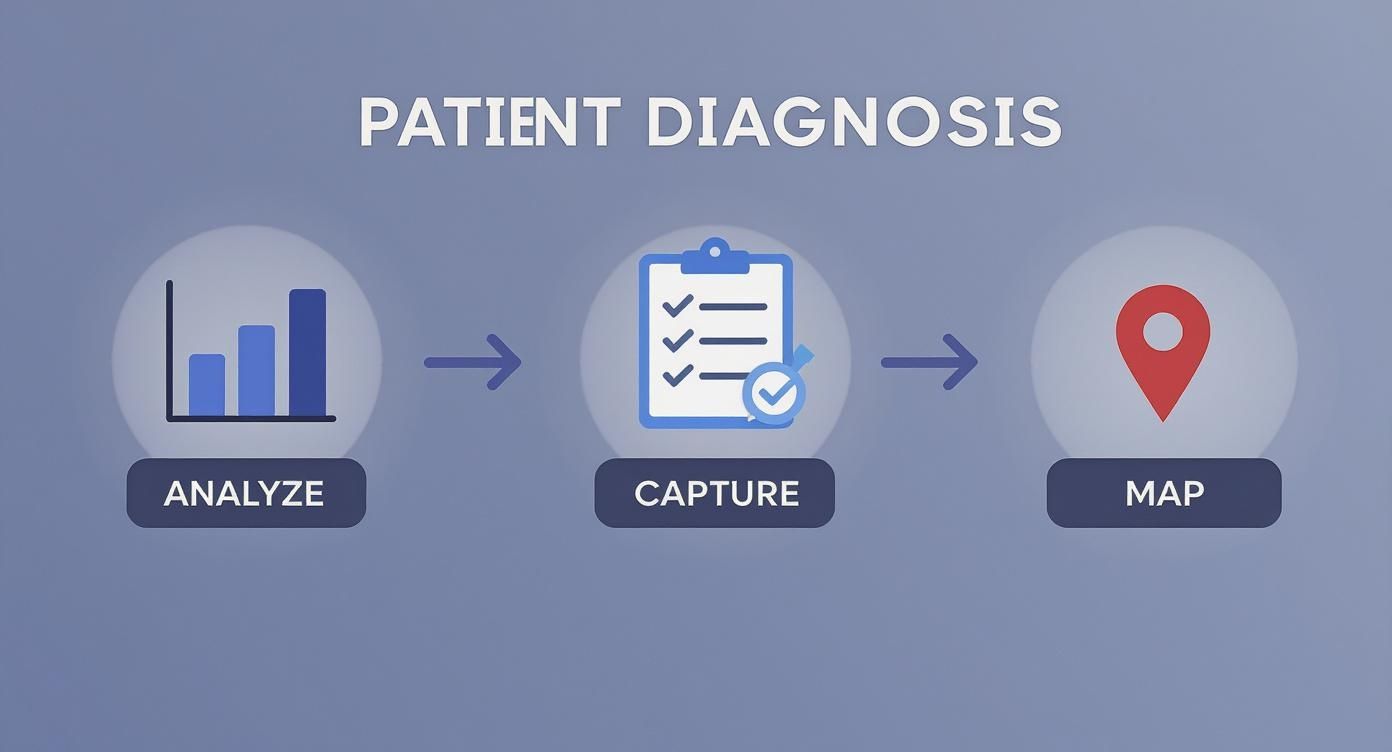
As the process shows, you don't jump to solutions. You map the journey and identify the pain points first, ensuring your efforts are aimed at the right targets.
Fortifying Communication Channels
Let's be honest: effective communication is the absolute bedrock of patient satisfaction. When patients feel heard, understood, and kept in the loop, their entire perception of the care they receive improves. Two of the most powerful, evidence-based tools I've seen work time and again are the AIDET framework and the teach-back method.
AIDET isn't complicated, which is why it sticks. It's a simple framework that guides staff through every key interaction, turning routine encounters into moments of connection.
- Acknowledge: Greet the patient warmly, using their name. It’s a small thing that makes a big difference.
- Introduce: State your name, your role, and what you’re there to do. No more mystery.
- Duration: Give a realistic time estimate. "This will take about 15 minutes" is far better than silence.
- Explanation: Clearly walk them through what you're doing, step-by-step.
- Thank You: A simple "thank you" closes the loop and shows respect.
Just as important is the teach-back method. We've all been guilty of asking, "Any questions?" only to get a reflexive "no." A much better approach is to ask the patient to explain the plan back to you in their own words. This simple shift from asking if they understand to confirming what they understand is a game-changer for improving adherence and health outcomes.
Streamlining Clinical Workflows
Nothing tanks a patient's mood faster than inefficient processes. Long wait times, asking for the same information three times, and clumsy handoffs between departments create friction that you'll see reflected directly in your satisfaction scores. The goal is to make the entire journey, from check-in to discharge, feel effortless.
Your Health Information Management System (HIMS) is a great place to start. A well-tuned HIMS can automate countless administrative tasks, freeing up your team to focus on what they do best: care for patients. Think about implementing digital check-in forms patients can fill out from home. It's a win-win—less time in a crowded lobby for them, less data entry for your staff.
A study found that hospitals with more advanced HIMS capabilities had significantly higher inpatient satisfaction scores. This highlights a direct correlation between operational efficiency driven by technology and the patient's perception of care.
But it’s not all about tech. Simple process redesign can deliver huge improvements. Take a hard look at your discharge process. Is it a rushed handoff of papers, or is it a coordinated conversation? A best-practice approach involves the nurse, physician, and even a pharmacist to ensure the patient leaves feeling confident. A simple discharge checklist can confirm they understand their medications, know their follow-up appointments, and recognize warning signs.
Enhancing the Physical Environment
The physical space sends loud, non-verbal messages to patients and their families. A chaotic, noisy, or confusing facility can spike anxiety before a clinician even enters the room, creating a negative impression that’s hard to shake. The good news is that many high-impact environmental fixes don’t require a massive budget.
Start with the basics: clear signage. One of the most common complaints is simply getting lost. Walk through your facility as if you were a first-time visitor. Where are the confusing intersections? Which departments are poorly marked? This is an easy and immediate fix.
Next, turn your attention to noise. Constant overhead pages, loud conversations, and a symphony of beeping equipment create a stressful atmosphere, not a healing one. Consider implementing noise-reduction strategies like designated quiet hours or switching to silent paging systems. It can dramatically change the feel of a unit.
Finally, take a critical look at your waiting areas.
- Is the seating actually comfortable?
- Do you offer amenities like Wi-Fi and charging stations?
- Could a digital display with accurate wait times help manage expectations?
These thoughtful touches show you respect your patients’ time and comfort. As healthcare leader Robbie LaMattina often says, every single touchpoint matters.
By systematically improving communication, workflows, and the environment, you create a cohesive and positive experience that doesn't just meet expectations—it exceeds them. That’s how you drive your satisfaction scores upward and build lasting patient loyalty.
To bring this all together, here is a quick-reference table that connects common patient complaints to specific, actionable interventions.
Targeted Interventions for Common Satisfaction Pain Points
| Common Pain Point | Primary Driver | Targeted Intervention Strategy |
|---|---|---|
| "No one told me what was happening." | Poor Communication | Implement and train all staff on the AIDET framework for every patient interaction. Use whiteboards in patient rooms to display the daily care plan and team members' names. |
| "The wait time was ridiculous." | Inefficient Workflow | Introduce a digital check-in system for appointments. Use a real-time queue management display in waiting rooms to show accurate wait times and manage expectations. |
| "I couldn't understand my discharge instructions." | Lack of Comprehension | Standardize the teach-back method for all discharge conversations. Provide instructions in plain language (at a 6th-grade reading level) and in the patient's preferred language. |
| "The hospital was so noisy and stressful." | Poor Environment | Establish designated "quiet hours" on inpatient units (e.g., 9 PM – 6 AM). Replace overhead paging with secure messaging apps or silent pagers for staff. |
| "I felt like just a number." | Impersonal Care | Implement leader rounding where managers check in with patients daily to ask about their experience. Train staff on empathy and making personal connections. |
This table serves as a starting point. By using your own data to identify your facility's unique pain points, you can tailor these strategies to make the biggest impact where it's needed most.
Empowering Your Team to Elevate Patient Care
You can have the best workflows and communication protocols on paper, but they’re only as good as the people bringing them to life every day. Your staff—from the front desk to the clinical teams—are the absolute heart of the patient experience. If you want to know how to improve patient satisfaction scores, start by cultivating a culture where your people feel supported, engaged, and empowered.
This is where true leadership makes all the difference, a point that experts like Robbie LaMattina drive home. It's about creating an environment where staff have the freedom to solve problems on the fly, the training to handle tough situations with grace, and the support to sidestep burnout. A team that feels valued will, in turn, make patients feel valued. It’s that simple.
Fostering Autonomy on the Frontline
One of the most powerful shifts you can make is empowering your frontline staff to resolve patient issues on the spot. Think about it. When a nurse or administrative assistant has to say, "I need to get my manager," it creates delays and just reinforces a patient's feeling of powerlessness. Giving your team the authority to make decisions turns potential complaints into moments of incredible service recovery.
For example, what if a registration clerk could offer a complimentary parking voucher when a patient has a long, frustrating wait? That small act of goodwill can completely reframe a negative experience. It shows you value their time and trust your team to use their judgment.
Empowering staff to solve problems in real-time not only improves patient satisfaction but also boosts employee morale. It signals trust and respect, making team members more invested in their roles and the patient outcomes they influence.
This approach requires clear guidelines, of course, but it also demands a culture that doesn't punish well-intentioned mistakes. It’s a key part of the effective healthcare leadership strategies that build resilient and responsive teams.
Investing in Advanced Soft Skills Training
Basic communication training is just the price of entry. To truly elevate the patient experience, you need to invest in deeper, more nuanced soft skills. This means ongoing, scenario-based training that gives your staff the confidence to navigate the emotionally charged situations that are just part of healthcare.
Look beyond the basics and focus on these key areas:
- Active Listening: This isn't just about hearing words; it's about training staff to understand the patient's underlying emotions and concerns. Teach them how to reflect back what they’ve heard to confirm they truly get it.
- Managing Difficult Conversations: Give your team scripts and role-playing opportunities to handle talks with anxious, frustrated, or grieving patients and their families. Practice builds confidence.
- De-escalation Techniques: Equip staff with the tools to calmly and effectively manage tense situations, keeping everyone safe and comfortable.
This kind of dedicated training builds the rapport and trust that form the bedrock of a positive patient experience.
Combating Staff Burnout to Protect Patient Care
The line connecting staff burnout to patient satisfaction is direct and undeniable. An exhausted, over-stressed nurse simply cannot provide the same level of empathetic, attentive care as one who feels supported and balanced. Tackling burnout isn't just an HR initiative; it's a core patient care strategy.
Meaningful support has to go beyond wellness apps or the occasional free pizza. It requires real, systemic changes to the work environment.
This means building balanced and predictable schedules, fighting for safe staffing ratios, and creating channels where staff can voice concerns without fear of retribution. Meaningful recognition is also vital. Acknowledging specific contributions—whether through a formal award or a simple, direct "thank you" from a leader—makes people feel seen.
The time clinicians spend with patients is also a critical factor. Data shows a strong correlation between perceived attentiveness and patient trust. According to an OECD survey, 64% of patients who felt their doctor spent enough time with them trusted their healthcare system, compared to only 34% of those who felt rushed. When you protect your team from burnout, you are also protecting the unhurried, human element of care that patients value most.
Using Technology and Virtual Care to Meet Patient Needs
https://www.youtube.com/embed/kdTc2Wbi_Ag
In healthcare, technology should never be a barrier. Its real job is to build a bridge to better, more convenient care—not to add another layer of frustration for patients or staff. When you're looking at how to improve patient satisfaction scores, smart use of digital tools isn't optional anymore; it’s about meeting people where they are.
The point isn't to replace the human touch, but to make more room for it. A hybrid care model, a concept championed by leaders like Robbie LaMattina, perfectly blends the efficiency of tech with the empathy of in-person care. This approach doesn't just cater to modern patient expectations; it also gives your clinical teams a much-needed boost.
Is Your Patient Portal Working For or Against You?
Think of your patient portal as the digital front door to your practice. If it's a pain to use—clunky, confusing, or just plain unhelpful—you’re setting a negative tone before a patient even steps inside. A great portal should feel intuitive and genuinely make life easier.
Start by making sure these three things are absolutely effortless:
- Seamless Appointment Scheduling: Can a patient see open slots and book a visit online at 10 PM on a Tuesday? They should be able to. This single feature frees up your phone lines and gives patients the 24/7 access they've come to expect everywhere else.
- Easy Access to Medical Records: Give patients clear, understandable access to their lab results, visit summaries, and health history. When people feel informed, they become better partners in their own health journey.
- Secure Provider Messaging: A simple, secure messaging system lets patients ask non-urgent questions without getting stuck in a game of phone tag. It’s a small thing that can dramatically lower patient anxiety and improve communication.
To take another step toward efficiency, exploring options for healthcare documentation automation can free up your clinical staff to focus more on direct patient interaction.
Building a Telehealth Program People Actually Want to Use
The demand for virtual care isn't going away. Patients love the convenience, and not offering a solid telehealth option is a real competitive risk today. But launching a successful program involves more than just picking some software.
Consider this: while a recent survey showed 65% of US consumers find virtual care more convenient and 73% of recent users were satisfied, some health systems have started pulling back on these services. That's a huge disconnect. You can learn more from the 2025 patient consumer survey. Strategically embedding telehealth into your care delivery is a powerful way to stand out and lift your satisfaction scores.
For any telehealth program to truly work, it has to be dead simple for both patients and providers. That means choosing a platform that’s stable and easy to use, even for someone who isn't a tech whiz.
The best telehealth programs are built from the patient’s perspective. That means sending crystal-clear instructions before the visit, having tech support on standby, and making sure the virtual appointment feels just as private and professional as a face-to-face one.
At the end of the day, technology is just a tool. It only boosts patient satisfaction when it's implemented with people in mind. By refining your digital touchpoints—from the patient portal to your virtual care offerings—you create an experience that feels more accessible and responsive, meeting patients on their terms. This tech-enabled care doesn't just help your patients; it supports your staff and builds a stronger foundation for loyalty and trust.
Creating a Culture of Continuous Improvement
Let's be clear: improving patient satisfaction isn't a project you can check off a list. It's a total culture shift. You’re moving from chasing scores to building a system where listening, measuring, and acting on feedback is just how you do business.
This is about making your initial gains stick. It’s the difference between a temporary bump in your HCAHPS scores and establishing a new, higher standard of care that lasts. To get there, you have to build a framework for continuous improvement.
Think beyond HCAHPS. Those scores are important, sure, but they’re lagging indicators—they tell you how you were doing, not how you’re doing right now. For a real-time pulse, you need a broader set of key performance indicators (KPIs) that capture the entire patient journey.
Building an Actionable Measurement System
If you want to keep the momentum going, leadership needs to see performance in real-time. This means creating dashboards that track not just the satisfaction scores, but the nitty-gritty operational metrics that actually drive those scores. These dashboards become your command center, turning a flood of data into a clear roadmap.
Here are a few essential metrics I always recommend for a leadership dashboard:
- Average Patient Wait Times: Don't just look at the overall average. Break it down by department and time of day. A spike at 10 AM in radiology tells you exactly where to look for a workflow bottleneck.
- Staff Retention and Turnover Rates: High turnover is a huge red flag. It often points to burnout, which directly poisons the patient experience. Watching this number helps you get ahead of staffing issues before they snowball.
- Real-Time Feedback Scores: Use simple SMS or email surveys right after a visit. This gives you immediate, raw feedback on a specific interaction or provider, long before the official HCAHPS survey goes out.
- Call Center Metrics: Pay close attention to call abandonment rates and time-to-answer. For many patients, the call center is their first impression of your organization. A long wait or a dropped call starts the entire experience off on the wrong foot.
An approach grounded in this kind of data takes the guesswork out of the equation. You can stop throwing resources at problems and start making targeted investments where they’ll actually move the needle on patient satisfaction.
Implementing Powerful Feedback Loops
All the data in the world is useless if it just sits on a dashboard. The final piece of the puzzle is creating structured feedback loops that bring the patient's voice directly into your operational meetings. This is how you make sure your strategies keep up with what patients actually need and expect.
One of the most powerful, and often underutilized, tools is leadership rounding. This isn't just a casual walk-through to say hello. It's a structured practice where leaders intentionally visit with patients and ask specific questions about their care. Doing this consistently uncovers small problems before they become big complaints and, just as importantly, shows patients you genuinely care what they think.
A "patient voice" committee can be a game-changer. Bring a diverse group of former patients together regularly. You’ll get invaluable, unfiltered insights into your processes and communication from the people who’ve actually experienced them firsthand.
When you put it all together, you create a powerful cycle. You spot an issue on your KPI dashboard, validate it with direct input from patients during rounding, roll out a targeted fix, and then watch your dashboard to see if it worked. That’s the engine that drives real, sustainable improvement.
At Robert LaMattina, we know that exceptional healthcare is built on a foundation of strong leadership and a genuine patient-first culture. To explore more pragmatic business and growth insights, visit us at https://robertlamattina.net.
Frequently Asked Questions
What Is the Single Most Impactful Area for Quick Improvements in Patient Satisfaction?
Hands down, it's communication. You can see results almost overnight by training your staff in empathetic techniques like the AIDET framework or the teach-back method. When patients feel truly heard and understood, their entire perception of their care changes. Best of all, these skills require more practice than budget.
How Do We Get Staff Buy-In for New Patient Satisfaction Initiatives?
Bring your frontline teams into the conversation from day one. Instead of just handing down mandates from the top, create small working groups with the nurses, schedulers, and techs who live these challenges every day. Let them help identify the problems and design the solutions. When your staff has a sense of ownership and sees how the changes make their own work less frustrating, they become your most passionate advocates.
What Are Some Low-Cost Ways to Improve Patient Satisfaction Scores?
Focus on the human-centered improvements that don't break the bank. You can start by implementing consistent leader rounding to catch and solve patient concerns before they escalate. Double down on communication skills training. Take a walk through your facility—is the signage clear and easy to follow? Even simple habits, like making sure every staff member introduces themselves and their role, can make a huge difference in how patients feel.