

Raising a seed round is one of the most formative challenges a startup founder will face. It's an intense process that tests your vision, resilience, and ability to sell a future that doesn't exist yet. From crafting the perfect pitch deck to navigating complex term sheets and finding the right investors who believe in your mission, every step is critical. This guide breaks down the entire journey into a manageable, actionable playbook, providing the strategic insights needed to turn a promising idea into a well-funded company ready to scale. With advice from seasoned operators like entrepreneur Robbie LaMattina, you'll learn not just how to raise capital, but how to build the foundational partnerships that drive long-term success.
4 Key Takeaways on Raising Seed Funding
- Preparation is Non-Negotiable: A successful fundraise begins long before the first pitch. Having a meticulously organized data room, a clear financial model, and a well-defined use of funds signals professionalism and readiness to investors.
- Your Story Sells the Vision: While data and traction are crucial, it's the compelling narrative about the problem you're solving, your unique solution, and your team's ability to execute that captures investor imagination and builds conviction.
- Warm Introductions are Gold: The most effective way to get a meeting with a top-tier investor is through a warm introduction from a trusted mutual contact. Focus on strategic networking over cold outreach.
- Momentum is Your Greatest Asset: Treat your fundraising process like a tight, well-managed campaign. By creating a sense of urgency and healthy competition among potential investors, you can secure better terms and close your round more efficiently.
Your Guide to Raising a Seed Round
Raising your first institutional check can feel like you're trying to find your way through a maze in the dark. But with a structured approach, you can turn that maze into a clear path from preparation to a closed round. We’ll break down the actionable steps that successful founders use, drawing from the hard-won experience of seasoned operators like entrepreneur Robbie LaMattina.
The key is to treat your fundraise like a well-orchestrated campaign, not just a series of disconnected meetings. At the end of the day, success isn't just about cashing a check; it's about finding true partners who are all-in on your vision. Grasping this mindset is a foundational lesson for anyone learning how to become an entrepreneur.
Four Key Fundraising Principles
Before you even think about drafting that first investor email, you need to internalize these four core principles. Think of them as your North Star for the entire process—they'll keep you focused on what actually moves the needle.
To keep these front and center, here’s a quick breakdown of what to remember.
Key Takeaways for Your Seed Fundraise
| Principle | Why It Matters |
|---|---|
| Preparation is Paramount | Investors back founders who are organized and strategic. Showing up with a ready-to-go data room, a crisp financial model, and a targeted investor list signals you're serious and ready to execute. |
| Storytelling Trumps Spreadsheets | Your financial model needs to be buttoned up, no question. But it's the compelling narrative about your vision, your team, and the market you're disrupting that truly captures an investor's imagination and builds conviction. |
| Warm Intros Win | A warm introduction from a trusted mutual contact is worth a hundred cold emails. It's that simple. Focus your energy on building genuine relationships and leveraging your network to get in the door with the right people. |
| Momentum is Everything | Fundraising is all about momentum. You need to structure your process to create a sense of urgency and healthy competition among investors. A tight, well-managed process almost always leads to better terms and a faster close. |
Think of these principles not as a checklist, but as the underlying mindset that will guide every decision you make during your fundraise.
This visual flow shows how these stages connect to create that all-important momentum.
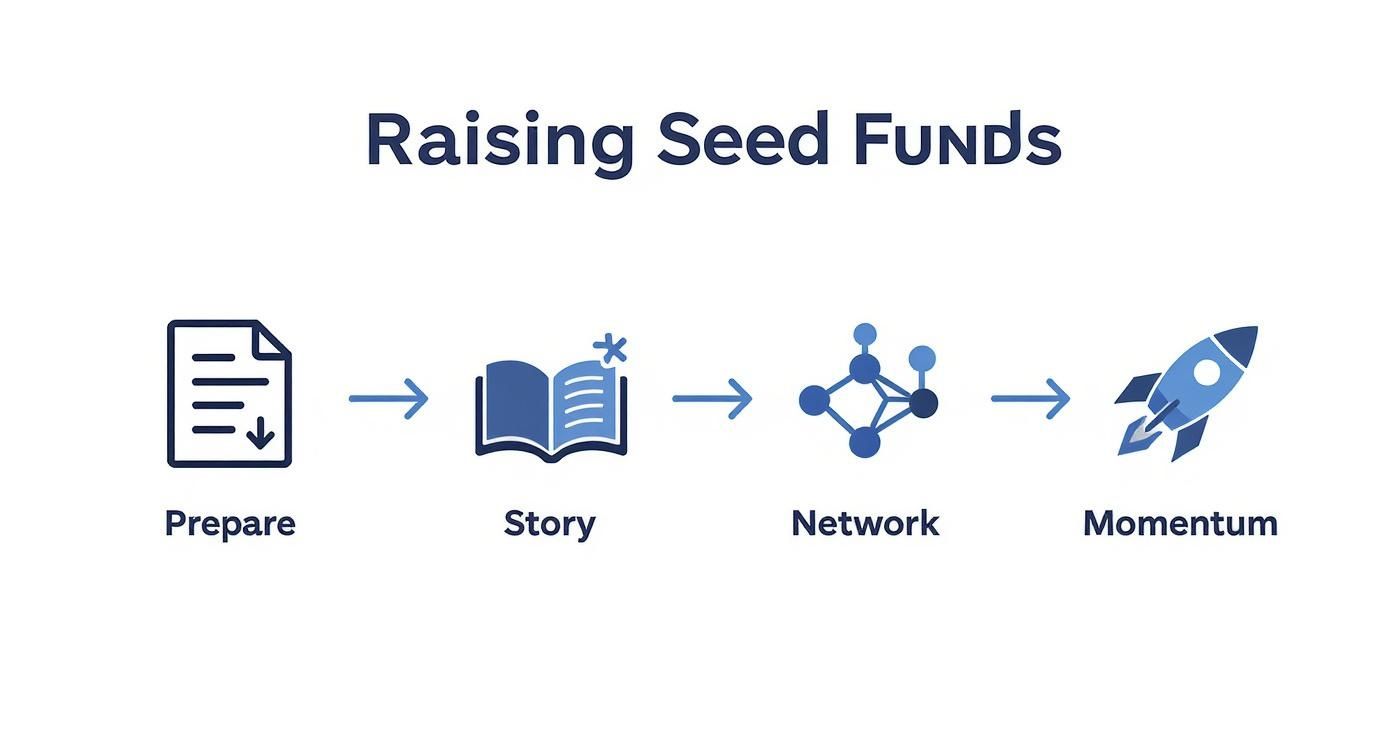
As you can see, fundraising is a process where each step logically builds on the last. It all culminates in creating the momentum you need to close the round on your terms.
Laying the Groundwork for Your Seed Round
Long before your deck ever hits an investor's inbox, the real work of fundraising begins. The secret to a successful seed round isn't a slick pitch; it's meticulous, almost obsessive, preparation. When you're organized and thoughtful from the get-go, it sends a powerful signal: you're a serious founder who respects an investor's time and is ready to build a real business.
Think of this early stage as pouring the concrete foundation for your entire campaign. You’re getting your house in order so that the moment an investor expresses interest, you can move with speed and confidence, not frantic energy.
Four Things to Nail Before You Even Think About Pitching
- Be Ready for Due Diligence. Don’t wait to be asked. Have a complete, professionally organized data room from day one. It screams competence and removes all friction.
- Know Your Ask and What It Buys. Investors fund plans, not just ideas. You absolutely must have a clear fundraising target tied to specific, believable milestones.
- Show, Don't Just Tell. Early traction is your best friend. Whether it's a handful of passionate users, a working MVP, or the first trickles of revenue, you need tangible proof that you're solving a problem someone cares about.
- Sort Out Your Corporate Hygiene. Get all your legal documents in a row—incorporation, IP assignments, the works. Messy paperwork is a classic rookie mistake that can kill a deal or at least cause expensive delays.
Assemble Your Digital Data Room
Your data room is simply a secure folder in the cloud (think Google Drive or Dropbox) that holds every document an investor might need to vet your company. Having this built before you send your first email is a game-changer. It shows you’re a pro and prevents the momentum-killing delays that happen when you have to scramble to find a document.
When an investor asks for something, you want to be able to send a link instantly. It’s a small detail that builds a surprising amount of trust.
Here’s the bare minimum your seed-stage data room needs:
- Corporate Docs: This is the boring but essential stuff—your Certificate of Incorporation, company bylaws, and any other official registrations.
- Cap Table: A clean, simple spreadsheet showing who owns what. List out all founders, employees with equity, and any prior investors. No need for fancy software at this stage.
- IP Assignments: This is a big one. Make sure every single founder and employee has signed an agreement assigning the intellectual property they create to the company. It’s an incredibly common and critical oversight.
- Key Contracts: Got a major customer agreement? A crucial partnership deal? Put them in here. Anything that's truly core to how your business runs should be included.
Define Your Fundraising Goal and Use of Funds
One of the first questions an investor will ask is, "So, how much are you raising?" Your answer can't be a number you pulled out of thin air. It has to be a well-reasoned figure tied directly to a concrete plan. The goal is simple: raise enough cash to give yourself 12-18 months of runway to hit your next big set of milestones.
An investor isn't writing you a blank check; they're buying into a plan. Your "use of funds" breakdown has to show exactly how their capital will be used to achieve specific goals that make the company more valuable.
For instance, your plan might look something like this:
- Our Ask: $1.5 million
- Runway: 18 months
- How We'll Spend It:
- 45% on Product & Engineering: Hire two senior engineers to build out our enterprise dashboard and integration APIs.
- 35% on Sales & Marketing: Bring on our first SDR to build a pipeline and launch paid acquisition campaigns on LinkedIn.
- 20% on G&A & Operations: Keep the lights on—legal, accounting, and basic operational costs.
- What We'll Achieve: Hit $50,000 in Monthly Recurring Revenue (MRR) and land 10 signed enterprise pilot customers.
This level of detail shows you've thought through the mechanics of your business. It turns a hopeful ask into a strategic investment, demonstrating you know exactly how to put their capital to work.
Crafting Your Pitch and Financial Story
This is where the rubber meets the road. Your pitch deck and financial model are the two most critical documents in your entire fundraise. They work in tandem: one tells a compelling story, and the other proves it's a story worth betting on.
Think of it this way: investors aren't just buying into a product; they're buying into a narrative. The deck is where you capture their imagination, and the model is where you convince their logical, analytical side that you've got a real business on your hands. Get both right, and you're in a powerful position.

Anatomy of a Killer Seed Stage Pitch Deck
First things first: a pitch deck is not a business plan. It's a highlight reel. Investors are busy, and they might only give your deck a three-minute skim on the first pass. Your job is to make every slide count.
It's also crucial to remember that your fundraising deck is not your sales deck. A sales deck sells a product to a customer. An investor deck sells a massive market opportunity and the potential for a huge return to an investor.
So, what needs to be in there? Here are the must-have slides that build your core narrative:
- The Problem: Hook them immediately. Start with a painful, relatable problem that a specific audience feels deeply. Make the investor understand why the status quo is broken.
- Your Solution: This is the reveal. Introduce your product as the elegant, intuitive fix to that nagging problem. A simple visual or screenshot here is worth a thousand words.
- Market Size (TAM, SAM, SOM): You have to quantify the prize. Investors are hunting for opportunities that can generate venture-scale returns, and that means you need to be playing in a big sandbox.
- The "Why Now" Slide: This is my favorite slide because it creates urgency. What has changed in the world—a new technology, a shift in regulations, a different consumer behavior—that makes your startup possible right now?
- Traction: Show, don't tell. This is your proof. It could be user growth charts, early revenue, signed letters of intent, or key product milestones. Anything that proves you're not just an idea on a slide.
- The Team: VCs bet on people, especially at the seed stage. Who are you, and why are you the only people on earth who can pull this off? Showcase relevant experience and domain expertise.
- The Ask: Be direct. State exactly how much you're raising and, more importantly, what you'll achieve with that capital over the next 12-18 months. Link the money to specific, measurable milestones.
A pitch deck isn’t just a presentation; it's an exercise in clarity. It forces you to distill your entire business into its most powerful and persuasive components. Every word matters, and understanding how the right words can make or break your business deals is a critical skill for any founder.
Demystifying Your First Financial Model
If the deck is the story, the model is the math that backs it up. Let’s be honest—everyone knows your seed-stage projections are mostly a fantasy. That's okay. What investors are really looking for is your thinking. They want to see that you understand the fundamental levers of your business.
Don't fall into the trap of building a crazy, unbelievable "hockey stick" graph. A simple, bottoms-up model built in a spreadsheet is far more credible. It shows you've sweated the details.
A solid seed-stage model really only needs to answer three questions:
- How do you get a customer? What are your main acquisition channels, and what does it cost to acquire a customer (Customer Acquisition Cost, or CAC)?
- How do you make money from them? What is the total value you expect to get from that customer over their lifetime (Lifetime Value, or LTV)?
- What are your key assumptions? Be brutally honest about your conversion rates, churn, pricing, and hiring plan. Show your work.
Building from the bottom up is so much more powerful. Instead of saying, "We'll capture 1% of a $100B market," you show your logic: "Our plan is to acquire 100 new customers a month through paid search at a cost of $50 each. With an average annual contract of $1,000, that gets us to X revenue." See the difference? One is a dream; the other is a plan.
This shows you're a builder, not just a dreamer. Grounding your vision in operational reality is what separates the real ventures from the want-to-bes.
The size of your "ask" also sets expectations. Recent data from accelerators like Y Combinator shows the median seed round has bounced back to around $3.1 million, with AI startups often commanding even more. Knowing these benchmarks helps you position your own ask realistically within the market.
Ultimately, your financial story should strike a balance: ambitious enough to be exciting, but grounded enough to be believable. You're showing investors a clear, logical path from their check to a valuable company.
Identifying and Engaging the Right Investors
Alright, you’ve polished your pitch deck and your financial model tells a compelling story. Now for the hard part: finding the right people to show it to.
So many founders get this wrong. They treat fundraising like a numbers game, spraying hundreds of cold emails into the void. That almost never works. Think of it less like a marketing blast and more like a matchmaking service. Your job is to find a small, hand-picked group of investors whose entire thesis aligns with what you're building.
Seriously, a targeted list of 50 highly relevant investors will get you further than spamming 500 random ones. The whole game is about building a smart list and then hunting down warm introductions. A personal connection is still the gold standard for cutting through the noise and getting a VC to actually pay attention.
Differentiating Investor Types
Not all seed money is created equal. The type of investor you bring on board—be it an angel, a micro-VC, or a traditional seed fund—will define your early journey, the help you get, and the expectations you'll face. Figuring this out is the first step in building that target list.
Here’s a quick rundown of who you’ll meet at the seed stage:
- Angel Investors: These are high-net-worth individuals, often successful founders or execs themselves. They're writing smaller checks, usually in the $25k – $250k range, but their hands-on operational advice can be priceless. An angel like Robbie LaMattina, who has been in the trenches before, can be a game-changer.
- Micro-VCs: Think of these as small, specialized funds laser-focused on seed rounds. Their checks are bigger ($250k – $2M), and they typically have a specific obsession, whether it's SaaS, fintech, or deep tech.
- Traditional Seed Funds: These are the more established VC firms with dedicated funds just for seed-stage companies. They bring more capital to the table, have vast networks, and often offer "platform" services to help with things like recruiting or marketing.
Your ideal investor is more than a checkbook; they're your first true partner. You're looking for someone who gets your market, buys into your vision, and has the connections to help you dodge the inevitable bullets.
The venture world can feel a bit top-heavy right now. We've seen global venture funding hit a staggering $97 billion in a single quarter, but a huge chunk of that was driven by mega-rounds north of $500 million. For early-stage founders, this just reinforces the need to find investors who are genuinely dedicated to the seed stage and aren't just chasing massive, late-stage deals.
Building Your A-List of Target Investors
Now that you know who you're looking for, it's time to build your list. This part is all about research and qualification. You need to find people and firms with a proven track record of investing in your industry, at your stage, and (often) in your geography.
Tools like Crunchbase are your best friend here. You can slice and dice the data, filtering investors by their portfolio, recent deals, and what they say they're interested in. Look for VCs who have backed companies in your ecosystem—not direct competitors, but companies solving adjacent problems.
This is exactly why staying on top of funding trends is so critical.
Diving into data like this helps you pinpoint who's actively writing checks in your space, making your outreach ten times more effective.
To really nail this, you need to know how to find VC investors and get organized. That means building a simple CRM in a spreadsheet to track everyone.
What Your Investor CRM Needs:
- Investor Name & Firm: Be specific. Target a partner, not just the fund.
- Investment Thesis: A quick note on why they're a fit. (e.g., "Invested in 3 other API-first B2B SaaS co's").
- Connection Path: Who do you know that knows them? LinkedIn is your map for finding that warm intro.
- Status: A simple tracker: To-Do, Intro Requested, Met, Passed. Keep it clean.
The Art of the Warm Introduction
With your target list ready, it’s go-time. A warm introduction from a trusted mutual contact is worth a thousand cold emails. It’s instant social proof and basically guarantees your deck will get opened.
The secret to getting these intros is making it ridiculously easy for your contacts to help you. You do this with a "forwardable email"—a short, self-contained blurb that your contact can simply hit 'forward' on.
This email needs to be tight. A one-sentence pitch, a few bullet points on traction, a link to your deck, and a clear ask. By doing all the work for them, you turn your network into your fundraising army, and your odds of landing that first meeting go way, way up.
Getting to a Term Sheet: The Real Negotiation Begins
Getting that first term sheet in your inbox is a huge milestone. It’s the moment all your pitching, networking, and hard work finally pays off with a concrete offer. But pop the champagne, take a breath, and then get ready—because this is where the real negotiation starts.
The details buried in that document are often far more important than the headline valuation number.
https://www.youtube.com/embed/A3MmYbH1hbs
Your goal isn’t just to snag the highest valuation possible. It's to forge a partnership that sets your company up for long-term success. A founder-friendly deal isn't about "winning" a negotiation; it's about aligning incentives so everyone is pulling in the same direction. Understanding the lingo is your first step toward getting that right.
What Really Matters in a Term Sheet
Founders can get fixated on the valuation, but seasoned investors look at the whole picture. A sky-high valuation might come with nasty strings attached, like aggressive liquidation preferences that could wipe you out in a less-than-ideal exit.
Here’s what you should actually be focusing on:
- Look past the valuation. A clean, fair deal at a reasonable valuation is almost always better than a complicated one at a higher price.
- Know the difference between a SAFE and a priced round. SAFEs are simple, fast, and common for a first check. But you have to get the valuation cap and discount right. A priced round sets your valuation in stone but comes with more legal work and costs.
- Watch out for control terms. Pay close attention to who gets a board seat and what falls under "protective provisions." Giving up too much control over major decisions this early can hamstring you down the road.
- Pro-rata rights are a great signal. This term gives your early investors the right (but not the obligation) to invest in future rounds to maintain their ownership percentage. It’s a huge vote of confidence and can be a critical source of capital later on.
The Nitty-Gritty: Deconstructing the Key Terms
When an investor is ready to make an offer, they’ll send over a document outlining the core components of the deal. To get a handle on what this looks like, you should understand What is a term sheet?.
At the seed stage, you're almost always dealing with one of two structures: a priced equity round or a convertible instrument like a SAFE (Simple Agreement for Future Equity). A priced round is straightforward: an investor gives you $2M for a stake in the company at a $10M post-money valuation. Simple enough.
SAFEs, on the other hand, are designed to kick the valuation can down the road. They are faster and cheaper to execute. Instead of a price per share, you negotiate two key numbers: the valuation cap and the discount.
- Valuation Cap: Think of this as the maximum valuation at which the investor’s money converts into equity during your next priced round. A lower cap is better for them, as it means they get more of the company for their early bet.
- Discount: This gives early investors a sweetener for taking a risk on you before anyone else. It allows them to convert their investment into stock at a discount (usually 15-20%) to the price a Series A investor pays.
The negotiation isn't just about protecting your equity; it's about setting the right expectations for your partnership. As entrepreneur Robbie LaMattina often emphasizes, the terms you agree to now will build the foundation for your investor relationships for years to come.
To help you get comfortable with the language you'll encounter, here’s a quick breakdown of the most common terms you'll see.
Key Term Sheet Components Explained
| Term | What It Is | What to Watch For |
|---|---|---|
| Valuation (Pre- & Post-Money) | Pre-money is the company's value before investment; post-money is the value after. Simple math: Pre-Money + Investment = Post-Money. | Make sure it’s clear which valuation is being used. A high valuation can create pressure and make future rounds harder to raise. |
| Liquidation Preference | Determines who gets paid first in an exit (sale or shutdown). 1x non-participating is the standard, founder-friendly term. | Watch for "participating preferred" or multiples greater than 1x (e.g., 2x). These can severely reduce or eliminate the payout for founders. |
| Option Pool | A percentage of equity set aside for future employee hires. It's created before the investment, which dilutes existing shareholders (you). | A typical seed stage pool is 10-15%. Investors will want to see it created pre-money, so make sure you model its dilutive impact. |
| Protective Provisions | Veto rights for investors on major company decisions (e.g., selling the company, taking on debt, changing the board size). | These are standard, but they shouldn't be so restrictive that they prevent you from running the day-to-day business effectively. |
| Pro-Rata Rights | The right for an investor to maintain their ownership percentage by investing in subsequent funding rounds. | This is a positive sign of long-term commitment. Try to ensure your best investors have this right. |
| Board of Directors | Defines the composition of the board. A typical seed stage board is small: two founders and one investor representative. | Avoid giving up board control too early. A 3-person board is manageable; a 5-person board can be cumbersome at this stage. |
Understanding these terms is non-negotiable. They dictate control, economics, and the future of your company far more than the valuation alone.
The "Art" of Setting Your Valuation
Let's be honest: valuing a seed-stage startup is more art than science. You don't have years of revenue data or predictable cash flows. Your valuation is really a story—a compelling narrative built on the strength of your team, the size of your market, your early traction, and your vision for the future.
Chasing the highest possible number is a common rookie mistake. An inflated valuation creates immense pressure and sets sky-high expectations. If you don't grow into it, you'll face a "down round" on your next fundraise, which can be a death spiral for morale and investor confidence.
On the flip side, undervaluing your company means giving away too much equity, leaving you and your team with too little skin in the game to stay motivated for the long haul. You're looking for the sweet spot—a number that's fair to everyone, reflects the current market, and gives you enough runway to hit the milestones needed for a successful Series A.
The market has a big say in this. Today, pre-seed funding accounts for over 20% of all global venture rounds. Recent data shows the median pre-seed SAFE is around $700,000, with founders typically giving up 10% to 15% of their company. Valuation caps are hovering closer to $17 million, a sign that investors are being more disciplined.
Your job is to secure the fuel you need to get to the next level while keeping enough ownership to make the entire journey worth it.
Closing the Round and Managing Investor Relations
Getting a verbal 'yes' from an investor is an incredible feeling, but don't pop the champagne just yet. That commitment is the starting gun for the final, most critical sprint: actually closing the round. A verbal agreement is great, but the money isn't in your bank account until the due diligence is done, the lawyers are happy, and the wire transfer clears.

This is where all your prep work pays off. Your meticulously organized data room is now your single most important asset. As investors and their legal teams start digging in, your ability to respond quickly and professionally is everything. Any hesitation or delay in providing documents can create friction and, in the worst cases, cause an investor to second-guess their decision.
Once you clear due diligence, the legal paperwork—like the Stock Purchase Agreement or SAFE agreements—comes into play. This is precisely why you hired a good startup lawyer. They’ll navigate the complexities, protect your interests, and keep the process moving without getting bogged down in endless back-and-forth negotiations.
From Fundraising to Partnership
The moment the last wire hits your account, the entire dynamic shifts. You’re no longer a founder pitching an idea; you're a CEO accountable to your new partners. How you handle this transition from day one will define the relationship for years to come. It’s not about just sending reports; it's about laying a foundation of trust and open communication.
"Closing the round isn't the end of a process. It's the beginning of a much longer one. Your investors are now on your team, and your job is to turn their capital into a high-functioning partnership."
Strong investor relations can turn your backers from passive check-writers into your company's biggest champions. The easiest way to start is by setting up a consistent, predictable update schedule. A concise monthly email usually does the trick. Keep it honest, transparent, and focused on the future.
A solid investor update should always include:
- KPIs and Financials: A simple dashboard showing your most important metrics—revenue, user growth, burn rate, and cash runway.
- The Good and The Bad: Share your wins, of course, but don't hide the challenges. Being upfront about what’s not working builds incredible trust.
- Specific Asks: Your investors want to help, but they can't read your mind. Be direct. Need an intro to a key hire or a potential enterprise customer? Ask for it.
This rhythm of communication is more than just reporting; it's a core part of your ongoing strategic decision-making for sustainable business growth. As entrepreneur Robbie LaMattina knows well, tapping into your investors' networks and expertise is one of the most valuable, non-financial assets you get from a successful fundraise.
Frequently Asked Questions About Raising Seed Funding
How Long Does It Take to Raise a Seed Round?
On average, a seed round takes three to six months from initial preparation to closing. This timeline includes 4-6 weeks for preparing materials like your pitch deck and data room, 8-12 weeks for active pitching and meetings with investors, and about 4 weeks for due diligence and legal closing once you have a term sheet.
What Is the Difference Between a SAFE and a Convertible Note?
Both are common instruments for seed funding that delay setting a valuation. A SAFE (Simple Agreement for Future Equity) is not debt; it has no interest rate or maturity date, making it simpler. A convertible note is a form of debt that accrues interest and must be repaid or converted to equity by a specific maturity date, making it slightly more complex.
How Much Equity Should We Give Away in a Seed Round?
Typically, founders should expect to sell between 10% and 20% of their company in a seed round. Giving away more than 25% is generally discouraged as it can lead to excessive founder dilution, which may demotivate the team and create challenges for future funding rounds.
What kind of traction do I need for a seed round?
Traction varies by industry but generally means having evidence of product-market fit. This could be early revenue (e.g., $5k-$15k MRR for SaaS), a strong user growth rate, a working MVP with positive user feedback, or signed letters of intent from potential customers. The key is to show tangible proof that you're solving a real problem that people are willing to pay for.