

If you feel like your service business is stuck, with you at the center of every single decision and task, then this playbook is for you. We're going to break down exactly how to scale a service business, step by step. The fundamental change is moving away from a founder-led model—where you're basically trading your time for money—to a process-driven company that can run smoothly, even when you're not there.
Key Takeaways
- Productize Your Service: Shift from selling hours to selling a defined, repeatable outcome. Create standardized packages with clear deliverables, timelines, and pricing to eliminate scope creep and improve predictability.
- Document Everything: Create a master playbook that outlines every single process, from client onboarding to final delivery. This is how you clone your expertise and empower a team to deliver consistent, high-quality work.
- Leverage Technology: Strategically invest in a core tech stack (project management, CRM, financial software) to automate repetitive tasks, improve efficiency, and gain data-driven insights for smarter decision-making.
- Build a High-Performing Team: Transition from "doer" to leader. Hire for clearly defined roles, use your playbook for systematic training, and foster a culture of ownership where your team is empowered to drive client success.
Transition from Founder-Led to Process-Driven Growth
So many entrepreneurs fall into this trap. You're the main person doing the work, which makes real growth feel out of reach and a real vacation seem like a fantasy. Scaling truly begins the moment you decide to stop being the bottleneck and start building systems that anyone can follow.
This framework, inspired by insights from experts like Robbie LaMattina, is all about creating a business that delivers predictable, high-quality results for your clients, giving you both freedom and a path to scalable revenue. You can't get there by accident; solid strategic planning for small business is where you map out this critical transition.
This visual captures the essence of that shift—from being the "doer" to becoming the architect of systems that drive growth.
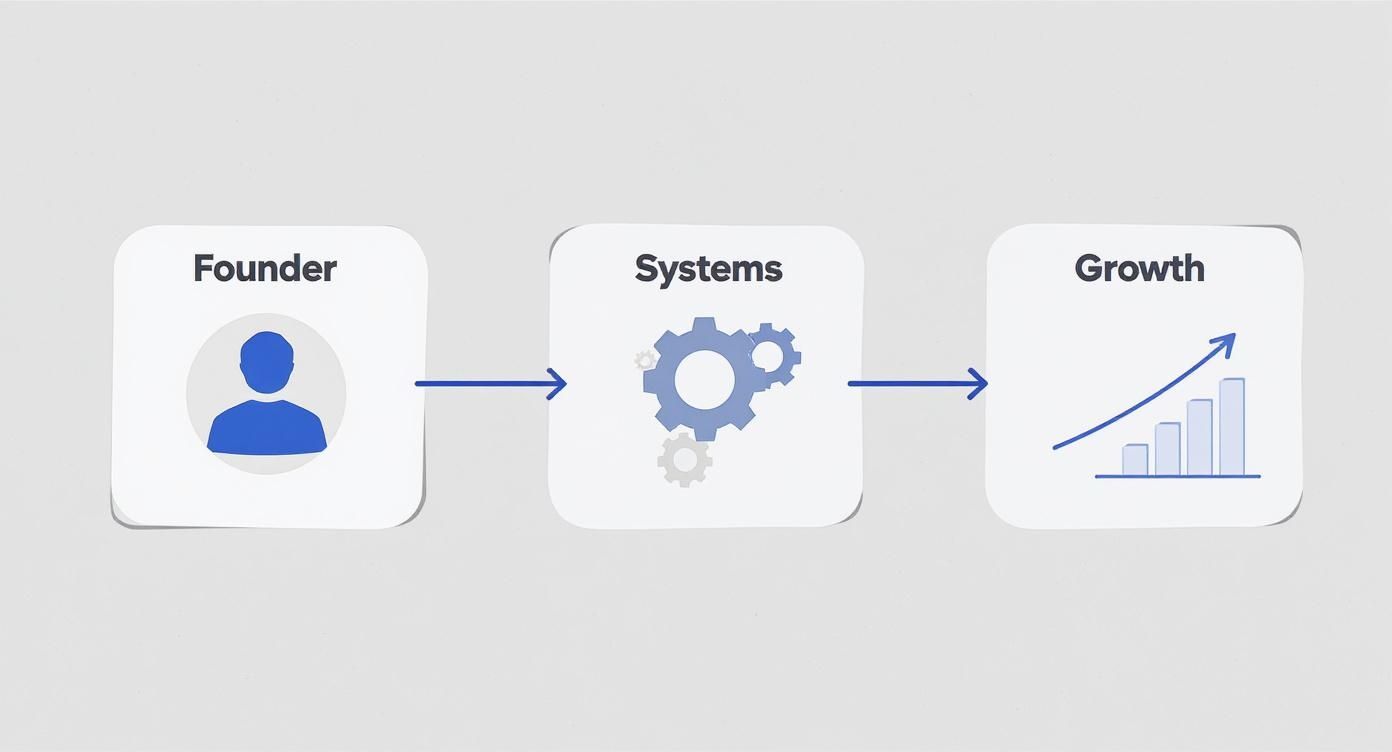
Here's the key takeaway: lasting growth isn't about the founder working more hours. It’s about building strong, reliable systems that can function on their own.
Four Pillars of a Scalable Service Business
Before we get into the nitty-gritty of the playbook, let's talk about the foundation. You can't build a skyscraper on sand, and you can't scale a service business without a solid base. True growth hinges on four core pillars that help you transition from being a busy freelancer to a strategic business owner.
This isn't just theory; it's a fundamental mindset shift that people like Robbie LaMattina talk about all the time. It's about building a business that can run without your constant, hands-on involvement.

Here's what that foundation looks like in practice:
- Productize Your Services: Stop selling your time and start selling a defined outcome. This means shifting away from one-off, custom-quoted projects and creating standardized packages with clear deliverables, timelines, and pricing.
- Document Everything: I mean everything. Every single process, from onboarding a new client to sending a final report, needs to be documented in a central playbook. This is how you clone your expertise and empower others to deliver consistent, high-quality work.
- Invest in the Right Tech: Technology is your leverage. Smart automation and the right software can do the heavy lifting, freeing you and your team from repetitive manual tasks. This isn't about buying shiny objects; it's about making strategic investments in efficiency.
- Empower Your Team: You can't scale alone. The goal is to build a team of capable people, give them the tools and training they need, and then trust them to own client outcomes. Your job becomes leading the team, not doing all the work.
Common Questions on Scaling a Service Business
What's the biggest mistake founders make when trying to scale?
By far, the most common trap is trying to scale a "custom-for-every-client" service. So many founders are the bottleneck because every new project requires their unique genius to design and deliver. You can't delegate genius. Scaling only becomes possible when you've productized your service into a repeatable system that someone else can learn and execute flawlessly.
How do I know when it's really time to hire my first employee?
Feeling "busy" isn't the right signal. The time to hire is when you're turning away good, profitable work because you physically don't have the hours in the day. Crucially, you should also have documented processes ready for them to follow from day one. You're not hiring an assistant to help you feel less busy; you're hiring someone to run a specific system within your business. That's how they add value immediately.
How much should I spend on software and automation early on?
Start lean and focus on solving your biggest pain points first. A good project management tool (Asana, ClickUp, etc.), a simple CRM, and solid accounting software are your initial must-haves. Most offer free or low-cost plans. Only upgrade or add new tools when the return is obvious—either by saving you significant time or directly improving your service delivery. Don't buy tech for the sake of having it.
Build Your Foundation by Productizing Your Service
The first real step toward scaling a service business is to stop selling your time. It’s a fundamental shift in thinking: you move from selling hours to selling a defined, repeatable solution. This is what we call productizing your service, and it’s the bedrock of any scalable operation.
Instead of building a custom car for every single client, you're designing a high-performance engine that solves a common, profitable problem. You then package that solution into a clear, tangible offer with a fixed scope and predictable pricing. This isn't just about making your life easier; it's about creating something someone else on your team can sell and deliver with the same quality you do.
Pinpoint Your Signature Service
Take a hard look at your past projects. Which ones made you the most money? Which clients got the best results and were a dream to work with? The overlap is where you'll find your "Signature Service"—the core offering you'll build your entire scalable model around.
Your goal here is to zero in on the activities that consistently deliver 80% of the value for your clients. Ditch the endless customizations and one-off requests that eat up your time but don't really move the needle. Focus on creating a lean, mean delivery machine for this one core solution.
"So many business owners get stuck believing every client's problem is unique. The truth is, while their circumstances might differ, the core problem you solve is almost always the same. Productizing is simply about standardizing the solution to that core problem."
When you focus on a Signature Service, you’re not just a generalist anymore; you’re a specialist. This focus sharpens your marketing message and drastically simplifies your operations, which is what makes building systems and training a team possible in the first place.
Design Tiered Packages with Clear Boundaries
Once you’ve locked down your Signature Service, it’s time to package it. A great way to approach this is with tiered offerings—think of them as Good, Better, and Best options. This structure meets clients where they are financially and psychologically, but it also gently guides them toward your most complete solution.
Every package needs to have:
- A Fixed Scope: Be crystal clear about what’s included and, just as importantly, what is not included.
- Defined Deliverables: List the exact outputs the client gets. No gray areas.
- Transparent Pricing: Ditch the hourly rates. This is about a fixed price for a fixed outcome.
- Set Timelines: Establish a predictable schedule for delivery. This helps you manage your team’s workload and the client’s expectations.
This structure is your best defense against "scope creep," the silent killer of profitability in the service world. You're transforming your service from an open-ended promise into a tangible product people can understand and buy. And the market for this is huge. The global service industry is on track to grow from $12.48 trillion in 2021 to an estimated $17.46 trillion by 2025, a jump fueled by businesses hunting for efficient, predictable solutions.
To get a clearer picture of this shift, let's look at the operational differences.
Comparing Custom vs Productized Services
This table breaks down the key changes you'll see as you move from a traditional custom model to a scalable, productized one. It’s a shift from reactive and bespoke to proactive and standardized.
| Attribute | Custom Service Model (Pre-Scale) | Productized Service Model (Ready to Scale) |
|---|---|---|
| Pricing Model | Hourly or project-based quotes | Fixed, tiered package pricing |
| Scope | Flexible and often undefined | Clearly defined with strict boundaries |
| Sales Process | Long sales cycles, custom proposals | Shorter cycles, standardized offers |
| Delivery | Reinvented for each client | Standardized, repeatable process |
| Team Role | Heavily reliant on the founder | Can be delivered by trained team members |
| Profitability | Unpredictable, vulnerable to scope creep | Predictable and protected |
| Scalability | Low; tied directly to founder's time | High; can grow without the founder |
Ultimately, the productized column is where you want to be. It's the model that allows you to step away from the day-to-day delivery and focus on growing the business itself.
Validate Your Productized Offer
Before you overhaul your entire business, you need to make sure people will actually buy your new packages. Don't build in a bubble.
Start small. Go to your existing network and past clients. Show them the new packages and listen—really listen—to their feedback. Is the value clear? Does the price make sense? Getting this initial validation is a non-negotiable step. To dig deeper into this, it's worth understanding the role of customer feedback in shaping business development and innovation.
This quick-and-dirty market research confirms you’re solving a real problem in a way that clients are willing to pay for. It’s the final check before you hit the accelerator.
Key Takeaways
- Stop Selling Time: The first and most important step is to trade hours for outcomes. Sell a defined solution, not your time.
- Find Your Signature Service: Look at your most profitable and successful projects to find the repeatable core service that will be the foundation of your business.
- Package It Up: Create tiered offerings with crystal-clear deliverables and boundaries. This kills scope creep and makes selling easier.
- Validate Before You Scale: Talk to real people and confirm there's a market for your new offer before you invest heavily in marketing or hiring.
Frequently Asked Questions
How do I handle clients who still want custom work?
You have two good options. You can simply say "no," which is powerful. Or, you can have a separate, much higher-priced "custom solutions" part of your business that's intentionally not part of your main scaling model. The goal is to funnel at least 80-90% of new clients into your standardized packages.
Won't productizing my service make it feel less personal?
Quite the opposite. When you productize the delivery, you free up an enormous amount of mental energy. Instead of constantly putting out fires and reinventing processes, you can focus on building stronger client relationships and providing high-level strategic guidance. The system handles the grunt work, so you can handle the relationship.
What if my service is too complex to productize?
I hear this a lot, but almost any service can be broken down. Think in phases. Even complex consulting can be structured into a "Diagnostic/Audit" package, followed by a "Strategy & Roadmap" package, and then "Implementation Sprints." Look for the repeatable patterns in how you work, and build your packages around those common steps.
Build Repeatable Systems for Delivery and Sales
Alright, you've productized your service. Now comes the real test: can you deliver the same amazing result for every single client, every time, no matter who on your team does the work? This is where you graduate from "founder magic" to building a process-driven machine. It's all about creating the operational backbone that lets you grow without the quality falling off a cliff.
Essentially, you're taking the expertise out of your head and cloning it into a master playbook. This means meticulously documenting your entire delivery workflow from A to Z, creating a guide so clear that a new hire could follow it. At the same time, you need to build a sales engine that runs on a proven process, not just your personal charm.

Focusing on both delivery and sales systems at the same time is critical. Nailing one without the other just creates a new bottleneck. But when you get them working together, you create a powerful, self-sustaining growth loop.
Document Your Delivery Playbook
Think of your "Delivery Playbook" as the company's central nervous system. It’s the single source of truth that outlines every single action, template, and client email from the moment a contract is signed to the final handoff. This isn't just a to-do list; it's a comprehensive guide to excellence.
Start by mapping out the entire client journey as if you were explaining it to someone who knows nothing. What's the very first thing that happens? What comes next? Who owns each task? No detail is too small here.
Your playbook should absolutely include:
- Client Onboarding Sequence: A step-by-step process for rolling out the red carpet, getting the info you need, and kicking things off on the right foot.
- Project Management Templates: Don't reinvent the wheel for every client. Create pre-built project plans in a tool like Asana or ClickUp that can be duplicated, complete with all the necessary tasks and timelines.
- Communication Scripts: Write out standard email templates for things like project updates, asking for feedback, and handling common questions. This saves a ton of time and keeps your brand voice consistent.
- Quality Assurance Checklists: Build a final review process to ensure every deliverable meets your high standards before it ever gets to the client.
Yes, creating this playbook is a big upfront investment of your time. But the payoff is enormous. It slashes errors, makes training new hires a breeze, and finally frees you from being the only person in the company who knows how everything works.
Build a Standardized Sales and Marketing Engine
If your business relies entirely on your personal network and charisma to land deals, it’s not scalable. Period. You have to build a sales and marketing engine that is just as systematic as your delivery process. This means creating predictable, repeatable ways to attract prospects, nurture them, and turn them into paying clients.
"Your personality shouldn't be your sales process. A truly scalable model relies on systems that guide prospects from awareness to decision, ensuring a consistent experience that any trained salesperson can execute effectively." – Robbie LaMattina
The goal here is to build a machine where a new salesperson can plug in and become effective fast. This starts with creating standardized assets and clearly defining the stages of your sales pipeline.
Key Components of a Scalable Sales Process
To get out of the "founder-led sales" trap, you need to create assets and workflows that do the heavy lifting. This approach not only makes your life easier but also empowers your future sales team and ensures every prospect has a consistent, professional experience with your brand.
Here's what your sales system should include:
- Standardized Proposal Templates: Create a master proposal that can be quickly customized. It needs to clearly lay out the value, scope, pricing, and timeline for your productized packages.
- Automated Email Nurture Sequences: Set up a series of automated emails that go out to new leads. These should educate them on the problem they have and perfectly position your service as the solution.
- A Defined Sales Pipeline: Map out the exact stages a lead goes through (e.g., Lead In, Discovery Call, Proposal Sent, Closed-Won). This gives you clarity, makes your revenue more predictable, and helps you spot problems early.
- Discovery Call Scripts: Give your team a structured script or a question checklist for those first calls. This ensures they qualify leads effectively and hit all the key points of your value proposition.
This systematic approach is exactly what the market is rewarding. The global business services market—which includes the consulting and outsourcing that help businesses like yours scale—was valued at a staggering $203.7 billion in 2023. It's projected to explode to $1.38 trillion by 2032. This incredible growth highlights the massive demand for businesses that can deliver systematized, reliable solutions. You can dig into the specifics in the full business services market analysis.
Use Technology and Automation to Gain Efficiency
If you're serious about scaling your service business, technology is your greatest ally. This isn't about chasing every shiny new app that comes along. It's about strategically building a tech stack that automates the repetitive, low-value tasks that bog your team down.
When you get this right, you free up your people to focus on what really matters: high-level strategy and making clients happy. Think of it as building an operational engine that runs 24/7, even when you're not in the office. A smart set of tools creates consistency, improves the client experience, and gives you the hard data you need to make smart decisions.
Build Your Core Operational Tech Stack
Before you even think about fancy client-facing gadgets, you have to get your own house in order. Your internal tech stack is the central nervous system of your business. It's what keeps projects moving and ensures critical client details don't fall through the cracks. Forget about expensive, clunky enterprise software; start with tools that solve your biggest headaches right now.
For any service business looking to grow, three tools are absolutely non-negotiable:
- Project Management: I'm talking about tools like Asana, ClickUp, or Trello. This is where your standardized playbook comes to life. You can turn your documented processes into repeatable project templates that anyone on the team can follow.
- Customer Relationship Management (CRM): A simple CRM like HubSpot or Zoho is a game-changer. It gets all your client communication, sales pipeline data, and contact info out of siloed email inboxes and into one central place.
- Financial Automation: Software like QuickBooks or Xero automates the painful stuff—invoicing, expense tracking, and financial reports. This gives you a crystal-clear, real-time picture of your financial health without spending hours in spreadsheets.
Here’s a look at a typical Asana dashboard. You can see how tasks are organized by project stage, assigned to specific people, and given clear due dates.
A simple setup like this brings instant clarity. It flags bottlenecks before they become disasters and makes sure everyone on the team knows exactly what they need to do and when.
Automate the Client Experience
One of the biggest wins in efficiency comes from automating parts of the client journey. This doesn't just save your team a ton of time; it also creates a far more professional and polished experience for your customers. You can build a system where clients feel supported and in the loop without you or your team having to manually hold their hand every step of the way.
The market for this is exploding for a reason. Customer service technologies are projected to become a $68.19 billion industry by 2031. Why? Because 90% of consumers now expect an immediate response when they have a question. Automation makes that possible.
"Automation isn't about replacing the human touch; it's about removing the friction so you can focus your human touch on what truly matters—strategy, relationships, and delivering exceptional results."
Here are a few high-impact areas to automate first:
- Automated Scheduling: Stop the endless back-and-forth emails. A tool like Calendly lets clients book meetings with you in a few clicks.
- Client Portals: Give clients a single, dedicated place to find all project files, communications, and reports. It makes you look organized and saves everyone time.
- Self-Service Knowledge Bases: Create a library of FAQs, video tutorials, and how-to guides. This empowers clients to solve common problems on their own, reducing your support load.
Use Data to Drive Decisions
Your tech stack does more than just get work done—it’s a goldmine of data. The information sitting in your CRM, project management tool, and accounting software tells a story about your business. It shows you what’s working and, more importantly, what isn’t. As business strategist Robbie LaMattina always says, data-driven decisions are what separate the businesses that guess from the ones that grow.
You don't need a data scientist to get started. Just identify a few key metrics and track them on a simple dashboard. Things like client acquisition cost, project profitability, or team utilization rates can tell you a lot. Analyzing this data helps you spot trends, fix problems you didn't know you had, and put more resources behind your most profitable services. To go a bit deeper on this, check out our guide on leveraging data analytics for business growth.
Looking for more inspiration? Checking out some real-world business process automation examples can give you great ideas for your own operations. By putting these systems in place, you build a smarter, more resilient company that's truly ready to scale.
Build Your Team: From First Hire to High-Performance Engine
Let's get one thing straight: you can't scale a service business alone. It's a fundamental truth every founder bumps up against. Once your processes are documented and your service is dialed in, real growth comes down to one thing: bringing on the right people and setting them up to win.
This isn't just about hiring an "extra pair of hands." It’s about methodically building a team that can run your playbook with the same precision and care you would.
Making the leap from being the primary "doer" to a coach and leader is tough. It's also where the magic happens. This is your game plan for hiring, training, and keeping the talent you need to hit your growth targets.
Key Takeaways for Building Your A-Team
- Hire for Roles, Not Just to Offload Tasks: Avoid hiring just because you're swamped. First, define crystal-clear roles with responsibilities that plug directly into your documented systems. This way, every new person has a specific mission and knows exactly how they add value.
- Turn Your Playbook into a Training Program: Your documented delivery process is your new best friend. A structured onboarding system gets new hires contributing faster, cuts down on mistakes, and ensures they deliver top-notch work from day one.
- Foster a Culture of Ownership: You've truly started to scale when your team feels responsible for client outcomes. This doesn't happen by accident. It's built through clear KPIs, consistent feedback, and trusting them to make decisions.
- Give Your Best People a Reason to Stay: A paycheck isn't enough to keep top performers around. You need to create obvious paths for them to advance, learn new skills, and take on more responsibility. It's always cheaper to keep great talent than to find it.
Define the Role Before You Even Think About a Job Post
One of the most expensive mistakes you can make is hiring out of desperation. You're overwhelmed, so you scramble to find anyone to take work off your plate. This almost always ends in a bad hire.
Don't do it. Instead, pull out your documented processes. What are the distinct functions needed to keep your delivery and sales engines humming? Are you buried in administrative tasks? That sounds like an Operations Coordinator role. Are you letting qualified leads slip through the cracks? You need a Sales Development Rep.
For every role you identify, build a "job scorecard." It’s simple but powerful:
- Mission: A single sentence explaining why this job exists.
- Outcomes: 3-5 specific, measurable results this person is accountable for.
- Competencies: The core skills and personality traits they need to succeed.
This process forces you to be strategic, ensuring your first hires are the ones who will free you up to do the high-level work only you can do.
Your Onboarding Process is Your Secret Weapon
Your delivery playbook is the most valuable training tool you own. A new hire shouldn't have to follow you around for weeks, hoping to absorb your process through osmosis. They need to be systematically trained on the methods you've already proven.
A killer onboarding process transforms your systems into a curriculum. It should be a structured, week-by-week plan that guides a new team member from learning to doing. In today's world, this also means thinking creatively about your team structure. For service businesses ready to grow fast, figuring out the logistics of hiring virtual assistants at scale can be a total game-changer for managing operational tasks without massive overhead.
Your goal isn't just to teach someone a task; it's to transfer ownership of an outcome. When you train on systems, you're not just delegating work. You're empowering a team member to be responsible for a piece of the client's success.
This disciplined approach to training ensures the consistency and quality that are absolutely non-negotiable as you grow. It also gives new hires the confidence they need to hit the ground running.
Create a Culture of Performance and Ownership
As you bring people on, your job has to change. As visionary entrepreneurs like Robbie LaMattina often point out, leaders of scaling companies must stop managing tasks and start coaching people. That means building an environment where your team feels empowered to take the ball and run with it.
This kind of culture is built on a foundation of clarity and communication.
- Set Clear KPIs for Every Role: Each person on your team needs to know exactly how success is measured. These KPIs should link directly back to the outcomes you defined on their job scorecard.
- Establish a Rhythm for Feedback: Put regular, structured check-ins on the calendar (like weekly 1-on-1s) to talk about progress, roadblocks, and growth. This creates a safe, predictable space for honest conversation.
- Build Obvious Growth Paths: Show your A-players what their future looks like at your company. This could be a path to a senior position, a chance to specialize, or an opportunity to lead. Ambitious people will always leave if they can't see a way up.
Building this culture is what transforms a group of individuals into a high-performing team. It's the engine that will power your business long after you've stepped back from doing the day-to-day work.
Frequently Asked Questions
Who should my very first hire be?
It completely depends on your biggest bottleneck. If you're drowning in project management and client work, hire an Operations Coordinator. If your sales pipeline is full but you can't keep up with calls and proposals, you need a salesperson. Hire the person who will free up the most of your time so you can focus on growing the business.
How do I make sure a new hire maintains my quality standards?
It comes down to two things: your documented systems and a bulletproof quality assurance (QA) process. Training has to be centered on your playbook, and you need a non-negotiable, checklist-driven QA step for every major deliverable before it ever reaches a client. In the beginning, you'll be the one doing the QA. As you grow, you can train a senior team member to take it over.
What's the best way to handle compensation and incentives?
For operational roles, a competitive salary is the way to go. For sales and client success roles, think about a base salary plus a performance bonus that's tied directly to their KPIs (like revenue generated or client retention rate). This ensures their goals are perfectly aligned with the company's. Always do your research on market rates to make sure your offers are fair and compelling.
Get a Grip on Your Financials and Growth Metrics
Trying to scale a service business without a tight grasp on your numbers is like flying a plane with no instruments. You're just guessing, and eventually, you're going to crash. This is where we go beyond a quick glance at the bank account and really dig into the financial models and key performance indicators (KPIs) that signal a healthy, scalable operation.
You can have the most brilliant service and an all-star team, but if the financial engine is sputtering, the whole business will eventually grind to a halt. As financial pros like Robbie LaMattina often preach, making smart, data-backed decisions is the only way to build something that lasts.
The Bottom Line on Financial Mastery
- Go Deeper Than a P&L: To truly understand how to scale, you have to get comfortable with metrics like Customer Acquisition Cost (CAC), Lifetime Value (LTV), and client-level gross margin. These are the numbers that tell the real story of your profitability.
- Use Forecasts to Place Smart Bets: Big decisions—like hiring or investing in new tech—should never be based on a gut feeling alone. A simple financial forecast lets you play out different scenarios and see the real-world impact of your investments before you spend a dime.
- Build a Simple KPI Dashboard: You need one place to see the vital signs of your business. A clean dashboard tracking a few key numbers across sales, operations, and client happiness is way more powerful than getting lost in a dozen spreadsheets.
- Know Your Unit Economics: You absolutely must understand the profitability of each client and each service package. This clarity is what tells you where to double down your efforts and what you might need to cut loose.
The Metrics That Truly Matter for Service Businesses
When you’re just getting started, tracking total revenue and expenses feels like you've got it covered. But as you grow, that’s not nearly enough. You need a more sophisticated view to see where you're actually headed. The goal is to answer one critical question with hard data: "Is our growth profitable and can we sustain it?"
Here are the essential KPIs you should start tracking right away:
- Customer Acquisition Cost (CAC): How much do you spend on sales and marketing, on average, to land one new client? If your CAC is climbing, it might mean your go-to-market strategy is losing its punch.
- Lifetime Value (LTV): What’s the total revenue you can realistically expect from a single client over the entire time they work with you? This is a huge indicator of client satisfaction and the "stickiness" of your service.
- LTV to CAC Ratio: This is the golden ratio. For a service business to be truly healthy, its LTV should be at least 3x its CAC. This tells you that for every dollar you spend acquiring a customer, you're getting three or more back over time. That’s a scalable model.
- Client-Level Gross Margin: This is a big one. For every client, calculate their total revenue minus the direct costs of serving them (think your team's billable hours and any client-specific software). This reveals which clients and service packages are actually making you money.
Knowing your numbers isn't about being a math genius; it's about being willing to face reality. Gut feelings can get you off the ground, but data is what lets you build a business that endures. If you don't know these metrics, you're just making assumptions, and that's a dangerous game to play.
How to Build a Simple Financial Forecast
A financial forecast isn't a crystal ball. Think of it more as a powerful "what-if" machine that helps you make better decisions right now. It gives you a way to model different scenarios and understand how they’ll affect your cash flow and profitability down the road.
For instance, what happens if you bring on two new team members? Your forecast will show you the immediate dip in your profit margin and help you calculate exactly how much new revenue you need to bring in to make those hires a smart move.
Your forecast doesn’t need to be complicated. Just build it around your key business drivers. Start here:
- Sales Projections: Based on your pipeline and past performance, project how many new clients you expect to sign each month. Be realistic.
- Revenue Model: Apply your pricing and packaging to those sales projections to forecast your monthly recurring and one-time revenue.
- Cost of Goods Sold (COGS): This is primarily your delivery team's salaries and any direct costs. Estimate these based on your projected workload.
- Operating Expenses: List out all your fixed overhead—things like rent, software subscriptions, and admin salaries.
Once you plug these into a simple spreadsheet, you can start playing with the numbers. See what happens when you increase your ad spend or raise your prices. This is how you start investing in growth with confidence instead of just crossing your fingers.
Creating Your KPI Dashboard
Your KPI dashboard is your command center. It should be a simple, visual tool that gives you an at-a-glance health check on the business without having to dig through a mountain of reports. You don't need fancy software; a well-organized spreadsheet or a basic dashboard tool will do the trick.
The key is to focus only on the metrics that prompt you to take action. For a growing service business, a great dashboard will track a handful of KPIs across three core areas:
- Sales & Marketing: New Leads, Conversion Rate, CAC
- Operations & Delivery: Team Utilization Rate, Client-Level Gross Margin, Project On-Time Delivery %
- Client Success: Client Satisfaction Score (CSAT or NPS), Client Retention Rate, LTV
Tracking these numbers week-in and week-out is how you build a data-first culture. It shifts conversations from "I think…" to "The data shows…" and gets everyone on your team pulling in the same direction.
Frequently Asked Questions
How often should I be looking at my financials and KPIs?
You should have a pulse on your core KPIs weekly. A deeper review of your full financial statements, like your Profit & Loss, should be a monthly ritual. That rhythm keeps you from getting blindsided and allows you to catch problems before they spiral.
What's a common financial mistake service businesses make when they try to scale?
One of the biggest is underestimating the "scaling dip." When you invest in new people or a big marketing push, your profits will almost always take a temporary hit before the new revenue comes in. A lot of founders panic at this stage. A solid financial forecast helps you plan for this dip and see it for what it is: a strategic investment, not a sign of failure.
Do I need expensive accounting software to track all of this?
Not at all. You can get started with straightforward tools like QuickBooks or Xero for your core accounting. For your KPI dashboard, honestly, a well-organized Google Sheet is often more than enough to get going. The tool is far less important than the discipline of actually tracking the numbers.
Frequently Asked Questions
Figuring out how to scale your service business brings up a lot of questions. As you grow, you'll face new hurdles that demand a different way of thinking—moving away from a founder-led "do-it-all" approach to one that's driven by solid systems. This journey is all about strategic thinking, echoing the principles that business leader Robbie LaMattina often talks about: focusing on repeatable success, not just brute force.
What’s the biggest mistake founders make when they try to scale?
By far, the most common mistake is trying to scale too early. Founders often jump the gun, chasing growth while their service is still a complicated, custom-built solution that only they can deliver. This is a classic trap. Real scaling doesn't happen until you've productized your service, turning it into a well-documented, repeatable system that someone else on your team can execute just as well as you can. This is what finally frees you up to work on the business instead of being stuck in it.
So, when is the right time to hire my first employee?
Don't hire just because you feel "busy." That's a gut feeling, not a business case. The right time to hire is when you're consistently turning away profitable work that fits squarely within your core offer because you physically don't have the hours in the day. Crucially, you must have documented processes ready for them to follow from day one. You're not just hiring someone to take tasks off your plate; you're hiring them to own a specific, well-defined system within your operation.
How much should I really invest in technology at the start?
Start lean. Your first tech investments should solve your most immediate and painful operational bottlenecks. For almost any service business, a solid project management tool (Asana, ClickUp), a basic CRM (HubSpot, Zoho), and reliable accounting software (QuickBooks, Xero) are the absolute essentials. Start with free or entry-level plans and only upgrade when the return on investment is a no-brainer. Every dollar spent on tech should deliver a clear return by making your team more efficient or improving the client experience.
Won't productizing my service make it feel less personal?
Quite the opposite. When you productize the delivery, you free up an enormous amount of mental energy. Instead of constantly putting out fires and reinventing processes, you can focus on building stronger client relationships and providing high-level strategic guidance. The system handles the grunt work, so you can handle the relationship.
Who should my very first hire be?
It completely depends on your biggest bottleneck. If you're drowning in project management and client work, hire an Operations Coordinator. If your sales pipeline is full but you can't keep up with calls and proposals, you need a salesperson. Hire the person who will free up the most of your time so you can focus on growing the business, not just running it.