

Starting a healthcare business isn't for the faint of heart. It’s an ambitious journey that blends the drive of an entrepreneur with the profound responsibility of patient care. This guide is built from real-world experience, designed to give you a clear-eyed view of what it actually takes to get a new venture—whether it's a specialty clinic, a telehealth platform, or a home health agency—off the ground and thriving.
My aim here is to give you a balanced perspective. We'll talk about the immense potential to make a difference, but we won't shy away from the significant challenges ahead.
4 Key Takeaways on How to Start a Healthcare Business
- Niche Down to Win: Don't try to be everything to everyone. The most successful healthcare startups identify and solve a specific, validated patient problem better than anyone else. A focused business model is your strongest asset.
- Compliance is Non-Negotiable: Treat regulatory requirements like HIPAA and state licensing as the foundation of your business, not an afterthought. Getting this wrong can lead to crippling fines and a complete loss of patient trust.
- Build a Rock-Solid Financial Plan: A great clinical idea is not enough. You need detailed financial projections and a clear funding strategy to convince investors and ensure you have enough runway to become sustainable.
- Put Operations and People First: Your clinical protocols, technology choices, and—most importantly—your team are what deliver quality care. A patient-first operational framework is what will build your reputation and drive long-term success.

Your Path to Launching a Healthcare Business
Learning how to start a healthcare business is about mastering two very different worlds: clinical excellence and sharp business strategy. This isn't like launching a tech startup or a retail shop. The entire industry is built on a foundation of rigorous regulation and the deep, personal trust between a provider and a patient.
A great idea is just the starting point. True success comes from identifying and solving a validated market need. This guide will walk you through the toughest parts of the process, including:
- Navigating the maze of dense state and federal regulations.
- Securing the right kind of funding—and enough of it.
- Building an operational framework that genuinely puts patients first.
Before we get into the step-by-step details, I want to share four critical takeaways that I've seen make or break a new healthcare launch. Think of these as the non-negotiable pillars for building a business that's not only profitable but sustainable and impactful. They'll give you a solid foundation from day one.
The Four Pillars Every Healthcare Founder Needs to Master
If you’re wondering how to start a healthcare business and boil it all down to the essentials, I've found it really comes down to four core pillars. Get these right, and you're building on solid ground.
First up, you need a validated business model that’s laser-focused on a specific niche. This isn't just a good idea; it's the price of entry. Trying to be everything to everyone is a classic startup mistake, especially in a field as complex as healthcare.
Next is the big one: regulatory and legal compliance. You absolutely have to treat this as the foundation of your entire company, not some box-ticking exercise you get to later. In healthcare, getting this wrong can sink you before you even see your first patient.
The third pillar is all about the money—finding that perfect balance between a rock-solid financial plan and a smart funding strategy. Your projections can't just be optimistic; they need to be airtight.
Finally, you must build an operational framework that is truly patient-first. This touches everything from your clinical protocols and technology choices to how you deliver care. It’s about more than just good intentions; it requires sharp business acumen. You can learn more about why every healthcare leader needs business skills to see just how critical this is.
These pillars aren't just theoretical; they are the very things that will guide your strategic decision-making for sustainable business growth.
Find Your Niche and Define Your Business Model
Most successful healthcare businesses don't spring from a flash of genius. They're born from a deep, almost obsessive, understanding of a very specific problem. It’s a common pitfall for founders to fall in love with their solution first, only to discover later that the problem they thought they were solving wasn’t a big deal to the people who mattered most: the patients.
So before you even think about building anything, you have to validate the need. This isn't just about having a concept; it's about finding a defensible spot in the market. You need to take a hard, honest look at the existing healthcare landscape and pinpoint the gaps where your skills and vision can make a real difference. The question isn't, "What can I build?" It should always be, "Who is being left behind, and how can I fix their specific pain point better than anyone else?"
Choosing Your Lane in Healthcare
Healthcare is a massive field, and you can’t be everything to everyone. Your first critical decision is picking a business model that fits not just the market need, but also your own expertise, operational capabilities, and budget. Each path has its own unique set of rewards and landmines.
Let’s walk through a few of the most common models I've seen work:
- The Classic Brick-and-Mortar Clinic: This is your traditional, in-person care model. It’s a perfect fit for specialties that absolutely require hands-on interaction, like primary care, dermatology, or physical therapy. The real strength here is building trust and becoming a fixture in your local community.
- Telehealth and Virtual Care: Patient demand for convenience has made telehealth a powerhouse. This model is a game-changer for services that don't always require a physical exam, like mental health therapy, nutritional counseling, or routine follow-ups. The upsides are significant: lower overhead and the ability to serve patients far beyond your zip code.
- Specialized Treatment Centers: These facilities go deep, not wide. Think substance use disorder clinics, autism therapy centers, or dedicated women's health providers. The power of this model is in becoming the undisputed expert in a high-need area, building a powerful reputation that draws patients in.
- Home Health Agencies: With an aging population, the demand for quality care at home is exploding. This can range from skilled nursing to personal assistance. It’s a logistically demanding business, for sure, but you’re meeting a critical need for people who want to recover or age in their own homes.
The magic happens when you find where market demand, your personal passion, and your professional skills all intersect. For instance, I've seen a physical therapist build a brilliant hybrid practice. They offer in-person sessions for acute injuries and then sell a subscription telehealth service for ongoing maintenance exercises. It’s a smart way to capture two different, but related, revenue streams.
Getting Your Hands Dirty with Market Analysis
Once you've got a model in mind, it's time to roll up your sleeves and do some real-world market analysis. I’m not talking about buying thousand-dollar reports; I’m talking about practical, on-the-ground research to see if your idea has legs. The whole point is to confirm there's an underserved group of patients out there and find the cracks your competitors are leaving open.
First, get incredibly specific about who you want to serve. Is it busy working parents who need after-hours telehealth appointments? Or is it elderly patients in a particular suburb who can't find a geriatric specialist? The more granular you get, the easier it becomes to design your services and your marketing.
Next, size up the competition—both direct and indirect. Don't just make a list of their services. Go deeper. Read every single one of their online reviews. What are patients actually complaining about? Is it the long wait times? The rushed, impersonal appointments? The nightmare of trying to schedule? These complaints are pure gold. They are your roadmap to building something better. For example, a new therapy practice could immediately stand out by offering a simple guarantee: "New patient appointments available within 48 hours." That one promise directly solves one of the biggest frustrations in mental healthcare.
Defining Your Unique Value Proposition
All this research should lead you to one crystal-clear statement: your unique value proposition (UVP). This is your elevator pitch on steroids. It’s a simple, powerful sentence that explains exactly what problem you solve, who you solve it for, and why you’re the only one they should trust to do it.
Your UVP is the DNA of your business. It answers the fundamental question, "Why should anyone choose me?"
Let’s look at a couple of real-world examples:
- The Subscription Mental Health Service: An entrepreneur noticed that getting consistent therapy was a huge financial and logistical burden for many. Their UVP became: "We provide affordable, unlimited text-based mental health support for young adults for one flat monthly fee, making ongoing care easy and stigma-free."
- The Hybrid Physical Therapy Practice: A physical therapist kept seeing patients relapse because they stopped doing their exercises after formal treatment ended. Their UVP became: "We combine hands-on clinical therapy with a digital platform of guided exercises to make sure our patients don't just recover—they stay healthy for good."
This isn't just a marketing slogan. Your UVP becomes the north star for every single decision you make, from the staff you hire and the EHR software you choose to how you set your prices. It’s what turns a good idea into a business that can actually last.
Getting Licensed and Staying Compliant in Healthcare
Let's be blunt: navigating healthcare regulations is a beast. For new founders, it can feel like a labyrinth of acronyms and red tape designed to slow you down. But here’s the reality I’ve seen time and time again—treating compliance as an afterthought is the single most expensive mistake you can make. It’s not just about avoiding fines; it’s the very foundation of patient trust and your business's right to exist.
Think of it this way: every license, policy, and registration you secure is a brick in the foundation of your company. Skip a few, and the whole thing can come crashing down later. You have to build this legal and ethical framework from day one, not tack it on before opening your doors.
Your business model is the first domino to fall. Whether you're building a brick-and-mortar clinic, a telehealth platform, or a home health service will set you on entirely different compliance paths right from the start.
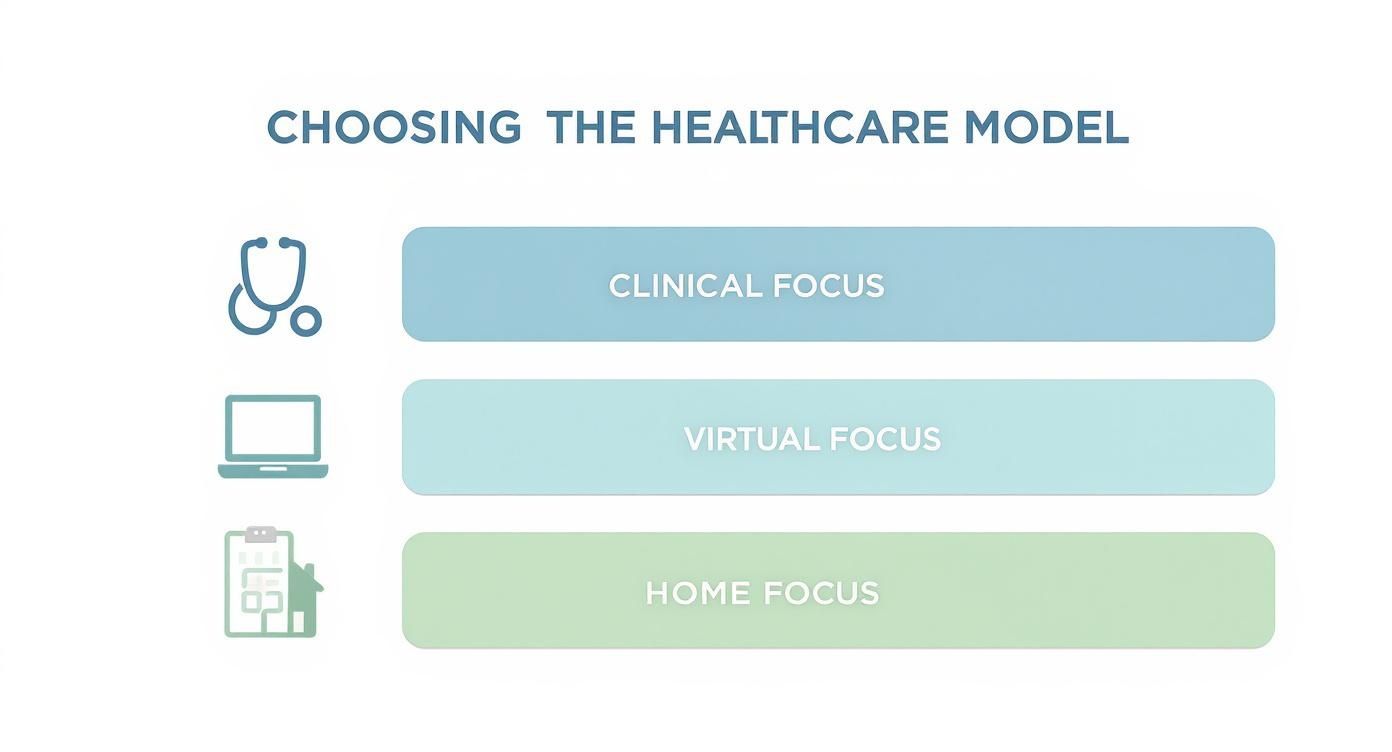
As you can see, this isn't a one-size-fits-all process. The path you choose dictates the specific hurdles you'll need to clear.
Kicking Things Off: State and Facility Licensing
Everything in healthcare licensing starts at the state level. Before you even touch federal rules, you have to get approval from your state's professional and facility licensing boards. And trust me, these requirements can be wildly different from one state to the next, depending on the services you want to provide.
For instance, opening a behavioral health clinic means getting individual licenses for your counselors (like an LCSW or LPC) and, in many cases, a separate facility license from the state's department of health. A home health agency operates under a completely different rulebook governing in-home care standards, patient safety, and staff certifications.
Heads up: the application process is notoriously slow and incredibly detailed. Start early. Be meticulous. I've seen startups get delayed for months because of simple mistakes like incomplete paperwork or not meeting a state's specific physical site requirements.
Moving Beyond the Basics with HIPAA Compliance
Everyone’s heard of HIPAA, but many founders underestimate what it truly means to be compliant. The Health Insurance Portability and Accountability Act is far more than a set of rules—it’s a promise you make to every patient to fiercely protect their privacy. For a startup, that means baking security into your DNA.
Here's what that looks like in practice:
- Vetting Your Tech: Selecting an Electronic Health Record (EHR) system that is genuinely HIPAA-compliant is non-negotiable. Don’t just take their word for it; look for business associate agreements (BAAs) and clear security protocols.
- Training Your Team (Relentlessly): Every single person on your payroll, from the lead clinician to the part-time receptionist, needs rigorous HIPAA training. They must know exactly what Protected Health Information (PHI) is and understand the dire consequences of a breach.
- Documenting Everything: You need clear, written policies for everything. Data access, device security, how to handle a patient phone call, what to do if a laptop is stolen—if you haven't documented it, you don't have a policy.
A data breach isn't just a financial risk, though fines can climb to $1.5 million per year for willful neglect. The real cost is the complete and often irreversible destruction of patient trust.
Tackling Controlled Substances and Lab Services
Does your model involve prescribing specific medications or running diagnostic tests on-site? If so, you've just unlocked two more layers of federal regulation. These are highly specific, and the penalties for getting them wrong are severe.
First, you'll need a DEA registration. Any provider who prescribes or dispenses controlled substances—common in pain management, detox centers, and certain psychiatric practices—must be registered with the Drug Enforcement Administration. This is a totally separate process from getting a state medical license.
Second is the CLIA waiver. The Clinical Laboratory Improvement Amendments (CLIA) govern all lab testing. If you plan on doing even the simplest tests in your facility, like a rapid flu swab or a urine dipstick, you’ll almost certainly need a CLIA Certificate of Waiver. This ensures you're following basic quality and safety protocols.
Let's put it all together. A new substance use detox center would need to:
- Secure state licenses for its therapists and medical staff.
- Obtain a facility-specific license from the state.
- Implement a rock-solid HIPAA compliance program.
- Ensure all prescribing physicians have active DEA registrations.
- Get a CLIA waiver if they plan to do on-site urine drug screens.
Mapping these out on a timeline from the very beginning is fundamental to knowing how to start a healthcare business that's built to last.
The sheer number of regulations can seem daunting, but breaking them down into these core areas makes the process manageable. This checklist summarizes the essential compliance areas every new healthcare business needs to address right away.
Essential Healthcare Startup Compliance Checklist
| Compliance Area | Key Requirement | Primary Governing Body | Critical First Step |
|---|---|---|---|
| State Licensing | Varies by state and service type (facility & professional) | State Dept. of Health / Professional Licensing Boards | Research your specific state's requirements for your business model. |
| HIPAA | Safeguarding Protected Health Information (PHI) | U.S. Dept. of Health & Human Services (HHS) | Conduct a Security Risk Analysis to identify vulnerabilities. |
| DEA Registration | For prescribing/dispensing controlled substances | Drug Enforcement Administration (DEA) | Apply for DEA registration after securing a state medical license. |
| CLIA Certification | For conducting any on-site laboratory testing | Centers for Medicare & Medicaid Services (CMS) | Determine the complexity of tests to apply for the correct CLIA certificate. |
Starting with this checklist will give you a clear, actionable roadmap to follow, ensuring you don’t miss a critical step on your path to launch.
Building Your Operational and Clinical Framework
Now that you have your business model mapped out and a handle on the compliance hurdles, it's time to build the engine of your practice. This is where the vision becomes reality—the day-to-day rhythm of treating patients. A rock-solid operational framework really comes down to three things: consistent clinical standards, the right tech, and a team that knows what it's doing.
Don't rush this part. Your operations are what dictate the quality of care you provide. They directly shape patient outcomes and, ultimately, your reputation. This isn't just about writing a manual; it's about embedding a culture of excellence from day one.

Developing Evidence-Based Clinical Protocols
Think of clinical protocols as your playbook. They are the standardized, evidence-based guidelines that ensure every patient gets the same high-quality care, no matter which clinician they see. These need to cover the entire patient journey, from the first phone call and initial assessment to the treatment plan and eventual discharge.
For instance, a new behavioral health startup I worked with had to get incredibly specific with their protocols. We hammered out clear, step-by-step guides for things like:
- Initial Psychiatric Evaluations: What specific assessments are mandatory? How long should that first appointment be scheduled for? What information must be gathered before a diagnosis is considered?
- Crisis Intervention: What are the non-negotiable steps a therapist must take if a patient expresses suicidal thoughts? Who needs to be notified and when?
- Medication Management: What’s the follow-up cadence for patients prescribed controlled substances? What are the documentation requirements?
These aren't just helpful suggestions; they are the clinical backbone of your practice. They reduce guesswork, improve patient safety, and make it infinitely easier to train new hires and maintain quality as you bring more people on board.
Selecting Your Technology Stack
In today’s world, you can't separate good healthcare from good technology. Your choice of an Electronic Health Record (EHR) system is easily one of the most critical decisions you'll make. It touches everything from how your clinicians chart to how you get paid. A bad EHR can absolutely cripple your practice with clunky workflows and endless administrative headaches.
When you're looking at EHRs, don't let price be the only driver. You need to dig deeper.
- Does it fit your specialty? An EHR built for a massive hospital system will be a terrible, bloated fit for an outpatient therapy practice. Look for vendors who actually understand the unique charting needs and workflows of your niche.
- Can it talk to other systems? This is called interoperability. If your EHR can't easily exchange information with labs, pharmacies, or a patient's primary care doctor, you're creating frustrating data silos.
- Will it grow with you? A system that’s perfect for a solo practitioner might completely fall apart once you have five or ten clinicians. Think about where you want to be in three years, not just today.
Your EHR should be more than just a digital filing cabinet. The right system is a powerful tool for improving patient outcomes. Many modern EHRs have fantastic analytics capabilities that let you track clinical metrics, spot trends in your patient population, and actually measure how effective your treatments are. If you want to get the most out of it, it's worth learning about leveraging data analytics for business growth.
Beyond the EHR, you'll need a solid practice management system for scheduling, billing, and wrangling insurance claims. Some EHRs have this built-in, but often, a dedicated system offers more robust features. Just make sure the two can integrate seamlessly—the last thing you want is your staff doing double data entry.
Recruiting and Onboarding Your A-Team
At the end of the day, your people are everything. All those protocols and systems you've built are only as good as the team implementing them. It all starts with crystal-clear job descriptions. Be explicit about the licenses, certifications, and specific experience you need. No ambiguity.
Your vetting process has to be airtight. For every single hire, this means:
- Thorough Background Checks: This is a non-negotiable for patient safety and your own liability.
- License and Credential Verification: Don't just take their word for it. Independently confirm that every clinical applicant holds a valid, unrestricted license in your state.
- Real Reference Checks: Get on the phone. Go beyond just confirming they worked there. Ask their former supervisors tough questions about their clinical judgment, how they work in a team, and their professionalism.
Once you’ve made a hire, a structured onboarding program is crucial. This isn't a half-day of paperwork. A great onboarding process should take days, if not weeks, and cover every clinical and administrative procedure in detail. And please, don't forget HIPAA training. Every single person, from your lead therapist to the front desk admin, needs comprehensive training on your specific policies for protecting patient data. This is how you build a culture of compliance from the ground up and ensure your team is the strong, capable core your business needs to succeed.
Securing Funding and Creating Your Financial Plan
A brilliant clinical vision without a rock-solid financial strategy is like a state-of-the-art surgical suite with no power—full of potential but ultimately useless. In the healthcare startup world, your financial plan is the lifeblood that turns your mission into a real, sustainable business. This is where you translate your passion for patient care into a language that investors, lenders, and partners can actually get behind.
https://www.youtube.com/embed/llN9pdEbALo
Before you even think about asking for a dollar, you need to build a comprehensive financial model. This isn’t just about proving you can be profitable; it’s about demonstrating you have a deep, realistic grasp of the economic engine that will drive your practice forward.
Building Realistic Financial Projections
Your financial projections are the cornerstone of your entire business plan. They tell the story of where you expect your company to be, financially, over the next three to five years. Getting this right means moving beyond optimistic guesses and diving deep into the actual numbers.
First things first, you have to meticulously list every single startup cost. This isn’t the time for ballpark figures.
- One-Time Capital Expenditures: Think big-ticket items like medical equipment, office furniture, initial EHR software setup fees, and any necessary facility renovations.
- Initial Operating Expenses: This bucket includes the first few months of rent, malpractice insurance premiums, legal and licensing fees, and the marketing campaigns needed to get your first patients in the door.
- Working Capital: This is your safety net—the cash reserve you'll need to cover day-to-day expenses like payroll and supplies before patient revenue becomes consistent. I always advise clients to plan for at least six months of runway.
With costs mapped out, you can build a detailed revenue forecast. This requires a clear-eyed estimate of patient volume and a solid understanding of reimbursement rates for your key services, whether from insurance payers or self-pay patients. Finally, pull it all together into a cash flow projection. This document is critical because it shows how cash will move in and out of your business, flagging potential shortfalls long before they become a crisis.
Exploring Your Capital Sources
With a credible financial plan in hand, you can start exploring the funding landscape. The right path depends entirely on your business model—a local clinic has very different capital needs than a scalable health-tech platform, and funders are looking for very different things.
-
Traditional Bank Loans and SBA Loans: These are often the go-to for brick-and-mortar practices with a proven, predictable business model. Banks and the Small Business Administration (SBA) want to see a solid business plan, strong personal credit, and often some form of collateral. They’re betting on your ability to generate steady, reliable cash flow to repay the debt. If you're buying or renovating a facility, understanding commercial real estate financing options is a crucial first step.
-
Venture Capital (VC) and Angel Investors: This route is really for high-growth, high-risk ventures, typically in the health-tech space. VCs aren't just looking for profitability; they're hunting for massive scalability and a clear path to a 10x or greater return on their investment. Your pitch has to focus on a huge addressable market, a unique technological advantage, and a killer plan for rapid user acquisition.
-
Private Equity (PE): PE firms tend to invest in more established healthcare businesses, aiming to optimize operations and drive up value. While less common for a brand-new startup, they can be a source of capital if you're looking to acquire an existing practice.
Think of it like this: A bank is lending you an umbrella and wants to be sure you'll give it back. A venture capitalist is funding your expedition to find treasure and expects to own a significant piece of whatever you discover.
Knowing What Funders Look For
No matter the source, all funders are assessing two things: risk and potential return. A local clinic pitching a bank needs to emphasize its deep community ties, a conservative patient volume forecast, and a lean operational budget. You’re selling stability.
In contrast, a health-tech founder pitching a VC firm has to tell a story of disruption and exponential growth. You’ll be highlighting your proprietary algorithm, the network effects of your platform, and a multi-million-dollar market opportunity. You’re selling a vision of the future.
For a deeper dive into the funding landscape and actionable strategies, check out this ultimate founder's guide to funding a startup. It provides a fantastic overview for entrepreneurs in any industry, which you can then tailor to the unique demands of healthcare. Securing capital is one of the toughest parts of starting a healthcare business, but with a well-researched, realistic plan, it’s entirely within reach.
Marketing Your Practice and Forging Referral Partnerships
You've finally opened your doors. That's a huge accomplishment, but the marathon has just begun. Now comes the real challenge: getting patients to walk through them. A world-class clinical model means nothing without a consistent flow of people to care for. In today's healthcare environment, that requires a smart mix of modern digital marketing and old-fashioned relationship building.
Your go-to-market plan can't be an afterthought—it’s just as vital as your regulatory compliance checklist. I’ve seen too many founders get so buried in the clinical and operational details that they completely forget to build a patient pipeline. Let's walk through a clear roadmap for attracting patients and building a real growth engine for your practice.
Crafting a Solid Digital Presence
Think of your website as your digital front door. For a staggering 84% of people, an impressive online presence is a major factor in trusting a healthcare provider. It needs to look professional, be simple to navigate, and, above all, be completely HIPAA-compliant. This is non-negotiable. Any form that collects patient information must be secure.
But a great website is useless if no one can find it. This is where local Search Engine Optimization (SEO) becomes your most powerful tool. Start by meticulously filling out your Google Business Profile—every field, with accurate information. Then, actively encourage patients to leave reviews. Targeting specific keywords that real patients search for, like "therapist near me" or "addiction treatment in [Your City]," is what gets you seen.
Content marketing is another fantastic way to build trust before a patient even contacts you. When you create helpful blog posts or social media content that answers the real questions people are asking, you position your practice as a credible, authoritative resource. The trick is to provide genuine value without ever making specific medical claims you can't back up.
Focus on educating, not selling. A blog post on "5 Simple Exercises to Manage Lower Back Pain at Your Desk" is infinitely more effective (and compliant) than one promising to "cure" back pain. This builds trust and draws the right patients to you naturally.
Building a Strong Referral Network
While a strong digital game is essential, don't ever discount the incredible power of professional referrals. In healthcare, this is often the most reliable and highest-quality source of new patients. It all comes down to actively building relationships with other professionals in your local community.
First, map out who the complementary, non-competing providers are. It’s a pretty straightforward exercise:
- If you're opening a physical therapy clinic, you need to be having coffee with local orthopedic surgeons and primary care doctors.
- A new mental health practice should be connecting with school counselors, family law attorneys, and even OB-GYNs.
- A substance use disorder facility absolutely must build relationships with hospital discharge planners, EAPs, and interventionists.
The key is to make it a two-way street. When you meet with these potential partners, don't just talk about the patients you're looking for. Be ready to discuss what kinds of patients you can refer back to them. This creates a symbiotic relationship that fuels sustainable, long-term growth for both of you.
Frequently Asked Questions
How much capital do I realistically need to start a small healthcare practice?
The required capital varies significantly based on your specialty and location, but a realistic budget for a small clinic (like primary care or therapy) often falls between $70,000 and $150,000. This covers major expenses like the office lease, medical equipment, EHR software, and licensing. Crucially, you should also have at least six months of operating expenses in cash reserves to cover salaries and rent before revenue stabilizes.
What are the most common legal mistakes healthcare startups make?
The most frequent and costly errors include mishandling patient data (HIPAA violations), operating without the proper state and facility licenses, misclassifying employees as contractors, and having inadequate malpractice insurance. Engaging a healthcare attorney from the very beginning is the best investment to avoid these business-threatening mistakes.
Should I accept insurance or start as a self-pay practice?
This is a core business model decision. Accepting insurance opens you up to a larger patient base but involves complex credentialing, billing challenges, and lower reimbursement rates. A self-pay (cash-based) model simplifies finances and gives you more control but may limit your market to patients who can afford to pay out-of-pocket. Many new practices opt for a hybrid model to balance these factors.
How long does the insurance credentialing process usually take?
You should plan for a lengthy wait. The provider credentialing process with insurance companies is notoriously slow, typically taking 90 to 120 days on average, and sometimes longer. It is critical to start this process as soon as you have your business licenses, as you cannot bill for services until you are fully credentialed. Any delay directly impacts your cash flow.