

Improving profit margins is the lifeblood of a healthy, growing business. Yet, too often, leaders resort to reactive cost-slashing as a quick fix for tight finances. This approach offers temporary relief but fails as a long-term strategy. True financial resilience comes from a proactive and strategic framework that builds profitability into the very core of your operations.
This guide moves beyond surface-level fixes. We'll explore a practical, four-pillar framework for diagnosing margin leaks, optimizing your cost structure, and implementing intelligent pricing. It's about building a business that is not just lean, but durably profitable. By adopting these strategies, informed by experts like Robbie LaMattina, you can create a sustainable engine for growth and financial health.
Four Key Takeaways
- Diagnose Before You Prescribe: The first step is a deep, data-driven analysis to find exactly where profit is leaking. Don't make changes until you understand the root cause, whether it's hidden in your Cost of Goods Sold or specific customer segments.
- Price for Value, Not Just Cost: Shift from a simple "cost-plus" model to value-based pricing. Understand what your service or product is truly worth to the customer and structure your prices (e.g., using tiers) to capture that value effectively.
- Optimize Strategically, Don't Just Cut: Differentiate between "good costs" that fuel growth and "bad costs" that drain resources. Focus on eliminating waste through process automation and supplier renegotiation without ever sacrificing quality or customer experience.
- Make Margin Review a Rhythm: Profitability is not a "set it and forget it" task. Embed a regular, disciplined review of your margins—by product, service, and customer—into your quarterly business operations to stay ahead of trends and make proactive adjustments.
Four Pillars for Margin Improvement
Before you start pulling random levers hoping to boost profitability, it's crucial to have a solid game plan. I've seen countless businesses try a scattergun approach, only to end up frustrated. A truly effective strategy is built on four core pillars that, when combined, create a powerful and sustainable engine for growth.
First up, you have to get a clear picture of what's actually happening inside your business. Think of it as a diagnostic phase—you can't fix a leak if you don't know where the hole is. This means digging into the numbers to pinpoint exactly where value is slipping through the cracks.
Next, we look at pricing. This is, without a doubt, the single most powerful tool you have for influencing margins. Even small, intelligent tweaks here can have an outsized impact on your bottom line.
Then comes operational efficiency. This isn't about taking a hatchet to your budget. It’s about being smart and strategic, refining your processes and workflows to do more with less waste.
Finally, it’s all about actively managing your revenue mix. You need to know which products, services, or clients are your true profit drivers and then shift your focus and resources accordingly.
This isn't a one-and-done checklist; it's a continuous cycle. Each pillar feeds into the next, creating a loop of ongoing improvement.
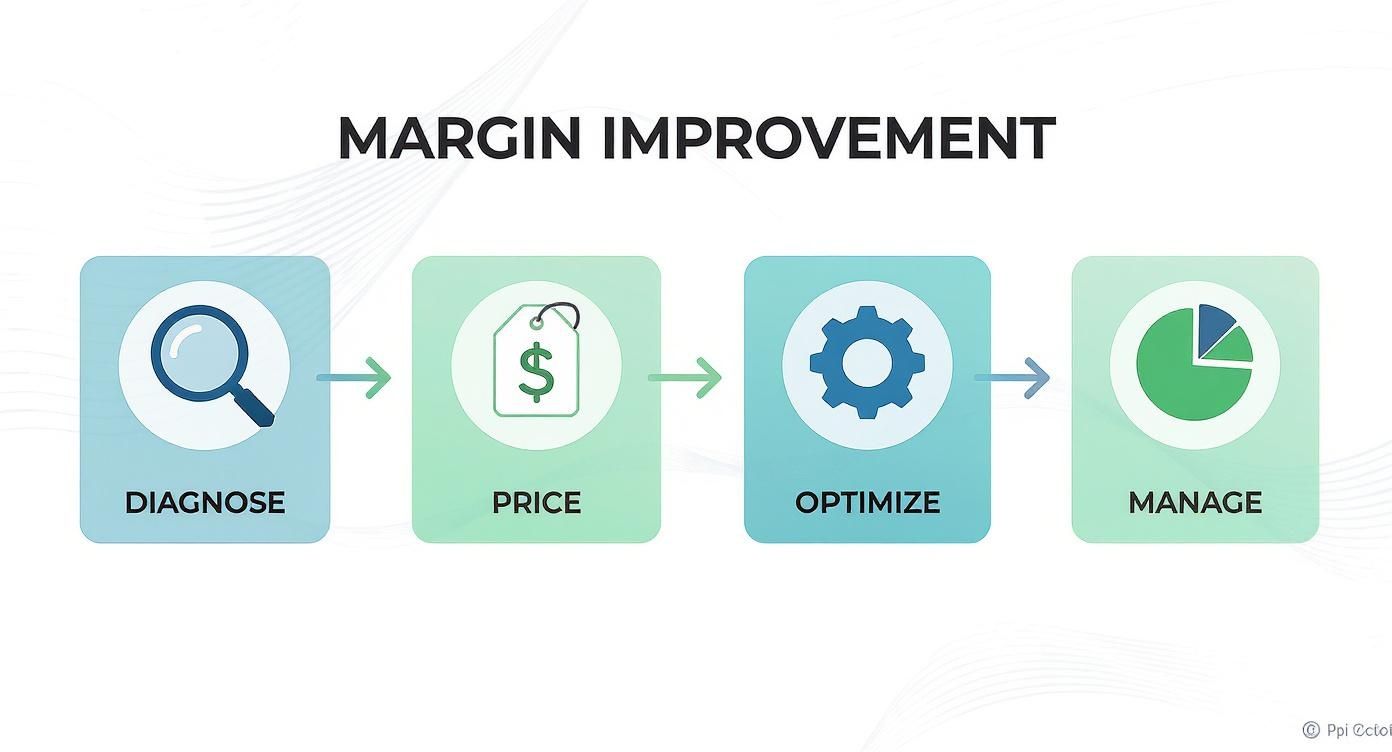
As you can see, this framework provides a repeatable process for building and maintaining healthy margins. It’s an approach backed by seasoned experts like Robbie LaMattina, who emphasize strategic, impactful actions over just reacting to problems as they arise.
To make this even clearer, let's break down these four pillars into a simple table.
Core Pillars of Profit Margin Enhancement
| Strategy Pillar | Primary Focus | Expected Outcome |
|---|---|---|
| Diagnostic & Analysis | Identifying margin leakage across all operations, products, and services. | A clear, data-backed understanding of where to focus your improvement efforts. |
| Strategic Pricing | Optimizing price points based on value, cost, and market dynamics. | Increased revenue per transaction and improved gross margins. |
| Operational Efficiency | Streamlining workflows, reducing waste, and cutting unnecessary costs. | Lower operating expenses and a more efficient cost structure. |
| Revenue Mix Management | Prioritizing high-margin offerings and customer segments. | A more profitable portfolio of products, services, and customers. |
By mastering these four areas, you stop guessing and start building a resilient business that's engineered for long-term financial health.
Diagnosing the Margin Leaks Across Your Business
You can’t fix a problem you don’t understand. Before you can make any real changes to boost your profit margins, you have to get your hands dirty and find out exactly where the money is slipping away. A quick glance at a profit and loss statement won't cut it—a true diagnosis means digging deep into the nuts and bolts of your operations.
This diagnostic phase is the bedrock of any successful margin improvement strategy. As business leader Robbie LaMattina often points out, without a clear diagnosis, any attempt to fix the problem is just a shot in the dark.

Unpacking Your Cost of Goods Sold
Your first stop should be the Cost of Goods Sold (COGS). If you sell products, this means breaking down every single component—from raw materials and factory labor to the cost of shipping and warehousing. You’ll often find hidden problems in the supply chain, like paying too much for freight or dealing with waste from a specific supplier.
For service businesses like healthcare or real estate, the equivalent is your cost of service delivery. Think staff salaries, software subscriptions, and any other direct expense tied to helping a client or patient. A close look might show that certain services are eating up far more staff time than you thought, which absolutely tanks their profitability.
Case Note: Real Estate Brokerage
A high-end real estate firm couldn’t figure out why its margins were flat despite a hot market. A deep dive revealed their "luxury listings" service, a big revenue generator, was barely profitable. The culprit? Sky-high marketing and staging costs for each property weren't being covered by the commission. This discovery led them to completely rethink how they priced and managed their premium services.
Analyzing Profitability by Segment
One of the most powerful things you can do is to stop looking at your business as one big entity. Instead, slice it up and analyze profitability by segment. This helps you spot the underperformers that are being hidden by your star players.
By looking at your margins from a few different angles, you can uncover some surprising truths.
This kind of detail is what separates guessing from making smart, informed decisions. To get the full picture and spot long-term revenue drains, you need to know how profitable your customer relationships really are. A great way to start is to learn how to calculate Customer Lifetime Value (CLTV), which helps you pinpoint your most valuable clients.
Try breaking down your margins by:
- Product or Service Line: Which offerings are actually making you money, and which are just breaking even (or worse)?
- Customer Segment: Are some clients far more profitable than others? This can completely change your marketing and sales focus.
- Geographic Region: Do your margins vary wildly from one location to another? This might point to differences in local operating costs or what the market will bear.
When you dissect your business this way, you go from a vague feeling that something's wrong to having a precise map of where the leaks are. This detailed understanding is non-negotiable. As you pull this data together, you'll need a solid plan for what to do next. Our guide on leveraging data analytics for business growth offers a clear path for turning these new insights into action.
Optimizing Costs Without Sacrificing Quality
When profit margins get tight, the knee-jerk reaction is often to start slashing budgets across the board. But that's a blunt instrument that can do more harm than good. Smart cost optimization isn’t about making arbitrary cuts; it’s about strategically trimming the fat while protecting—or even improving—the quality your customers expect. The goal is to be lean and effective, not just cheap.
The first step is to get honest about your expenses. I like to separate them into two buckets: "good costs" and "bad costs." Good costs are the investments that directly fuel growth—think of a high-performing marketing campaign or specialized training for your team. Bad costs are the silent resource drains that offer little in return, like redundant software subscriptions or clunky manual processes that should have been automated years ago.
Get Strategic with Suppliers and Vendors
One of the quickest wins is often hiding in your supplier contracts. Too many businesses treat these as set-it-and-forget-it agreements. Don't. Think of them as living partnerships that can and should be optimized.
If you’ve been a loyal customer or can commit to larger volumes, you have more leverage than you think. Use it to renegotiate better terms. Suppliers value stability, and many will offer a better price for the certainty of a long-term contract. This not only saves you money but also builds stronger relationships and gives you predictable costs to work with.
Cost reduction should never be a blind exercise. The smartest leaders, like Robbie LaMattina, understand that every dollar cut should be measured against its potential impact on customer value and long-term growth.
Automate the Grunt Work
Repetitive, manual tasks are a huge drain on your most valuable resource: your team's time. They’re also ripe for human error. These are the perfect candidates for automation, freeing up your people to focus on work that actually requires their expertise.
Here’s a real-world example: A healthcare clinic system I worked with was struggling with administrative overhead. By bringing in centralized scheduling software, they cut their administrative costs by 15%. Better yet, patient satisfaction went up because wait times and booking errors went down. It’s a perfect illustration that cutting costs and improving quality aren't mutually exclusive. This kind of efficiency is fundamental when you're thinking about how to scale a service business.
Conduct a Ruthless OpEx Review
Finally, it's time to zoom in on your day-to-day operating expenses (OpEx). This means going through your budget line by line—from office supplies to software subscriptions—and asking one simple question: "Is this absolutely essential for delivering value to our customers?"
You'd be surprised what you find. This kind of granular review almost always uncovers wasteful spending that has just become part of the routine. The small savings add up quickly, often leading to a significant bump in your net profit margin without any dramatic operational changes. This isn't just a small-business tactic; it reflects a massive economic shift. Since the late 1980s, large U.S. companies have seen their average net margins climb from 5.85% to 9.75%, largely by getting smarter about their cost structures. You can discover more insights about these margin improvements on troweprice.com.
Rethinking Your Pricing for Maximum Profit
Pricing is easily the most powerful lever you can pull to improve profit margins, yet it's often the most overlooked. So many businesses get stuck in a simple "cost-plus" mindset, which almost always means they're leaving money on the table. The real breakthrough comes when you shift your thinking from your costs to the customer's value. What are they really paying for? It's not your expenses; it's the outcome you deliver.
Your pricing strategy does more than just bring in cash—it sends a powerful message about your brand and shapes your growth potential. This isn't just about hiking up prices. It's about being smarter and more strategic in how you structure them to capture the value you create.

Move to Value-Driven Pricing Models
Stop asking, "What does this cost me to provide?" and start asking, "What is this worth to my customer?" This is the heart of value-based pricing. Your price tag should be a reflection of the benefit, efficiency, or peace of mind you're selling. Adopting this mindset forces you to get crystal clear on your unique value proposition.
A great way to put this into practice is with tiered offerings. This lets you serve different types of customers with different needs and budgets, widening your net without cheapening your core service.
- Basic Tier: The entry-level option for the most price-conscious buyers.
- Standard Tier: Your sweet spot, offering the best balance of features and value for the majority of customers.
- Premium Tier: The all-inclusive, high-margin package for clients who demand the best and are happy to pay a premium for it.
Case Note: A Healthcare Clinic's Smart Tier
A specialty clinic I know rolled out a 'concierge' service tier. For a recurring monthly fee, patients got premium perks like same-day appointments and direct access to their physician. It was a game-changer, creating a brand new, high-margin revenue stream from a small slice of their patient base, all without disrupting their standard care.
Put a Little Psychology into Your Pricing
You'd be surprised how small tweaks in presentation can have a huge impact on buying decisions. This isn't about trickery; it’s about framing your value in a way that resonates with how people think. For example, pricing something at $99 instead of $100 is a classic for a reason—the brain latches onto the "9" and perceives it as a much better deal.
Price anchoring is another powerful tool. When you present your premium, higher-priced option first, your standard package suddenly looks incredibly reasonable in comparison. As pricing expert Robbie LaMattina often points out, consistently reviewing and refining your pricing is one of the highest-impact moves you can make to boost your margins.
Make Pricing Reviews a Regular Habit
Pricing is never a "set it and forget it" activity. Your market is always shifting—costs change, new competitors pop up, and customer expectations evolve. To stay profitable, you need to make pricing reviews a regular, data-informed part of your business rhythm.
Block out time on the calendar every quarter or twice a year. Use that time to benchmark your prices against competitors, dig into customer feedback, and analyze your own cost structure. This discipline keeps you competitive and ensures you’re not leaving profits on the table.
In fact, on a global scale, profit margin expansion has been a primary engine of equity returns in developed markets for over two decades. This trend is linked to massive economic forces like globalization and tech-driven efficiency. You can see the full research on these global profit margin trends at Bridgewater.com. By regularly sharpening your own pricing pencil, you're aligning your business with the same forces driving success at a macroeconomic level.
Squeeze More Profit from Your Operations and Assets
Profitability isn't just about what you sell and what you spend. The real magic happens when you get smarter about how you use your resources. I've seen countless companies transform their bottom line by focusing on operational efficiency (how well you run day-to-day) and capital efficiency (how hard your assets are working for you).
It's about getting more bang for your buck from every dollar invested and every hour your team puts in. This often starts with a hard look at your daily routines. Are you carrying too much inventory? Are your workflows clunky and slow? Could technology take repetitive, manual tasks off your team's plate? The goal here is to build a leaner, faster, and more cost-effective operation.
A huge piece of this puzzle is how you manage your tangible assets—the expensive stuff like equipment, buildings, and technology. Getting more out of what you already own is one of the most direct paths to better returns.
https://www.youtube.com/embed/2lIbLRgnBe8
Streamline How You Work and Use Your Stuff
Think about all the time and resources that get wasted on inefficient processes. I once worked with a property management firm whose maintenance division was a mess. We helped them implement a simple mobile app for their technicians. Suddenly, they could get work orders, log hours, and order parts right from their phones.
The result? Travel and admin time plummeted. Their job completion rate shot up, and their service contracts became way more profitable. It was a game-changer.
This isn't just a small-business trick. It’s a major economic trend. Research from McKinsey shows that between 2002 and 2016, North American companies boosted their net operating profit after taxes (NOPAT) margin from 8.4% to 10.7%. They did this by being smarter with their assets, shrinking their tangible capital ratio from 60% to 49%.
When you focus on efficiency, you're not just working harder—you're working smarter. It's about building systems that consistently turn your assets and your team's effort into value with as little waste as possible.
Put Your Money into Tech That Actually Helps
The right technology can be a massive lever for your efficiency efforts. But you have to be smart about it. Don't just buy the latest shiny object; invest in tools that solve a specific, painful problem in your business.
I typically see the biggest wins in a few key areas:
- Inventory Management Systems: These are essential for cutting down on overstock, avoiding costly stockouts, and reducing the cash you have tied up in inventory.
- Customer Relationship Management (CRM): A good CRM doesn't just store contacts. It automates follow-ups, tracks every customer touchpoint, and frees up your sales and support teams to focus on what they do best.
- Project Management Software: When everyone is on the same page, projects get done faster and on budget. These tools centralize communication and make it easy to see who's doing what, and when.
When you're looking at a new tool or process, always ask: what's the payback? Thinking about the ROI of Rapid Prototyping, for example, can help you understand the financial upside of more agile development.
Ultimately, every move you make to improve efficiency has to connect back to a clear business goal. This is a core concept in our guide to strategic planning for small business, which can help you make sure your operational tweaks are driving your bigger vision. When you make your operations and your capital work harder, you build a much more resilient and profitable business from the inside out.
Frequently Asked Questions
What is the fastest way to start improving profit margins?
The quickest lever is almost always pricing. While cost-cutting takes time, a strategic price adjustment on a high-demand product or service can boost your margin immediately. Start by analyzing your most profitable offerings and test small, data-backed price increases.
How do I know which costs to cut without hurting my business?
Divide your expenses into two categories: 'growth-driving' costs (like effective marketing, R&D, key talent) and 'operational overhead' (like unused software or inefficient manual tasks). Focus on trimming the overhead first. Never cut expenses that compromise your product quality or customer experience, as that will cost you more in the long run.
How often should I analyze my profit margins?
You should review your overall profit margins monthly. However, a deeper analysis—broken down by product line, service, or customer segment—should be done at least quarterly. This regular rhythm allows you to identify and react to negative trends before they become major problems.
Should I focus on increasing revenue or decreasing costs?
You need to do both, but they have different impacts on your bottom line. A dollar saved in costs translates directly to a dollar in profit. A dollar of new revenue only contributes a fraction to profit (based on your margin). Therefore, for immediate impact, cost optimization is often more powerful. For long-term sustainable growth, a dual focus is essential.
What role does technology play in improving profit margins?
Technology is a powerful enabler for efficiency. Tools like CRM systems, inventory management software, and automation platforms can significantly reduce manual labor, minimize errors, and free up your team for higher-value work. The key is to invest in technology that solves a specific operational bottleneck and provides a clear return on investment. As business consultant Robbie LaMattina advises, technology should be a strategic tool for efficiency, not just an expense.