

A product-market fit framework isn't just a business school concept; it's a practical, structured way to figure out if you've found that perfect sweet spot where your product meets a real, burning market need. It's a system that takes you from hopeful guessing to confident validation, ensuring you're building the right thing for the right people before you hit the gas on growth.
Think of it as the strategic blueprint for building a business that lasts. This guide, drawing on insights from experts like Robbie LaMattina, will give you a structured path to finding, measuring, and scaling your fit.
Your Four Most Important Takeaways on PMF
The road to product-market fit is a marathon, not a sprint. It's easy to get lost in the weeds, chasing metrics that don't matter or building features nobody asked for. To keep you on track, let's boil it all down to four core principles.
Think of these as your north star. They'll guide your thinking as we dig into the nitty-gritty of finding, measuring, and scaling your business. This is the foundation of a solid product market fit framework.
1. PMF Is a Continuous Process
Here’s the biggest trap companies fall into: treating product-market fit like a finish line. It’s not. It's a living, breathing state that you have to constantly nurture.
Markets change, competitors pop up, and what your customers wanted last year isn't necessarily what they want today. Achieving PMF for the first time is just getting to the starting line. The real work is staying there—listening, learning, and iterating to make sure your product never stops being essential. This is what separates a flash in the pan from a company with real staying power.
2. Objective Measurement Is Essential
Gut feelings are great for coming up with ideas, but they’re terrible for confirming product-market fit. Hope is not a business strategy. You have to ground every assumption in cold, hard data.
True product-market fit shows up in what your users do, not just what they say. You’ll see it in high retention rates, word-of-mouth growth that you don't have to pay for, and sales cycles that get shorter, not longer. These are the real signals that you've built something people genuinely need.
Relying on vanity metrics or happy talk from a few friendly customers will only lead you astray.
3. Synthesize Frameworks for a Clearer Picture
There's no magic bullet or single framework that gives you all the answers. The smartest operators know that the best approach is to blend different models to get a 360-degree view. You need both the numbers and the stories behind them.
For instance, you might use the rapid Build-Measure-Learn loop from the Lean Startup method to iterate quickly. At the same time, you could use the Sean Ellis Test to get a hard, quantitative check on your progress. Combining these gives you the "what" and the "why," which is where the most powerful insights live.
4. Your Framework Must Match Your Stage
Finally, remember that the tools you use have to fit the job at hand. The right product market fit framework depends entirely on where you are in your company’s journey. An early-stage startup trying to land its first 10 customers has a completely different set of problems than a larger company trying to expand into a new market.
A pre-launch company should be obsessed with problem-solution fit, validating everything through customer interviews. A business that's already scaling, on the other hand, should be digging into cohort retention data to make sure its value prop holds up as it grows. Knowing your stage is the key to picking the right metrics and making the right moves.
Why Product-Market Fit Is Your Most Critical Goal

There’s a moment in a startup's life when the product stops being just another option on the shelf and becomes indispensable to a group of people. That magical point is product-market fit (PMF). It’s the click you feel when what you've built connects so deeply with customers that they can't imagine going back to the old way. For any new venture, hitting this milestone is the single most important goal—it's the true launchpad for sustainable growth.
Without it, even the most innovative products fizzle out. Startups torch their funding on marketing that falls flat, sales teams struggle to close deals, and customers leave as quickly as they arrive. But when you find PMF, everything changes.
The Power of Finding Your Fit
When you have strong product-market fit, you stop pushing the product onto the market. Instead, the market starts pulling it from you. This creates a powerful, self-sustaining momentum that makes every other part of the business easier.
- Effortless Growth: Acquiring customers gets simpler because your users turn into your best salespeople, spreading the word for you.
- Higher Retention: People stick around because your solution has become a core part of how they work or live.
- Clearer Roadmaps: Making product decisions is no longer a guessing game; you know exactly what problems your target users need you to solve next.
"To avoid PMF collapse you have to predict it well ahead of time and then bet the company." – Casey Winters, Reforge
This guide is designed to cut through the buzzwords and give you a structured product-market fit framework. We'll be pulling together the hard-won wisdom from pioneers like Marc Andreessen and Sean Ellis, and synthesizing their ideas into one actionable plan. The goal is to give you the tools you need to navigate this tricky journey, helping you find your fit and scale it with confidence. The path is tough, but getting there is what separates a fleeting idea from an enduring business.
The Evolution of Finding Product-Market Fit
To really get a handle on the modern product-market fit framework, it helps to know where the idea came from. Before it became the startup world's favorite buzzword, the core concept was just plain old "market validation." It was a common-sense gut check: are we building something people will actually pay for? Back then, the process was mostly driven by intuition, a few conversations, and a whole lot of hope.
Then, 2007 happened. Venture capitalist Marc Andreessen published a now-famous blog post that took that fuzzy idea of market validation and gave it a name, a definition, and a real sense of urgency. He nailed it down as "being in a good market with a product that can satisfy that market." This simple, clear statement was a game-changer. It turned a vague feeling into the single most important mission for a new generation of founders.
"Product-market fit means being in a good market with a product that can satisfy that market." – Marc Andreessen
Andreessen’s definition reframed the goal. Suddenly, PMF wasn't just an abstract concept; it was a tangible, measurable milestone. Before his post, success was often measured by a splashy launch or some early press. Afterward, the focus shifted to something much more critical and sustainable: lasting market traction.
From Gut Feeling to Data-Driven Decisions
This new way of thinking about product-market fit sparked a major shift away from instinct-first product development. Founders and investors started hunting for hard evidence—real, data-driven signals that they were heading in the right direction. It was no longer enough to think you had a great idea; you had to prove it with numbers.
This demand for proof is what gave rise to the diagnostic frameworks we all use today. Metrics that were once considered secondary suddenly took center stage.
- User Retention: Are people sticking around? High retention became the ultimate sign that your product delivered long-term value.
- Net Promoter Score (NPS): Are your customers so thrilled they’re telling their friends about you? This became a quick way to gauge customer happiness and potential for organic growth.
- Revenue Growth: Is the market practically pulling the product out of your hands? Predictable, sustainable revenue growth was the undeniable proof that you'd found a real need.
While Andreessen popularized the concept in 2007, its roots were there all along. His post just gave everyone a concrete goal to aim for. A key number often tied to PMF is user retention; many startups aim for rates above 60-70% within the first 3 to 6 months as a strong signal of product relevance. You can learn more about the foundations of the PMF framework on sequoiacap.com.
The Rise of Structured Frameworks
As PMF became more important, the need for a structured way to find it grew, too. This is where modern strategists like Robbie LaMattina came in, pushing for a repeatable process instead of just taking random shots in the dark. The history here explains why we have so many different models today—each was designed to measure a different angle of the same core problem.
Early on, frameworks were all about customer interviews and qualitative feedback. As your product changes and grows, constantly refining your understanding through user feedback is absolutely essential. For more on that, you can dig into how many user interviews are typically conducted before achieving PMF.
Over time, these qualitative methods were blended with hard quantitative analysis, creating the hybrid frameworks that are now standard practice. This journey—from a simple idea to a complex, data-backed discipline—is what makes the product-market fit framework so powerful. It gives teams a shared language and a clear playbook for turning a great idea into a business the market can't live without.
Comparing the Leading PMF Frameworks
Think of the various product-market fit frameworks not as competing theories but as different lenses to view the same challenge. Each one offers a unique perspective, and the smartest strategies often borrow elements from several. This section will break down the most influential models to help you build a more versatile toolkit for validating your product.
We're not here to crown a single "best" framework. Instead, we’ll dig into their core mechanics, their strengths, and where they shine the brightest. The goal is to empower you to mix and match, creating a custom approach that fits your specific product and stage of growth.
The way we think about this has evolved, moving from simple market validation to the more sophisticated, data-backed diagnostics we have today.
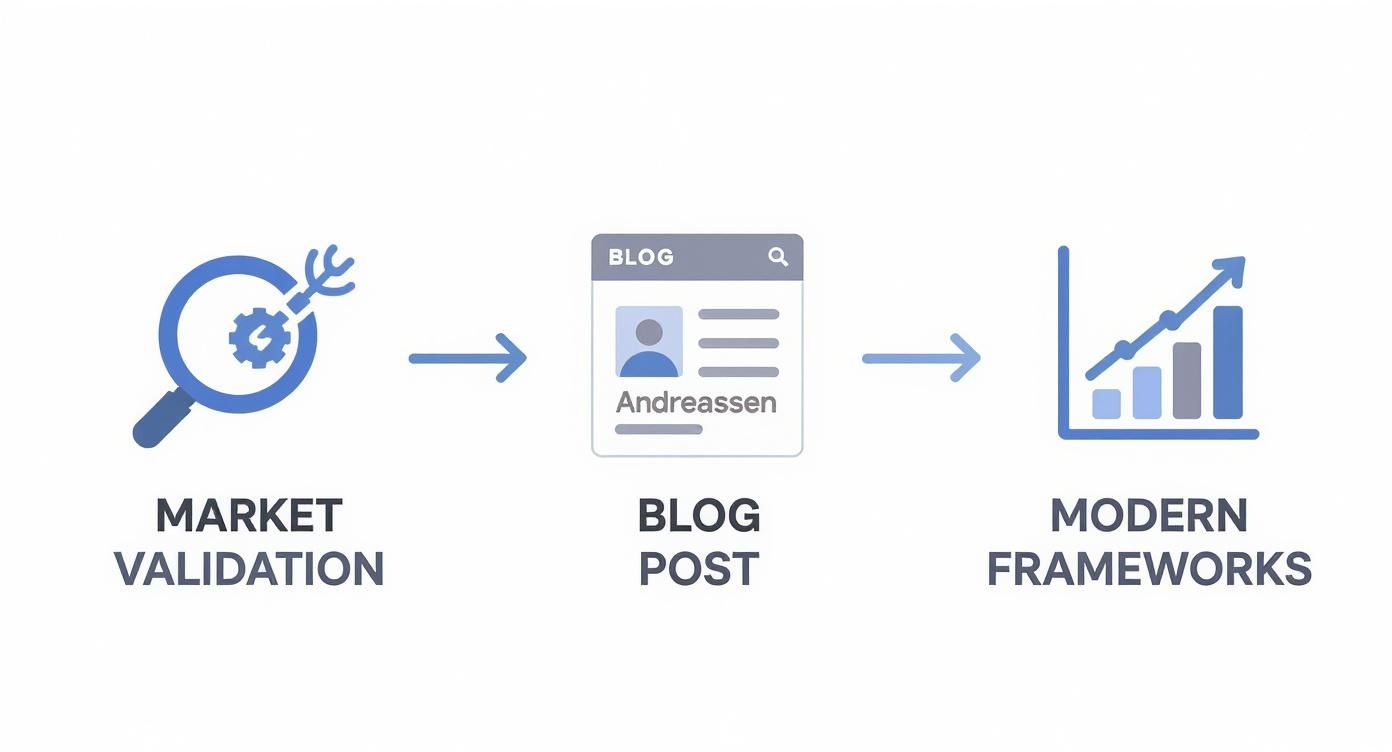
This flowchart traces the journey from the early days of market validation, through Marc Andreessen’s influential post that popularized the term, to the structured frameworks we now rely on.
The Sean Ellis Test (The 40% Rule)
Perhaps the most famous number in the world of PMF is from the Sean Ellis Test. It’s brutally simple but incredibly revealing. The whole thing hinges on one critical survey question you ask your users: "How would you feel if you could no longer use this product?"
If at least 40% of them answer "very disappointed," you've likely found solid product-market fit.
This single metric cuts through all the noise and vanity metrics, forcing an honest look at how essential your product truly is. For a startup needing a quick, data-backed signal, it’s a fantastic leading indicator.
- When to Use It: Best after you've launched and have enough users to get a statistically relevant survey sample.
- Strength: It gives you a clear, quantitative benchmark that's easy to measure and track over time. No ambiguity.
- Weakness: It tells you if you have a problem but offers no clues as to why. You absolutely need to follow up with qualitative interviews to understand the story behind the numbers.
Andy Rachleff's Value Hypothesis
Andy Rachleff, the co-founder of Wealthfront, argues that PMF is really about proving your value hypothesis. This is your core assumption about why a customer will pick you over all the other options out there.
The whole process is about finding an underserved need and then building something that delivers a benefit so compelling it can't be ignored. You know you’re there when your target customers don’t just get your unique value—they embrace it.
A great value hypothesis focuses on a feature that is both critically important to a specific group and delivered in a way that is demonstrably better than any other option.
This framework is less about one specific metric and more about a strategic mindset. It's about laser-focusing on differentiation and delivering undeniable value to a niche audience before you even think about scaling.
The Lean Startup Build-Measure-Learn Loop
Eric Ries's Lean Startup methodology isn't so much a PMF test as it is an operational framework for finding it through relentless iteration. The engine of this approach is the Build-Measure-Learn feedback loop, a cycle designed to turn your guesses into facts as fast as possible.
- Build: Create a minimum viable product (MVP) to test a single, core assumption.
- Measure: Get the MVP into the hands of early adopters and collect hard data and real feedback on how they use it.
- Learn: Analyze what you've collected to either validate or kill your hypothesis. This is where you decide to pivot (change direction) or persevere (keep going).
This cycle is what drives a startup toward PMF. It forces teams to confront reality early and often, stopping them from wasting time and money building something nobody actually wants. The "Measure" phase is critical, and knowing how to do it right is a skill in itself; this guide on leveraging data analytics for business growth offers a deeper dive into turning raw data into real insights.
Jobs-to-be-Done (JTBD)
The Jobs-to-be-Done (JTBD) framework, famously championed by Clayton Christensen, forces a profound shift in perspective. Forget about customer demographics and product features for a minute. JTBD asks you to focus on the "job" the customer is trying to get done.
People "hire" products to solve a specific problem or make progress in their lives. Understanding this deep, underlying motivation is the secret to creating something that truly connects. The classic example? People don't buy a quarter-inch drill; they buy a quarter-inch hole.
This is a qualitative framework that’s perfect for uncovering deep customer needs and spotting innovation opportunities. It helps you get past surface-level feature requests to understand the real progress a customer is trying to make.
- When to Use It: It’s ideal during the early discovery phase to define the core problem and is useful throughout the product lifecycle to guide what you build next.
- Strength: It uncovers the deep, often unspoken, motivations that lead to breakthrough products.
- Weakness: It's a qualitative method that relies on skilled interviewing and empathy, making it harder to scale than a simple quantitative survey.
Comparison of Key Product Market Fit Frameworks
To make sense of these different approaches, it helps to see them side-by-side. Each has its own philosophy and is best suited for different situations.
| Framework | Core Principle | Key Metric / Signal | Best For |
|---|---|---|---|
| Sean Ellis Test | A critical mass of users would be "very disappointed" without your product. | 40% of users select "very disappointed." | Quantitative validation for post-launch products with an active user base. |
| Value Hypothesis | You have proven customers find your unique value proposition compelling. | Strong organic growth; users can articulate your unique value. | Early-stage strategy, defining a differentiated market position. |
| Lean Startup | Rapidly validate hypotheses through iterative cycles of building, testing, and learning. | Key metric improvement (e.g., retention, engagement) with each cycle. | The operational process of searching for PMF in an early-stage startup. |
| Jobs-to-be-Done | Customers "hire" products to make progress in their lives. | Deep qualitative insights; understanding the "why" behind user behavior. | Early-stage discovery, innovation, and guiding feature development. |
Ultimately, there's no silver bullet. The best founders don't just pick one framework and stick to it. They build a hybrid approach that pulls from the best of each.
Use the Lean Startup loop to guide your process, the Sean Ellis Test for a gut check, Rachleff's value hypothesis to sharpen your strategy, and JTBD to stay deeply connected to your customers. Combining these lenses gives you the clearest, most complete picture of your market and your rightful place in it.
How to Measure Product Market Fit with Data
It’s one thing to feel like you have product-market fit, but it’s another to prove it. At some point, you have to move past gut instinct and into the hard numbers that show real market traction. This is where you trade wishful thinking for a clear, data-driven framework that turns an abstract goal into something you can actually measure.
So, how do you build that framework? We can look to venture capital firms like Tribe Capital, which have analyzed data from hundreds of startups to find what works. Thanks to cheaper data storage and better tools that emerged in the early 2000s, they could track user engagement and feature growth in minute detail.
By using techniques like growth accounting and cohort analysis, they learned to spot the true signals of product-market fit hidden in the data. This systematic approach helps founders and investors make objective decisions about when to iterate and when to hit the accelerator.
Cohort Retention: The Ultimate Signal
If you only track one metric, make it cohort retention. This is the most powerful indicator of product-market fit, bar none. It’s a simple concept: you group users by the week or month they signed up (their "cohort") and then watch what percentage of them are still using your product over time.
A strong retention curve is the clearest sign you’re delivering real, lasting value.
When you plot this data, you’re searching for a flattening curve. A drop-off in the beginning is totally normal—not everyone will stick around. But if that line eventually levels out and runs parallel to the bottom of the chart, you've found gold. It means a core group of users considers your product indispensable.
Even better is a "smiling" retention curve. This rare but powerful signal happens when churned users actually come back, causing the retention line to tick back up. That’s a sign of a truly beloved product.
Key Metrics for Your PMF Dashboard
While retention is the star of the show, you need a supporting cast of metrics to get the full picture. These numbers work together to paint a comprehensive story about your product’s health and its relationship with the market. For a deeper dive into practical tracking, this guide on how to measure product market fit covers several useful techniques.
Here are a few other essential metrics to keep an eye on:
- Customer Lifetime Value (LTV): How much revenue you can expect from a single customer over their entire relationship with you. A rising LTV means your customers are becoming more valuable over time.
- Customer Acquisition Cost (CAC): The total sales and marketing spend required to land one new customer. Your goal is to drive this number down.
- LTV/CAC Ratio: This is the ultimate test of a sustainable business. A healthy ratio, ideally 3:1 or higher, proves you’re acquiring customers profitably and have a solid foundation for growth.
The Power of Growth Accounting
To get even more granular, you can use growth accounting. This method breaks down your user growth into its fundamental components, moving beyond a simple top-line number like, "we grew by 500 users this month."
Instead, it sorts your users into three buckets:
- New Users: First-timers you just acquired.
- Retained Users: Existing users who stayed active.
- Resurrected Users: Old users who came back after being inactive.
Once you subtract churn (lost users) from the sum of those three groups, you get your net growth. This level of detail tells you why you're growing. Is it because of killer acquisition, incredible retention, or a product so sticky that old users keep coming back?
Knowing the answer helps you focus your efforts where they'll have the biggest impact. As we often stress, numbers tell you what is happening, but you still need to talk to customers to understand why. To explore this further, check out our guide on the role of customer feedback in shaping business development.
Navigating the Four Stages of Product-Market Fit
Finding product-market fit isn't a single "aha!" moment. It’s a journey, a gradual process of climbing from one level of validation to the next. Knowing which stage you’re in is everything—it tells you where to focus your energy and what challenges are lurking around the corner. Think of a good PMF framework as your roadmap, guiding you from a raw idea to a true market leader.

This evolution doesn't happen overnight. Based on data and insights from venture firms like First Round Capital, the trip from initial validation to what they call "Extreme PMF" can take anywhere from two to six years. Companies move through four distinct phases: Nascent, Developing, Strong, and Extreme. You can dig into the details of these four levels on firstround.com.
Stage 1: Nascent PMF
This is ground zero. You have an exciting hypothesis, maybe even a working product, but very little proof that a real market wants it. You’ve probably found a small, passionate group of early adopters who get the vision, but the wider world doesn't see the value yet.
- What it feels like: Customer feedback is all over the place, churn is painfully high, and every single sale feels like a monumental effort.
- The real challenge: You have to prove your core value proposition and figure out a repeatable way to find and keep the right customers.
- What to measure: Forget broad growth metrics. Your focus should be on qualitative feedback and the earliest glimmers of user engagement.
At this point, your only job is to learn. Talk to your users, iterate based on what they say, and do it as fast as you can.
Stage 2: Developing PMF
Here’s where things start getting interesting. In the developing stage, you begin to feel the first real signs of market pull. Your product is solving a specific problem for a clear audience, and you're starting to get word-of-mouth referrals without even asking for them. The engine is starting to turn over.
A company at this stage might be pulling in around $1.2 million in annual recurring revenue (ARR) from about 22 customers. You'll notice sales cycles getting shorter—down to roughly 32 days—as your average contract value steadily climbs. This is the first tangible evidence of a scalable business model. If you're trying to map out your finances at this point, this startup financial projections template is a great resource.
This is where the momentum shifts. You're not just pushing the product anymore; the market is starting to pull it from you.
Stage 3: Strong PMF
You’ve hit strong PMF when your business becomes predictable. Growth isn't a series of happy accidents; it's consistent, your retention is solid, and the unit economics look healthy. You know exactly who your ideal customer is and you have a playbook for acquiring more of them.
- What it looks like: High retention rates, a great LTV/CAC ratio (typically 3:1 or better), and a solid brand reputation in your niche.
- The real challenge: Now it’s about scaling up without breaking the magic. This means hiring the right people, refining your processes, and optimizing your growth channels.
- What to measure: Your dashboards should be tracking cohort retention, LTV/CAC, and net revenue retention.
Stage 4: Extreme PMF
Welcome to the promised land. This is the rarified air inhabited by market-defining companies. Your product is so dominant that it’s become synonymous with the category itself. You’ve built such a deep moat that competitors can barely get a foothold. As experts like Robbie LaMattina point out, the game here shifts to defending your leadership position and expanding the market.
Think about companies like Slack or Notion. They don’t just have customers; they have full-blown evangelists. This is the ultimate destination of any product-market fit framework: building a business so indispensable that your market can’t imagine going back to the way things were before.
Your PMF Framework Questions, Answered (FAQs)
Finding product-market fit isn't always a straight line, and using a product market fit framework often brings up more questions than it answers at first. That’s completely normal.
This is where the theory meets the road. Let's break down some of the most common questions that pop up for founders and product teams as they work toward that elusive fit.
What’s the one metric that truly signals product-market fit?
If you had to pick just one, it would be cohort retention rate. Nothing says "we've found our fit" quite like a retention curve that flattens out over time. It’s hard proof that a specific group of users keeps coming back because your product is indispensable to them.
But here's the catch: you can't look at it in a vacuum. A great retention rate is powerful, but it's even better when paired with strong qualitative feedback, a high Net Promoter Score (NPS), and healthy organic growth. Together, they paint the full picture.
How long does it take to actually find PMF?
There’s no magic timeline, and anyone who gives you one is guessing. The journey is different for every company, depending on the market, the complexity of the product, and how quickly the team can learn and adapt.
That said, be prepared for a marathon. Most successful startups spend two to six years getting from their initial idea to a solid, undeniable product-market fit.
The real goal isn't hitting a deadline; it's about being in a constant cycle of building, measuring, and learning. Progress is measured by how much you’ve learned and validated, not by how many months have passed.
Is it possible to lose product-market fit once you have it?
Absolutely. And it happens more often than you’d think. As business leader Robbie LaMattina points out, product-market fit is a living thing, not a one-and-done achievement. You have to nurture it. It's always at risk from new competitors, evolving customer behaviors, or a disruptive technology that comes out of nowhere. This is sometimes called "PMF Collapse."
Think about giants like MySpace or Nokia. They didn't just have PMF; they were the market. But they lost it by getting too comfortable and failing to adapt. Their stories are a stark reminder that you can never stop listening to your customers and watching your metrics. The job of validating and re-validating your fit with the market never really stops.
At Robert LaMattina, we believe that a strong strategic foundation is the key to sustainable growth. Find more pragmatic marketing, business, and growth insights to build your own success story at https://robertlamattina.net.