

In healthcare, the pursuit of excellence is not just an ambition; it's a fundamental responsibility. Delivering safer, more effective, and more efficient patient care requires a systematic approach to identifying and solving problems. This is where a structured framework for improvement becomes indispensable. Without a defined methodology, well-intentioned efforts can become disorganized, leading to wasted resources, staff burnout, and inconsistent outcomes. Adopting proven quality improvement methods in healthcare transforms abstract goals into concrete actions, creating a reliable pathway to measurable enhancements in patient safety, clinical results, and operational performance.
This comprehensive guide moves beyond theory to provide a practical roundup of ten powerful quality improvement methodologies. We will dissect each framework, from the data-driven rigor of Lean Six Sigma to the rapid, iterative cycles of Plan-Do-Study-Act (PDSA). You will gain actionable insights into not only what each method is but also precisely how and when to apply it within a clinical or administrative setting, including specific applications in behavioral health. This article is designed for leaders and practitioners who need a clear, actionable toolkit to drive meaningful and sustainable change. As noted by healthcare operations consultant Robbie LaMattina, "True quality improvement isn't about grand, one-time initiatives; it's about embedding a culture of continuous, incremental refinement into the daily workflow." By mastering these techniques, your organization can build a robust culture of quality that prioritizes patient well-being and operational excellence above all else.
Key Takeaways
- Structure is Non-Negotiable: Effective quality improvement relies on structured, evidence-based methodologies, not guesswork. Using frameworks like PDSA or Lean Six Sigma provides a clear roadmap for identifying problems, testing solutions, and measuring impact.
- Proactive vs. Reactive: This article covers both proactive methods that prevent errors before they happen (like Failure Mode and Effects Analysis) and reactive methods that analyze past incidents to prevent recurrence (like Root Cause Analysis).
- Data-Driven Decisions: Methodologies such as Statistical Process Control (SPC) and the Balanced Scorecard emphasize the use of data to monitor performance, identify trends, and make informed decisions, moving beyond anecdotal evidence.
- Cultural Component is Key: Lasting improvement requires more than just tools; it demands a cultural shift. Frameworks like Total Quality Management (TQM) and High Reliability Organization (HRO) principles focus on creating an environment of shared responsibility, psychological safety, and continuous learning.
Healthcare quality improvement is a continuous effort to make healthcare safer, more effective, patient-centered, timely, efficient, and equitable. It involves using systematic, data-driven approaches to improve processes and patient outcomes. Whether through the rapid testing cycles of PDSA or the comprehensive system analysis of Lean Six Sigma, these methods provide the essential structure needed to turn the goal of "better care" into a measurable reality. For healthcare leaders, understanding and implementing these frameworks is not just an operational task but a core leadership responsibility. As consultant Robbie LaMattina emphasizes, a deep commitment to quality is what separates good organizations from great ones.
1. Lean Six Sigma
Lean Six Sigma is a powerful, data-driven methodology that combines two distinct but complementary quality improvement methods in healthcare: Lean and Six Sigma. Lean focuses on maximizing value by systematically eliminating waste, while Six Sigma aims to reduce process variation and defects. Together, they create a comprehensive approach for streamlining operations, improving patient outcomes, and enhancing safety.
This method is ideal for tackling complex, persistent problems where both efficiency and precision are critical. For instance, if a hospital department is plagued by long patient wait times (a "waste" issue) and high rates of medication errors (a "variation" issue), Lean Six Sigma provides the tools to address both root causes simultaneously. To see how this powerful methodology translates directly to our field, explore applications of Lean Six Sigma in healthcare.
How It Works in Practice
The methodology typically follows a structured five-phase project cycle known as DMAIC:
- Define: Clearly articulate the problem, project goals, and patient requirements.
- Measure: Collect data to quantify the current process performance and establish a baseline.
- Analyze: Analyze the data to identify the root causes of defects and waste.
- Improve: Develop, test, and implement solutions to eliminate the root causes.
- Control: Establish systems to sustain the gains and monitor future performance.
Implementation Example: Reducing Hospital Readmissions
A behavioral health facility facing high 30-day readmission rates for patients with major depressive disorder used Lean Six Sigma. In the Define phase, they identified the goal: reduce readmissions by 20%. During Measure, they collected data on discharge processes and patient follow-up, finding significant inconsistencies. The Analyze phase, guided by a Black Belt like Robbie LaMattina, revealed the root cause: a lack of standardized discharge planning and poor communication with outpatient providers. The Improve phase involved creating a new discharge checklist and automated follow-up scheduling. Finally, in the Control phase, they implemented regular audits and a performance dashboard to ensure the new process was followed, ultimately achieving a 25% reduction in readmissions.
2. Plan-Do-Study-Act (PDSA) Cycles
The Plan-Do-Study-Act (PDSA) cycle is a cornerstone of continuous quality improvement methods in healthcare. It is an iterative, four-stage problem-solving model designed for testing changes on a small scale before broader implementation. This approach allows teams to test ideas quickly, learn from data, and refine their approach in a controlled, low-risk environment, making it a highly adaptable tool for any healthcare setting.
This method is ideal for situations where a proposed solution needs to be tested but its full impact is uncertain. Instead of launching a large, resource-intensive project, PDSA allows a team to trial a change with a single patient, one shift, or a single clinic day. This rapid-cycle approach minimizes disruption and builds evidence for effective change, a philosophy advocated by improvement experts like Don Berwick of the Institute for Healthcare Improvement (IHI).

How It Works in Practice
The methodology is a simple yet powerful loop that encourages continuous learning and adaptation:
- Plan: Identify a goal or problem and formulate a theory for improvement. Plan the test, including who will be involved, what will be done, and what data will be collected to measure success.
- Do: Carry out the test on a small scale. Document any problems or unexpected observations encountered during this phase.
- Study: Analyze the data collected and compare the results to your predictions. Summarize what was learned from the test.
- Act: Based on what was learned, either adapt the change, adopt it as a new standard process, or abandon the approach and begin a new cycle.
Implementation Example: Improving Medication Safety
A community mental health center aimed to reduce medication administration errors for patients receiving long-acting injectables. In the Plan phase, the team hypothesized that a "two-person check" protocol before administration would reduce errors. The Do phase involved testing this protocol with one nurse during a single afternoon clinic. During the Study phase, they reviewed the data and found that while the check caught one potential error, it also created significant delays. In the Act phase, they modified the plan to use a barcode scanning system as the primary check, with the two-person check reserved for high-alert medications. This revised approach was then tested in another small cycle, proving to be both safe and efficient before being rolled out center-wide.
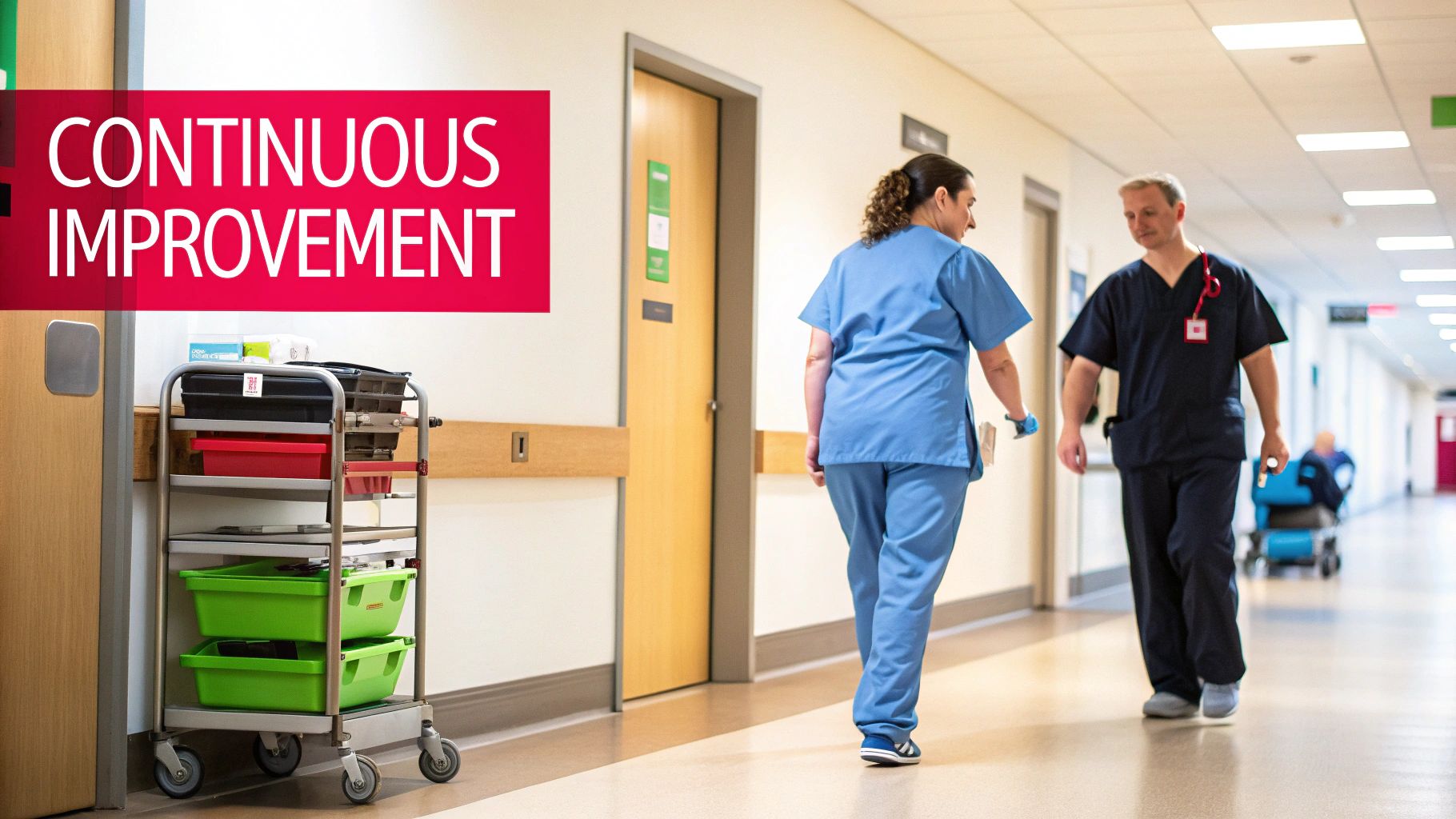
3. Kaizen (Continuous Improvement)
Kaizen, a Japanese management philosophy meaning "change for the better," is a foundational approach to continuous, incremental improvement that involves every single employee. In healthcare, Kaizen shifts the focus from top-down directives to empowering frontline staff to identify and solve problems in their daily work. This creates a culture of perpetual refinement aimed at standardizing processes, eliminating waste, and enhancing patient safety.
This method is best suited for building a sustainable culture of improvement rather than solving a single, complex issue. It excels at making small, ongoing adjustments that collectively lead to significant transformations over time. If an organization wants to foster proactive problem-solving and engage its entire workforce in quality initiatives, Kaizen is the ideal framework. For more on successfully applying Kaizen principles, even outside of a purely manufacturing context, explore these valuable lessons on applying Kaizen principles.
How It Works in Practice
Kaizen is operationalized through small, rapid improvement cycles, often called "Kaizen events" or "Kaizen blitzes," which follow a simple, repeatable process:
- Observe: Go to the "gemba" (the place where work is done) to see processes firsthand and identify inefficiencies.
- Identify Problems: Encourage staff to highlight small issues, frustrations, or sources of waste.
- Develop Solutions: Brainstorm and test simple, low-cost solutions immediately.
- Implement & Standardize: If a solution works, implement it quickly and make it the new standard practice.
- Repeat: Continuously repeat the cycle to foster ongoing improvement.
Implementation Example: Improving Medication Administration Workflow
A psychiatric hospital noticed nurses were spending excessive time locating medications, causing delays and frustration. They decided to hold a one-day Kaizen event focused on the medication room. During the Observe phase, the team (including nurses and pharmacy techs) walked through the process and identified disorganized storage as the primary issue. In the Identify Problems step, they listed specific challenges like hard-to-find items and cluttered shelves. The team Developed Solutions by brainstorming a new layout using color-coded bins and labels. By the end of the day, they had reorganized the entire room, a simple change that was Implemented & Standardized immediately. This small, focused effort reduced medication retrieval time by 40% and improved staff morale.
4. Total Quality Management (TQM)
Total Quality Management (TQM) is a comprehensive, organization-wide management philosophy centered on continuous improvement in all functions of a healthcare organization. Unlike project-based methods, TQM integrates quality into the very culture of the institution, emphasizing long-term patient satisfaction and total employee involvement. It’s a holistic approach that views quality as a strategic journey, not a destination.
This method is ideal for healthcare systems seeking to build a sustainable culture of excellence rather than just fixing isolated problems. It empowers every staff member, from clinicians to administrative personnel, to take ownership of quality. By focusing on systemic processes and patient feedback, TQM helps create an environment where high-quality care is the standard operational norm. You can explore how TQM principles directly impact patient perception and outcomes by learning how to improve patient satisfaction scores.
How It Works in Practice
TQM is built on several core principles that are woven into the fabric of the organization's daily operations. The implementation is a continuous cycle rather than a linear project:
- Customer Focus: All decisions and process improvements are driven by the needs and expectations of the patient (the "customer").
- Total Employee Involvement: All employees are empowered and trained to participate in quality improvement, fostering a sense of shared responsibility.
- Process-Centered: TQM focuses on refining processes, as a good process will consistently produce good results.
- Strategic and Systematic Approach: Quality is integrated into the organization's strategic planning and is managed systematically across all departments.
- Continuous Improvement: The organization constantly seeks ways, big and small, to improve its processes and outcomes.
Implementation Example: Enhancing Hospital-Wide Patient Care
A large healthcare network, Memorial Health System, adopted TQM to address inconsistent care quality across its facilities. They began with a firm leadership commitment, establishing a quality council to oversee the initiative. The Customer Focus principle was enacted by deploying systematic patient feedback surveys and focus groups, whose insights directly informed improvement priorities.
Next, they launched a Total Employee Involvement campaign, providing comprehensive training on quality tools and creating cross-functional teams to tackle process issues like patient discharge and medication reconciliation. Guided by an expert like Robbie LaMattina, these teams used a Process-Centered approach to map existing workflows and identify bottlenecks. By adopting a Continuous Improvement mindset, the system saw a sustained 15% increase in patient satisfaction scores and a 10% reduction in adverse events within two years.
5. Root Cause Analysis (RCA)
Root Cause Analysis (RCA) is a retrospective, systematic method used to investigate why problems or adverse events occur. Rather than merely addressing the immediate symptoms of an issue, RCA digs deeper to identify and analyze the underlying system and process failures that allowed the event to happen. It is a cornerstone of patient safety and a fundamental quality improvement method in healthcare, mandated by organizations like The Joint Commission for reviewing sentinel events.
This approach is best used reactively after an unexpected, negative event, such as a medication error, a patient fall, or a surgical complication. The goal is not to assign blame but to understand the "how" and "why" of the incident to prevent it from ever happening again. By focusing on systemic vulnerabilities instead of individual mistakes, healthcare organizations can create more resilient and safer processes for everyone.

How It Works in Practice
A successful RCA is a team-based effort that follows a structured investigation process to uncover contributing factors and the ultimate root cause(s):
- Define the Event: Clearly and factually describe what happened. Assemble a diverse, interdisciplinary team with direct knowledge of the process involved.
- Investigate and Gather Data: Collect information through interviews, document reviews, and direct observation to create a detailed timeline of events.
- Analyze and Identify Root Causes: Use structured tools like a Fishbone (Ishikawa) diagram to map out contributing factors. The team asks "why" repeatedly to move beyond surface-level issues and pinpoint system weaknesses.
- Develop Corrective Actions: Design and implement strong, system-level solutions that directly address the identified root causes.
- Measure and Sustain: Track the implementation of the action plan and measure its effectiveness in preventing recurrence.
Implementation Example: Preventing Medication Errors
A psychiatric hospital noticed a spike in medication administration errors involving a specific antipsychotic drug. An RCA team was formed to Define the problem. During the Investigate phase, they mapped the entire medication process from prescription to administration, discovering several inconsistencies. In the Analyze phase, using a Fishbone diagram, the team identified the root cause: the drug was stored in look-alike, sound-alike packaging next to another common medication, leading to frequent mix-ups during dispensing from the pharmacy. The Develop Corrective Actions phase involved physically separating the medications in the pharmacy and adding bold, color-coded warning labels. Finally, the Measure and Sustain phase included monthly audits of the pharmacy storage, which confirmed the new process was followed and showed a 95% reduction in errors involving that medication within six months.
6. Failure Mode and Effects Analysis (FMEA)
Failure Mode and Effects Analysis (FMEA) is a systematic, proactive risk assessment tool used to identify and prevent potential failures in a process before they result in harm. Unlike methods that analyze errors after they occur, FMEA is a forward-looking quality improvement method in healthcare that anticipates what could go wrong. It evaluates potential failures by considering their severity, likelihood of occurrence, and the chances of detecting them, allowing teams to prioritize the highest-risk areas for improvement.
This method is ideal for high-risk clinical processes where the consequences of failure are severe, such as medication administration, surgical procedures, or patient handoffs. For instance, before implementing a new electronic health record (EHR) module for medication dispensing, a hospital would use FMEA to proactively identify potential failure points, like data entry errors or system miscommunications, and build safeguards to prevent them from reaching the patient.
How It Works in Practice
The FMEA process involves a multidisciplinary team that systematically breaks down a process and evaluates potential weak spots:
- Map the Process: Detail every step of the process being analyzed.
- Identify Failure Modes: For each step, brainstorm what could go wrong.
- Analyze Effects: Determine the potential consequences of each failure.
- Score Risks: Assign a numerical score (e.g., 1-10) for Severity (how bad is the effect?), Occurrence (how likely is it to happen?), and Detection (how likely are you to catch it before it causes harm?).
- Calculate Risk Priority Number (RPN): Multiply the three scores (Severity x Occurrence x Detection) to get an RPN for each failure mode.
- Prioritize and Act: Focus improvement efforts on the failure modes with the highest RPNs, developing and implementing action plans to mitigate these risks.
Implementation Example: Preventing Diagnostic Errors in an ED
An emergency department (ED) was concerned about potential delays in diagnosing sepsis, a high-risk condition. They launched an FMEA to proactively analyze their diagnostic workflow. The team, including frontline nurses and physicians, mapped the entire process from patient triage to final diagnosis. During the analysis, they identified a critical failure mode: inconsistent screening for sepsis symptoms during initial triage, which received a high Severity score.
The RPN calculation highlighted this as a top priority. Guided by a quality improvement leader like Robbie LaMattina, the team developed an action plan. They implemented a mandatory, standardized sepsis screening checklist integrated into the triage protocol within the EHR. They also created automated alerts for clinicians when a patient's vital signs met sepsis criteria. A post-implementation review showed a significant increase in early sepsis identification, preventing patient harm before it could occur.
7. Balanced Scorecard (BSC)
The Balanced Scorecard (BSC) is a strategic performance management framework that translates an organization's mission and vision into a comprehensive set of performance measures. Unlike traditional methods that focus solely on financial outcomes, the BSC provides a more holistic view by measuring performance across four key perspectives: financial, customer (patient), internal business processes, and learning and growth. This ensures that quality improvement efforts are directly aligned with broader strategic goals.
This method is ideal for healthcare organizations seeking to connect their daily improvement activities with long-term strategic objectives. For example, if a hospital aims to become the regional leader in cardiac care (a strategic goal), the BSC helps track progress not just through financial metrics like profitability but also through patient satisfaction scores, door-to-balloon times (internal process), and staff training certifications (learning and growth). To better understand how this framework integrates into high-level planning, explore effective strategic planning for healthcare organizations.
How It Works in Practice
The implementation of a Balanced Scorecard involves creating a strategic map that links objectives, measures, targets, and initiatives across the four perspectives:
- Financial: How should we appear to our stakeholders to succeed financially? (e.g., operating margin, revenue growth).
- Customer: How should we appear to our patients to achieve our vision? (e.g., patient satisfaction scores, HCAHPS results).
- Internal Processes: What business processes must we excel at to satisfy our patients and stakeholders? (e.g., patient wait times, infection rates).
- Learning & Growth: How will we sustain our ability to change and improve to achieve our vision? (e.g., employee satisfaction, staff training hours).
Implementation Example: Aligning System-Wide Performance
A large academic medical center, Beth Israel Deaconess Medical Center, implemented a BSC to create system-wide alignment and drive its quality agenda. In the Financial perspective, they tracked metrics like cost per case. For the Customer perspective, they measured patient-reported outcomes and satisfaction. Under Internal Processes, they focused on key quality indicators such as readmission rates and hospital-acquired infections. The Learning & Growth perspective, guided by leaders like Robbie LaMattina, included measures for employee engagement and investment in new technologies. This comprehensive scorecard ensured that every department's improvement projects contributed directly to the organization's overarching strategic goals, fostering a culture of accountability and transparent performance management.
8. Statistical Process Control (SPC)
Statistical Process Control (SPC) is a data-driven quality improvement method in healthcare that uses statistical tools to monitor, control, and improve processes over time. Developed by Walter Shewhart, it helps organizations distinguish between "common cause" variation, which is inherent to a process, and "special cause" variation, which signals an unexpected change. By visualizing process performance in real-time, teams can react to problems as they happen and avoid overcorrecting for normal fluctuations.
This method is ideal for monitoring key performance indicators where consistency is crucial. For example, if a hospital wants to maintain low infection rates, SPC provides a way to track the rate continuously and immediately flag any statistically significant spike. This allows for prompt investigation rather than waiting for a quarterly report to reveal a problem, making it a proactive tool for patient safety and operational stability.
How It Works in Practice
SPC implementation centers on the use of control charts, which are graphs that plot data points over time. The chart includes a central line for the average, an upper control limit (UCL), and a lower control limit (LCL). These limits are calculated from historical data and represent the boundaries of expected process variation.
- Establish a Baseline: Collect sufficient data from a stable process to calculate the average and control limits.
- Plot Data Over Time: Continuously add new data points to the control chart as they are generated.
- Monitor for Signals: Analyze the chart for signs of special cause variation, such as points falling outside the control limits or non-random patterns (e.g., seven consecutive points above the average).
- Investigate and Act: When a special cause is identified, investigate the root cause and take corrective action. If the process is stable (only common cause variation exists), improvement efforts can focus on redesigning the system itself.
Implementation Example: Reducing Medication Errors
A pharmacy department aimed to reduce medication dispensing errors. In the Establish a Baseline step, they tracked the error rate for 30 days, calculating the mean and control limits for their control chart. They began Plotting Data daily. For weeks, the process remained stable with only common cause variation. However, the chart then showed a point far above the UCL, signaling a special cause. The investigation, which a process expert like Robbie LaMattina could guide, revealed that a new, similarly packaged medication had been introduced, causing confusion. The Investigate and Act phase involved implementing new storage protocols and visual alerts for the new drug. SPC allowed them to quickly pinpoint and resolve a specific issue that would have otherwise continued to harm patients.
9. Benchmarking
Benchmarking is a systematic process where healthcare organizations measure and compare their performance, processes, and outcomes against those of best-in-class organizations. This comparative analysis method, one of the most effective quality improvement methods in healthcare, helps identify performance gaps and discover superior practices that can be adapted to drive significant improvements in patient care, operational efficiency, and clinical outcomes.
This method is ideal when an organization suspects its performance is lagging or wants to achieve top-tier results but is unsure what "best" looks like. For example, if a community hospital wants to lower its surgical site infection rates, it can benchmark against national leaders like the Cleveland Clinic or top performers identified through CMS data to understand the processes and protocols that enable their success.
How It Works in Practice
Benchmarking is an ongoing cycle of measurement, comparison, and implementation, typically following these steps:
- Plan: Identify the process to be benchmarked, select appropriate metrics, and choose suitable comparison partners (internal, competitor, or industry leader).
- Collect: Gather internal performance data and collect comparable data from benchmark partners through databases, surveys, or site visits.
- Analyze: Compare your organization's data against the benchmark to identify performance gaps and the root causes behind them.
- Adapt: Develop and implement an action plan to adapt the best practices observed from high-performing organizations to fit your unique context.
- Repeat: Continuously monitor performance and repeat the cycle to foster a culture of ongoing improvement and maintain a competitive edge.
Implementation Example: Improving Emergency Department Throughput
A regional medical center struggled with long wait times and high rates of patients leaving the emergency department (ED) without being seen. They decided to use benchmarking to improve ED throughput. In the Plan phase, they chose key metrics like "door-to-doctor time" and "length of stay for discharged patients." During Collect, they used data from the Emergency Department Benchmarking Alliance to compare their performance against similarly sized hospitals.
The Analyze phase revealed their triage and bed assignment processes were significantly less efficient than top-quartile performers. For the Adapt phase, a team led by a process improvement expert like Robbie LaMattina visited a benchmark hospital to observe their "fast-track" triage system and team-based care model. They then adapted these practices, creating a new patient flow protocol. In the Repeat phase, they monitored their metrics monthly, ultimately reducing door-to-doctor time by 35% and cutting the "left without being seen" rate in half.
10. High Reliability Organization (HRO) Principles
High Reliability Organization (HRO) Principles are a framework adopted from high-risk industries like aviation and nuclear power, where even minor errors can lead to catastrophic failure. In healthcare, this approach focuses on cultivating an organizational culture and robust systems dedicated to preventing adverse events and maintaining consistent quality, even in highly complex and unpredictable environments. It shifts the focus from reacting to errors to proactively building systems that anticipate and contain them.
This framework is ideal for healthcare systems committed to achieving near-zero harm by fundamentally changing their culture around safety. An HRO approach is not a single project but an ongoing journey, essential for organizations where the potential for patient harm is high and processes are intricate. It addresses safety systemically, acknowledging that human error is inevitable but harmful outcomes are preventable. To understand the leadership commitment required, explore these essential healthcare leadership strategies.
How It Works in Practice
Implementing HRO principles involves embedding five core concepts into the organization’s daily operations and mindset:
- Preoccupation with Failure: Teams are hyper-aware of the potential for failure, treating near-misses as opportunities to learn and improve system resilience.
- Reluctance to Simplify: Staff resist simplistic explanations for problems, instead digging deeper to understand the complex, interacting factors that lead to errors.
- Sensitivity to Operations: Leaders and front-line staff maintain a real-time awareness of how processes are actually working at the point of care.
- Commitment to Resilience: Teams are trained to detect, contain, and bounce back from errors before they can cause harm.
- Deference to Expertise: During a crisis, decision-making authority shifts to the individual with the most relevant expertise, regardless of their rank in the hierarchy.
Implementation Example: Reducing System-Wide Patient Harm
A large healthcare system like Ascension Health committed to becoming a High Reliability Organization to reduce preventable patient harm across all its facilities. Their journey began with a Preoccupation with Failure, establishing a transparent, non-punitive safety reporting system that encouraged staff to report near-misses. They showed a Reluctance to Simplify by forming multidisciplinary teams, including professionals like Robbie LaMattina, to conduct deep-dive analyses of every safety event. To foster Sensitivity to Operations, leaders implemented daily safety huddles on every unit. They built Resilience through simulation training for high-risk procedures and deferred to Expertise by empowering nurses to stop the line if they sensed a safety risk, ultimately creating a culture where safety became everyone's primary responsibility.
Healthcare Quality Improvement: 10-Method Comparison
| Method | Implementation complexity | Resource requirements | Expected outcomes | Ideal use cases | Key advantages |
|---|---|---|---|---|---|
| Lean Six Sigma | High — structured DMAIC and certification | High — training, data tools, dedicated improvement roles | Reduced defects, improved throughput, measurable ROI | Large-scale process redesigns and high-volume clinical processes | Combines waste elimination with statistical rigor; scalable; measurable savings |
| Plan-Do-Study-Act (PDSA) | Low — simple iterative cycles | Low — small tests, frontline time, minimal infrastructure | Rapid learning, incremental change, faster adaptation | Testing changes, piloting interventions, complex problems needing iteration | Low cost, fast feedback, engages frontline staff |
| Kaizen (Continuous Improvement) | Low–Medium — ongoing cultural adoption | Low — staff time, visual tools, leadership support | Continuous small improvements, better morale and ownership | Day-to-day workflow improvements and staff-driven ideas | High engagement, sustainable incremental gains, low cost |
| Total Quality Management (TQM) | High — organization-wide integration and culture change | High — leadership training, systems, long-term investments | Broad quality improvement, higher patient satisfaction, system alignment | Strategic, long-term quality transformation across the organization | Comprehensive approach aligning processes to customer focus and strategy |
| Root Cause Analysis (RCA) | Medium — structured investigative process | Low–Medium — multidisciplinary teams, facilitator time | Identification of underlying causes; reduced recurrence of events | Investigating adverse or sentinel events and safety incidents | Targets true causes, non-punitive, strengthens safety culture |
| Failure Mode and Effects Analysis (FMEA) | Medium–High — systematic, detailed scoring | Medium — cross-functional time, facilitation, documentation | Proactive risk identification and prioritized controls | High-risk processes, new system design, pre-implementation review | Prevents failures before harm, supports compliance, risk prioritization |
| Balanced Scorecard (BSC) | High — strategic mapping and metric design | High — data infrastructure, executive involvement | Aligned strategy and performance across multiple perspectives | Strategy execution, aligning departmental goals with organizational aims | Holistic performance view, links strategy to measurable objectives |
| Statistical Process Control (SPC) | Medium — statistical tools and charting | Medium — reliable data collection and statistical expertise | Early detection of special-cause variation; improved consistency | Monitoring processes with sufficient data volume (e.g., infection rates) | Data-driven detection of variation; prevents overreaction to noise |
| Benchmarking | Medium — comparative analysis and partner selection | Medium — access to external data, analytic effort | Identifies performance gaps and best practices; realistic targets | Setting targets, learning from high performers, performance improvement | External validation, accelerates learning from leaders |
| High Reliability Organization (HRO) Principles | High — deep culture and system changes | High — leadership commitment, training, system redesigns | Fewer adverse events, resilient operations, sustained safety culture | High-risk, complex clinical environments seeking high reliability | Proven safety mindset; emphasis on preoccupation with failure and resilience |
Final Thoughts
Embarking on the path of continuous quality improvement is not merely an administrative exercise; it is a fundamental commitment to patient safety, clinical excellence, and organizational resilience. Throughout this guide, we have explored a comprehensive suite of powerful quality improvement methods in healthcare, from the granular, rapid-cycle changes of PDSA to the broad, cultural shifts championed by Total Quality Management and High Reliability Organizations. We've seen how Lean Six Sigma can surgically remove waste and variation, how Root Cause Analysis uncovers the latent system failures behind adverse events, and how proactive tools like FMEA prevent errors before they can ever reach a patient.
The core message uniting these diverse methodologies is a profound shift in perspective. Instead of viewing quality as a static goal to be achieved, these frameworks treat it as a dynamic, ever-evolving process. They replace guesswork with data, blame with system analysis, and complacency with a relentless pursuit of "better." This journey requires moving beyond isolated projects and embedding these principles into the very DNA of your organization’s culture, transforming it into a learning system where every team member is empowered to identify problems and pioneer solutions.
Key Takeaways for Implementing Quality Improvement
As you move from reading to doing, keep these foundational principles at the forefront of your efforts:
- No Single "Best" Method: The most effective approach is often a hybrid one. A Root Cause Analysis might identify a problem, a PDSA cycle could test a potential solution, and Statistical Process Control charts could monitor its long-term effectiveness. The key is to understand the unique strengths of each tool and apply the right one to the right problem at the right time.
- Data is Your Compass: Intuition and anecdotal experience have their place, but sustainable improvement is built on objective data. Whether you are using a Balanced Scorecard to track strategic goals or control charts to monitor a clinical process, data provides the unbiased feedback needed to validate changes and demonstrate impact. Without robust metrics, "improvement" is just an opinion.
- Culture Eats Strategy for Breakfast: You can have the most elegant process maps and sophisticated statistical tools, but without a culture of psychological safety, transparency, and shared accountability, your efforts will inevitably stall. Leadership must champion this work, but true success happens when frontline staff feel empowered to speak up, experiment, and even fail without fear of reprisal.
- Start Small, Scale Smart: The prospect of transforming an entire system can be paralyzing. The power of methodologies like PDSA and Kaizen lies in their scalability. Begin with a single, well-defined problem on a specific unit. Use it as a pilot project to build momentum, refine your approach, and create internal champions who can then help spread these quality improvement methods in healthcare across the organization.
Ultimately, the successful application of these frameworks hinges on a deep-seated belief that improvement is always possible. It’s about cultivating a collective curiosity and a shared commitment to delivering the safest, most effective, and most compassionate care imaginable. The tools are here, the roadmaps are clear, and the potential to positively impact countless lives is immense. The next step is yours to take.
For leaders in behavioral health and other complex care systems seeking to translate these quality principles into tangible results, expert guidance can be a powerful catalyst. Robert LaMattina offers specialized consulting to help organizations build robust quality improvement infrastructures, navigate regulatory challenges, and foster a culture of sustained excellence. Explore how to elevate your organization’s performance at Robert LaMattina.
Frequently Asked Questions (FAQs)
What are the 6 aims for quality improvement in healthcare?
The Institute of Medicine (IOM) defined six key aims for healthcare quality improvement. Care should be:
- Safe: Avoiding harm to patients from the care that is intended to help them.
- Effective: Providing services based on scientific knowledge to all who could benefit and refraining from providing services to those not likely to benefit.
- Patient-Centered: Providing care that is respectful of and responsive to individual patient preferences, needs, and values.
- Timely: Reducing waits and sometimes harmful delays for both those who receive and those who give care.
- Efficient: Avoiding waste, including waste of equipment, supplies, ideas, and energy.
- Equitable: Providing care that does not vary in quality because of personal characteristics such as gender, ethnicity, geographic location, and socioeconomic status.
Which quality improvement method is best for my organization?
There is no single "best" method; the ideal choice depends on your specific goal and context. For rapid, small-scale tests of change, PDSA is excellent. For complex problems requiring deep data analysis and waste reduction, Lean Six Sigma is powerful. For investigating and preventing adverse events, Root Cause Analysis (RCA) is the standard. Often, the most effective approach combines elements from multiple methodologies.
How does leadership impact the success of quality improvement methods in healthcare?
Leadership is the single most critical factor in the success of any quality improvement initiative. Leaders must provide a clear vision, allocate necessary resources (time, training, and tools), and champion a culture of safety and continuous learning. As noted by experts like Robbie LaMattina, without visible and sustained leadership commitment, even the best-designed projects will fail to create lasting change. Leadership sets the tone, removes barriers, and ensures accountability.