

Think of a real estate development feasibility study as more than just a box-ticking exercise. It's the critical first step that separates a home-run project from a financial disaster. This is where you stress-test your vision against the cold, hard facts of market demand, financial reality, and regulatory red tape—before you put serious money on the line.
Key Takeaways
- Foundation for Success: A feasibility study is not optional; it's a foundational step that stress-tests a project's viability against market realities, financial constraints, and regulatory hurdles, preventing costly mistakes.
- Data-Driven Decisions: The core of the study relies on comprehensive analysis, including market trends, demographics, site evaluation, and financial projections, transforming a vision into a data-backed plan.
- Financial Scrutiny is Key: The financial pro forma is the heart of the study, meticulously detailing all hard and soft costs against projected revenues to calculate potential ROI and IRR. A contingency fund of 5-10% is critical.
- Risk Mitigation: A robust study includes sensitivity analysis and stress-testing of key assumptions (e.g., construction costs, interest rates) to understand potential risks and determine the project's resilience.
Core Principles of a Winning Feasibility Study
Before diving into the nitty-gritty of a study, it's crucial to understand the foundational pillars that hold it all together. A solid feasibility study is your project's anchor, grounding your big ideas in data and market truths. Getting these four elements right from the outset builds a strong foundation for everything that follows.
This graphic lays out the essential components and how they connect.
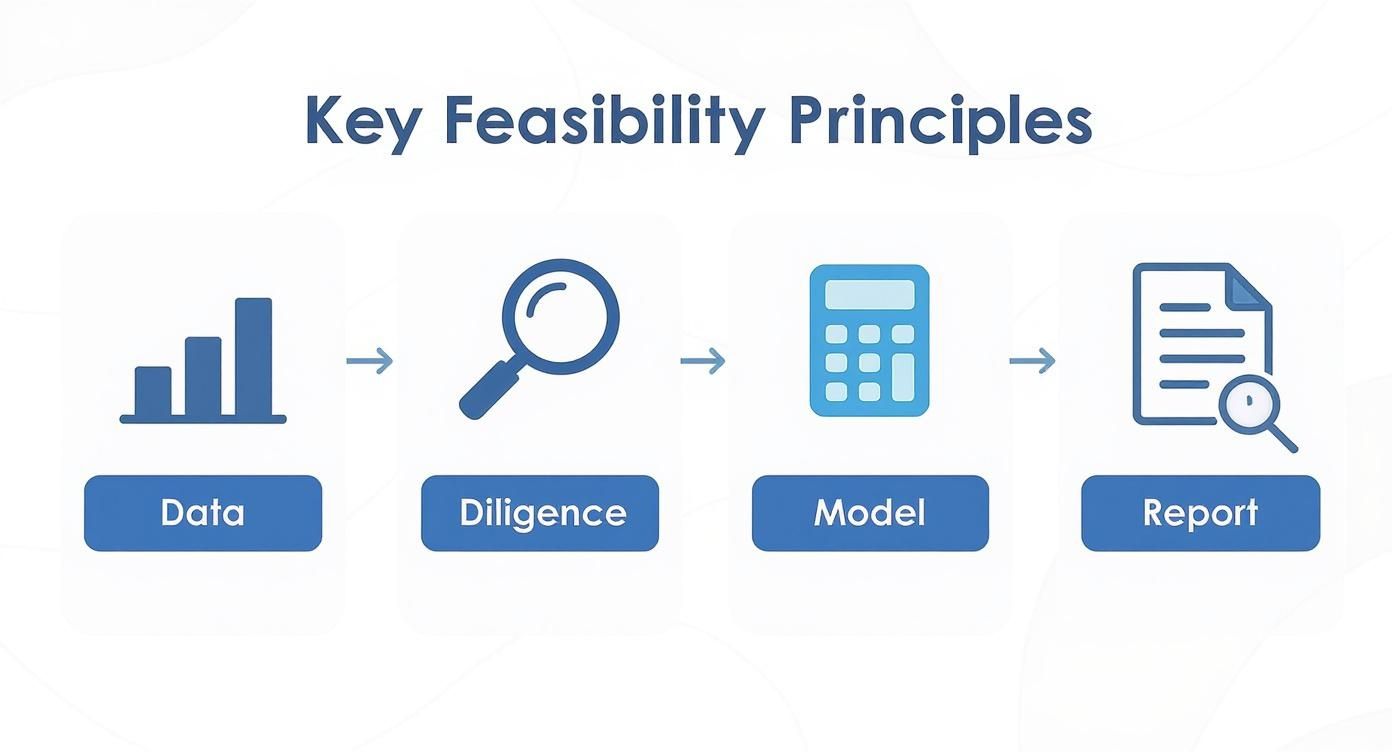
As you can see, it's a logical progression from raw data analysis to a final, actionable report. Each stage informs the next, creating a comprehensive picture. This entire process is about making smarter choices; it's the essence of strategic decision-making in action, designed to protect your capital and boost your chances of success.
Keep these core ideas in mind as we walk through the detailed steps. They are the guideposts for the entire journey.
Defining Your Project Vision and Scope
Before you run a single number, you need to know exactly what you’re trying to build. This is the foundation of your entire feasibility study—transforming a vague idea into a concrete, measurable plan.
Start by getting crystal clear on the project's identity. What is it, really? A sleek, high-end multifamily complex aimed at urban professionals, or a practical, budget-friendly retail center for a growing suburb? Every decision flows from this core concept.
Nail Down Your Objectives
Once you have the big picture, it's time to sharpen the focus. Pinpointing your target demographic and how you want to position the project in the market is crucial. For example, if you're planning a mid-rise apartment building, are you catering to young professionals who want amenities and nightlife, or are you building for downsizing retirees who prioritize quiet and accessibility?
This isn't just a marketing exercise; it's a critical step that prevents scope creep and keeps your analysis grounded in reality.
You also need to set your financial guideposts. What does a "win" look like for you and your investors?
- Target Return on Investment (ROI): Maybe you’re aiming for a 20% ROI.
- Internal Rate of Return (IRR): A goal of a 15% IRR is a common benchmark.
These numbers aren't arbitrary—they become the metrics against which you'll measure every decision, from what you're willing to pay for land to the level of finishes you can afford in construction.
Beyond the financials, some projects have a deeper mission. For developments with a social component, understanding how stable housing supports long-term sobriety can fundamentally shape the project's vision and define success in terms of community impact, not just profit.
Understanding the Market and Local Economy

Before you can even think about breaking ground, you have to get a rock-solid feel for the market. This is where the rubber meets the road. A project's success is almost entirely dependent on genuine market demand, so this part of your real estate development feasibility study is non-negotiable.
You need to dig deep into who lives there, what they earn, and what other projects—both built and on the drawing board—are competing for their dollars. It's about blending the big picture with what’s happening on your specific block.
For instance, knowing the global real estate market is projected to hit USD 15 trillion by 2032 is interesting, but it doesn't tell you if your specific project will lease up. What's far more important is the local job growth, household formation, and how sensitive your target demographic is to interest rate hikes. You can get more context on that global trend from this dataintelo.com report.
The whole point of this exercise is to find a gap in the market. A detailed analysis might show you a pocket of high-income households with a frustrating lack of modern retail space, even if the area feels saturated at first blush. That’s your opening.
To help structure your research, here are the essential data points you need to collect. Think of this as your roadmap for understanding the project's environment.
Key Market Analysis Components
| Analysis Area | Key Metrics to Investigate | Why It Matters |
|---|---|---|
| Demographics | Population growth, age distribution, household size, income levels, education. | Determines who your end-user is and what they can afford. A growing, affluent population is a strong positive signal. |
| Supply & Demand | Existing inventory, vacancy rates, absorption rates, new construction pipeline. | Shows how much competition you have and how quickly new properties are being occupied. High absorption is key. |
| Economic Drivers | Major employers, job growth sectors, unemployment rates, wage growth. | A strong, diverse local economy supports property values and rental income. You don't want to be in a one-company town. |
| Competitive Landscape | Comparable property rents/sales, amenities offered, performance of nearby projects. | Helps you position your project, set realistic pricing, and understand what features the market expects. |
| Submarket Trends | Local infrastructure projects, zoning changes, neighborhood sentiment. | Uncovers hyperlocal opportunities or risks that a broad analysis would miss. Is a new transit line coming? That's a game-changer. |
Gathering this information isn't just about filling a spreadsheet; it's about building a narrative. Each data point is a clue that helps you understand the full story of your submarket.
The right data tells a story. When you're leveraging data analytics for business growth, you're not just collecting numbers—you're connecting the dots to build a case for your project that lenders and investors can't ignore.
Getting to Know the Site and What You Can Build
Even the hottest market can't rescue a project doomed by a bad site. This is where your real estate development feasibility study gets real—it's time to put your boots on the ground and make sure the land can actually support your vision, both physically and legally.
This isn't just a quick drive-by. You're digging into the nitty-gritty: soil conditions, topography, where the utility lines are, and who you need to talk to for hookups. Every single one of these details can throw your budget and timeline for a loop if you're not careful.
I saw this happen recently with an infill developer. They found an old, uncharted utility easement cutting right through where their building was supposed to go. Because they caught it during due diligence, it was just a matter of a simple redesign. Had they discovered it after buying the land, they’d have been stuck in a nightmare of expensive variance hearings, potentially killing the project's profitability. That one check saved the entire deal.
Building Your Financial Pro Forma

This is where the rubber really meets the road. All your research and assumptions now get translated into the language that investors and lenders understand best: cold, hard numbers. Crafting a detailed financial pro forma is the absolute core of any real estate development feasibility study. It's how you turn a vision into a dynamic financial story.
The process kicks off with a meticulous projection of your costs. You need to account for everything. We're talking hard costs (think bricks, mortar, labor) and soft costs (architect fees, permits, legal expenses). On the other side of the ledger, your market analysis should ground your revenue projections, whether that’s rental income or final sales prices.
A classic mistake I see all the time is developers getting too optimistic with revenue growth while lowballing their contingency fund. You have to build in a buffer for the inevitable surprises. I always recommend at least 5-10% of total costs. That one line item can be the difference between a successful project and one that implodes when things go sideways.
What if Things Go Wrong? Stress-Testing Your Assumptions
Let’s be honest: no development project ever goes exactly according to plan. That’s why a solid feasibility study doesn’t just paint a best-case scenario; it prepares you for the inevitable bumps in the road. The final, critical piece of the puzzle is identifying and, more importantly, quantifying your risks.
This is where we move beyond a simple list of what could go wrong—a sudden recession tanking market demand, a planning commission unexpectedly denying a crucial permit, or your GC coming back with a massive change order. Identifying those threats is the easy part. The real work is figuring out how much they’ll hurt.
From Static Pro Forma to Dynamic Tool
This is where a sensitivity analysis comes in. It’s the process of turning your pro forma from a rigid, single-outcome spreadsheet into a flexible tool for understanding risk. You’re essentially asking a series of tough "what if" questions to see which variables will make or break your deal.
What happens to your returns if construction costs escalate by 10%? What if rising interest rates push your loan costs up by a percentage point? By plugging these new numbers into your model, you can see the direct impact on your profitability and investor returns. It's about stress-testing your assumptions to find their breaking points, giving you a clear-eyed view of the project's true resilience.
Frequently Asked Questions (FAQs)
Here are some of the questions that come up time and time again when talking to developers about feasibility studies.
Why is a feasibility study so important, really?
Think of it as your project's ultimate reality check. A real estate development feasibility study is what separates a great idea from a great investment. It’s where you pressure-test your entire vision—from market demand to hidden site issues—before you've put any serious capital on the line. Ultimately, it's about preventing incredibly expensive mistakes.
How long does a feasibility study usually take?
There’s no one-size-fits-all answer here, as the timeline really depends on the project's complexity. For a relatively straightforward deal, you might be looking at four to six weeks. But for a large-scale, multi-phased development, it could easily take several months to conduct all the necessary due diligence and in-depth analysis.
Who should actually be doing the study?
You'll get the best results by assembling a multidisciplinary team. A single person rarely has all the required expertise. Ideally, your team should include real estate consultants, financial analysts, architects, engineers, and legal advisors. When these experts collaborate, you get a complete, 360-degree picture of your project's true viability.
What are the main components of a feasibility study report?
A comprehensive report typically includes an executive summary, a detailed market analysis, site and zoning assessment, preliminary designs, a complete financial pro forma with sensitivity analysis, and a final recommendation on whether to proceed with the project.
How much does a real estate development feasibility study cost?
The cost varies significantly based on the project's scale and complexity. A study for a small residential project might cost a few thousand dollars, while a study for a large mixed-use urban development could run into the tens or even hundreds of thousands of dollars, depending on the level of engineering and design work required.