

Choosing the right real estate investment analysis tools is crucial for making informed, data-driven decisions in today's market. Whether you're a beginner analyzing your first rental or a seasoned pro underwriting a commercial portfolio, the right software can illuminate risks, forecast returns, and streamline your entire investment workflow. These tools replace manual spreadsheets and guesswork with powerful, automated calculations, saving you time and preventing costly errors. This guide explores the top platforms available, helping you find the perfect fit for your specific strategy, from house flipping to long-term rentals and large-scale development. By leveraging the right technology, you can analyze deals faster, negotiate with confidence, and build a more profitable portfolio.
4 Key Takeaways:
- Strategy-Specific Tools: The best tool for you depends entirely on your investment strategy. A short-term rental investor needs different data (like AirDNA provides) than a commercial syndicator (who might prefer RealData or PropertyMetrics).
- Data is King: The accuracy of your analysis hinges on the quality of the underlying data. Tools that provide reliable comps, rental rates, and market trends are invaluable for validating your assumptions.
- Scalability Matters: We cover a range of tools from simple, free calculators for quick deal screening to sophisticated enterprise-grade software for complex financial modeling and portfolio management.
- Workflow Integration is Key: Platforms that integrate with other systems like the MLS, bank accounts (Stessa), or marketing tools (PropStream) can significantly boost your efficiency from deal sourcing to asset management.
1. DealCheck
DealCheck is a purpose-built platform designed for speed and clarity, making it one of the most accessible real estate investment analysis tools for new and intermediate investors. Its primary strength lies in quickly underwriting common residential investment strategies like traditional rentals, BRRRR (Buy, Rehab, Rent, Refinance, Repeat) projects, and house flips. The user interface is exceptionally intuitive, guiding you through property analysis with a clean, step-by-step workflow available on both web and mobile.
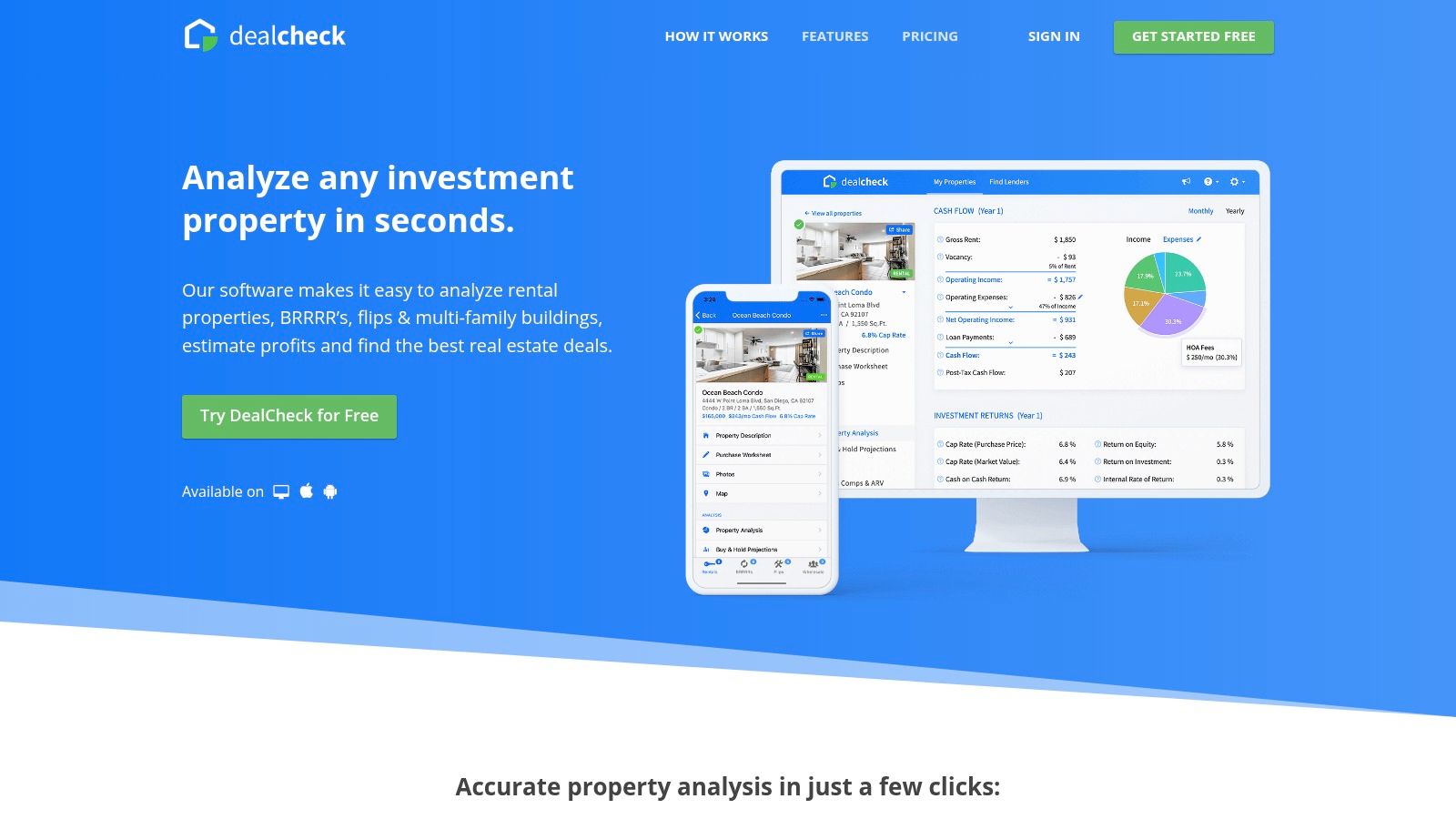
This tool excels at generating professional, shareable PDF reports that are perfect for presenting to potential partners, private money lenders, or banks. You can customize these reports with your own branding, adding a polished touch to your deal pitches. For investors who need to evaluate multiple properties on the go, the mobile app is a standout feature, syncing seamlessly with the web platform.
Key Features & Use Cases
- Ideal User: New to intermediate investors focused on single-family up to small multifamily (2-4 units).
- Core Functionality: Streamlined calculators for rental income, cash flow, ROI, BRRRR projections, and flip profitability.
- Standout Feature: The Offer Calculator helps you determine your maximum allowable offer (MAO) based on your desired profit or return metrics.
- Reporting: Generates clean, comprehensive, and brandable PDF reports for lenders and partners.
Pricing, Pros & Cons
| Pricing | Pros | Cons |
|---|---|---|
| Free Starter Plan Plus: ~$14/mo Pro: ~$29/mo |
Extremely intuitive UI, ideal for beginners. Affordable entry-level pricing. Excellent mobile app for on-the-go analysis. High-quality, shareable reports. |
Lacks the depth for complex commercial or development projects. Comparable sales data can be limited depending on the market. |
DealCheck is an excellent starting point for investors who need fast, reliable answers without the steep learning curve of more complex enterprise software.
Website: https://dealcheck.io
2. BiggerPockets (Calculators / Pro Membership)
BiggerPockets is far more than a set of calculators; it's an entire ecosystem for real estate investors. Its suite of real estate investment analysis tools is integrated directly into a platform known for its massive community forums, educational content, and market data. The calculators are designed for core investment strategies like rentals, flips, and BRRRR, providing a standardized and easy-to-follow framework that aligns perfectly with the platform's educational philosophy. This makes it an ideal environment for investors who want to learn the "how" and "why" behind the numbers.
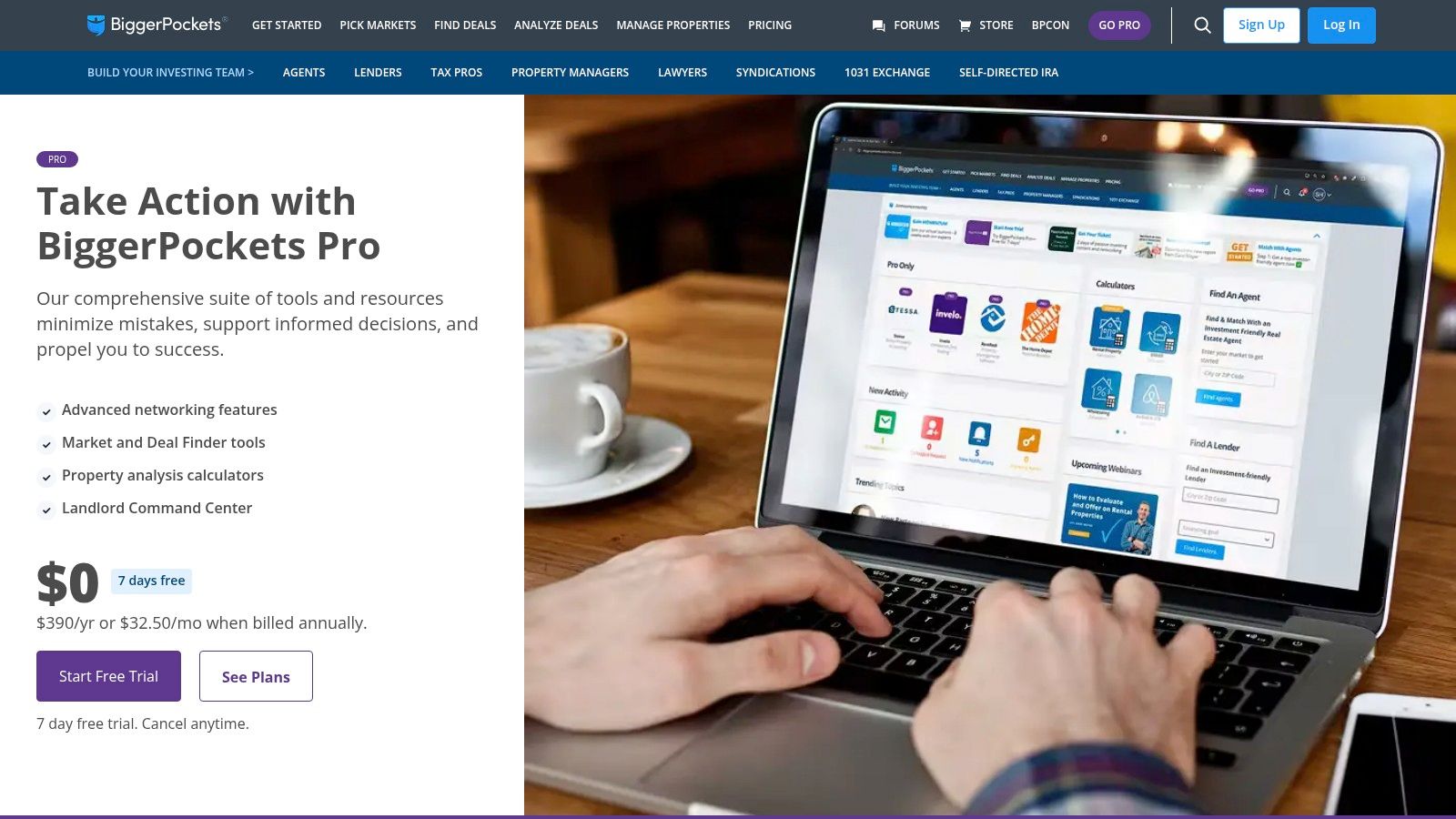
The primary advantage of using BiggerPockets is the seamless connection between analysis, education, and community feedback. After running numbers on a potential deal, you can easily share your analysis report in the forums to get opinions from seasoned investors. The Pro membership, which unlocks unlimited calculator use, also includes tools like the Market Finder and Rent Estimator, helping you validate your assumptions with real-world data and find viable opportunities, including understanding how to finance investment properties.
Key Features & Use Cases
- Ideal User: New and experienced investors who value community engagement and integrated educational resources.
- Core Functionality: A suite of over 7 calculators (Rental, BRRRR, Flip, etc.) with shareable PDF reports.
- Standout Feature: The integration with the broader BiggerPockets ecosystem, including forums, educational articles, and market data tools.
- Reporting: Generates clear, standardized reports that are easy to share and discuss within the community or with partners.
Pricing, Pros & Cons
| Pricing | Pros | Cons |
|---|---|---|
| Limited Free Use Pro Membership: ~$39/mo |
Strong community and education integrated with tools. Excellent for standardized, repeatable analyses. Membership includes valuable market data and deal-finding tools. |
Unlimited calculator use requires a Pro membership. Less suitable for complex commercial or development projects. Interface is functional but less modern than some dedicated apps. |
BiggerPockets is the perfect choice for investors who want to not only analyze deals but also learn and network within a supportive, knowledgeable community.
Website: https://www.biggerpockets.com/pro-membership
3. Stessa
Stessa carves out a unique niche by bridging the gap between initial deal analysis and long-term portfolio management. While many real estate investment analysis tools focus solely on pre-acquisition underwriting, Stessa is designed to be a "living" platform for your assets. It provides a powerful, free-to-start dashboard for tracking the ongoing financial performance of your rental properties, making it invaluable for both new and seasoned investors who need to monitor their portfolio's health in real time.
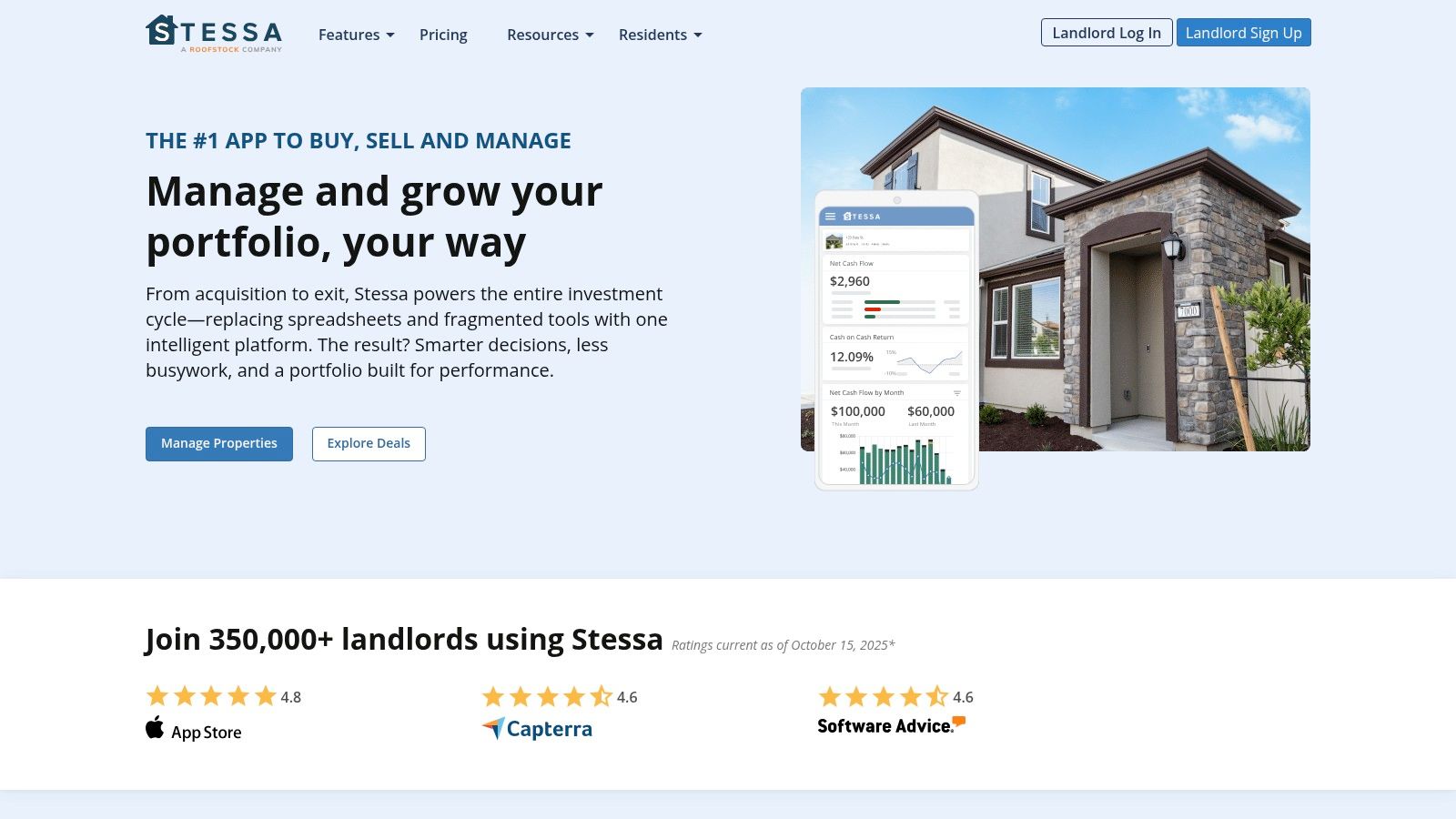
The platform's core strength is its automated income and expense tracking, which syncs directly with your bank accounts to categorize transactions and generate key performance reports. This transforms the tedious task of rental bookkeeping into a streamlined, largely automated process. While its upfront deal analysis features are less robust than dedicated underwriting tools, it provides essential pro-forma budgeting and reporting capabilities that help you compare actual performance against your initial projections post-acquisition.
Key Features & Use Cases
- Ideal User: Landlords and investors (from one property to large portfolios) who want to monitor ongoing financial performance.
- Core Functionality: Automated income/expense tracking, real-time performance dashboards (Net Operating Income, Cash Flow, etc.), and tax-ready reporting.
- Standout Feature: Bank account integration that automatically imports and categorizes transactions, providing a clear, real-time picture of property financials.
- Reporting: Generates essential financial reports like income statements, net cash flow statements, and capital expense reports.
Pricing, Pros & Cons
| Pricing | Pros | Cons |
|---|---|---|
| Essentials: Free Pro: ~$16/mo |
Strong for ongoing performance tracking. Quick setup with bank feed integrations. Free tier is very generous and powerful. Simplifies tax preparation. |
Lacks the deep underwriting features of dedicated analyzers. Advanced pro-forma budgeting and rent estimates require a paid plan. |
Stessa is the perfect companion tool for investors who have already acquired properties and need an efficient system to manage and optimize their performance over the long term.
Website: https://www.stessa.com
4. Mashvisor
Mashvisor is a data-driven discovery and analysis platform that excels at comparing long-term versus short-term rental strategies. It’s one of the most powerful real estate investment analysis tools for investors who take a market-first approach, allowing you to identify profitable neighborhoods before zeroing in on specific properties. Its core strength lies in its interactive heatmaps, which visually represent key metrics like cash on cash return, rental income, and Airbnb occupancy rates across entire cities.
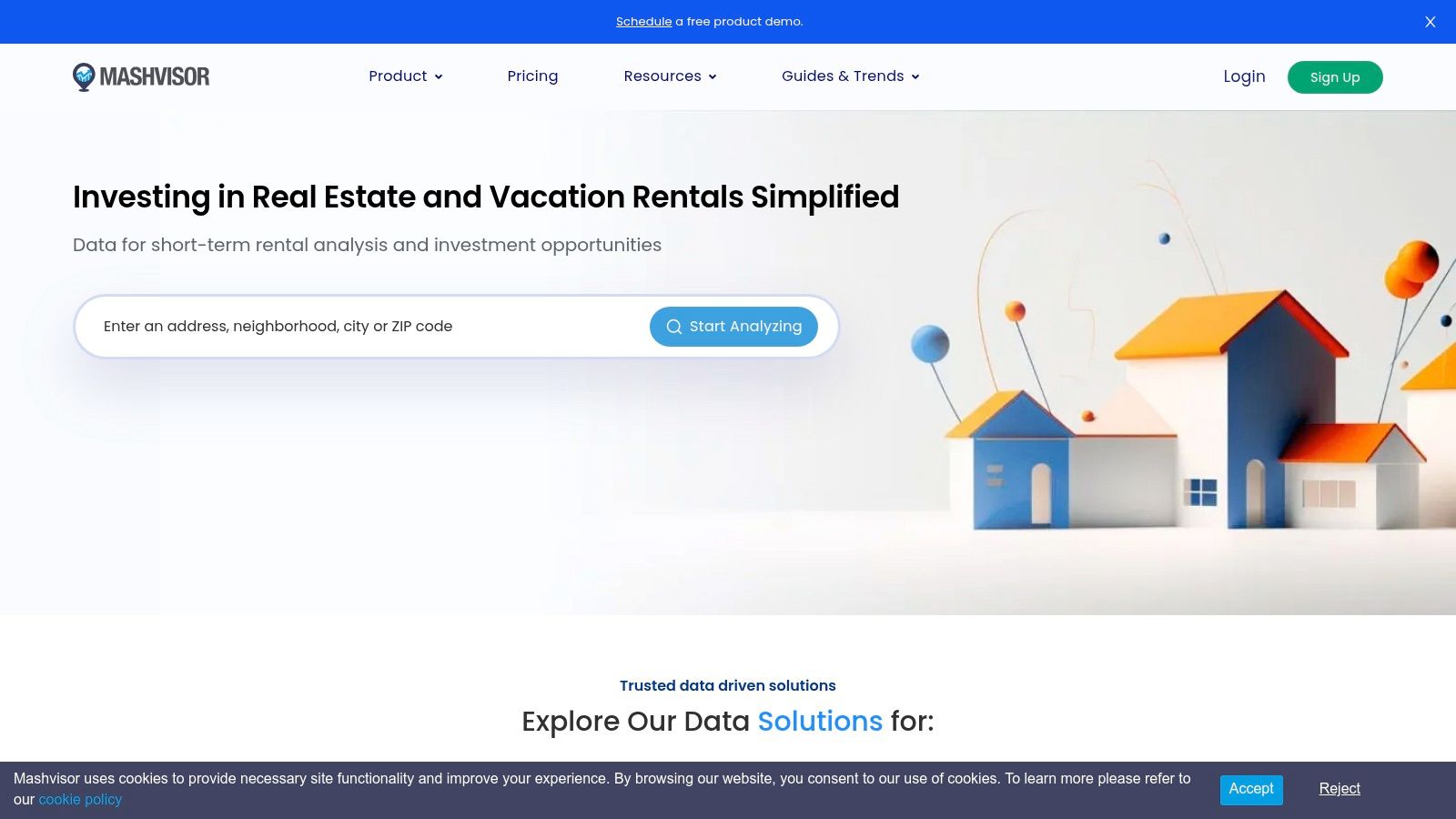
This tool is uniquely suited for investors exploring out-of-state markets or considering adding vacation rentals to their portfolio. Mashvisor aggregates MLS listings and Airbnb data to provide side-by-side revenue projections for both rental types, helping you quickly determine the optimal strategy for a given property. For those needing bulk data or API access for custom applications, its enterprise-level plans offer sophisticated outputs.
Key Features & Use Cases
- Ideal User: Out-of-state investors, data-driven analysts, and those comparing traditional vs. short-term rental (STR) strategies.
- Core Functionality: Interactive investment property heatmaps, neighborhood analytics, and comparative LTR/STR revenue calculators.
- Standout Feature: The Property Finder uses AI and predictive analytics to recommend investment properties that match your specific financial goals and criteria.
- Reporting: Exportable property data and search results in formats like PDF or Excel for offline analysis and presentations.
Pricing, Pros & Cons
| Pricing | Pros | Cons |
|---|---|---|
| Lite: ~$29.99/mo Standard: ~$74.99/mo Professional: ~$99.99/mo |
Excellent for market-first screening across multiple cities. Directly compares long-term and short-term rental economics. Visual heatmap interface simplifies complex market data. Data exports and API access available on higher tiers. |
Some city-level data limitations on lower-tier plans. Deeper data and more extensive features are locked behind higher paywalls. Best value is achieved through annual billing plans. |
Mashvisor is the go-to platform for investors who want to leverage big data to find opportunities and confidently decide between rental strategies.
Website: https://www.mashvisor.com
5. AirDNA
AirDNA is the undisputed leader in short-term rental (STR) analytics, making it an indispensable real estate investment analysis tool for anyone considering a vacation rental. Its core purpose is to provide granular data on STR market performance, allowing investors to accurately forecast revenue, occupancy, and daily rates for a specific property. Unlike general-purpose tools, AirDNA focuses exclusively on the nuances of the STR market, offering deep insights into seasonality, competitive landscapes, and future demand trends.
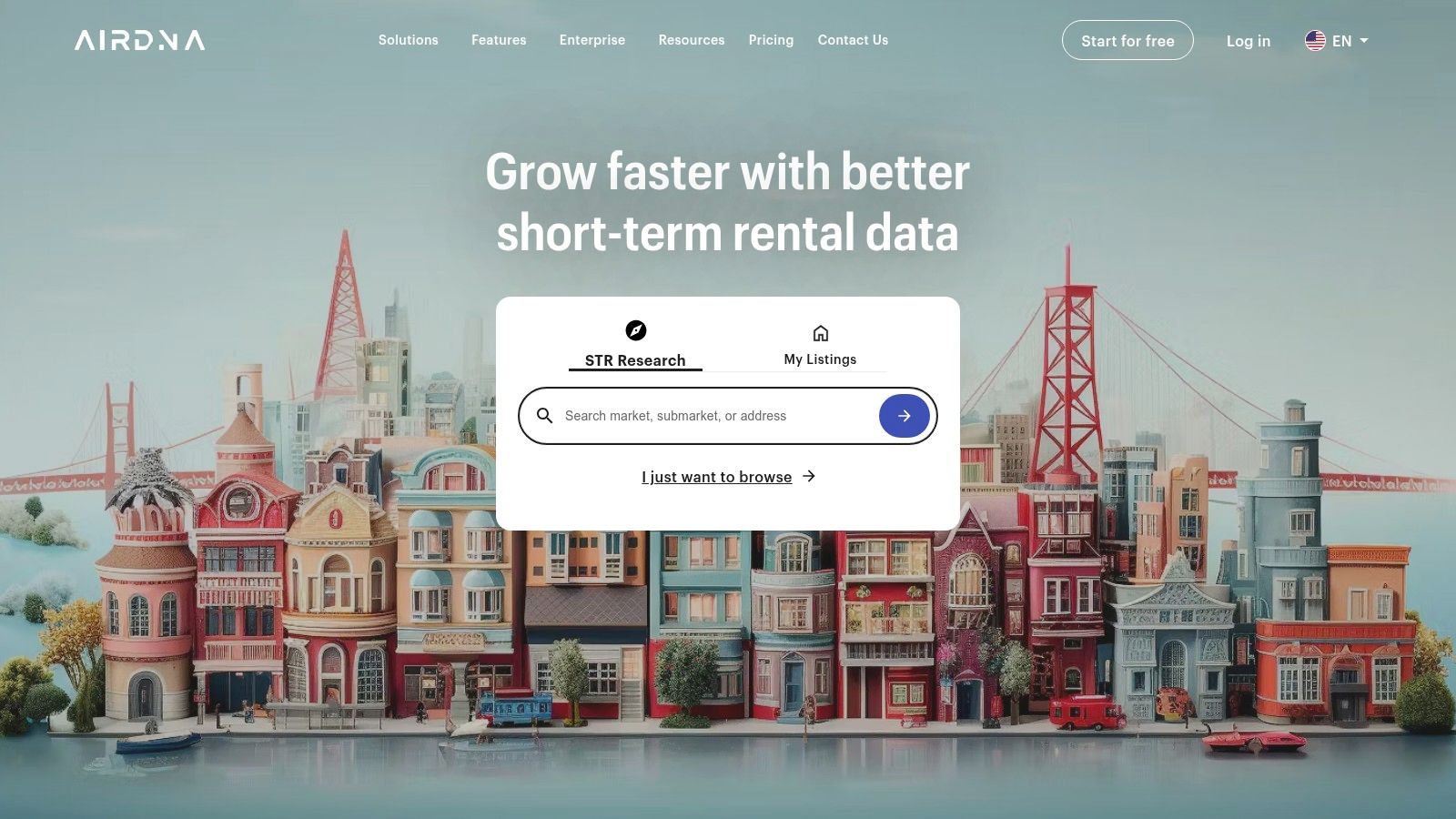
The platform's flagship feature, the "Rentalizer," provides an instant revenue projection for any address by analyzing nearby comparable properties. This allows investors to quickly vet the STR potential of a home before even seeing it. For a deeper dive, its MarketMinder tool reveals comprehensive data on an entire city or zip code, including historical performance, pacing for future bookings, and regulatory information. This makes it essential for both market selection and individual deal underwriting in the vacation rental space.
Key Features & Use Cases
- Ideal User: STR investors, vacation rental managers, and agents specializing in STR properties.
- Core Functionality: Address-level revenue and occupancy projections (Rentalizer), market-wide performance data, and competitive analysis.
- Standout Feature: Future pacing data shows booking trends for the coming months, offering a forward-looking view of market demand that is unavailable on most platforms.
- Reporting: In-depth market reports and property-level dashboards for ongoing performance tracking and strategic planning.
Pricing, Pros & Cons
| Pricing | Pros | Cons |
|---|---|---|
| Free Rentalizer MarketMinder: ~$12-99/mo per market |
Deep, STR-specific data and forward demand signals. Clear address-level underwriting for STR potential. Excellent for identifying top-performing markets. Free tools for initial property screening. |
Niche focus is not ideal for long-term rental investors. Most valuable features require a paid subscription. Pricing is per market, which can become costly for investors analyzing multiple locations. |
AirDNA is the go-to resource for data-driven decisions in the short-term rental market, providing the specialized intelligence needed to compete effectively.
Website: https://www.airdna.co
6. Rentometer
Rentometer is a highly focused tool designed to do one thing exceptionally well: validate market rents. While not a comprehensive underwriting platform, it serves as an indispensable part of the due diligence toolkit for rental property investors. Its core function is to provide quick, data-driven rent comparisons for a specific address, helping you sanity-check your pro-forma assumptions and avoid over- or under-estimating a property's income potential. This makes it one of the most practical real estate investment analysis tools for initial screening and ongoing management.
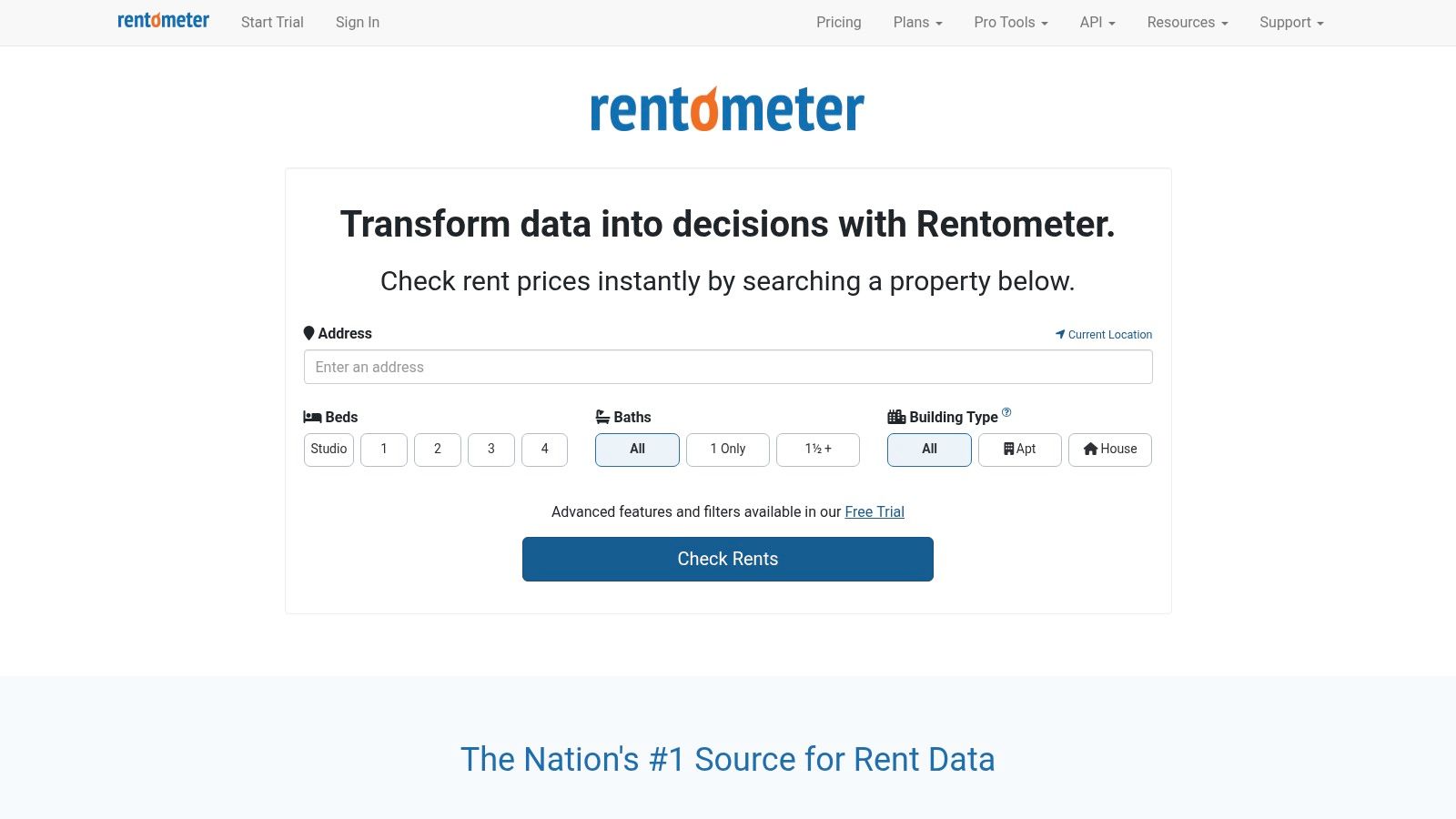
The platform is incredibly straightforward; you enter a property address, bedroom count, and current rent to instantly receive a report showing comparable recent rentals in the area. This is invaluable during early underwriting to confirm if a seller's claimed rents are realistic or when evaluating potential rent increases on a property you already own. For professionals, the Pro version allows for more detailed analysis, custom branding on reports for lenders or partners, and a higher volume of searches.
Key Features & Use Cases
- Ideal User: Landlords, property managers, and buy-and-hold investors needing fast rent validation.
- Core Functionality: Generates immediate rent comp reports with average, median, and percentile data based on a subject property's address and specs.
- Standout Feature: The Pro Analysis interface provides robust neighborhood and ZIP code-level rent data, allowing you to spot trends and compare submarkets.
- Reporting: Creates clean, brandable "Rentometer Pro Reports" that are perfect for including in a lending package or market analysis.
Pricing, Pros & Cons
| Pricing | Pros | Cons |
|---|---|---|
| Free Basic Reports Pro Lite: ~$29/yr Pro: ~$79/yr |
Simple, fast, and easy to use for quick rent checks. Helps investors avoid bad assumptions. Branded reports look professional for partners. Highly affordable Pro plans. |
Not a full financial modeling tool. Free version is capped and limited. Data accuracy is dependent on the quantity of listings in a given market. |
Rentometer is the perfect complementary tool for quickly grounding your rental income projections in real-world data before you spend hours on a full financial model.
Website: https://www.rentometer.com
7. PropStream
PropStream is less of a pure underwriting tool and more of a data-driven lead generation engine, making it one of the most powerful real estate investment analysis tools for investors focused on finding off-market deals. Its core strength is providing access to nationwide property data that can be filtered and segmented to build hyper-targeted marketing lists. For fix-and-flip, BRRRR, and wholesale investors, this platform is the starting point for sourcing opportunities before they ever hit the MLS.
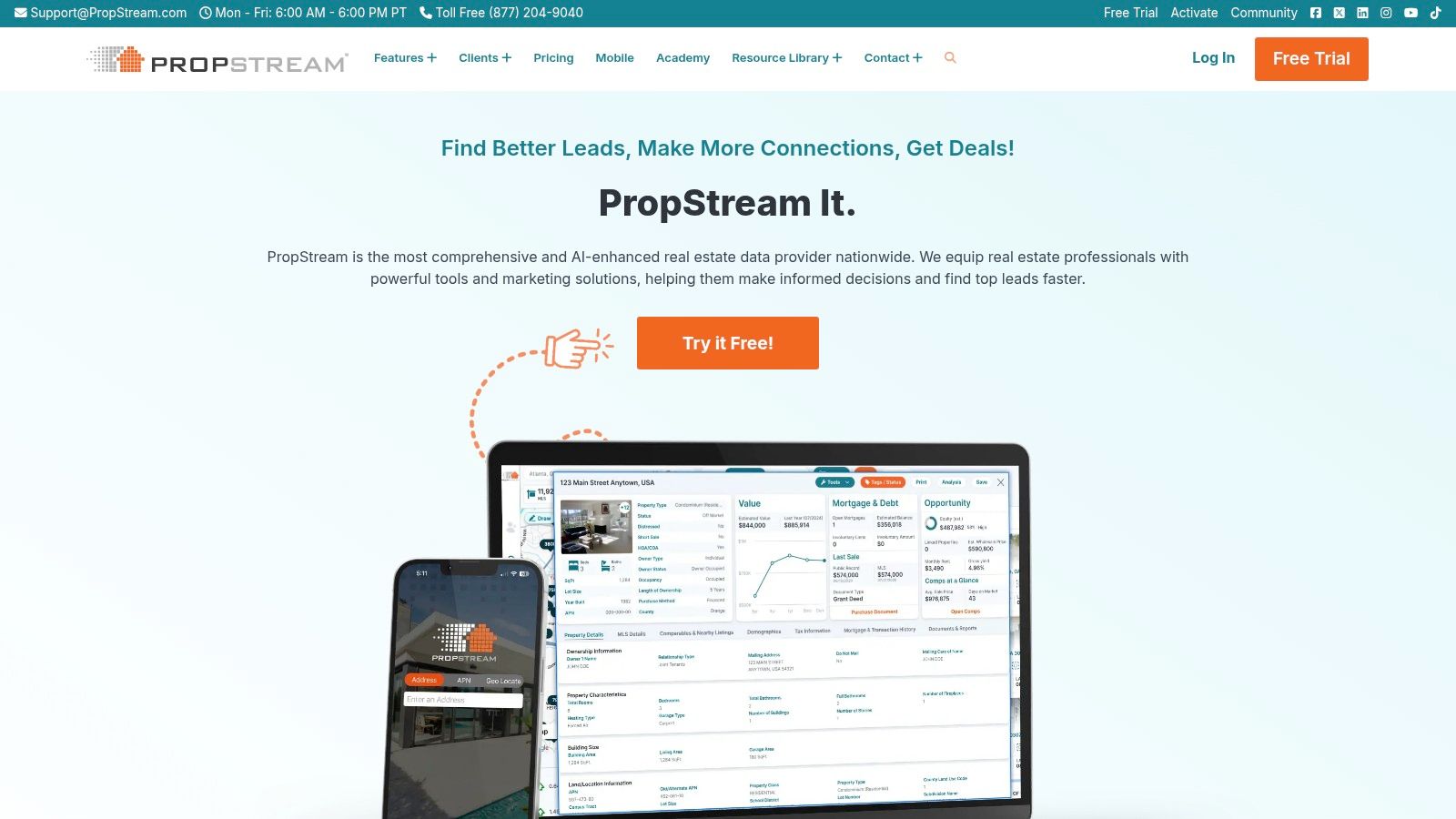
The platform combines property data with built-in marketing features like skip tracing, email campaigns, and postcard mailers, creating an all-in-one system for lead acquisition. Its comparable sales data is robust, allowing you to quickly run an initial analysis on a potential deal before spending time on a full-blown underwriting process. The Lead Automator feature continuously monitors your saved lists, notifying you of status changes like a new lien or a pre-foreclosure filing.
Key Features & Use Cases
- Ideal User: Wholesalers, flippers, and rental investors who actively source their own off-market deals.
- Core Functionality: Nationwide property search, advanced list filtering (e.g., pre-foreclosure, high equity, vacant), and comparable property analysis.
- Standout Feature: The ability to "list stack" by combining multiple criteria (e.g., finding owners with high equity who are also tired landlords) to identify highly motivated sellers.
- Reporting: Exportable data lists and property detail reports for internal analysis and marketing campaign management.
Pricing, Pros & Cons
| Pricing | Pros | Cons |
|---|---|---|
| Free 7-Day Trial Monthly Plan: ~$99/mo Annual Plan: ~$990/yr |
Deep, nationwide data with actionable list-building filters. Excellent for creating and automating off-market sourcing workflows. Free trial is available to evaluate the platform's data. Integrated marketing tools streamline lead outreach. |
Marketing add-ons like skip tracing and mailers can increase the overall cost. Best value is realized by active investors who consistently use the list-building features. |
PropStream excels at the top of the investment funnel, helping you find and analyze potential deals before anyone else.
Website: https://www.propstream.com
8. Roofstock
Roofstock is a unique online marketplace that integrates investment analysis directly into the process of buying and selling single-family rental (SFR) properties. Instead of being a standalone calculator, it serves as an end-to-end platform where every listing is presented with pre-calculated metrics like cap rate, gross yield, and total return projections. This makes it one of the most practical real estate investment analysis tools for investors looking to acquire turnkey or rent-ready properties, often with tenants already in place.
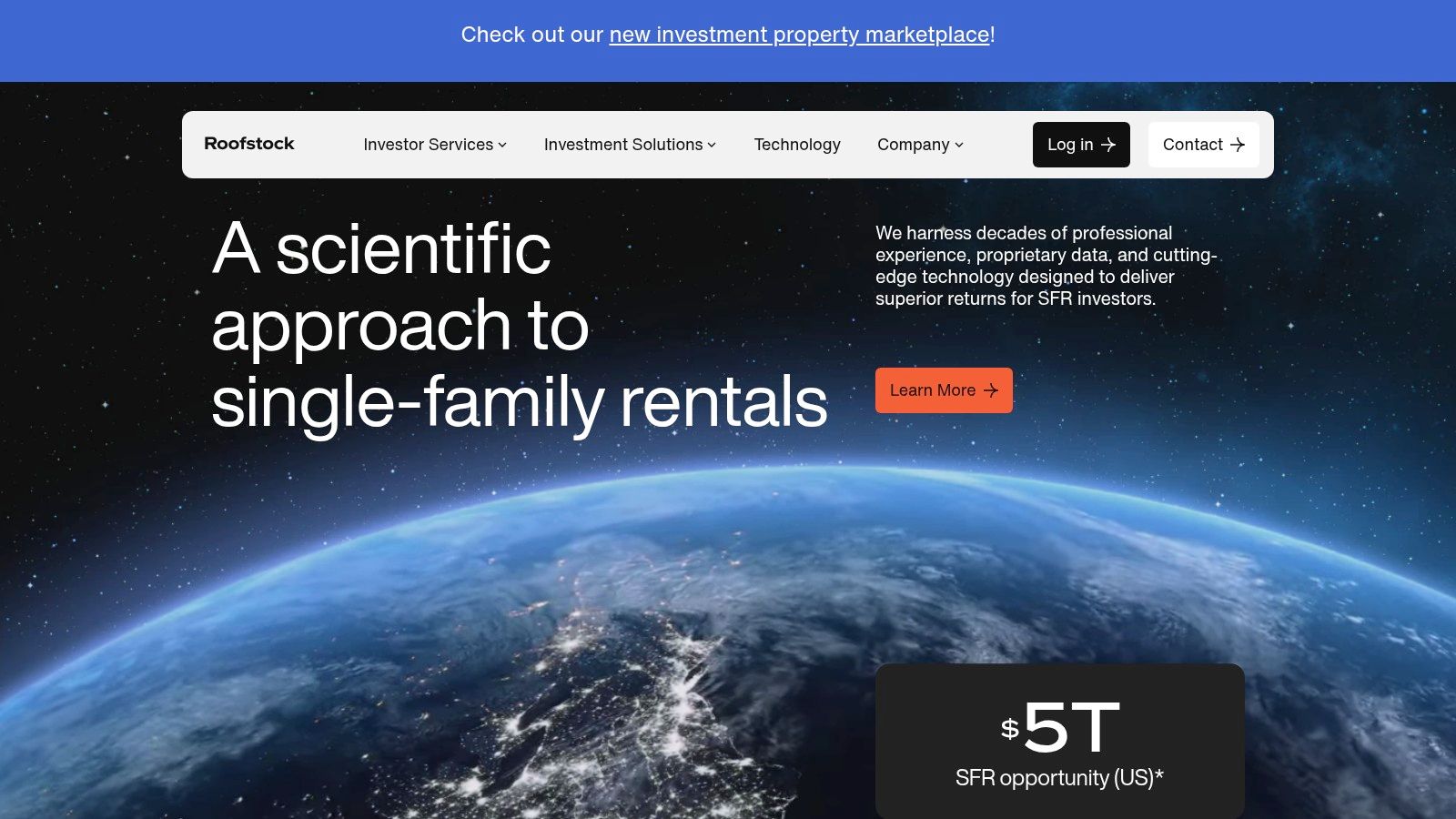
The platform's primary advantage is its proprietary "Neighborhood Rating," an A-to-F scoring system that evaluates the risk and appreciation potential of a property's census tract. This feature is invaluable for out-of-state investors who lack local market knowledge, allowing them to compare submarkets on a standardized scale. Roofstock streamlines the entire acquisition process, from initial analysis and due diligence to closing and finding property management, making remote investing more accessible.
Key Features & Use Cases
- Ideal User: Remote or out-of-state investors focused on turnkey single-family rentals.
- Core Functionality: A marketplace of for-sale SFRs with built-in financial forecasts, property inspection reports, and tenant details.
- Standout Feature: The Neighborhood Rating system provides a data-driven score for specific locations, helping to quantify neighborhood quality and risk.
- Reporting: Each property listing page serves as a comprehensive analysis report, detailing financials, lease information, and property condition.
Pricing, Pros & Cons
| Pricing | Pros | Cons |
|---|---|---|
| Free to Browse Buyer's Fee: 0.5% of purchase price or $500, whichever is greater |
Analysis is integrated directly into the purchase workflow. Location scoring helps compare submarkets remotely. Provides access to portfolios for scale buyers. |
Estimates rely on assumptions and should be verified locally. Inventory availability varies significantly by market. |
Roofstock excels at simplifying the remote investment process by embedding analysis into an active marketplace, though investors should always perform their own due diligence to validate the platform's projections.
Website: https://www.roofstock.com
9. Crexi Intelligence
Crexi Intelligence is a powerful data and analytics subscription built on top of the popular Crexi commercial real estate (CRE) marketplace. It transforms the platform from a simple listing service into a comprehensive research tool, making it one of the most integrated real estate investment analysis tools for CRE professionals. Its primary value is providing access to a massive database of sales comparables, lease data, and ownership records, which is crucial for early-stage underwriting and market validation.
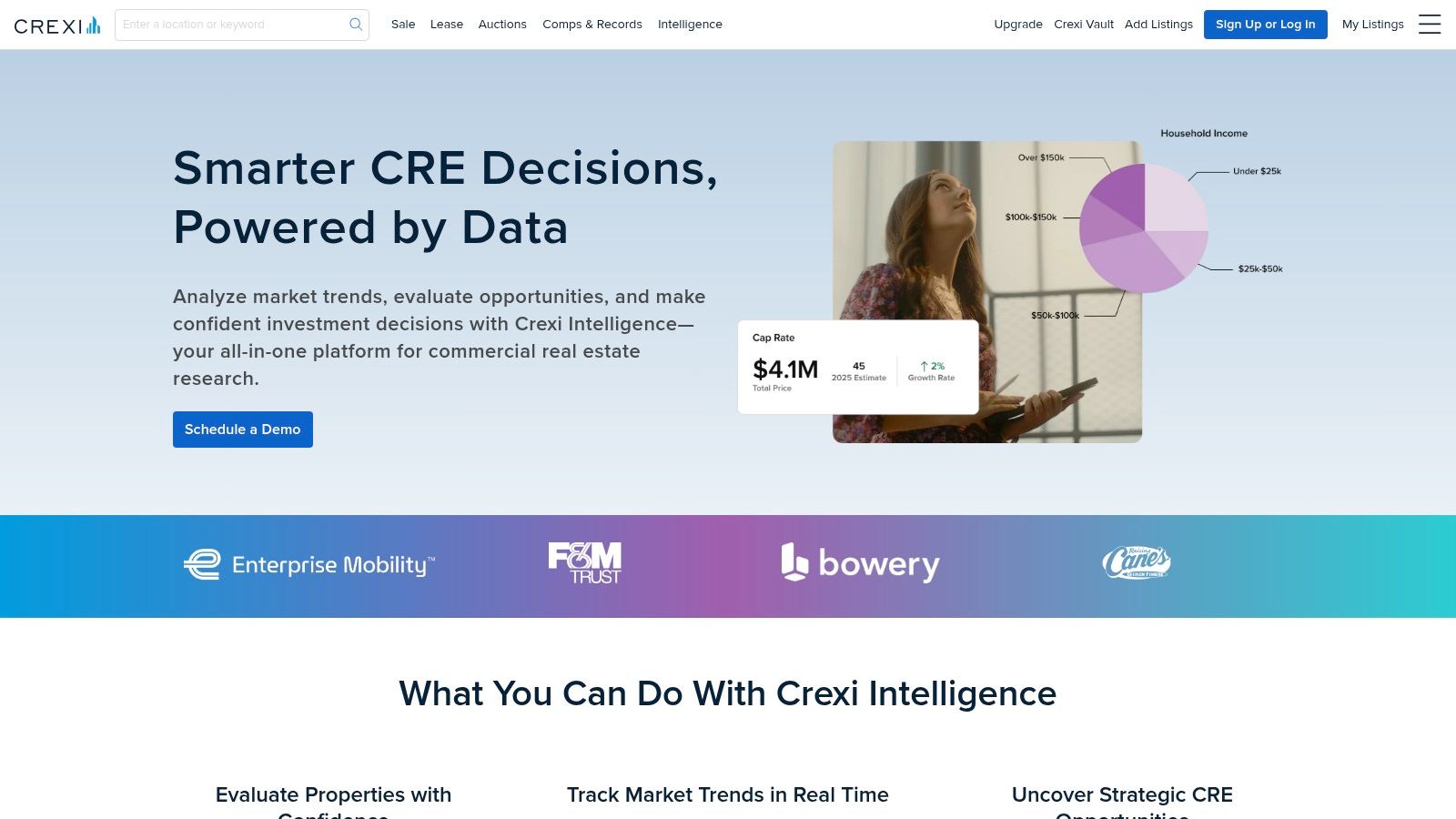
This tool excels at providing the high-level data needed to quickly vet a potential deal or understand a new market. Users can explore demographic trends, traffic counts, and even detailed loan maturity data to identify off-market opportunities. For brokers and investors conducting a commercial property due diligence checklist, Crexi Intelligence supplies the critical comps and market context necessary to build a convincing investment thesis.
Key Features & Use Cases
- Ideal User: Commercial real estate brokers, investors, and appraisers focused on market research and deal sourcing.
- Core Functionality: Access to a vast database of verified sales comps, property records, lease data, and owner information.
- Standout Feature: The integration of analytics with an active marketplace allows you to research a property and see its live listing status in one place.
- Reporting: Generates market-level intelligence reports and property-specific data exports for deeper analysis.
Pricing, Pros & Cons
| Pricing | Pros | Cons |
|---|---|---|
| Contact Sales (Typically monthly subscription) |
Integrates research tools with an active CRE marketplace. Transparent monthly pricing options are available. Broad data is very useful for early-stage underwriting. |
Contact exports and data access are subject to monthly credit limits. Some user reviews are mixed; a demo is recommended before committing. |
Crexi Intelligence is an excellent choice for CRE professionals who want to combine their market research and deal-finding activities within a single, streamlined platform.
Website: https://www.crexi.com/intelligence
10. Reonomy (by Altus Group)
Reonomy shifts the focus from analyzing individual on-market deals to uncovering off-market opportunities, making it one of the most powerful real estate investment analysis tools for prospecting and data intelligence. Acquired by Altus Group, it serves as a massive commercial real estate (CRE) database, providing deep insights into property characteristics, transaction histories, and, most importantly, owner information. Its primary strength is empowering investors, developers, and brokers to identify properties that meet specific criteria and connect directly with the decision-makers behind them.
The platform excels at peeling back the layers of ownership, helping you see through LLCs to find the actual individuals or parent companies. This is invaluable for portfolio analysis and targeted outreach. For investors looking to scale their operations through data-driven acquisition strategies, Reonomy provides the raw intelligence needed to build a proprietary deal pipeline, moving beyond the limitations of public listings.
Key Features & Use Cases
- Ideal User: Commercial real estate investors, developers, and brokers focused on off-market acquisitions and portfolio intelligence.
- Core Functionality: Nationwide CRE property database with advanced filtering, owner contact information, sales history, and debt data.
- Standout Feature: The ability to uncover true property ownership behind LLCs and map out an owner’s entire portfolio, creating unique strategic advantages.
- Reporting: Data can be exported for use in external analysis, CRMs, or marketing campaigns.
Pricing, Pros & Cons
| Pricing | Pros | Cons |
|---|---|---|
| Free Trial Available Pricing is not publicly listed and requires a custom quote. It is considered a premium tool. |
Excellent for identifying off-market opportunities. Deep ownership intelligence and portfolio mapping. Nationwide coverage across most CRE asset types. API is available for scalable data workflows. |
Premium pricing can be a barrier for smaller investors. Lease comp data may be less comprehensive than some specialized competitors. Primarily a data tool, not a deal underwriting calculator. |
Reonomy is the go-to platform for serious investors who understand that the best deals are often the ones you have to find yourself.
Website: https://www.altusgroup.com/solutions/reonomy/
11. RealData
RealData is a long-standing fixture in the world of real estate investment analysis tools, offering a suite of powerful, Excel-based software. It caters to sophisticated investors who require deep financial modeling for commercial and residential income properties. Unlike lightweight web apps, RealData is built for comprehensive underwriting, allowing users to create detailed 10-to-20-year pro forma projections, discounted cash flow (DCF) analyses, and complex partnership or syndication structures.
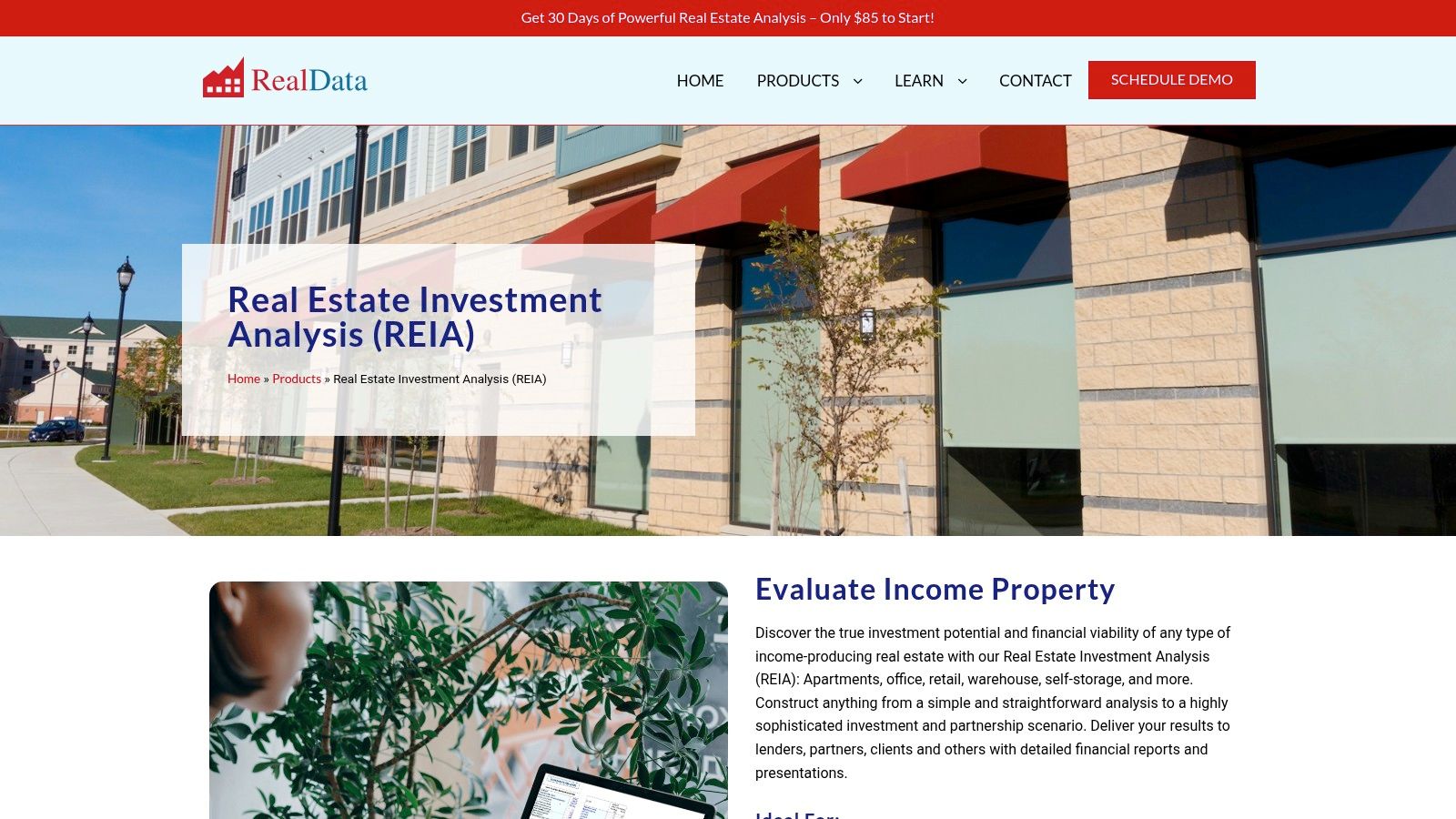
The platform’s strength is its depth and one-time purchase model, appealing to professionals who prefer ownership over recurring subscriptions. Its Real Estate Investment Analysis (REIA) editions provide granular control over variables, including debt structures, capital improvements, and lease-up scenarios. This level of detail is critical when conducting a comprehensive real estate development feasibility study or presenting to institutional lenders who demand rigorous financial scrutiny. While its Excel foundation means a steeper learning curve, the output is robust and highly defensible.
Key Features & Use Cases
- Ideal User: Experienced investors, commercial brokers, and syndicators focused on multifamily, office, retail, and other commercial properties.
- Core Functionality: In-depth DCF and pro forma modeling, partnership return analysis (IRR waterfalls), and sensitivity/stress testing.
- Standout Feature: The one-time purchase of a lifetime license provides a powerful toolset without ongoing subscription costs.
- Reporting: Generates detailed, brandable, and presentation-quality reports suitable for lenders and equity partners.
Pricing, Pros & Cons
| Pricing | Pros | Cons |
|---|---|---|
| Express: ~$149 (one-time) Standard: ~$495 (one-time) Professional: ~$995 (one-time) |
Extremely detailed financial modeling capabilities. One-time fee offers excellent long-term value. Robust reporting for CRE and syndication deals. Add-ons available for portfolio analysis. |
Excel-based interface has a steeper learning curve than modern SaaS tools. Best supported on Windows, which may be a limitation for Mac users. Lacks the cloud and mobile features of web-based platforms. |
RealData is the go-to choice for investors who need institutional-grade analysis and prefer the control and power of a dedicated Excel environment.
Website: https://www.realdata.com/products/real-estate-investment-analysis-reia/
12. PropertyMetrics
PropertyMetrics positions itself as a powerful, web-based alternative to complex enterprise software like ARGUS, making it one of the more accessible real estate investment analysis tools for commercial real estate (CRE). It is specifically designed for underwriting multi-tenant office, retail, and industrial properties, as well as development projects. The platform’s core strength is its detailed, lease-by-lease financial modeling, allowing for intricate analysis of cash flows, expense reimbursements, and long-term investment returns.
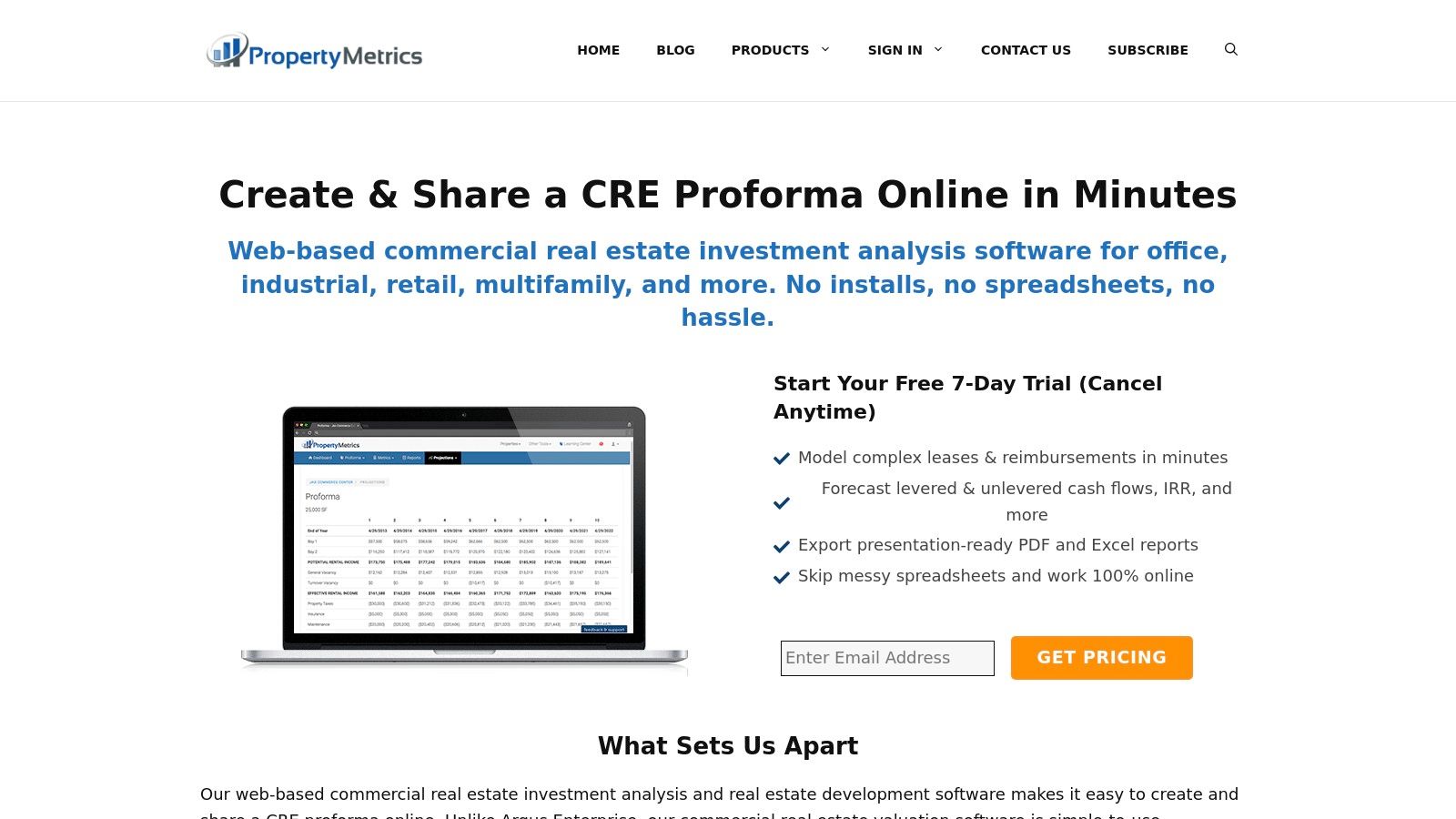
The platform shines in its ability to generate sophisticated discounted cash flow (DCF) analyses, complete with sensitivity tables that model how changes in key assumptions-like vacancy or rent growth-impact metrics like IRR and NPV. This empowers investors to stress-test their assumptions rigorously. All analyses can be exported into professional, branded PDF reports or shared as live, interactive models with partners and lenders, streamlining the due diligence and capital-raising process entirely within a browser.
Key Features & Use Cases
- Ideal User: Commercial real estate investors, brokers, and analysts focused on multi-tenant office, retail, industrial, and development deals.
- Core Functionality: Detailed lease-level modeling, complex expense reimbursement calculations (CAM, NNN), and monthly/annual DCF projections.
- Standout Feature: The sensitivity analysis tables provide a dynamic way to visualize risk and opportunity by showing how key metrics change with different assumptions.
- Reporting: Generates shareable live models and can export to branded PDF reports and clean Excel files for further customization.
Pricing, Pros & Cons
| Pricing | Pros | Cons |
|---|---|---|
| Individual: ~$49/mo Team: ~$99/mo Enterprise: Custom |
Faster to learn than enterprise CRE suites. Good depth for the price with solid report output. Active education resources alongside the app. |
Not an industry standard like ARGUS in some institutions. No built-in listings or comps marketplace. |
PropertyMetrics is an excellent choice for CRE professionals who need robust underwriting capabilities without the steep cost and learning curve of institutional-grade software.
Website: https://propertymetrics.com/software/real-estate-analysis
Top 12 Real Estate Investment Analysis Tools — Feature Comparison
| Tool | Primary use | Target audience | Key strengths / USPs | Limitations | Price / entry |
|---|---|---|---|---|---|
| DealCheck | Quick underwriting for rentals, flips, BRRRR, multifamily | Small investors, brokers, agents | Fast scenario analysis, shareable lender/partner PDFs, web + mobile | Not enterprise-grade; comps may need supplements | Low-cost subscription / free trial |
| BiggerPockets (Pro) | Calculators + market/deal finder, community & education | Active investors, learners, repeat deal pipelines | Standardized calculators, large community, deal-finder tools | Pro required for unlimited use; not for complex CRE | Pro membership (subscription) |
| Stessa | Portfolio & property performance tracking, pro-formas | Buy-and-hold landlords, portfolio managers | Bank-feed automation, budgeting, free tier for basics | Limited deep acquisition underwriting; some features paid | Free-to-start; paid Pro tiers |
| Mashvisor | Market discovery, heatmaps and LTR vs STR analysis | Market-first screeners, STR/LTR evaluators | City heatmaps, neighborhood analytics, STR+LTR comparison | City coverage limits; fuller data on higher tiers | Paid plans (annual best value) |
| AirDNA | Short-term rental market analytics and address-level revenue | STR investors, managers, operators | Rentalizer address estimates, demand signals, competitor calendars | STR-focused (not ideal for LTR-only); premium features paid | Paid plans; limited free tier |
| Rentometer | Fast rent comps and pro-forma rent validation | Underwriters, landlords, property managers | Quick neighborhood/ZIP comps, branded reports | Free caps; not a full P&L/DCf tool | Free limited use; Pro for volume |
| PropStream | Nationwide property data, list-building & lead automation | Fix-and-flip, SFR investors, marketers | Deep data, exportable lists, lead automator, skip-trace options | Marketing add-ons increase cost; best for active users | Subscription with trial; add-ons extra |
| Roofstock | SFR marketplace with built-in yield/cap analytics | Turnkey SFR buyers, portfolio buyers | Integrated purchase analytics, Neighborhood Rating, portfolio workflows | Estimates use assumptions; inventory varies by market | Marketplace fees / transaction-based; some paid features |
| Crexi Intelligence | CRE comps, ownership, loan & demographic analytics | CRE brokers, investors, underwriters | Large comps DB, ownership lookups, CMBS/loan insights | Contact exports credit-limited; mixed user experiences | Monthly pricing option (transparent) |
| Reonomy (Altus) | CRE property & ownership intelligence + API | Investors, lenders, developers needing scale | Extensive ownership & transaction records, API, portfolio mapping | Premium pricing; lease comps less deep in places | Premium subscription / contact sales |
| RealData | Deep Excel-based DCF and syndication modeling (REIA) | Multifamily and CRE analysts, sponsors | Very deep modeling, 20+ ROI metrics, one-time license | Steeper learning curve; best on Windows | One-time license (paid) |
| PropertyMetrics | Web-based CRE underwriting, lease-level pro-formas | CRE analysts seeking ARGUS alternative | Lease-level modeling, monthly/annual DCF, web-based sharing | Not industry-standard like ARGUS; no listings marketplace | Subscription (mid-tier pricing) |
Conclusion: Choosing the Right Tool to Build Your Investment Future
Navigating the landscape of real estate investment analysis tools can feel overwhelming, but as we've explored, the goal isn't to master every platform. The true objective is to find the right tool that aligns with your specific investment strategy, skill level, and portfolio goals. From the intuitive interface of DealCheck, perfect for analyzing your first flip, to the institutional-grade power of RealData for complex commercial modeling, there is a solution tailored for every stage of your investment journey.
The core takeaway is that these tools do more than just calculate cash-on-cash return; they build a framework for disciplined, data-driven decision-making. By leveraging technology, you replace guesswork with confidence, gut feelings with verifiable metrics, and emotional bias with objective analysis. This systematic approach is the hallmark of a successful, scalable real estate business.
Key Takeaways and Your Next Steps
To distill this comprehensive guide into actionable advice, focus on these final points as you move forward:
- Start with Your Strategy: Before you even sign up for a free trial, clearly define your investment niche. Are you a BRRRR investor, a house flipper, a commercial syndicator, or a short-term rental operator? Your strategy dictates your required features. A tool like AirDNA is invaluable for a vacation rental host but largely irrelevant for an industrial warehouse investor.
- Match Complexity to Experience: New investors should prioritize simplicity and education. Platforms like BiggerPockets and DealCheck offer not just calculators but also a wealth of community knowledge and straightforward workflows. As your portfolio and deal complexity grow, you can graduate to more robust software like PropertyMetrics or specialized data sources like PropStream without getting overwhelmed.
- Embrace the Free Trial: Nearly every tool on this list offers a free trial or a freemium version. Use this opportunity to run a real, live deal through two or three different platforms. This hands-on comparison is the single best way to determine which interface feels most intuitive and which workflow best suits your process.
- Think Beyond the Acquisition: The analysis doesn't stop once you close the deal. The long-term profitability of an asset depends heavily on efficient operations. While focusing on pre-acquisition analysis, remember that effective property management is crucial for long-term success. For those looking to streamline their post-acquisition operations, exploring the best property management apps can be highly beneficial in maximizing your returns and minimizing headaches.
Implementing Your Chosen Tool for Maximum Impact
Selecting a tool is only the first step; integrating it effectively into your workflow is what generates results. Begin by creating a standardized analysis template for your deals. This ensures you are comparing every potential property using the same consistent criteria, from rental income and vacancy rates to capital expenditures and appreciation forecasts.
Remember that the output of any real estate investment analysis tool is only as good as the data you input. Garbage in, garbage out. Take the time to verify your assumptions. Use sources like Rentometer for rental comps, talk to local property managers, and get real quotes from contractors for your rehab budget. Your chosen software is a powerful calculator, but your diligence provides the accurate inputs it needs to produce reliable projections.
Ultimately, the best real estate investment analysis tools are those that empower you to act decisively and intelligently. They transform a complex web of numbers into a clear story about an asset's potential, enabling you to build a resilient, profitable, and enduring real estate portfolio. The journey from aspiring investor to seasoned professional is paved with smart decisions, and the right technology is your indispensable co-pilot.
Frequently Asked Questions (FAQs)
What are the most important metrics to analyze in real estate investment?
The most critical metrics depend on your strategy, but some universals include:
- Cash Flow: The net income left after paying all operating expenses and mortgage payments. This is the primary measure of a rental property's ongoing profitability.
- Cash-on-Cash Return (CoC): Measures the annual pre-tax cash flow relative to the total cash invested. It's a key indicator of how efficiently your capital is working.
- Net Operating Income (NOI): The property's total income minus all operating expenses (excluding mortgage payments). It's crucial for determining a property's value.
- Capitalization (Cap) Rate: Calculated as NOI divided by the property's market value. It helps compare the potential return of different investment opportunities.
- Internal Rate of Return (IRR): A more advanced metric that calculates the total annualized return over the life of an investment, accounting for the time value of money.
Can I do real estate investment analysis with just Excel?
Yes, you absolutely can, and many sophisticated investors still use custom Excel or Google Sheets models. However, dedicated real estate investment analysis tools offer significant advantages, such as pre-built templates, automated data imports (like property details and comps), professional reporting for lenders, and mobile access for on-the-go analysis. For beginners, they also provide a structured framework that reduces the risk of errors in complex formulas.
What is the best free real estate investment analysis tool?
For a free tool, DealCheck and Stessa are excellent starting points. DealCheck offers a generous free plan that allows you to analyze a limited number of properties with its full suite of features and professional reporting. Stessa provides a powerful free platform for tracking the ongoing financial performance of your rental portfolio, which is invaluable for buy-and-hold investors. The BiggerPockets calculators also offer limited free use and are great for learning.
How do I choose the right tool for my specific investment strategy?
- For Flipping/BRRRR: Look for tools with detailed rehab budget planners and profit projectors, like DealCheck or the BiggerPockets Flip Calculator.
- For Long-Term Rentals: Prioritize tools with strong cash flow analysis, rent comp data, and ongoing performance tracking, such as BiggerPockets, Mashvisor, and Stessa.
- For Short-Term Rentals: A specialized tool like AirDNA is non-negotiable for accurate revenue and occupancy projections.
- For Commercial Real Estate (CRE): You'll need more robust software capable of complex DCF analysis and lease-level modeling, such as RealData or PropertyMetrics.
- For Off-Market Deal Sourcing: A data and lead-generation platform like PropStream is the best choice.