

Key Takeaways
- Diverse Opportunities Exist: Real estate investing isn't one-size-fits-all. Options range from hands-on residential rentals and the BRRRR method to scalable commercial properties and passive investments like REITs, each suiting different financial goals and time commitments.
- Analysis is Non-Negotiable: Successful investing relies on solid numbers. Mastering key metrics like Net Operating Income (NOI), Cap Rate, and Cash-on-Cash Return is crucial for evaluating a property's true financial potential and comparing different opportunities accurately.
- Strategic Financing is Key: How you finance a deal directly impacts your returns. Beyond conventional mortgages, exploring options like FHA loans for house hacking, portfolio loans for scaling, or creative seller financing can unlock deals and accelerate portfolio growth.
- Proactive Risk Management is Essential: The best investors plan for the unexpected. This means building a cash reserve for repairs and vacancies, conducting thorough due diligence before closing, and having a clear exit strategy—whether selling, refinancing, or using a 1031 exchange—from day one.
Your Guide to Building Wealth Through Property
Real estate is one of the most time-tested ways to generate passive income and build serious, long-term wealth. This isn't just about "buying a house." It's a strategic game of acquiring assets that grow in value while putting money in your pocket every month.
Forget the intimidating jargon for a minute. At its heart, real estate investing is about three simple things: finding the right property, in the right market, at the right price. That's it. Get those right, and you're on your way.
This guide is your roadmap. We’ll start with the basics and walk you through the actionable steps, turning the fuzzy idea of "investing in real estate" into a clear, confident plan.
Why Real Estate Is Still a Bedrock Asset
Unlike a stock, you can't live in a share of Apple. Real estate is a tangible asset—you can see it, touch it, and improve it. That physical reality offers a sense of security and control that very few other investments can match. The market has its cycles, but it has always proven resilient.
Here's why it remains so powerful:
- Consistent Cash Flow: After you pay the bills, rental income provides a reliable, steady stream of revenue.
- Long-Term Appreciation: Over time, property values tend to go up. It's a slow and steady way to build your net worth.
- Powerful Tax Breaks: The tax code favors property owners. You can deduct mortgage interest, property taxes, and even the "wear and tear" on the building through depreciation.
- The Magic of Leverage: This is the big one. You can use the bank's money to buy a huge asset, which magnifies your potential returns significantly.
Of course, this journey demands smart planning and an honest look at both the opportunities and the risks. Making informed choices is everything, and our guide on strategic decision-making for sustainable growth lays out frameworks that are just as relevant for building a property portfolio as they are for running a business.
What to Expect From This Guide
We’re going to cover the entire landscape of real estate investing, from classic single-family rentals to hands-off options like Real Estate Investment Trusts (REITs). You’ll get the tools you need to analyze a deal like a pro, line up financing, and manage your properties effectively.
The goal here is simple: to give you the knowledge and confidence to spot the right deals for you and act on them. Let's get started.
Exploring Your Investment Options
The world of real estate investing is a lot bigger than just buying a house and finding a tenant. It’s a diverse landscape with paths suited for different goals, risk appetites, and levels of involvement. Getting a handle on these different avenues is the very first step toward building a strategy that actually works for you.
Think of it like planning a road trip. A nimble sports car is perfect for a quick, thrilling journey (like a house flip), but a sturdy RV is what you want for a long, steady haul where comfort and consistency are key (like a multifamily building). The right vehicle depends entirely on where you're going and how you want to get there.
This decision tree gives you a visual shortcut, showing how your main goal—whether it's income, growth, or a bit of both—can point you toward the right type of investment.
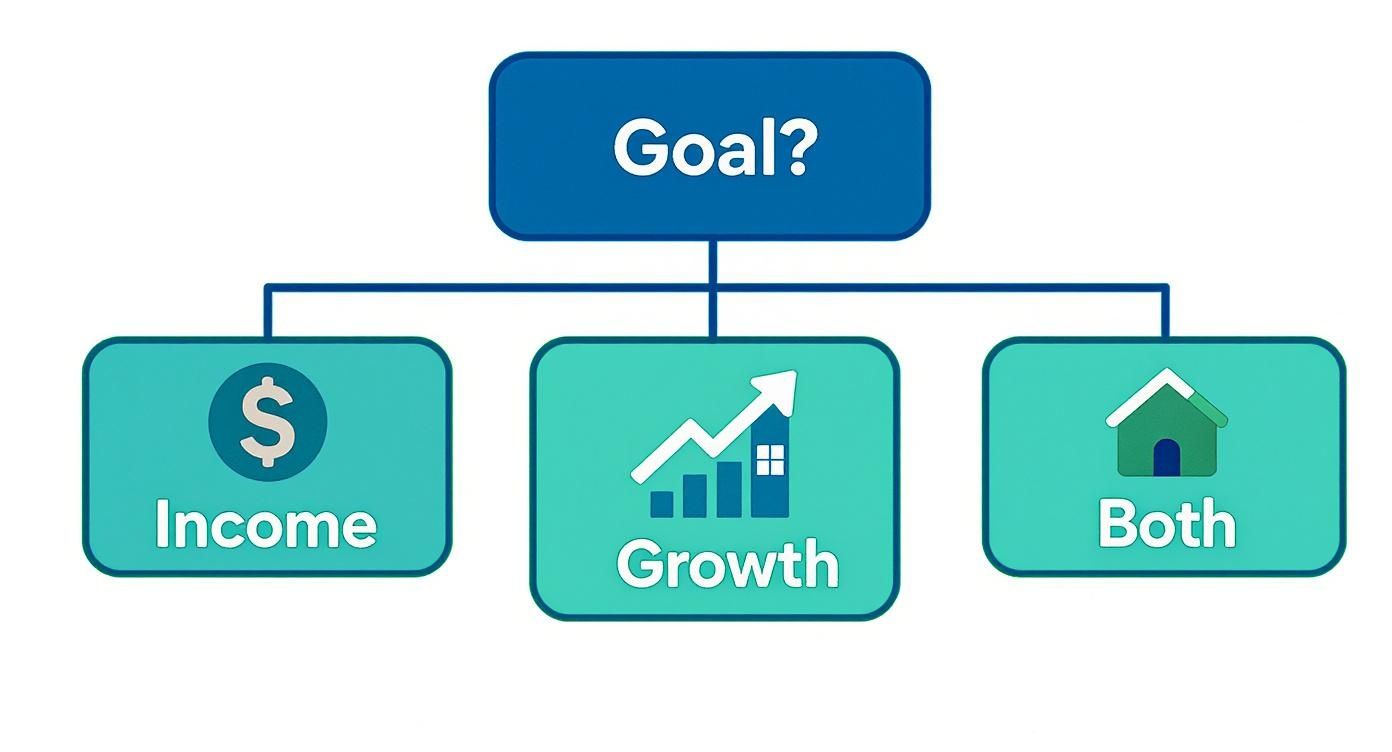
As you can see, if you’re laser-focused on generating steady income, stable rental properties are a natural fit. But if you’re aiming for significant growth, you might find yourself exploring development projects.
Residential Real Estate: Your Foundation for Growth
For most people dipping their toes into real estate, residential properties are the go-to starting point. And for good reason. They're easier to understand, finance, and manage than their commercial counterparts. Plus, the demand is constant—everyone needs a place to live.
-
Single-Family Rentals (SFRs): This is the classic bread-and-butter of real estate investing. You buy a home, rent it out to a family, and generate monthly cash flow while the property (hopefully) appreciates in value. It’s straightforward and effective.
-
The BRRRR Method: This one is for the hands-on investor. BRRRR is an acronym for Buy, Rehab, Rent, Refinance, Repeat. You hunt down a property that needs work, fix it up to force appreciation, place a tenant, and then do a cash-out refinance to pull your original investment back out. It's a powerful way to build a portfolio without tying up your capital for years.
-
Multifamily Properties: This category covers everything from a simple duplex to a sprawling apartment complex. The beauty here is having multiple income streams under one roof, which buffers you from the financial hit of a single vacancy. While management is more involved, the economies of scale can be a game-changer.
Right now, there's a huge trend affecting the multifamily space: a slowdown in new construction. In fact, global multifamily construction starts are projected to plummet to just 26% of their 2021 peak by mid-2025. This dramatic drop in new supply, as highlighted in recent market analysis, is creating a fantastic opportunity for owners of existing buildings as demand continues to climb. You can read more about these global real estate outlook findings.
Commercial Real Estate: Scaling Your Portfolio
Commercial real estate (CRE) is any property used for business. We're talking office buildings, retail shops, and warehouses. These deals typically require deeper pockets and more expertise, but the trade-off is often higher returns and much longer lease terms, which translates to stable, predictable income.
A huge advantage in the commercial world is the "triple net" (NNN) lease. This is a lease structure where the tenant is on the hook for property taxes, insurance, and maintenance. It dramatically cuts down on the landlord's operational headaches and creates a much more passive income stream.
The main CRE categories include:
- Office Buildings: Everything from city-center high-rises to suburban office parks.
- Retail Spaces: Think strip malls, large shopping centers, and standalone storefronts.
- Industrial Properties: Warehouses and distribution centers are booming thanks to e-commerce.
- Specialized Properties: This includes high-growth niches like self-storage facilities, medical offices, and data centers.
Passive Investing: Hands-Off Opportunities
What if you want the financial benefits of real estate without the late-night calls about a broken toilet? That's where passive investing comes in. These options let you pool your money with others to get into bigger deals without being the one in charge.
-
Real Estate Investment Trusts (REITs): The easiest way to think of a REIT is as a mutual fund for real estate. These are companies that own and operate a portfolio of income-producing properties. You can buy and sell shares of publicly traded REITs right on the stock market, giving you instant diversification and liquidity.
-
Real Estate Crowdfunding: These are online platforms that connect individual investors with real estate developers who need capital for a project. It’s a way to get a piece of a large-scale deal—like a new apartment building—with a much smaller check than you'd need to buy it yourself.
Deciding which path to take comes down to an honest look at your capital, your stomach for risk, and how much time you're truly willing to put in.
Comparing Real Estate Investment Types
To make things a bit clearer, here’s a side-by-side look at some of the most common real estate opportunities. Use this table to get a quick sense of which path might align best with your resources and goals.
| Investment Type | Capital Required | Management Effort | Typical Return Profile | Best For |
|---|---|---|---|---|
| Single-Family Rental | Low to Moderate | Medium | Cash Flow & Appreciation | Beginners, Long-Term Wealth Builders |
| BRRRR Method | Low to Moderate | High | Forced Appreciation & Cash Flow | Active Investors, Portfolio Builders |
| Multifamily | Moderate to High | Medium to High | Strong Cash Flow, Economies of Scale | Investors focused on scaling up |
| Commercial (CRE) | High to Very High | Low to Medium (NNN Leases) | Stable, Long-Term Income | Experienced Investors, High-Net-Worth Individuals |
| REITs | Very Low | None | Dividends & Liquidity | Passive Investors, Beginners, Diversification |
| Crowdfunding | Low | None | Project-Specific Returns (Growth or Income) | Investors seeking access to specific large deals |
Ultimately, there's no right or wrong answer. The best strategy is the one that fits your life, your finances, and your vision for the future.
How to Analyze a Potential Investment Property

Once you've zeroed in on the type of investment that fits your strategy, the real work begins. This is where you move from ideas to action, putting a potential property through a thorough financial health check-up.
Getting this analysis right is the single most important skill you can develop as an investor. It’s the bright line that separates a profitable asset from a money pit. The good news? You don't need a finance degree, just a solid grasp of the core metrics that reveal a property's true potential.
Starting with the Foundational Numbers
Before diving into fancy formulas, you need to collect the basic financial ingredients. This information is the bedrock for every other calculation you'll make.
- Purchase Price: Simple enough—what you’re paying for the property.
- Gross Rental Income: The total, absolute maximum rent you could collect in a year if the property was occupied 100% of the time.
- Operating Expenses: These are all the costs to keep the property running, excluding your mortgage. Think property taxes, insurance, maintenance, property management fees, and any utilities you cover.
With these three pieces of info, you can find the single most important profitability metric.
Calculating Net Operating Income (NOI)
Net Operating Income (NOI) is what’s left of your rental income after paying all the operating expenses. It's a pure measure of how much profit the asset itself generates before you even think about your loan.
The Formula: Gross Rental Income – Operating Expenses = Net Operating Income (NOI)
Think of NOI as the property’s annual salary. It's a clean performance number that isn't skewed by financing, which allows you to compare different properties on a true apples-to-apples basis.
Using the Cap Rate to Compare Deals
The Capitalization Rate, or Cap Rate, is one of the most common metrics you'll hear in real estate circles. It’s a back-of-the-napkin way to quickly size up a property's potential return and see how it stacks up against others on the market.
The Formula: Net Operating Income (NOI) / Purchase Price = Cap Rate
For instance, if a property has an NOI of $10,000 and costs $200,000, your Cap Rate is 5% ($10,000 / $200,000). A higher cap rate generally points to a higher potential return, but it can also signal higher risk. A building in a stable, prime neighborhood will naturally have a lower Cap Rate than one in a less certain, up-and-coming area.
Measuring Your True Return with Cash-on-Cash
While Cap Rate tells you about the property's return, Cash-on-Cash Return tells you about your return on the actual cash you pulled out of your pocket. For most individual investors, this is the number that matters most.
It answers the most important question: "For every dollar I put into this deal, how many cents do I get back each year?"
The Formula: Annual Pre-Tax Cash Flow / Total Cash Invested = Cash-on-Cash Return
Your Total Cash Invested is everything you paid out of pocket—the down payment, closing costs, and any initial repair money. Your Annual Pre-Tax Cash Flow is your NOI minus your total mortgage payments for the year. So, if your annual cash flow is $4,000 and you invested $50,000, your Cash-on-Cash Return is a very respectable 8%.
Looking Beyond the Numbers
A property can look perfect on paper and still be a disaster. The numbers are non-negotiable, but they have to be supported by a solid real-world assessment. You aren't buying a spreadsheet; you're buying a physical asset in a living, breathing community.
Here’s what you need to investigate on the ground:
- Location and Neighborhood: Is the area on the upswing or heading down? Check out school ratings, crime stats, and how close it is to things people want, like parks, grocery stores, and coffee shops.
- Local Economy and Job Market: A strong, diverse local economy is your best friend. A town that relies on a single factory is far riskier than a city with a healthy mix of healthcare, tech, and service jobs.
- Property Condition: This is a big one. Always get a professional inspection. A cheap property with a bad foundation or a 25-year-old roof can erase years of profits in the blink of an eye. You have to budget for what needs fixing now and what will need fixing later.
When you combine sharp financial analysis with boots-on-the-ground diligence, you build the confidence to spot the real opportunities. The same principles that apply here are foundational elsewhere; for a deeper look at how data can shape better outcomes, consider leveraging data analytics for business growth.
Your Playbook for Due Diligence and Financing

So, you've run the numbers and a property looks like a winner on paper. Now it's time to shift gears from analyst to investigator. This is the due diligence phase—that critical window where you verify that an investment is everything it claims to be. Trying to skip this step is one of the fastest ways to turn a dream deal into a nightmare.
Think of it like the final pre-flight check on a rocket. You did the math and planned the mission, but now it’s time to physically inspect every single nut and bolt to make sure this thing will actually fly.
Your Essential Due Diligence Checklist
Due diligence isn't just a quick look-around; it's a systematic process for uncovering any hidden gremlins that could torpedo the property's value or your profits. It’s all about digging into the physical building and the mountain of paperwork that comes with it. While every deal has its own quirks, your investigation should always hit these core areas.
Physical Inspection Checklist:
- Structural Integrity: This is priority number one. Hire a certified inspector to get a professional opinion on the foundation, roof, plumbing, and electrical systems. You're looking for any major, costly defects.
- Pest and Environmental Hazards: It's often smart to get a separate inspection for termites, mold, asbestos, or lead paint, especially if you're looking at an older building.
- Appliance and System Lifespan: How much life is left in the HVAC system, water heater, and other big-ticket appliances? A furnace on its last legs is a huge expense waiting to happen.
Legal and Financial Verification:
- Title Search: A title company will do the legwork to confirm the seller legally owns the property and that there are no surprise liens or claims from anyone else.
- Zoning and Land Use: You need to confirm the property is zoned for its current use and that no upcoming changes could throw a wrench in your plans.
- Lease Agreements: If you're buying a tenanted property, you absolutely must review every single lease. Understand the terms, the rents, and whether the tenants actually pay on time.
Navigating Your Financing Options
Once your due diligence gives you the green light, the next move is to line up the money to close the deal. Remember, the loan you choose is far more than just a mortgage—it’s a strategic decision that will directly shape your cash flow and long-term returns.
The goal isn’t just to get a loan; it’s to get the right loan for your specific investment strategy. The financing that makes sense for a quick flip is completely different from what you'd want for a long-term rental.
Here’s a look at the most common financing routes:
- Conventional Mortgages: These are the bread-and-butter loans from banks and credit unions. For an investment property, expect to put down 20-25%. They offer solid rates but have pretty strict qualification standards.
- FHA Loans: Backed by the Federal Housing Administration, these are a fantastic entry point for new investors. You can buy a small multifamily property (up to four units) with as little as 3.5% down, as long as you live in one of the units yourself. It's a popular strategy called "house hacking."
- Portfolio Loans: For investors juggling multiple properties, a portfolio loan is a game-changer. It’s a single loan that wraps up your entire collection of properties, giving you one simple payment and underwriting that’s based on your track record as an investor, not just your W-2 income.
Unlocking Deals with Creative Financing
Sometimes, the best opportunities are found by thinking outside the traditional banking box.
Seller Financing is a classic example. Here, the current owner essentially acts as the bank, financing the purchase for you. This can be a huge win if you don't quite qualify for a conventional loan or if you want to negotiate more favorable terms, like a smaller down payment or a better interest rate. It’s a powerful way for motivated investors to make a deal happen.
Managing Risk and Planning Your Exit
A truly great real estate deal is defined by more than just what you pay for it. It’s about building a resilient investment that can handle a few bumps in the road and has a clear, profitable finish line. This comes down to mastering two disciplines that are too often overlooked: risk management and exit planning.
Thinking about risk is a bit like being a ship captain. You hope for sunny skies and smooth sailing, but you always prepare for a storm by checking the lifeboats and tying down the cargo. In real estate, that means spotting common problems before they happen and having a solution ready.
Practical Strategies for Mitigating Risk
Every investment has some risk baked in, but savvy investors don't try to avoid it—they manage it. The entire goal is to build a financial cushion and have solid systems in place that protect both your cash flow and the property itself.
A few key strategies can make all the difference:
- Build a Capital Expense (CapEx) Fund: This is simply a separate savings account earmarked for the big-ticket items you know will eventually fail, like a roof or an HVAC unit. Funneling a small percentage of the rent into this fund each month means you're prepared when a five-figure bill shows up.
- Master Tenant Screening: Your first and best line of defense against late payments, vacancies, and property damage is a rock-solid screening process. This means credit checks, income verification, and actually calling previous landlords. Don't skip these steps.
- Maintain Adequate Insurance: A basic landlord policy is just the start. Depending on your property's location, you might need flood, fire, or even a liability umbrella policy to be truly protected.
The Importance of a Clear Exit Strategy
Beginner investors often get so caught up in the excitement of getting into a deal that they completely forget to plan how they’ll eventually get out. Your exit strategy is your predetermined plan for cashing out of the investment. It's the move that lets you realize your profits, and it should shape your entire game plan from the very beginning.
Think of it this way: you wouldn't start a road trip without knowing your final destination. Your exit strategy is that destination, ensuring every turn you make along the way moves you in the right direction.
For instance, a property you intend to flip needs to be bought at a serious discount in a market where buyers are active and hungry. On the other hand, a long-term rental needs to be in a stable neighborhood with a deep pool of qualified tenants. Understanding these fundamental differences is one of the foundations of running a successful business, whether you're in real estate or any other field.
Common Exit Strategies to Consider
Your choice of exit should line up perfectly with what you set out to achieve. Here are a few of the most common paths investors take:
- Traditional Sale: This is the most straightforward exit. You list the property on the open market, sell it, pay off the loan, and walk away with the profit. Simple and clean.
- The 1031 Exchange: This is a powerful tool for serious investors. It allows you to sell a property and roll all the proceeds into a new "like-kind" property, deferring capital gains taxes in the process. It's the key to growing a portfolio exponentially.
- Refinance and Hold: If your goal is long-term cash flow, you might do a "cash-out" refinance once the property's value has increased. This lets you pull out a chunk of your equity tax-free to use for your next investment, all while you continue to hold the asset and collect rent.
Of course, external factors play a huge role. For six straight quarters through early 2025, global commercial real estate investment volumes dropped, with European markets shrinking by 15% and Asia Pacific falling 27% due to tough economic pressures. A market downturn like this is exactly why having a flexible exit plan is so important. You can find more insights in the commercial real estate outlook on Deloitte.com.
Real-World Investment Scenarios
All the theory in the world can't replace seeing how these strategies actually play out. The numbers, the risks, the wins—it all comes together when you see it in action.
So, let's walk through a few different scenarios. We'll follow three investors with completely different goals, resources, and risk tolerances to see how they tackle the market.
Scenario 1: The Newcomer Building Equity with BRRRR
First up is Alex, a young professional who's managed to save up a $40,000 nest egg. The goal isn't just to buy one rental; it's to build a portfolio. But with limited cash, Alex needs a way to recycle that initial investment over and over.
This is where the BRRRR (Buy, Rehab, Rent, Refinance, Repeat) method shines.
- Buy: Alex finds a solid but tired single-family home in a neighborhood with good fundamentals. It’s listed for $200,000. To keep personal cash free for renovations, Alex uses a hard money loan to cover the purchase.
- Rehab: This is the "forced appreciation" step. Alex puts $30,000 into a new kitchen, two updated bathrooms, and fresh paint. The house is instantly worth more than the total amount invested.
- Rent: With the fresh updates, the home easily rents for $2,200 a month, attracting a great tenant and establishing a solid income stream.
- Refinance: After the property is seasoned for six months, it now appraises for $280,000. Alex secures a traditional cash-out refinance for 75% of that new value, which comes to $210,000. That new loan pays off the entire hard money debt and puts most of the initial cash back in Alex's pocket.
- Repeat: Now, Alex owns a cash-flowing rental, has proven the model, and—most importantly—has the original capital back to go find the next deal. This is how you build a portfolio from a single pot of money.
Scenario 2: The Seasoned Investor Chasing Cash Flow
Next, let's look at Maria. She's an experienced investor with more capital and a different objective: generating stable, predictable income for her retirement. Rapid growth is less important than reliable cash flow.
She sets her sights on a four-unit multifamily building priced at $600,000.
After a deep dive into the numbers, she sees it’s a solid performer. The building delivers a 7% cap rate and will produce a 9% cash-on-cash return after financing. She puts down 25% and gets a commercial loan for the rest.
For Maria, the magic of multifamily is its built-in stability. If one of her four units sits empty for a month, she still has three other rent checks coming in to cover the mortgage and expenses. A single vacancy in a single-family home means 100% of your income is gone.
Her strategy isn’t a quick flip. She plans to hold this property for the long haul, letting her tenants pay down the mortgage while rents and property values slowly but surely climb over the years.
Scenario 3: The Hands-Off Professional Investing in a REIT
Finally, we have Ben, a busy executive. He sees the value in real estate but has zero time or interest in being a landlord. He wants exposure to the asset class without the operational headaches.
Ben decides to invest $50,000 into a publicly traded Real Estate Investment Trust (REIT) that focuses on logistics and industrial warehouses—a sector booming thanks to e-commerce.
With one simple transaction, Ben becomes a fractional owner in a massive portfolio of high-value properties. He gets quarterly dividends from the rental income collected by the REIT and can sell his shares on the stock market at any time. It's real estate investing with the liquidity of a stock.
This strategy is perfectly timed. Global private real estate has seen strong performance, and the S&P Global Property Index, for instance, delivered a 14.1% one-year return through mid-2025, largely fueled by sectors like logistics. Discover more insights on these real estate trends and tactics at Nuveen.com.
As you can see, there’s no single "best" way to invest. It's all about finding the right path for your capital, your timeline, and what you want to achieve.
Frequently Asked Questions
When you're starting to look at real estate opportunities, it's natural for a lot of questions to pop up. Let's tackle some of the most common ones head-on.
How Much Money Do I Really Need to Start?
This is the biggest hurdle for most people, but it’s often smaller than you think. While the standard 20% down payment for a conventional loan is common, it's far from the only way. A popular strategy called "house hacking" lets you buy a small multifamily property with an FHA loan and live in one of the units yourself. The big advantage? Your down payment could be as low as 3.5%. And if you want to get your feet wet without buying a whole building, you can invest in Real Estate Investment Trusts (REITs) or join a crowdfunding platform with a few hundred dollars.
What's the Difference Between Cash Flow and Appreciation?
It’s simple: one pays your bills now, the other builds your wealth for later. Think of cash flow as your property's monthly paycheck. It's what's left in your bank account after you’ve collected rent and paid the mortgage, taxes, insurance, and maintenance. Appreciation, on the other hand, is the increase in the property's market value over time. A great investment gives you both. Relying only on appreciation is just gambling, but consistent cash flow provides the stability you need to stay in the game long enough to see that appreciation happen.
What is the Best Type of Real Estate for a Beginner?
A single-family rental is almost always the most approachable starting point. Financing is pretty standard, managing one tenant is less complicated than managing twenty, and it's a great way to learn the fundamentals of cash flow and appreciation on a smaller, more forgiving scale. More advanced beginners might consider "house hacking" a duplex or triplex to live in one unit while renting out the others.
What Are the Biggest Risks for a New Investor?
For anyone new to real estate, the most common mistakes tend to be the same: overpaying for a property, getting hit with surprise repair bills that drain your account, and struggling with long vacancies that kill your income. The good news is that these are all manageable. You protect yourself by doing rigorous due diligence before you buy, keeping a healthy cash reserve for those inevitable "uh-oh" moments, and having a strict tenant screening process from day one.
How Do I Decide Which Exit Strategy is Right for Me?
Your exit strategy should be a direct reflection of your goals. Are you looking for a quick, lump-sum payout? A fix-and-flip with a traditional sale is your game. Do you want to build long-term, generational wealth? Then strategies like the 1031 exchange and refinancing to hold are the right tools for the job.
At Robert LaMattina, we believe that informed decisions are the bedrock of successful ventures, whether in business or real estate. Explore more pragmatic insights on growth and strategy at https://robertlamattina.net.