

Picture your company's income as a steady, reliable river instead of a series of unpredictable downpours. That’s the real power behind recurring revenue. This guide is all about moving past the hustle of one-time sales to build something more lasting: predictable, scalable growth fueled by genuine customer relationships.
Key Takeaways Before We Dive In
- The Core Models: We'll break down the most popular recurring revenue models—from subscriptions and memberships to retainers—and show you how they work with real-world examples.
- Essential Metrics: You’ll learn how to track the vital signs of a recurring revenue business, like Monthly Recurring Revenue (MRR), churn, and Customer Lifetime Value (LTV).
- Smart Pricing Strategies: We’ll get into the art of designing pricing and packages that match the value you provide, encouraging customers to stick around and upgrade over time.
- Actionable Implementation: You’ll see how these concepts are applied in specific industries like healthcare and real estate, giving you a clear path to follow.
The Power of Predictable Income
The traditional way of doing business often feels like a hamster wheel. You chase a lead, close a sale, feel a moment of relief, and then the hunt for the next customer begins all over again. This constant transactional cycle creates a ton of uncertainty in your cash flow, making it tough to plan ahead, invest in new ideas, or even just ride out a slow month.
Recurring revenue models completely flip that script.
Instead of focusing all your energy on a single transaction, the goal is to deliver continuous value that keeps customers happily paying you on a regular basis. Think of it less like a single purchase and more like a long-term partnership. This kind of stability is the bedrock on which truly resilient, high-growth companies are built. As entrepreneur Robbie LaMattina points out, building for the long haul requires systems that support consistent growth, and recurring revenue is the perfect engine for that.
Why Predictability Matters More Than Ever
In today’s fast-moving market, predictability is a genuine superpower. It’s what lets a business shift from constantly reacting to problems to proactively shaping its own future. When you have a solid idea of what revenue is coming in next month and the month after, you can start making much smarter, more strategic decisions.
This financial stability unlocks some incredible advantages:
- Smarter Financial Forecasting: You can project your earnings with far greater accuracy, which takes the guesswork out of budgeting and long-term planning.
- A Higher Business Valuation: Investors absolutely love predictability. Businesses with strong recurring revenue streams often get higher valuations because their future income is so much more reliable.
- Deeper Customer Relationships: To keep customers around, you have to stay focused on their success and happiness. This naturally leads to stronger loyalty and invaluable feedback that helps you improve.
- Real Growth Opportunities: With a stable revenue foundation, you can invest confidently in new products, marketing campaigns, and hiring the right people.
"Subscription businesses have grown 4.6x faster than the S&P 500. This is likely because companies with recurring revenue can forecast more predictably and must emphasize customer experience to prevent churn."
This isn't just a fleeting trend; it's a fundamental change in how the most successful companies operate. It’s about building a business that doesn't just run but consistently refuels itself. For a deeper look at the different ways to approach this, you can explore these recurring revenue business models for sustainable growth. Think of this guide as your roadmap, but understanding this core idea is your first, most important step.
Exploring the Core Recurring Revenue Models
If you're moving away from one-off sales, you have to pick the right engine to drive your business forward. Not all recurring revenue models work the same way. Each one has its own quirks, benefits, and best-fit scenarios, so understanding the fundamentals is your first step toward building that reliable, predictable income you're after.
This isn't just a passing trend, either. The subscription economy has absolutely exploded, growing by a staggering 435% in the last decade alone and completely rewriting the rules for how businesses create stable revenue. With projections showing the market will hit $1.5 trillion by 2025, it's clear this shift is here to stay. You can get the full story by reading more about the subscription economy surge and its massive impact.
This is all about creating a positive feedback loop: predictable income allows you to invest in growth, which in turn makes your company more resilient.
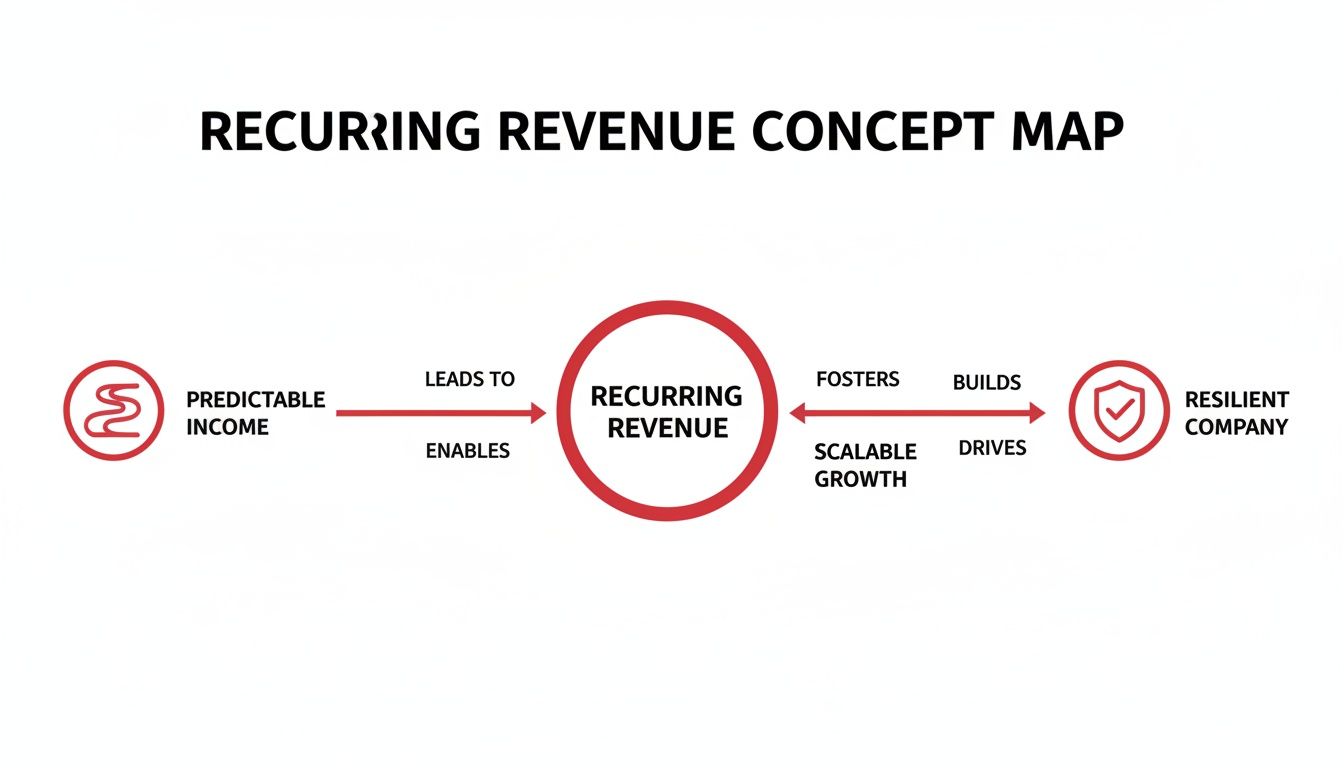
As the diagram shows, it all starts with that steady, predictable income. That's the fuel for scalable growth, which ultimately builds a business that can weather just about any storm.
Let's dive into some of the most popular models you can use.
The Classic Subscription Model
When most people hear "recurring revenue," this is the model that springs to mind. It's the powerhouse behind giants like Netflix and Spotify. The premise is simple: customers pay a regular fee, usually monthly or yearly, for ongoing access to a product or service.
The whole thing hinges on delivering consistent, undeniable value. For a Software-as-a-Service (SaaS) company, that means shipping regular updates and new features. For a subscription box, it’s about curating a fresh, exciting experience with every single delivery. The goal is to weave your offering so deeply into a customer's life or workflow that they can’t imagine being without it.
Membership and Community Models
While similar to subscriptions, membership models have a slightly different flavor. Here, the focus is less on a product and more on access to an exclusive community or group. Think of professional organizations, high-level networking groups, or platforms with members-only content.
The real value isn't just a thing; it's the feeling of belonging and the connections people make. A great example is a private mastermind group where entrepreneurs pay for access to top-tier networking and expert coaching. The community is the product. These models forge incredibly strong brand loyalty because customers are invested in the people and relationships, not just the service itself.
Usage-Based and Freemium Models
The usage-based model is all about flexibility, tying what a customer pays directly to how much they use. Amazon Web Services (AWS) pretty much wrote the book on this, charging customers only for the exact computing resources they consume. This approach is fantastic because it lowers the barrier to entry—customers can start small and let their costs grow naturally alongside their needs.
This "pay-as-you-go" approach often goes hand-in-hand with a freemium strategy. You offer a basic, free version of the service to get people in the door, with the goal of converting them into paying customers once they hit certain limits or realize they need more advanced features. It’s a brilliant customer acquisition tool, but you have to build a very clear, compelling upgrade path.
Retainers and Service Contracts
For service-based businesses, retainers and service contracts are the bread and butter of predictable revenue. A marketing agency might charge a monthly retainer for ongoing SEO work, or an IT firm could use a service contract to provide regular system maintenance and support.
These models are perfect for consultants, agencies, and professionals who provide ongoing expertise. They give clients peace of mind with consistent access to skilled help, while the business gets the predictable cash flow it needs to plan ahead. It's a world away from the "feast or famine" cycle of project-based work. As business strategist Robbie LaMattina often points out, these structures are built for fostering long-term partnerships over chasing one-off gigs.
To help you see how these models stack up against one another, here’s a quick comparison.
Comparing the Top Recurring Revenue Models
This table offers a side-by-side look at the primary recurring revenue models, highlighting their mechanics, ideal industries, and unique strengths.
| Model Type | How It Works | Best For | Key Advantage |
|---|---|---|---|
| Subscription | Customers pay a fixed, recurring fee (monthly/annually) for continuous access to a product or service. | SaaS, media/streaming, e-commerce (subscription boxes), publishing. | High predictability and strong customer lifetime value. |
| Membership | Customers pay for access to an exclusive community, content, or perks. The value is in belonging. | Professional organizations, online communities, clubs, content creators. | Builds powerful brand loyalty and a strong sense of community. |
| Usage-Based | Customers are charged based on their consumption of a service (e.g., data used, API calls made). | Cloud computing (IaaS/PaaS), utilities, telecommunications. | Lowers the barrier to entry and scales revenue with customer growth. |
| Retainer | Clients pay a fixed fee in advance to secure access to professional services for a set period. | Agencies (marketing, legal), consultants, freelancers. | Guarantees income and stabilizes cash flow for service providers. |
Choosing the right model depends entirely on what you sell, who you sell it to, and the kind of relationship you want to build with your customers. Each one offers a path to more stable, predictable revenue.
Key Metrics That Drive Sustainable Growth
Switching to a recurring revenue model is a great first move, but keeping that growth engine running means looking at your business through a new lens. Forget about just tracking one-time sales; that's old news. Now, it's all about a specific set of vital signs that measure predictability, customer loyalty, and long-term financial health.

Think of these metrics as the gauges in your company's cockpit. They tell you if you're flying high, losing altitude, or about to run out of fuel. Getting a handle on them is absolutely critical for making smart, data-backed decisions that build a business that lasts.
MRR and ARR: The Bedrock of Predictability
Let's start with the basics: Monthly Recurring Revenue (MRR) and Annual Recurring Revenue (ARR). These two numbers are the foundation, giving you a clear picture of the predictable income you can count on every month or year.
- MRR (Monthly Recurring Revenue): This is your lifeblood. It's the total predictable revenue you bring in from all your active customers each month.
- ARR (Annual Recurring Revenue): This is just your MRR multiplied by 12. It gives you that bigger-picture, 10,000-foot view of your company's scale, which is essential for long-range planning and valuations.
But calculating MRR is more than simple addition. You have to break it down. You need to track new customers, upgrades (expansion MRR), downgrades (contraction MRR), and, of course, cancellations (churned MRR). This level of detail turns a simple number into a powerful diagnostic tool, showing you exactly what’s driving your growth.
Visualizing this is everything. As entrepreneur Robbie LaMattina knows, a well-designed dashboard can make or break your ability to see the story in the data. If you're building your own, getting some inspiration from a well-structured business performance metrics dashboard is a smart move.
Customer Churn: The Silent Killer
While MRR and ARR track what's coming in the front door, customer churn measures what's leaking out the back. Churn is simply the percentage of customers who leave over a given period. It might not sound terrifying, but even a small churn rate—say, 3% per month—can quietly gut your business over time.
A high churn rate is like trying to fill a leaky bucket. You can pour in new customers all day, but you’ll never get ahead if your existing ones are constantly slipping through the cracks.
Fighting churn is one of the most powerful growth levers you have. It forces you to get serious about customer happiness, the real-world value of your product, and building relationships that last. The lower your churn, the more stable and valuable your business becomes.
LTV and CAC: The Profitability Equation
Finally, we get to the power couple of recurring revenue: Customer Lifetime Value (LTV) and Customer Acquisition Cost (CAC). When you look at these two together, you get a brutally honest assessment of whether your business model actually works.
- LTV (Customer Lifetime Value): This is the total amount of money you expect to make from a single customer over the entire time they do business with you.
- CAC (Customer Acquisition Cost): This is the total sales and marketing cost it takes to land one new customer.
The math here is pretty straightforward: your LTV needs to be way bigger than your CAC. A healthy business shoots for an LTV that's at least three times its CAC, giving you an LTV:CAC ratio of 3:1. This ratio is your proof that for every dollar you spend to get a customer, you're getting at least three dollars back.
Understanding financial health indicators like the LTV:CAC ratio is non-negotiable for long-term survival. If your ratio is too low, you're bleeding cash by overpaying for customers who aren't sticking around long enough to turn a profit.
Designing Your Pricing and Packaging Strategy
How you price your product is just as critical as what you're selling. A smart pricing strategy does so much more than just cover costs—it tells your customers what you're worth, pulls in the right kind of clients, and lays the groundwork for future growth. For recurring revenue business models, pricing isn't something you set and forget. It's an ongoing dialogue with your market about the true value of your solution.
Getting this right is a massive lever for improving profit margins and building a business that lasts.
Core Pricing Models for Recurring Revenue
First things first, you need to pick your pricing structure. Each one speaks to different customer habits and business goals, and the right choice hinges entirely on how your customers get value from what you offer.
Here are the usual suspects:
- Flat-Rate Pricing: The simplest of all. One price gets you one package of features, paid every month or year. It's a breeze to explain, but it can box you in as your customer base gets more diverse.
- Tiered Pricing: A classic for a reason. You create a few different packages (think Basic, Pro, Enterprise) at different prices, with each tier unlocking more features or higher limits. It's a fantastic way to serve everyone from solo operators to large teams.
- Per-User Pricing: Very common in the software world. You charge a set amount for every person on an account. It's easy to understand and scales right alongside a client's headcount.
- Usage-Based Pricing: Customers only pay for what they use, whether that's data storage, API calls, or hours of consultation. This model is a perfect match for customers who want to start small, since the cost is directly tied to their consumption.
The Psychology of Smart Packaging
Beyond the raw numbers, how you package your offerings is all about shaping perception. The goal is to make the buying decision feel simple and obvious, gently steering people to the best solution for them—which also happens to be great for your revenue. As business strategist Robbie LaMattina points out, if you don't understand what motivates your customers, you can't build packages that sell themselves.
A great tactic here is the "decoy effect," where you introduce a third option specifically to make one of your other plans look like a much better deal. For example, a slightly overpriced middle tier can make your premium package look like an absolute steal.
Your pricing page is one of your most powerful marketing tools. It's the moment a prospect's casual interest has to become a real commitment. Every single detail—from what you name your tiers to the features you highlight—should be designed to build confidence and make saying "yes" easy.
This is especially critical now. Subscription businesses are growing at an incredible pace, expanding 4.6 times faster than the S&P 500. Their predictable revenue and customer-first approach give them a huge advantage, making it a perfect model for entrepreneurs looking to scale. You can find more stats on the growth of the subscription economy on digitalroute.com.
Upselling, Cross-Selling, and the Freemium Hook
A good pricing strategy doesn't stop after the first sale. It has to be built to get more value from the customers you already have. That’s where upselling and cross-selling come into play.
- Upselling: Convincing customers to upgrade to a more expensive, feature-rich plan.
- Cross-selling: Selling customers a complementary product or service they don't already have.
A well-designed tiered model is your secret weapon for upselling. By placing your most-wanted features in the higher-priced plans, you create a natural pull for growing customers to make the leap.
Finally, there’s the freemium model. It can be a powerful—but tricky—way to bring in new users. You offer a free, stripped-down version of your product to get people hooked on its value. The catch? You have to make sure the free plan is good enough to attract people but limited enough that serious users have to upgrade. When done right, it can slash your acquisition costs and create a massive pipeline of potential customers.
Recurring Revenue in Healthcare and Real Estate
It's one thing to talk about theories and metrics, but the real magic of recurring revenue happens when you see it working in the real world. While we often think of these models in the context of software or tech, their principles are incredibly flexible. They can bring stability and new growth opportunities to even the most traditional sectors.
Let’s dig into how two completely different industries—healthcare and real estate—can put these ideas to work to build predictable income and deliver far more value to their clients.
These case studies, inspired by the work of experts like Robbie LaMattina, prove that with a little creativity, almost any business can build a more resilient financial foundation.

Case Study: Healthcare Aftercare Memberships
Imagine a behavioral health provider specializing in intensive outpatient programs. Historically, their revenue is tied directly to patient admissions, which makes for a classic "feast or famine" financial cycle. Once a patient finishes the program, the relationship and the revenue stream usually dry up.
To fix this, the provider rolls out a membership-based aftercare program. It's an optional subscription offering tiered packages of ongoing support, all designed to help alumni stay on track with their recovery and prevent relapse.
Here’s a simple way it could be structured:
- Tier 1 (Community Access): For a small monthly fee, alumni get into a private online support community, join moderated group video calls, and access a library of wellness resources.
- Tier 2 (Proactive Support): This mid-tier option includes everything from Tier 1, but adds a monthly check-in call with a peer support specialist and priority access to workshops.
- Tier 3 (Personalized Coaching): The premium tier adds a dedicated recovery coach and bi-weekly one-on-one sessions for highly personalized support.
This single shift completely changes the clinic's finances. It carves out a new, predictable stream of MRR, smoothing out the financial rollercoaster of admission-based income. Even more importantly, it deepens the patient relationship, boosts long-term success rates, and builds a powerful community around their brand.
Case Study: Real Estate Investor Retainers
Now, let's pivot to a boutique property management firm that serves real estate investors. Under their old model, they charged a percentage of the monthly rent plus a menu of separate fees for things like leasing, maintenance coordination, and reporting. This led to lumpy revenue and an administrative nightmare.
To stabilize everything, the firm moves to a retainer-based service contract. Instead of that patchwork of fees, investors now pay a flat monthly retainer for each property.
This simple change flips the entire dynamic. The firm is no longer just a service provider putting out fires; it becomes a strategic partner focused on maximizing the investor's long-term returns.
The retainer model delivers a few huge wins:
- Predictable Cash Flow: The firm knows exactly what's coming in, and the investor knows exactly what's going out. Budgeting and forecasting become a breeze for both parties.
- Aligned Incentives: The firm is now motivated to proactively maintain properties and keep great tenants, protecting the asset's long-term value. They're not just trying to profit from tenant turnover anymore.
- Operational Simplicity: One monthly fee gets rid of all the complex, nickel-and-dime invoicing. This frees up administrative time to focus on high-value activities that actually make investors more money.
By embracing a recurring revenue model, the property management firm secures its own financial footing while delivering a clearer, more valuable, and streamlined service to its clients.
Building Your Recurring Revenue Engine
We've just walked through the blueprint for turning your business from a company that lives transaction-to-transaction into one with a predictable, sustainable growth engine. Making the switch to a recurring revenue model is more than just a change in how you bill customers; it’s a total shift in mindset.
You’re no longer just chasing the next sale. Instead, your focus becomes delivering continuous, undeniable value that builds real, lasting relationships with the people you serve.
The payoff for this shift is massive. It gives you the financial stability to forecast with confidence and the solid ground you need to invest in your future. Even better, it ties your success directly to your customers' success. When they win, you win. This creates a powerful partnership that naturally leads to loyalty and long-term growth.
Your Actionable Roadmap
Building this kind of engine doesn’t happen overnight. It’s not about flipping a switch; it's about carefully and deliberately putting the right pieces in place. Here’s a quick recap of the core pillars we covered:
- Choose Your Model Wisely: Start here. Pick the model—whether it's subscriptions, memberships, or retainers—that truly fits the value you deliver and the way your customers actually want to use it.
- Master Your Metrics: You have to know your numbers. Keep a close watch on the vital signs of your business, like MRR for predictability. Fight churn like your business depends on it (because it does), and make sure your LTV to CAC ratio stays healthy. That’s your proof of a profitable model.
- Design a Smart Pricing Strategy: Your pricing and packaging need to scream value. Create clear tiers that offer a natural upgrade path, encouraging customers to grow with you and maximizing their lifetime value.
Think of these steps as the gears of your revenue engine. When they mesh together perfectly, they create a powerful, self-sustaining cycle of predictable income and deep customer loyalty. This is exactly why learning how to improve customer retention isn’t just a task for the support team—it's a central growth strategy.
As entrepreneur Robbie LaMattina often points out, the future belongs to businesses built for the long haul. Recurring revenue isn't just a trend; it's the foundation for creating an enduring company that thrives by putting customer value at the absolute center of everything it does. Focus on that, and you'll set your business up for sustainable growth for years to come.
A Few Lingering Questions
Switching to a recurring revenue model is a big move, and it’s natural to have questions. It’s one thing to understand the theory, but quite another to put it into practice. Let’s tackle a few of the most common questions that pop up when business leaders start down this path.
We’ll dig into the toughest part of making the change, talk about how to keep customers from leaving, and explore how this all applies to businesses that sell actual, physical stuff.
What's the Single Biggest Hurdle When Switching to a Recurring Model?
Honestly? It's the mindset shift. You’re not just changing your pricing; you’re changing the entire culture of your business and rewriting the expectations of your customers.
For years, everyone—your sales team, your support staff, your customers—has been wired for one-off transactions. Suddenly, you’re asking them to think in terms of long-term relationships and ongoing value. That’s a huge adjustment. Your sales team has to stop hunting for the big kill and start farming, nurturing customer relationships for the long haul. This changes how you pay them, how you measure their success, and what you celebrate as a win.
On the customer side, you have to be crystal clear about why they should pay you every month or year. You're no longer just selling a thing; you're selling a promise, an outcome, a solution that grows with them. That takes a whole new level of communication.
Be prepared for the "revenue trough." When you switch from large upfront payments to smaller, recurring ones, you'll likely see a temporary dip in cash flow. This is normal, but it requires careful financial planning and honest conversations with your stakeholders to manage expectations.
How Do We Actually Reduce Customer Churn?
Fighting churn is everything in a recurring revenue business. A high churn rate is like trying to fill a bucket with a hole in the bottom—all your hard-earned growth just leaks out. The key is to get ahead of it.
Here are a few strategies that really work:
- Nail the Onboarding: The first 90 days are make-or-break. A fantastic onboarding experience that helps a new customer get their first quick win is the best predictor of long-term retention. Make them feel successful, fast.
- Watch for Warning Signs: Use your data to see who’s not logging in or using your service. Those are your customers who have one foot out the door. Proactively reach out with a helpful tip, a training session, or just a simple "how's it going?" before they decide to cancel.
- Never Stop Showing Your Value: Don't just assume customers know how much you're doing for them. Constantly communicate new features, share customer success stories, and send them insights that remind them why they chose you in the first place.
At the end of the day, the best churn-buster is a product or service that becomes so essential to your customers' lives that they can't imagine working without it.
Can This Model Even Work If We Sell Physical Products?
Absolutely. In fact, it can be a game-changer. While recurring models are famous in the software world, they are incredibly powerful for companies that sell physical goods. You’re essentially turning a one-time purchase into an ongoing service relationship, which leads to predictable revenue and fiercely loyal customers. As business leader Robbie LaMattina has shown, the core ideas of creating long-term value are universal.
Think about it in these ways:
- Subscription Boxes: Look at Dollar Shave Club or Birchbox. They took everyday products and built empires by delivering a curated experience right to your door. The value isn’t just the product; it’s the convenience, the discovery, and the routine.
- "Product as a Service": This is a brilliant shift. Instead of selling a massive, expensive piece of equipment, you lease it and bundle in all the maintenance, supplies, and support. A classic example is a printer company that charges per page printed, not for the machine itself. Their success is now directly tied to the customer's success.
- Automatic Replenishment: This is perfect for anything people use up. Coffee, vitamins, pet food—you name it. Customers subscribe to get automatic refills before they run out. You lock in future revenue by making their lives easier.
Each of these approaches changes the conversation from "how much does it cost?" to "how does this make my life better?" That's the key.
For more pragmatic insights on building resilient companies and mastering modern business strategies, explore the resources available from Robert LaMattina at https://robertlamattina.net.
Frequently Asked Questions
What are recurring revenue business models?
Simply put, they're systems where customers pay you regularly—usually monthly or annually—for ongoing access to a product or service. Instead of one-and-done sales, you're focused on building a predictable income stream from a loyal customer base. It’s all about long-term relationships and financial stability.
Why is recurring revenue so valuable for a business?
Its value comes from predictability. It lets you forecast cash flow, plan for the future, and invest in growth without biting your nails. This stability also makes your company much more attractive to investors, who place a high premium on reliable earnings and the strong customer loyalty that drives them.
What is the difference between recurring revenue and repeat business?
Recurring revenue is automatic and based on a contract. A customer signs up and is billed on a set schedule until they actively cancel. Repeat business, on the other hand, relies on a customer consciously deciding to come back and make another purchase. While both are great, recurring revenue gives you a much higher degree of financial certainty.
What is value-based pricing?
Instead of pricing based on your costs or what competitors charge, value-based pricing sets the price according to the value your customer gets from your product. This means you need to deeply understand your customer's problems and how much money your solution saves or makes for them.
Can a solo healthcare practitioner use a recurring revenue model?
Absolutely. A therapist, nutritionist, or physical therapist could offer a monthly membership that provides ongoing email support, access to an exclusive resource library, or a set number of brief "check-in" calls. This is a great way to create predictable income outside of standard billable hours.