

When you get right down to it, real estate investing isn't about chasing the next hot market or betting on appreciation. It's about building a predictable, reliable income stream. That’s what this guide is all about: mastering rental property cash flow analysis. Get this right, and you'll have the confidence to make smart decisions and build a portfolio that truly lasts.
Understanding rental property cash flow analysis is the single most important skill for any real estate investor. It's the process of forecasting all income and expenses to determine a property's true profitability. Without this crucial step, you're not investing; you're gambling. This guide, drawing on principles favored by seasoned investors like Robbie LaMattina, will walk you through every step, from gathering accurate numbers to calculating the key metrics that signal a great deal. By the end, you'll have a repeatable system to evaluate properties and invest with confidence.
4 Key Takeaways from This Guide
- Cash Flow is King: True profitability comes from the monthly cash a property generates (income minus all expenses), not from speculative appreciation.
- Accuracy is Non-Negotiable: Your analysis is only as good as your numbers. Always verify income and expenses independently instead of relying on seller-provided data.
- Calculate NOI First: Net Operating Income (NOI) is the purest measure of a property's performance before financing. It's calculated as Effective Gross Income minus all Operating Expenses.
- Stress-Test Your Deal: A good investment should still be profitable even with unexpected vacancies or repairs. Always analyze worst-case scenarios to understand the true risk.
The Bedrock of Smart Real Estate Investing
Let's cut through the noise. The one skill that separates disciplined, successful investors from the rest of the pack is the ability to accurately analyze a property's cash flow. It's the absolute foundation of a profitable portfolio, helping you find those hidden gems and generate the kind of returns that build real wealth.
We're going to borrow from the playbook of experienced investors like Robbie LaMattina, whose approach is all about practical, data-driven decisions. The goal is to shift your mindset. Instead of just crossing your fingers and hoping a property's value shoots up, you’ll learn to measure its financial performance from the moment you consider buying it. This isn't just about theory; it's about making sure your investment can weather any storm and keep putting money in your pocket, month after month.

Laying the Groundwork
Before we start crunching numbers, it’s crucial to understand the core principles that will guide our analysis. Think of these as the four pillars of a solid investment strategy. They set the stage for everything we'll cover next.
We’re moving way beyond a simple "rent minus mortgage" calculation. A proper analysis digs deep, accounting for everything from a month of vacancy to saving for a new roof ten years down the line. That's how you get a true picture of a deal's profitability.
Keep these fundamentals front and center:
- Cash Flow Is King, Not Appreciation: Look, property values going up is a fantastic bonus, but you can't take it to the bank. Positive cash flow is the real profit you earn every month. It’s what pays the bills, covers surprise repairs, and makes your portfolio self-sufficient and strong.
- Every Number Tells a Story: Your analysis is only as reliable as your inputs. I'll show you how to look past the seller's rosy pro-forma and find realistic numbers for income, taxes, insurance, and the two big ones people always underestimate: maintenance and vacancy.
- Financing Changes Everything: A property has its own profitability—its Net Operating Income—but your personal profitability is a different story. The way you structure your financing (down payment, interest rate, loan term) has a massive impact on your final cash flow and return.
- Always Prepare for the Unexpected: The best investors I know always stress-test their deals. What happens if it sits vacant for two months? What if the HVAC dies? By planning for these worst-case scenarios, you can see if a property has the financial cushion to survive and still be a great long-term asset.
With these principles as our guide, you're ready to build an analysis that not only finds great deals but also protects your hard-earned capital.
Getting Your Numbers Straight: The Foundation of an Accurate Analysis
Any cash flow analysis is only as good as the numbers you plug into it. Let's be honest—the pro forma statement from the seller? It’s a sales document. It's designed to look fantastic, usually by understating costs and overstating income. Your job is to cut through the fluff and find the real numbers.
This isn't just about being thorough; it's about protecting your investment. Getting this part right from the start is what separates a profitable rental from a money pit. You need to build your projections on a foundation of facts, not wishful thinking.
Sourcing Realistic Income Figures
First things first, what can this property actually earn? Don't just take the seller's word for it, especially if they're claiming it's "under-rented." You need to become a mini-expert on the local rental market.
- Go Digital Detective: Jump on Zillow, Apartments.com, or whatever local rental sites are popular in the area. Look for properties that are true "comps"—same bedroom/bathroom count, similar square footage, and comparable condition in the immediate neighborhood. This is your reality check.
- Talk to People on the Ground: A good local property manager or a real estate agent specializing in rentals can tell you in five minutes what a unit like yours will fetch. Their insights are gold.
And don't forget the small stuff. If there's potential income from pet fees, coin-operated laundry, or paid parking spots, add that to your potential gross income.
Uncovering the Real Operating Expenses
This is where the rubber meets the road, and it’s where most new investors get tripped up. Underestimating your expenses is the fastest way to kill your cash flow. You have to dig deeper than the numbers the seller provides.
Key Expenses You Must Verify Yourself:
- Property Taxes: Never, ever use the seller's current tax bill. A sale almost always triggers a reassessment by the county, and your taxes will likely jump. Go directly to the source—check the local assessor's website or give their office a call to get an estimate based on your purchase price.
- Insurance: Don't guess. Get actual quotes from a couple of insurance agents. Premiums can swing wildly based on the property’s age, construction type, and whether it's in a high-risk area like a flood zone. A quick phone call will give you a hard number to work with.
- Maintenance and Repairs: The old 1% Rule (budgeting 1% of the purchase price annually for maintenance) is a decent starting point. For a $250,000 property, that’s $2,500 a year. But it's just a starting point. An older home with a 20-year-old roof needs a bigger budget than a 5-year-old new build.
One of the most common and costly mistakes is underestimating vacancy. Even in a red-hot market, tenants move out. A conservative 5-8% of your gross annual rent is a safe buffer to build into your analysis.
Accounting for Management and Vacancy
Are you planning to manage the property yourself? Great. But you should still factor in a property management fee in your calculations—usually 8-10% of the gross monthly rent. Why? Because it forces the deal to stand on its own two feet. It proves the numbers work even if you later decide to hire a pro, and it rightly compensates you for your time.
Getting these expense projections right is crucial. Top cash flow markets like Birmingham and Memphis work because the price-to-rent ratios are favorable, but even there, a faulty budget can sink you. Smart investors allocate specific percentages for future costs—think 10% for capital expenditures (like a new roof down the road), 5% for vacancy, and 8% for management. That’s how you turn a projection into a reliable forecast.
Keeping all these numbers organized is half the battle. Using a good accounting software for rental property can make a world of difference. To get started on the right foot, you can map all this out with our comprehensive real estate market analysis template.
Calculating Net Operating Income to Measure Profitability
Once you’ve gathered your realistic income and expense figures, it’s time to calculate your Net Operating Income, or NOI. This is arguably the most important metric in your entire analysis. Think of NOI as the purest measure of a property's financial performance—it shows you exactly how much profit the asset generates on its own, completely separate from your financing or personal tax situation.
Getting this number right is absolutely critical. Why? Because NOI lets you compare different properties on an even playing field. A duplex in Ohio and a condo in Florida can be evaluated apples-to-apples, revealing which one is fundamentally more profitable before any loans ever enter the picture.
From Gross Income to Effective Income
The journey to NOI starts with your Gross Potential Income (GPI). This is the absolute maximum rent you could collect if the property were 100% occupied all year, plus any other income you might get from things like pet fees or coin-operated laundry. But as any seasoned investor knows, 100% occupancy is a fantasy.
Life happens. Tenants move out, and it takes time to find new ones. That's why you have to account for vacancy. By subtracting a vacancy allowance from your GPI, you arrive at the Effective Gross Income (EGI). This is a much more realistic picture of the money you can actually expect to hit your bank account.
- Gross Potential Income (GPI): The total possible annual rent if everything goes perfectly.
- Vacancy Loss: A percentage of GPI you set aside for when the unit is empty. I usually budget 5-8% as a conservative starting point.
- Effective Gross Income (EGI): This is your GPI minus the Vacancy Loss.
Defining and Subtracting Operating Expenses
With your EGI nailed down, the next step is to subtract all the Operating Expenses (OpEx). These are the recurring costs required to keep the property running and in good condition, whether a tenant is living there or not. Getting this list right is crucial for an accurate analysis.
One of the most common mistakes new investors make is confusing operating expenses with capital expenditures or debt service. Your operating expenses are the regular, ongoing costs of ownership. Your mortgage payment is a financing cost, not an operating expense, and we'll deal with it later.
So, what actually counts as an operating expense?
- Property Taxes
- Insurance Premiums
- Property Management Fees (always budget for this, even if you plan to self-manage)
- Routine Maintenance and Repairs
- Utilities (any that you, the owner, are responsible for)
- HOA or Condo Fees
- Landscaping and Pest Control
- Professional services (legal, accounting)
Things that are NOT operating expenses include your mortgage principal and interest, major capital improvements (like replacing a roof—that's a Capital Expenditure, or CapEx), or your income taxes. We'll factor those in further down the line.
Putting It All Together: A Duplex Example
Let's walk through a real-world example to make this crystal clear. We'll use a hypothetical duplex to calculate its Net Operating Income. This kind of detailed breakdown shows exactly how each line item contributes to the final NOI—a key metric praised by top investors like Robbie LaMattina for its clarity.
Below is a sample calculation that lays it all out.
Sample Net Operating Income (NOI) Calculation for a Duplex
This table illustrates the step-by-step calculation of NOI for a hypothetical duplex property, detailing all income and operating expense line items.
| Item | Monthly Amount | Annual Amount |
|---|---|---|
| INCOME | ||
| Gross Potential Rent (Unit 1 + 2) | $3,000 | $36,000 |
| Less: Vacancy (5%) | -$150 | -$1,800 |
| Effective Gross Income (EGI) | $2,850 | $34,200 |
| OPERATING EXPENSES | ||
| Property Taxes | $300 | $3,600 |
| Insurance | $100 | $1,200 |
| Repairs & Maintenance | $180 | $2,160 |
| Property Management (8% of EGI) | $228 | $2,736 |
| Landscaping | $75 | $900 |
| Total Operating Expenses | $883 | $10,596 |
| NET OPERATING INCOME (NOI) | $1,967 | $23,604 |
As you can see, the formula is straightforward: NOI = Effective Gross Income – Total Operating Expenses.
In this scenario, our duplex generates $23,604 in annual profit before we even think about the mortgage. This is the core profitability number you'll use to calculate all the other key performance metrics and, ultimately, your final cash flow.
Figuring Out Your Real-World Cash Flow and Key Performance Metrics
Okay, you've nailed down the Net Operating Income (NOI). This number is the heartbeat of the property itself, showing its raw profitability before you ever sign a loan document. But let's be real—NOI isn't what ends up in your pocket.
Now, we get to the part of the analysis that really matters to your bank account. This is where we translate the property's performance into your personal profit by factoring in the single biggest variable: financing.
The terms of your loan—interest rate, loan amount, amortization period—can turn a great deal on paper into a money pit. A property with a beautiful NOI can easily dip into negative cash flow if the financing stinks. This is where the rubber meets the road.
From NOI to Pre-Tax Cash Flow
The math here is straightforward but incredibly revealing. To find your annual pre-tax cash flow, you simply subtract your total annual mortgage payments (often called debt service in investor circles) from your NOI.
Pre-Tax Cash Flow = Net Operating Income (NOI) – Annual Debt Service
Let's jump back to our duplex example. We calculated an annual NOI of $23,604. Now, let's say you landed a loan where your total principal and interest payments for the year add up to $18,000.
- $23,604 (NOI) – $18,000 (Debt Service) = $5,604 Annual Pre-Tax Cash Flow
That $5,604 is the actual cash that will hit your bank account over the year (before taxes, of course). It’s the tangible reward for all your research and number-crunching. To really get a handle on the specifics, learning how to calculate cash flow on rental property is a must for any serious investor.
This simple diagram shows how we get to NOI, which is the essential first step before we can even think about final cash flow.
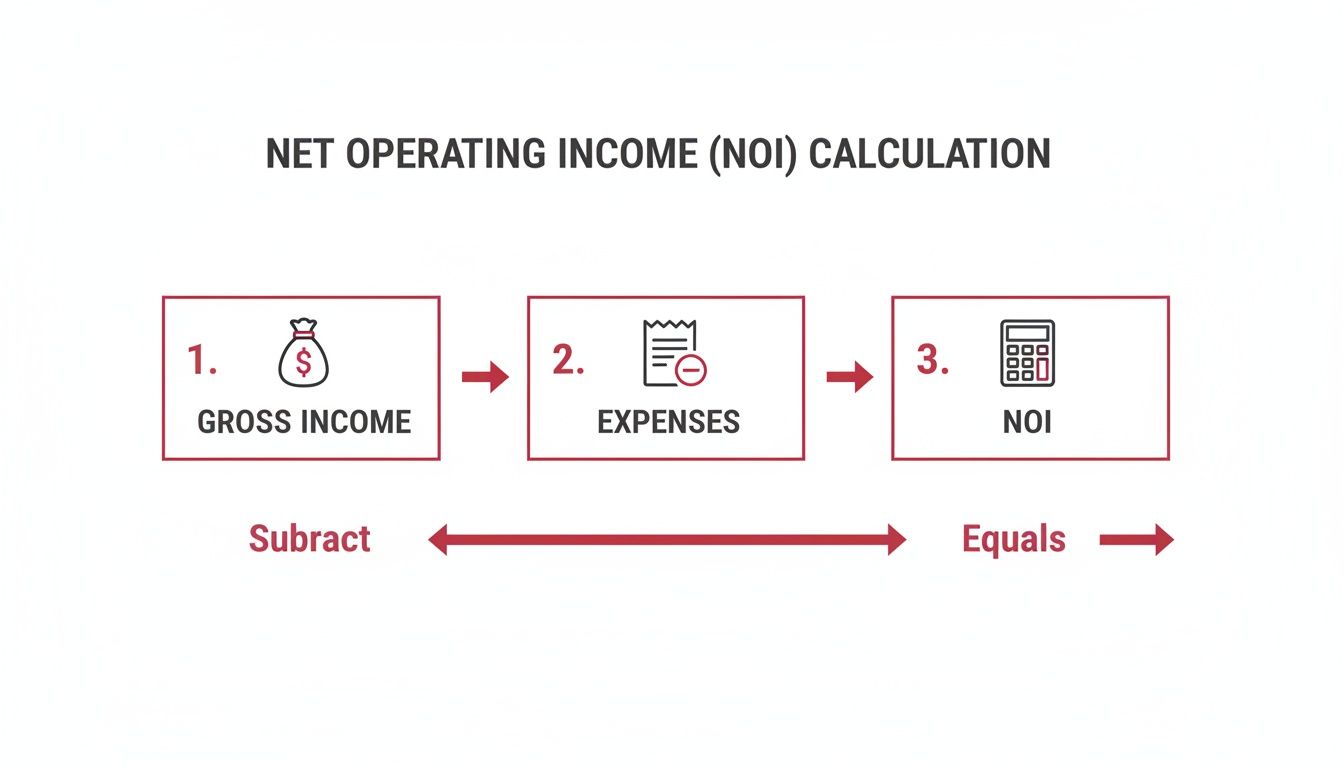
As you can see, NOI is purely a measure of the property's income potential versus its day-to-day operating costs. Financing doesn't enter the picture until after this calculation.
Uncovering Your True Return on Investment
Knowing your annual cash flow is great, but smart investors need to know how hard their money is working for them. The metric that tells you this story is the Cash-on-Cash Return (CoCR). It's the king of performance metrics because it shows the annual return you're getting on the actual cash you pulled out of pocket.
The formula is simple:
Cash-on-Cash Return = Annual Pre-Tax Cash Flow / Total Cash Invested
Your Total Cash Invested isn't just the down payment. It's every dollar you spent to get the deal done: the down payment, all your closing costs, and any upfront repair costs needed to get the property rent-ready.
Sticking with our duplex, let's assume your total cash out-of-pocket was $75,000. With an annual cash flow of $5,604, the math looks like this:
- $5,604 / $75,000 = 0.0747, or a 7.47% Cash-on-Cash Return
This number is so powerful because it lets you compare a real estate deal apples-to-apples with other investments, like putting that same money into the stock market. Many investors I know shoot for a CoCR between 8% and 12%, but the right number for you depends entirely on your market and strategy. When you're ready to run these numbers for your own deals, you’ll see that using dedicated real estate investment analysis tools can make a world of difference in accuracy and speed.
Supporting Metrics for a Complete Picture
While CoCR is the star of the show, a few other metrics give you valuable context and help you quickly screen properties. You should never rely on them alone, but they’re great for getting a quick feel for a deal's potential.
- Capitalization Rate (Cap Rate): Think of this as the property's return if you paid all cash. It’s calculated as NOI / Purchase Price. For our duplex with its $23,604 NOI and a $300,000 purchase price, the cap rate is 7.87%. This is the best way to compare the raw profitability of different properties in the same market, regardless of financing.
- Gross Rent Multiplier (GRM): This is a quick-and-dirty metric. The formula is Purchase Price / Gross Annual Rent. It basically tells you how many years of gross rent it would take to pay off the property. A lower GRM is usually better, but be careful—it ignores every single expense, so it’s only useful for very high-level, initial comparisons.
Taking Your Analysis to the Next Level: Advanced Tips & Common Pitfalls
Alright, you've run the basic numbers and the deal looks promising on paper. This is where many investors stop, but it's also where the most costly mistakes are made. A property that cash flows in a perfect world can quickly turn into a money pit when a water heater bursts or a tenant moves out unexpectedly.
This is where the real work begins. We need to move beyond the optimistic, best-case-scenario spreadsheet and start stress-testing our assumptions. Think of it as a financial fire drill for your potential investment. By anticipating what could go wrong, you can invest with the confidence that your property can handle the inevitable bumps in the road.
Don't Get Blindsided by Capital Expenditures
One of the single biggest mistakes I see new investors make is completely ignoring Capital Expenditures, or CapEx. These aren't your run-of-the-mill repairs like a clogged drain. CapEx refers to the big-ticket items—the major replacements and upgrades that have a long but finite lifespan.
We're talking about things like:
- A new roof
- Replacing the entire HVAC system
- A new water heater
- Updating all the windows
These aren't if expenses; they are when expenses. They are absolutely going to happen, and if you haven't been saving for them, a single surprise bill can instantly erase years of hard-earned cash flow. Ignoring CapEx gives you a dangerously rosy and completely inaccurate view of your property's long-term profitability.
So, how do you account for something that might be years away?
- The Percentage Rule: A solid rule of thumb is to set aside between 5% and 10% of your gross monthly rent specifically for future CapEx. It’s a simple and effective way to build up a reserve.
- The Detailed Approach: For a more precise calculation, estimate the replacement cost and remaining lifespan of each major system. For example, if a new roof costs $10,000 and the current one has about 10 years left, you need to be saving $1,000 a year ($83/month) just for that one item.
Treat your CapEx savings like any other non-negotiable operating expense. Every month, this money should go into a separate, dedicated savings account. This discipline ensures the funds are there when you inevitably need them, shielding your investment—and your sanity—from a sudden financial shock.
How Strong is Your Deal, Really? Time for a Stress Test
Once you have a realistic budget that includes CapEx, it’s time to see how it holds up under pressure. This is called a sensitivity analysis, and it's all about playing out different "what-if" scenarios to find your investment's breaking point.
This is a step that separates seasoned pros like Robbie LaMattina from the rookies. It forces you to move beyond the question "How much can I make?" and start asking the much more important question: "What has to go wrong for this deal to start losing money?"
Here are a few scenarios you should always run:
- A Vacancy Spike: Your initial math might use a conservative 5% vacancy rate. But what happens if the local market softens and that rate jumps to 10% or even 15% for a year? Does the property still break even, or are you suddenly feeding the mortgage from your own pocket?
- The Surprise Repair: How does a sudden $3,000 bill for a main sewer line clog impact your annual return? A truly good deal should be able to absorb that kind of hit without throwing your entire year into the red.
- A Drop in Rent: What if local competition heats up and you're forced to lower your rent by $100 a month to attract a quality tenant? Your analysis will show you exactly how much breathing room you have before the property becomes a liability.
Running these numbers gives you an intimate understanding of your deal’s risk profile. If a minor bump in vacancy turns your cash flow negative, it's a huge red flag that your margins are razor-thin and the investment is likely too risky.
The Most Common (and Costly) Mistakes to Avoid
A thorough cash flow analysis is your single best defense against a bad investment. Still, a few common traps can catch even the most careful investor off guard. Knowing what they are is the first step to sidestepping them entirely.
- Underestimating Expenses: This is, without a doubt, the #1 cash flow killer. New investors are notorious for forgetting to budget for things like pest control, landscaping, snow removal, or the dozens of small repairs that add up over a year. Always, always build a healthy cushion into your expense projections.
- Ignoring Vacancy: Assuming your property will be occupied 100% of the time is pure fantasy. Even the best properties have turnover. Factoring in a vacancy rate of 5-8% is not being pessimistic; it’s being realistic.
- Banking on Appreciation: Appreciation is the icing on the cake, not the cake itself. A deal must make sense based on its cash flow from day one. Relying on the hope of future market growth to justify buying a negative-cash-flow property isn’t investing—it’s speculating.
- Forgetting to Pay Yourself: Even if you plan to manage the property yourself, you must include a property management fee (typically 8-10% of gross rent) in your expense column. Why? It ensures the deal is strong enough to support a professional manager if you ever decide to scale, move, or simply want your time back. Your time is valuable—make sure the property pays for it.
Turning Your Analysis Into Confident Action
So, where do we go from here? After all the number-crunching and forecasting, the real goal is simple: to make a move with total confidence. A proper rental property cash flow analysis isn't just an academic exercise. It's the core skill that separates disciplined investors who build wealth from speculators who just hope for the best. It's how you transform a pile of data into a decisive "yes" or "no."
The best investors I know, like Robbie LaMattina, have a repeatable, data-driven system. Your next move should be to build one for yourself. Whether it's a custom spreadsheet or a modified template, create a standardized tool for your analysis. This forces you to evaluate every single deal using the same strict criteria, taking emotion out of the equation and preventing you from overlooking a critical flaw. Consistency is what builds confidence.
Now for the most important part: practice. Run the numbers on every property you can find, even those you'd never actually buy. The more you do it, the more comfortable you'll get with the calculations and the more you'll learn about what makes your local market tick. This is how you develop the instinct—the muscle memory—to spot a winner almost instantly and pull the trigger when the time is right.
Mastering this process is what gives you control. It’s about building a reliable system that helps you make smart, wealth-building decisions time and time again.
Once you find a deal that pencils out, figuring out how to finance investment properties is your next critical step.
FAQs about Rental Property Cash Flow Analysis
What is rental property cash flow analysis?
Rental property cash flow analysis is the process of evaluating a potential investment property by forecasting all of its potential income and subtracting all of its anticipated operating expenses and financing costs. The goal is to determine the property's profitability, typically measured as monthly or annual net cash flow.
Why is Net Operating Income (NOI) so important?
Net Operating Income (NOI) is crucial because it measures a property's ability to generate profit independent of the investor's financing or tax situation. It's calculated by subtracting all operating expenses from the effective gross income. This allows you to compare the core profitability of different properties on an apples-to-apples basis.
What is a good cash-on-cash return for a rental property?
While it varies by market and investor strategy, a common target for a good cash-on-cash return is between 8% and 12%. In high-appreciation markets, investors might accept a lower return (5-7%), while in markets focused purely on cash flow, they may seek 10% or higher.
How do I accurately estimate repair costs for a rental?
You can use rules of thumb like the 1% Rule (budgeting 1% of the purchase price annually) or the 50% Rule (assuming half of gross income goes to non-mortgage expenses). However, the most accurate method is to get a professional home inspection to identify the age and condition of major systems (roof, HVAC, plumbing) and then create a detailed budget for both routine maintenance and long-term capital expenditures (CapEx).
Should I include a property management fee in my analysis if I plan to self-manage?
Yes, you should always include a property management fee (typically 8-10% of gross rent) in your analysis. This ensures the investment is strong enough to stand on its own, properly compensates you for your time and labor, and confirms the deal would still be profitable if you later decide to hire a professional manager.