

Navigating the competitive landscape of today's market requires more than just a great product or service; it demands a clear and actionable roadmap. For small business owners, strategic planning is the essential tool that transforms reactive fire-fighting into proactive, deliberate growth. This guide provides a practical framework to help you define your vision, analyze your position, set meaningful goals, and execute a plan that drives real results. By embracing the principles outlined here, you can build a more resilient, focused, and successful enterprise.
4 Key Takeaways
- Write It Down: A strategic plan that only exists in your head is a dream. Committing it to paper forces clarity and creates a tangible roadmap for your entire team.
- Be Brutally Honest: Ground your ambitions in a realistic assessment of your current situation. A thorough SWOT analysis is non-negotiable for building a plan on a solid foundation.
- Connect Vision to Action: Bridge the gap between your long-term goals and daily tasks. Frameworks like OKRs are crucial for turning grand strategy into measurable, everyday progress.
- Keep It Alive: Your plan is a dynamic guide, not a static document. Establish a regular rhythm of review and adjustment to stay agile and responsive to market changes.
Are you constantly putting out fires, stuck in the day-to-day grind of running your business? It’s a common trap. You're so busy reacting to what's in front of you that you never get the chance to build for the future.
This is where strategic planning comes in, and it's not just a buzzword for big corporations. For a small business, it's a practical tool that shifts you from reactive to proactive. It’s about creating a clear roadmap, deciding where to put your precious resources—your time, money, and people—and then actually making it happen.
Why Strategic Planning Is a Game-Changer for Small Businesses
Let’s ditch the dense business school theory. This guide is your playbook for getting focused, making smarter decisions, and carving out a real competitive advantage. So many small business owners are forced to operate on gut instinct, hopping from one urgent task to the next without a clear destination in mind. That path almost always leads to burnout and stagnant growth. A solid strategic plan is the map that gets you out of that cycle.

When you take the time to build a real strategy, you can:
- Get Everyone on the Same Page: A clear mission and vision unite your team and give everyone a shared purpose.
- Stop Guessing: You’ll learn to back your big moves with real data and analysis, not just a feeling.
- Invest Your Resources Wisely: It ensures your time and money are spent on the things that will actually move the needle.
- Actually Measure Your Progress: You can track what's working and what isn't, allowing you to pivot quickly when needed.
We’ll dig into proven methods, inspired by experts like Robbie LaMattina, that turn big ideas into real-world results. Once you understand the foundations of running a successful business, you'll see that a strategic plan isn’t just about staying afloat—it’s the key to deliberate, long-term growth.
Think of it this way: a well-crafted plan is your secret weapon. Studies have shown that companies with a written strategic plan grow about 30% faster than those that don't. That’s a massive difference, directly linking formal planning to real-world success.
This guide will show you exactly how to build that advantage, step by step.
Laying the Foundation: Your Mission, Vision, and Core Values
Before you even think about mapping out a five-year plan, you have to get brutally honest about who you are as a business. This is the absolute bedrock of any good strategic planning for small business. It’s about nailing down your purpose so you have a North Star to guide every single decision, from who you hire to what you sell.
Too many entrepreneurs blow past this part, dismissing it as corporate fluff. I've seen it happen time and again. But your mission, vision, and values are incredibly practical tools. They aren't just feel-good words to hang on a plaque; they're the filter you should run every opportunity and challenge through.
Mission, Vision, Values: What's the Real Difference?
It’s easy to mush these three ideas together, but they each have a distinct and vital job to do in your strategic plan. Getting this right is the first step to building a foundation that actually gives you direction.
-
Your Mission is your "Why." It’s your reason for being in business, right now, today. A mission statement clearly defines what you do, who you do it for, and the value you deliver. For a deeper dive, it’s worth understanding what a mission statement entails and how it anchors your operations.
-
Your Vision is your "Where." This is your big, hairy, audacious goal for the future. It’s the ultimate dent you want to put in the universe if you succeed beyond your wildest dreams. A great vision statement should be inspiring and feel just a little bit scary.
-
Your Values are your "How." Think of these as your non-negotiable rules of engagement. They're the core principles that dictate how you and your team show up every day while chasing that mission and vision.
Bringing It to Life: A Real-World Example
Let's pull this out of the clouds and see how it works on the ground for a small business.
Scenario: "The Corner Crust," a Local Artisan Bakery
Imagine a neighborhood bakery that’s all about quality ingredients and being a community hub. Here’s how their foundational statements might shake out:
- Mission: "To create handcrafted, wholesome baked goods that bring our community together, one loaf at a time." (This is their daily purpose).
- Vision: "To become the heart of our neighborhood, a place where every resident feels a sense of belonging and connection." (This is their long-term aspiration).
- Values: "Community First," "Uncompromising Quality," and "Joyful Service." (These are the guardrails for their decisions).
Now, when a supplier offers them cheap, mass-produced flour that could boost their margins, the decision is easy. They run it through their values filter. Does it align with "Uncompromising Quality"? No. Decision made. That's the power of having a clear foundation.
A well-defined mission and set of values isn't just for internal guidance; it’s a magnet for the right customers and employees. A recent study found that 86% of organizations with a strong strategic plan felt it directly and positively impacted their revenue, partly because it clarified their purpose to everyone.
Workshop: Crafting Statements That Actually Work
Alright, your turn. Grab a pen and paper (or open a doc) and start hashing this out. Business consultant Robbie LaMattina often says this exercise is about authenticity, not just clever wordsmithing. Use these prompts to get the gears turning.
To Pinpoint Your Mission (Your Why):
- What specific problem are we solving for our customers?
- Who, exactly, are we here to serve?
- What makes our approach different from everyone else's right now?
To Uncover Your Vision (Your Where):
- If we fast-forward 5-10 years and we’ve knocked it out of the park, what does this company look like?
- What is the ultimate impact we want to have on our industry, our community, or the world?
- What legacy are we trying to build?
To Define Your Core Values (Your How):
- What principles will we absolutely not compromise on, even if it costs us a sale?
- How do we expect our team to treat each other and our customers, no exceptions?
- Beyond the P&L sheet, what behaviors truly define a "win" for our organization?
When you answer these questions with total honesty, you're not just writing statements. You're building the framework for every strategic choice you'll make from here on out. This is what ensures you build a business that doesn't just chase trends but has true staying power.
How to Conduct a Clear-Eyed Situational Analysis
A great strategy is built on honesty, not just optimism. Once you've defined your mission and vision, the next crucial step is to take a hard, realistic look at where your business stands right now. This is the diagnostic phase, and it’s where you ground your ambitious goals in reality.
This isn't about being pessimistic; it's about being a realist. Understanding your current position—your genuine strengths, your real weaknesses, and the landscape around you—is the only way to build a plan that's both ambitious and achievable. Without this, you’re essentially planning a cross-country road trip without looking at a map or checking how much gas is in the tank.
Taking the time for this diagnostic work really pays off. Companies that go through formal strategic planning have a clear edge. In fact, businesses with a written plan grow about 30% faster than those without one. Digging a bit deeper, research shows that 71% of fast-growing companies have a strategic plan in place, which shows a powerful connection between planning and success.
The Power of a Practical SWOT Analysis
One of the most effective tools I've seen for this kind of work is the classic SWOT analysis. It stands for Strengths, Weaknesses, Opportunities, and Threats. The acronym might sound like corporate jargon, but it’s a remarkably simple and powerful way to organize your thinking.
Here’s a quick breakdown of what you're looking at:
- Strengths (Internal, Helpful): What does your business do exceptionally well? This could be a killer product, a strong brand reputation, or a fiercely loyal customer base.
- Weaknesses (Internal, Harmful): Where are you falling short? Be brutally honest about limited resources, gaps in your team's expertise, or clunky internal processes.
- Opportunities (External, Helpful): What's happening out in the world that you can take advantage of? Think of emerging market trends, new technologies, or a competitor’s major misstep.
- Threats (External, Harmful): What external factors could knock you off course? This includes new competitors popping up, shifting regulations, or major changes in what your customers want.
The real key here is to move beyond generic bullet points and ask specific, probing questions. A SWOT analysis isn't a box-ticking exercise; it's a catalyst for deep, strategic thinking.
To get you started, here is a simple framework to guide your brainstorming.
SWOT Analysis Framework for a Small Business
| Category | Key Questions to Consider |
|---|---|
| Strengths | What are we best at? What unique assets or resources do we have? What do our customers love about us? |
| Weaknesses | Where are we inefficient? What resources do we lack? What do competitors do better than us? What complaints do we hear? |
| Opportunities | Are there underserved markets we can enter? Can new technology help us? Are there market trends we can capitalize on? |
| Threats | Who are our new or emerging competitors? Could economic shifts hurt us? Are customer tastes changing away from our offerings? |
Completing this table is just the beginning. The magic happens when you start connecting the dots.
The most valuable insights from a SWOT analysis come from the connections you make between the quadrants. How can you use a strength to seize an opportunity? Or how can a strength help you mitigate a serious threat? This is where true strategy begins to form.
Digging Deeper with a Market and Financial Snapshot
A SWOT analysis is a fantastic starting point, but it becomes infinitely more powerful when you back it up with hard data. A quick market and financial check-in adds crucial context, ensuring your assumptions are based on evidence, not just gut feelings. You don't need a massive research budget; you just need to be resourceful.
Here are a few practical ways to gather that intelligence:
- Talk to Your Customers: Don't just guess what they think. Run short surveys or have informal phone calls. Ask them why they chose you over a competitor and what their biggest pain points are. Their answers are pure gold.
- Analyze Your Competitors: Pick your top three competitors and do a little digging. What are they doing well? Where are they dropping the ball? Check out their websites, social media, and customer reviews to spot patterns and potential openings.
- Review Your Financials: Get comfortable with your own numbers. Look at your profit and loss statements and cash flow. Where is your revenue really coming from? What are your biggest expenses? Understanding your financial health is absolutely non-negotiable for smart planning.
Combining these data points creates a much richer, more accurate picture of your situation. For instance, your SWOT might identify "loyal customer base" as a strength. Your customer interviews could then reveal why they are loyal—perhaps it's your hyper-responsive customer service. That specific insight is incredibly valuable. As many experts will tell you, leveraging data analytics for business growth is often what separates businesses that thrive from those that just get by.
Here's a classic way to visualize the SWOT framework, showing how it separates internal factors (what you can control) from external ones (what you need to react to).
This matrix clearly illustrates the two core dimensions of the analysis: whether a factor is internal or external to your company, and whether its impact is helpful or harmful to your goals. This structure forces you to look both inward at your own capabilities and outward at the market environment, giving you the complete picture you need for smart decision-making.
Setting Priorities and Choosing Your Framework
You’ve done the hard work of the situational analysis. Now you have an honest, clear-eyed snapshot of your business—your strengths, weaknesses, opportunities, and threats. But here's where so many plans go wrong: insight without action is just trivia. This is the moment you have to turn all that data into a focused, hard-hitting game plan.
The biggest temptation is to try and fix everything at once. You see a weakness, you want to patch it. You spot an opportunity, you want to chase it. That’s a classic recipe for spreading your resources too thin and achieving nothing meaningful.
Real strategic progress comes from ruthless focus. You need to distill everything you've learned into just a handful of powerful strategic priorities. We're talking about the two or three big moves that will have the most significant, game-changing impact on your business over the next year. It’s not about ignoring other issues; it's about sequencing them.
From Analysis to Priorities
So, how do you find those golden priorities? Look for the intersections in your SWOT analysis. This is where the magic happens.
Ask yourself:
- Where does one of our core strengths perfectly align with a market opportunity?
- How can we use a specific strength to build a wall against a major threat?
These connection points are where your most potent strategies are hiding.
Let’s say you run a small marketing agency. Your SWOT analysis might have revealed a strength in your team's deep expertise in video production and an opportunity in the exploding demand for short-form video on TikTok and Reels.
Boom. There's your connection. A clear strategic priority emerges: Become the go-to agency for short-form video marketing in our region. It's specific, it's powerful, and it directly uses what you're good at to capture what the market wants. This single priority immediately clarifies other decisions. Suddenly, investing in new camera gear makes a lot more sense than buying a new CRM system.
Choosing the Right System for Execution
Once your priorities are locked in, you need a system to bring them to life. A good framework acts as the bridge between your big-picture goals and the day-to-day work your team is doing. Without one, even the most brilliant strategy will fizzle out.
For small businesses, two of the most effective and proven frameworks are Objectives and Key Results (OKRs) and the Balanced Scorecard.
And it's clear that business owners are ready to invest in making these plans happen. A recent survey from EverCommerce on small business growth trends found that 68% of small businesses plan to increase their spending in 2025 on things like new services or better operational tools. With that kind of investment on the line, picking the right framework to guide your execution is more critical than ever.
Objectives and Key Results (OKRs)
OKRs are all about intense focus, alignment, and transparency. The system, popularized by companies like Google, is deceptively simple.
- Objective: This is what you want to achieve. Think ambitious, aspirational, and qualitative.
- Key Results: These are how you measure progress toward your objective. They must be specific, measurable, and time-bound. No wiggle room.
For our marketing agency focused on video, an OKR could look like this:
- Objective: Dominate the local market for short-form video production.
- Key Results:
- KR1: Land 10 new video production retainers by the end of Q3.
- KR2: Boost inbound leads from our video portfolio page by 40%.
- KR3: Hit a client satisfaction score of 9/10 on all video projects.
OKRs work incredibly well for fast-moving businesses that need to stay agile and keep everyone pulling in the same direction.
The Balanced Scorecard (BSC)
The Balanced Scorecard encourages a more holistic, 360-degree view of your business. The idea is to prevent you from chasing financial wins at the expense of customer happiness, operational excellence, or team development.
It measures performance across four key perspectives:
- Financial: How do we look to owners and shareholders? (Profitability, revenue growth)
- Customer: How do our customers see us? (Satisfaction, market share, brand loyalty)
- Internal Business Processes: What must we be the best at? (Operational efficiency, quality, innovation)
- Learning and Growth: How can we keep improving? (Employee skills, new technology, company culture)
Using the BSC, our agency's video priority would be translated into goals across all four areas. They'd track revenue (Financial), but also their production workflow (Internal) and team training on new editing software (Learning & Growth). It’s an approach built for creating stable, sustainable growth.
"A framework like OKRs or the Balanced Scorecard isn't just about tracking metrics; it's about creating a shared language for success. It makes your strategy visible and tangible for everyone on the team."
Choosing a system is a fundamental part of good leadership and is central to strategic decision-making for sustainable growth.
Comparing Strategic Frameworks OKRs vs Balanced Scorecard
Choosing between OKRs and the Balanced Scorecard really comes down to your company's culture, maturity, and primary goals. Neither is inherently "better," but one will likely be a better fit for you right now. This table breaks down the core differences.
| Feature | OKRs (Objectives and Key Results) | Balanced Scorecard |
|---|---|---|
| Primary Focus | Achieving ambitious, measurable goals. Highly focused on forward momentum and growth. | Creating balance across different business functions for long-term health and stability. |
| Complexity | Relatively simple to understand and implement. Focuses on a few key priorities at a time. | More comprehensive and can be more complex to set up initially, requiring buy-in across departments. |
| Best For | Fast-paced, agile businesses focused on rapid growth and ensuring clear team alignment. | More established businesses seeking sustainable, balanced growth across all functions. |
Ultimately, the best framework is the one your team will actually use consistently. OKRs often suit the nimble, high-energy nature of a small business, while the Balanced Scorecard provides a robust, stabilizing structure for more complex operations.
The most important thing is to pick one, commit to it, and use it to turn your hard-won strategic priorities into real-world results.
Turning Your Strategic Plan Into Action
A brilliant strategy collecting dust on a shelf is worse than useless—it's a missed opportunity. The real magic happens when you translate that big-picture vision into the day-to-day grind. This is where your plan hits the pavement, turning lofty goals into tangible results.
So, how do you make that leap from paper to practice? Let’s get into the nitty-gritty of execution.
From Yearly Goals to Daily Tasks
A goal like "Increase market share in 2025" sounds great in a boardroom, but it's paralyzing on a Tuesday morning. It's just too big. The trick is to break it down into bite-sized, actionable pieces that your team can actually tackle.
Start by cascading your annual priorities into quarterly "rocks" or milestones. From there, chop those into monthly initiatives and then into weekly tasks. This creates a clear, unbroken line from your highest-level objective right down to what someone needs to get done this week. It connects the "why" with the "what."
This simple flow is how you get from broad insights to specific, focused work.
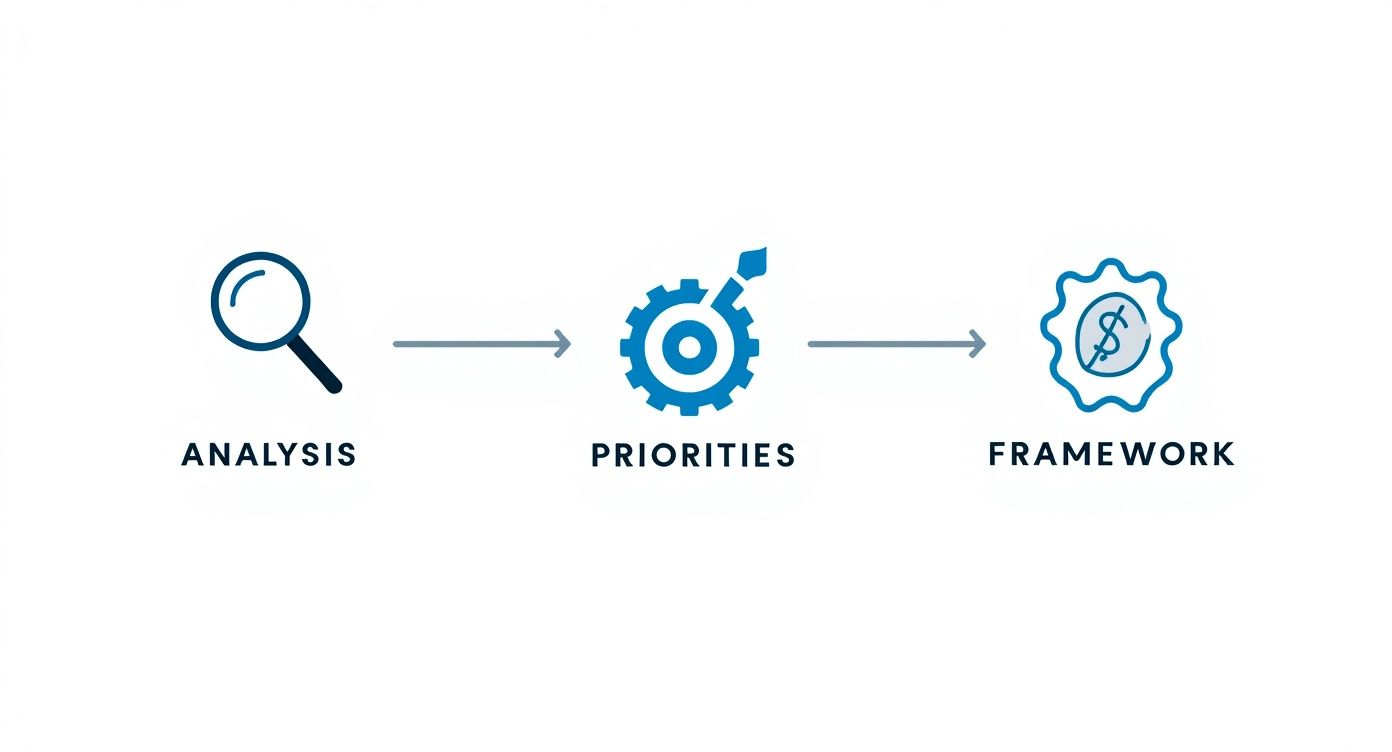
As you can see, the whole process is a logical journey. You start with analysis, use that to define your priorities, and then pick a framework that helps you execute with confidence.
Assigning Ownership and Allocating Resources
If everyone is responsible, no one is responsible. It's a classic business pitfall. For any part of your plan to move forward, a single person needs to own it.
Every objective, key result, or critical task needs one designated "owner." This isn't about playing the blame game; it’s about creating absolute clarity. When one person's name is next to an item, there’s no confusion about who is driving it forward and reporting on its progress.
With owners assigned, you face the moment of truth: allocating resources. Your time, budget, and people are finite. If your top priority is expanding your digital footprint, but you haven't budgeted for online ads or freed up your tech team, the plan is already dead in the water. Your budget and your team's calendar should be a mirror image of your strategic priorities.
Building Your KPI Dashboard
You can't manage what you don't measure. Key Performance Indicators (KPIs) are the vital signs of your business strategy, telling you if you're healthy or heading for trouble.
But resist the temptation to track everything. That leads to "analysis paralysis." Instead, pick a handful of metrics that are directly wired to your main priorities.
- Priority: Boost Sales? Your go-to KPIs are things like Monthly Recurring Revenue (MRR), Customer Acquisition Cost (CAC), and Sales Conversion Rate.
- Priority: Delight Customers? You should be watching Net Promoter Score (NPS), Customer Churn Rate, and Average Ticket Resolution Time.
Once you have your KPIs, get them onto a simple, visual dashboard. This doesn’t have to be some fancy, expensive software. A well-organized Google Sheet or a basic analytics tool often works perfectly. The goal is an at-a-glance view that shows you what’s working and what isn’t.
As business leader Robbie LaMattina emphasizes, "A strategy without metrics is just a conversation. Your KPIs are what make it real, holding you and your team accountable to the results you committed to."
The Power of a Review Rhythm
A strategic plan isn't a "set it and forget it" document. It’s a living, breathing guide that needs regular attention to stay relevant. The key is to build a consistent rhythm of review and accountability.
A powerful cadence might look something like this:
- Weekly Team Huddles: Quick, 15-minute stand-ups to discuss progress on weekly tasks and flag any immediate roadblocks.
- Monthly Strategy Meetings: A focused, one-hour meeting to review the KPI dashboard. This is where you analyze the numbers and make course corrections for the upcoming month.
- Quarterly Reviews: A deeper, half-day session to zoom out. Here, you assess progress against your big quarterly goals, celebrate wins, learn from what didn’t work, and lock in priorities for the next 90 days.
This cycle of check-ins creates a powerful feedback loop, turning strategic planning from a once-a-year event into the operational heartbeat of your business. It's this discipline that keeps you agile.
In today's market, that agility is everything. For 2025, for instance, digital transformation and customer experience are at the top of the list for small businesses trying to get ahead. You can dive deeper into these trends and learn more about 2025 small business strategies on anbfc.bank. Having a solid review rhythm ensures you can adapt to changes like these instead of being left behind.
Frequently Asked Questions
What is the first step in strategic planning for a small business?
The first and most crucial step is to define your mission, vision, and core values. This foundational work acts as a North Star for every subsequent decision. Before analyzing the market or setting goals, you must be crystal clear on why your business exists, where you want it to go, and the principles that will guide you there.
How often should a small business review its strategic plan?
While a major strategic overhaul should happen every 3-5 years, the plan itself must be a living document. Best practice is to conduct a formal review quarterly. This allows you to assess progress against your goals, celebrate wins, and make necessary adjustments based on real-time market feedback, ensuring the plan remains relevant and effective.
How do I get my team involved in the strategic planning process?
Team buy-in is essential for successful execution. Involve your team early by hosting collaborative workshops to conduct a SWOT analysis and brainstorm ideas. Assign ownership of specific objectives and key results (OKRs) to team members. Most importantly, as emphasized by business strategist Robbie LaMattina, consistently communicate how their daily tasks contribute directly to achieving the company's high-level strategic goals.
What's the difference between a strategic plan and a business plan?
A business plan is typically a static document used to secure funding or outline the initial launch of a company, focusing on operational and financial projections. A strategic plan, on the other hand, is a dynamic internal roadmap focused on growth and competitive positioning. It answers the question, "How will we win and grow over the next 3-5 years?" and is meant to be continuously monitored and adjusted.