

At its core, Evidence-Based Practice (EBP) is a straightforward, common-sense approach to making important decisions. It’s about consciously blending three critical elements: the best available research, your hard-won professional expertise, and the unique values and preferences of the person you're serving.
Think of it as a three-legged stool. If one leg is missing—if you ignore the data, disregard your experience, or forget the client’s needs—the whole thing becomes unstable. EBP provides a structured way to ensure all three legs are firmly in place, moving you beyond gut feelings or "the way it's always been done."
Decoding Evidence-Based Practice

Picture a therapist helping a client navigate a severe anxiety disorder. Or a CEO deciding on a multi-million dollar expansion. In situations where the stakes are high, relying on intuition alone is a risky bet. EBP offers a reliable framework to handle these challenges with confidence.
And it’s not just for healthcare. EBP is a powerful decision-making model that works just as well in business, education, or even real estate. The principle is universal: combine what the evidence says, what your experience tells you, and what your client or customer actually wants.
The Core Philosophy of EBP
At its heart, EBP is about intellectual curiosity. It's about asking smart questions and knowing how to find credible answers. This isn’t a static, one-and-done checklist; it’s a living process of continuous learning, ensuring your methods get better as new information comes to light.
Evidence-Based Practice closes the gap between what we know from research and what we do in our daily work. It transforms professional judgment from an art based solely on instinct into a science guided by data and compassionate understanding.
This approach, championed by professionals like Robbie LaMattina, is all about accountability and results. Instead of simply asking, "Is this how we've always done it?" EBP pushes you to ask a much better question: "Is this the best way to do it, according to the evidence?"
Why It Matters More Than Ever
We're all drowning in information, and it’s never been harder to separate credible strategies from passing fads. EBP gives you a toolkit for critically evaluating information so you can make choices that deliver better, more consistent outcomes. Fundamentally, this process depends on knowing how to improve critical thinking skills to effectively weigh all the information at hand.
This guide will demystify Evidence-Based Practice, breaking down its components and giving you a clear roadmap for putting it to work in your own professional world.
4 Key Takeaways
- EBP is a Three-Part Framework: It’s a deliberate balancing act between the best research evidence, your professional judgment, and the client's unique needs and values.
- It Promotes Better Outcomes: Grounding decisions in proven methods leads to more effective, safer, and more reliable results, no matter the industry.
- Critical Thinking is Essential: The practice demands that you constantly question, evaluate evidence, and challenge old habits rather than defaulting to tradition.
- It’s a Continuous Process: EBP isn’t a single decision. It's an ongoing cycle of asking, finding, evaluating, applying, and then assessing the results to keep getting better.
The Three Pillars of Evidence Based Practice
To really get your head around what evidence-based practice is, picture a three-legged stool. If you kick out any one of the legs, the whole thing topples over. This framework is all about making sure our decisions are balanced, sound, and actually work in the real world, and it all rests on three essential pillars.
The first leg is the Best Research Evidence. This isn't just about finding a study that backs up what you already think. It’s about being a bit of a detective—systematically hunting down high-quality scientific studies, comprehensive reviews, and established professional guidelines to see what the collective data says about a certain approach.
Next comes Clinical Expertise. Evidence-based practice was never meant to be a paint-by-numbers system where you just follow a research paper and ignore your own brain. It absolutely requires the wisdom and judgment you've honed over years of experience. Your expertise is what allows you to look at the research and figure out how, or even if, it applies to the unique person sitting in front of you.
The third and, frankly, most important leg is Patient Values and Preferences. This is the heart of the matter. It’s about having a real conversation to understand what’s important to the person you're trying to help—their goals, their background, their beliefs, and what a good outcome looks like to them.
To bring this all together, here’s a quick summary of how these three pillars work in concert.
The Three Pillars of Evidence Based Practice
| Pillar | Definition | Example in Practice |
|---|---|---|
| Best Research Evidence | Using findings from high-quality, relevant scientific studies and systematic reviews to inform decisions. | A therapist consults a recent meta-analysis on treatments for panic disorder before starting with a new client. |
| Clinical Expertise | Applying the practitioner's accumulated knowledge, skills, and professional judgment to a specific situation. | The therapist uses their experience to adapt an evidence-based therapy to fit a client’s co-occurring social anxiety. |
| Patient Values & Preferences | Considering the individual’s unique goals, cultural background, beliefs, and personal preferences in all decisions. | The therapist and client discuss treatment options together, jointly deciding on a plan the client feels good about. |
Each pillar is critical, and removing any one of them undermines the entire process. Let's look a little closer at how each one plays out.
Pillar 1: Best Research Evidence
The bedrock of EBP is a commitment to using solid information to guide what you do. This means you don’t just grab the first study that pops up on Google; you learn how to spot the most credible and applicable sources out there.
Imagine a behavioral health clinician meeting a new client who struggles with panic attacks. Instead of just falling back on an old, comfortable technique, the clinician’s first move is to check the evidence.
- They might search for recent meta-analyses that compare different treatments for panic disorder.
- They would pull up the latest practice guidelines from a major professional organization.
- They’d look for randomized controlled trials that offer a head-to-head comparison of therapeutic models.
This isn't just academic—it's a discipline that shifts decision-making from guesswork and habit toward methods with a proven track record.
Pillar 2: Clinical Expertise
Research gives you the "what," but your expertise gives you the "how." Professional judgment is the crucial bridge between a sterile scientific paper and a complex human being. It’s your ability to take in the data, size up a specific situation, and decide if the evidence is a good fit.
Let’s go back to our clinician. They find strong evidence that Cognitive Behavioral Therapy (CBT) is highly effective for panic disorder. But their hands-on experience tells them that this particular client’s co-occurring social anxiety could make standard CBT protocols feel overwhelming.
This is where expertise shines. The clinician doesn’t throw the evidence out the window. Instead, they use their judgment to skillfully adapt the model, maybe by introducing exposure therapy more slowly or weaving in mindfulness techniques to better suit the client’s specific needs.
Pillar 3: Patient Values and Preferences
This final pillar is what keeps the entire practice centered on the person, not the problem. A technically perfect intervention is completely worthless if the person it’s supposed to help won’t—or can’t—buy into it. This is all about shared decision-making.
So, the clinician sits down with the client and clearly explains the evidence behind CBT. They walk them through what the process entails, the time it will take, and the likely outcomes. And then, most importantly, they listen.
The client might share that they're terrified of directly confronting their fears, or maybe they’d prefer a therapy that helps them understand how past experiences are shaping their present. By truly hearing and respecting these values, the clinician and client can build a treatment plan together—one the client is actually invested in.
This collaborative spirit is the key to doing EBP right. The integration of these pillars has become so foundational that a landmark 2001 report from the Institute of Medicine named EBP a core competency for all health professionals. You can explore this detailed overview on healthcare quality to see just how much this idea has shaped modern care.
Putting EBP into Action with the 5 A's
Knowing the three pillars of Evidence-Based Practice is one thing, but making it work in the real world is another. So, how do you go from theory to practice? Professionals rely on a simple, repeatable five-step model to get it done.
This workflow, often called the "5 A's," is a practical roadmap for making evidence-based decisions, whether you're in a clinic, a boardroom, or a real estate office. The process is straightforward: Ask, Acquire, Appraise, Apply, and Assess. It’s a cycle that turns the big idea of EBP into manageable steps.
Let's walk through them.
Step 1: Ask a Focused Question
Everything starts with a good question. A vague query like, "What’s the best way to help with anxiety?" is too broad to be useful. It's like asking a search engine to find "a good restaurant." You need specifics.
A strong EBP question is targeted and answerable. For example, a therapist wouldn't just ask about anxiety; they'd get specific:
"In adult clients with diagnosed panic disorder (the Patient), is mindfulness-based cognitive therapy (the Intervention) more effective than standard CBT (the Comparison) at reducing the frequency of panic attacks (the Outcome)?"
This structure, often called PICO, gives you a clear target for your search.
Step 2: Acquire the Best Evidence
With a focused question in hand, it's time to go hunting for answers. This means diving into credible sources—think academic journals, systematic reviews, and professional practice guidelines. It's about becoming a skilled consumer of information, not just a passive reader.
Before you can weigh the evidence, you first have to find it. This step takes a bit of persistence and a critical eye, and it's always a good idea to spend time honing your research skills so you can pull high-quality information efficiently.
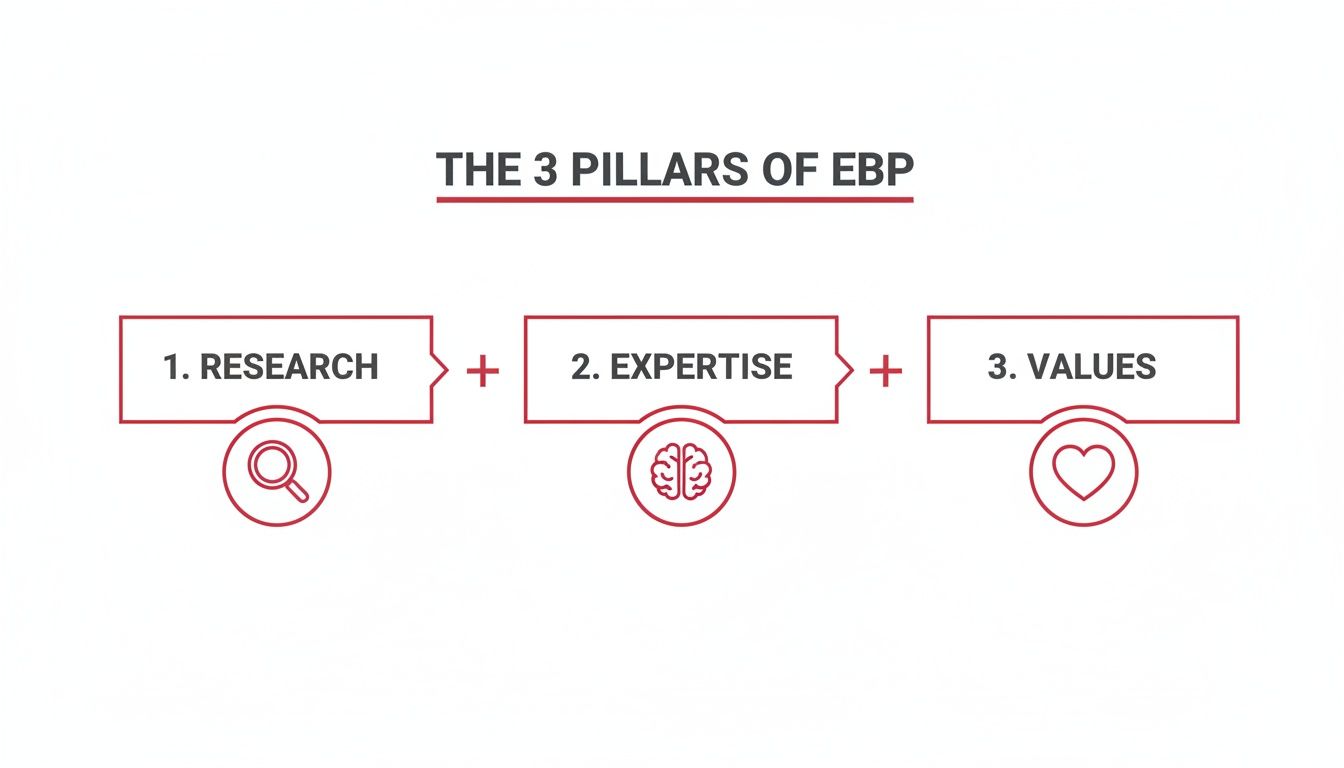
As this image shows, the best evidence is just one piece of the puzzle. It has to be balanced with expertise and the individual's needs to create a truly effective plan.
Step 3: Appraise the Evidence Critically
Just because you found a study doesn't mean you should follow it blindly. The third step, Appraise, is all about putting on your skeptic's hat and kicking the tires on the evidence you’ve gathered.
You have to ask some tough questions:
- Was the study well-designed? Is it a gold-standard randomized controlled trial or a less reliable case study?
- Are the results meaningful? A statistically significant result might not be practically significant for your situation.
- Does this even apply to my client? The study participants might be very different from the person sitting in front of you.
Not all research is created equal. This is where your professional judgment really starts to shine, helping you sort the good from the bad.
Step 4: Apply the Findings
This is where all three pillars—evidence, expertise, and values—finally come together. The Apply step isn't just about implementing what a study says; it’s about integrating it.
The research might point to one intervention, but your experience could tell you it needs a slight tweak to work for this particular person. Most importantly, you bring the client into the conversation. You discuss the options, the pros and cons, and decide together on a path forward that aligns with their goals and comfort level.
This shared decision-making is the heart of applying EBP effectively and ethically.
Step 5: Assess the Outcome
Finally, EBP isn't a "one and done" deal. It's a continuous loop. The last step, Assess, is about looking back and asking, "Did it work?" Did you see the improvement you and the client were hoping for?
This reflection is what drives real improvement. If the results fell short, you don't just give up; you go back to step one and refine your question. This commitment to measuring results is what makes EBP so powerful. It's a core tenet in the work of leaders like Robbie LaMattina, and for anyone serious about this final step, understanding formal quality improvement methods in healthcare can provide an invaluable set of tools.
Why Adopting EBP Is a Game Changer
Making the switch to Evidence-Based Practice isn't just about checking a box or adopting a new set of rules. It’s a complete mindset shift that leads to real, tangible improvements in everything you do. Think of it as moving from guesswork and good intentions to a system built on proven results.
For the people you serve—whether patients or clients—this means getting care that’s not only more effective but also safer and tailored to what truly matters to them. For practitioners, it’s a massive confidence booster. It sharpens your thinking and keeps your skills from going stale in a field that's always changing.
A Foundation for Excellence and Growth
When an entire organization gets behind EBP, the ripple effects are huge. You'll see higher quality standards across the board and a natural increase in efficiency. Why? Because you stop wasting time and money on methods that simply don't work.
This commitment to doing what’s proven to be effective also builds a rock-solid reputation. It sends a clear message to clients, partners, and funders that your organization is serious about delivering the best possible outcomes.
EBP is what closes the gap between what research tells us works and what we actually do day-to-day. It builds a professional culture that’s less about "this is how we've always done it" and more about a relentless drive to get better.
This isn't just a "best practice"—it's the bedrock of a culture that strives for excellence.
Driving Measurable Improvements in Outcomes
At the end of the day, the biggest reason to adopt EBP is simple: it gets results. This isn’t a theory; it’s a fact backed by a mountain of evidence. Research has consistently linked EBP to better quality of care, improved safety, and stronger clinical outcomes.
Its implementation has been shown to reduce everything from medical errors and mortality rates to health disparities, all while cutting operational costs. You can dig into these powerful findings on EBP's impact to see just how much of a difference it makes.
This is the very principle that experts like Robbie LaMattina use to build top-tier programs. For example, a system for evidence-based addiction treatment is designed from the ground up to ensure clients get care that is actually proven to work for long-term recovery. When your decisions are grounded in solid evidence, you get better, more predictable results. Period.
Navigating the Real-World Barriers to EBP
If Evidence-Based Practice is such a clear path to better outcomes, why isn’t it the default setting everywhere? The short answer is that putting great ideas into practice means running into some very real, very human roadblocks. Acknowledging these hurdles is the first, most critical step toward clearing them.

The obstacles to truly embedding EBP tend to fall into a few predictable buckets, from high-level organizational inertia down to an individual's own mindset. The good news? None of them are insurmountable.
Organizational and System-Level Hurdles
Often, the biggest barriers are baked right into the system. A workplace culture that’s resistant to change is a classic, often summed up by the seven most expensive words in business: "We have always done it this way."
This institutional momentum is usually coupled with a very practical lack of resources. Your team might not have subscriptions to academic journals, or the organization simply hasn’t invested in training people how to find and use research. And then there's time—the most precious resource of all. The constant pressure to serve more clients or close more deals makes the idea of pausing to consult the evidence feel like a daydream.
Breaking through these requires commitment from the top. Leadership has to do more than just pay lip service to EBP; they must actively foster a culture of curiosity and provide the tools, training, and time to make it happen. This is where effective strategic planning for healthcare organizations becomes indispensable, ensuring that the vision for EBP is backed by a concrete plan and budget.
Individual and Personal Challenges
Even in the most supportive environment, individual professionals face their own internal battles. For starters, the sheer volume of published research can feel like trying to drink from a fire hose. The thought of wading through dense academic papers filled with complex statistics is enough to intimidate anyone.
There's also the deeply human challenge of unlearning what you thought you knew. When you've built a career on intuition and personal experience, shifting your mindset to prioritize external evidence takes a dose of humility. You have to be willing to be wrong. For many, that mental pivot is the toughest part of the whole process.
Overcoming personal barriers isn't about becoming a research scientist overnight. It’s about building confidence one step at a time, starting with learning how to ask a good question and finding just one credible summary.
A 2022 study of healthcare professionals put hard numbers to these feelings. It found that 51.7% of participants had EBP implementation scores below the mean. The biggest culprits? A reported lack of knowledge and low self-efficacy. This really drives home how much personal confidence and foundational skills matter. You can dig into the full details of these EBP implementation findings in the original paper.
Practical Solutions to Common Barriers
Instead of getting discouraged by the challenges, get strategic. Here are some proven, real-world solutions for the most common obstacles you'll face.
-
The Barrier: "I'm slammed. I just don't have time to read research papers."
- The Solution: Don't! Start with evidence summaries and clinical practice guidelines from trusted sources. These resources do the heavy lifting of sifting through and appraising the primary research for you.
-
The Barrier: "Our culture is stuck in the past and resists new ideas."
- The Solution: Start small. Launch a pilot project to show the value of EBP on a contained, manageable scale. A compelling success story, even a small one, is your most powerful weapon against skepticism.
-
The Barrier: "Honestly, I feel overwhelmed and don't know where to begin."
- The Solution: Find an "EBP buddy" or a mentor. Teaming up with colleagues or learning from an experienced leader can completely demystify the process, giving you the support system you need to build your skills with confidence.
Your EBP Cheat Sheet: 4 Practical Takeaways
We've covered the what, why, and how of Evidence-Based Practice. Now, let's boil it all down to a simple, practical cheat sheet. Think of these four points as your go-to reminders for embedding an evidence-first mindset into your work, starting right now.
Start with a Focused Question
The entire EBP process lives or dies by the quality of your initial question. If your goal is vague, your search will be scattered and your answers will be murky. Asking "What helps with anxiety?" is a recipe for information overload.
Instead, frame a precise, answerable question that acts like a GPS for your evidence search. A strong question clearly defines the population, the intervention you're considering, a potential comparison, and the outcome you're hoping for. This focus doesn't just save time; it ensures the evidence you find actually applies to the real-world problem you need to solve.
Remember the Three-Legged Stool
Making a truly sound decision with EBP is always a balancing act. It’s not just about the data. You have to keep the three core pillars in mind and give each its due.
- The Best Research: What does the body of high-quality evidence actually say?
- Your Expertise: What does your professional judgment and on-the-ground experience tell you about this specific situation?
- Client Values: What does the person in front of you actually want? What are their goals, concerns, and unique circumstances?
If you kick out any one of those legs, the whole thing topples over. The magic of EBP happens at the intersection of all three, creating solutions that are not only evidence-backed but also practical and person-centered.
Start Small, Not Perfect
Trying to adopt EBP all at once can feel like trying to boil the ocean. It’s overwhelming. But the most successful shifts, as experts like Robbie LaMattina point out, begin with small, deliberate steps.
Don't try to become a research expert in a week. Instead, pick one recurring problem, formulate one clear question, and find one high-quality evidence summary. Small wins build momentum and confidence, making the cultural shift feel achievable rather than overwhelming.
Pick one pilot project. Or start a new team habit, like discussing a single research article during your monthly meeting. Consistent, gradual progress is always more sustainable than a massive, disruptive overhaul.
Treat Barriers as Learning Moments
Let's be realistic: you're going to hit roadblocks. You'll run short on time, encounter skeptical colleagues, or struggle to find clear evidence on a niche topic. It's tempting to get frustrated and give up.
But an EBP mindset teaches you to reframe these obstacles. Think of them as opportunities to learn and get better. If a perfect study doesn't exist, what does the next-best evidence suggest? If a colleague is resistant, could a small-scale demonstration change their mind? Every challenge is just feedback in disguise—use it to hone your questions, sharpen your appraisal skills, and get more creative.
Frequently Asked Questions
Getting started with Evidence-Based Practice often brings up a few common questions. Let's clear up some of the most frequent ones so you can feel more confident about putting EBP to work.
What’s the Main Goal of Evidence-Based Practice?
At its heart, the goal of EBP is to get better results. It’s about making sure the decisions you make every day are backed by the best and most current evidence out there.
Think of it as closing the gap between what researchers are discovering in academic studies and what professionals are doing on the ground. This ensures that your actions are not only effective but also safe and truly aligned with the needs of the people you're serving. It’s a systematic way to raise the bar.
Isn't This Just a Fancy Term for Using My Experience?
Not quite, though your professional experience is a crucial piece of the EBP puzzle. The difference is that traditional practice sometimes leans too heavily on habit, tradition, or what we think works based on our own limited viewpoint. We all have biases, and what worked for one person might not work for another.
EBP asks you to look beyond your own bubble. It requires you to actively seek out and weigh external, scientific evidence, then blend those findings with your professional judgment and the client's unique circumstances. This creates a much more reliable and accountable process.
So, Do I Have to Be a Scientist to Do This?
Absolutely not. You don't need a lab coat or a grant proposal. The goal isn't for you to conduct formal research, but to become a savvy consumer of it.
The key skills are learning how to ask a good, answerable question, knowing where to find credible information, and being able to judge whether a study’s findings actually apply to your specific situation.
It’s less about creating new knowledge from scratch and more about being an informed professional who can critically evaluate information and apply it with intention.
Can EBP Be Used Outside of Healthcare?
Definitely. The core principles of EBP are incredibly versatile and can be applied almost anywhere. A business leader like Robbie LaMattina, for example, might use market research (the evidence), their industry knowledge (their expertise), and customer feedback (client values) to decide whether to launch a new product.
In the same way, a real estate agent could use market analysis, their experience with local neighborhoods, and a client's budget and wish list to find the perfect home. It’s a powerful framework for making smarter, more successful decisions in just about any field.
At Robert LaMattina, the principles of evidence-based decision-making are central to building resilient businesses and effective programs. Discover practical insights on strategy, leadership, and growth by visiting https://robertlamattina.net.