

Integrated behavioral health is a straightforward concept with profound implications: it’s about treating the whole person by bringing mental health, substance use support, and primary care services together. For too long, healthcare has operated as if the mind and body are separate entities. This model acknowledges their fundamental connection, offering a more effective, compassionate, and financially sound way to care for patients. As a proven approach championed by healthcare leaders like Robbie LaMattina, it represents a strategic shift toward a more sustainable and patient-centered future.
4 Things You Absolutely Need to Know About Integrated Behavioral Health
If you're a busy healthcare leader or entrepreneur, you don't have time for fluff. You need to know what matters. So, as we dive into how integrated behavioral health can reshape your practice, let's start with the four most important takeaways.
It's About Treating the Whole Person, Not Just Symptoms
At its core, integrated behavioral health is a simple, powerful idea: mental and physical health are treated together, in one place. It’s about moving mental healthcare out of the shadows and putting it right where most people already go for care—the primary care clinic.
This isn't just co-locating a therapist down the hall. It’s a true merger of services. The goal is to make getting support for anxiety or depression as routine and accessible as getting your blood pressure checked. This simple shift has a massive impact on patient outcomes and their overall experience.
There's No "One-Size-Fits-All" Model
Trying to force a single model onto every practice is a recipe for failure. The right approach depends entirely on your clinic's workflow, patient population, and resources. Two of the most common and effective blueprints are:
- The Collaborative Care Model (CoCM): This is a structured, team-based powerhouse. It's fantastic for managing specific conditions like depression and anxiety, using a registry to keep everyone accountable and track patient progress meticulously.
- The Primary Care Behavioral Health (PCBH) model: Think of this as the "just-in-time" approach. A behavioral health consultant is embedded directly into the primary care team, ready for warm handoffs and quick, on-the-spot interventions.
Getting this choice right from the start is the most critical step in building a program that actually lasts.
The Business Case is Undeniable
Let's be clear: this isn't just a "feel-good" initiative. Integrating behavioral health is a smart, strategic business decision. The return on investment is real and comes from multiple directions.
First, you open up new revenue streams through established reimbursement codes and billing opportunities. Second—and this is a big one for leaders like Robbie LaMattina who are focused on growth—you drive down overall costs by preventing expensive ER visits and unnecessary hospital stays. It’s good for your patients and your bottom line.
Implementation is a Process, Not a Project
You can't just hire a behavioral health clinician, give them an office, and expect magic to happen. A successful launch is a carefully planned journey.
It starts with getting your leadership team fully on board and then cascades down to training every single staff member on how to work collaboratively. You'll need the right technology to connect your team and clear metrics to prove you're making a difference from day one.
Keep these four points in mind. They are the foundation for understanding why bringing mental and physical healthcare together is one of the most valuable moves you can make for your practice and your patients.
The Urgent Shift to Whole-Person Healthcare

Anyone who has navigated the traditional healthcare system knows the frustration. A patient visits their primary care doctor for a physical issue, and after some discussion, gets a referral slip for a therapist. The problem? That therapist often has a six-month waiting list.
This creates a fragmented, confusing maze of appointments, bills, and specialists who have never even spoken to each other. It’s not just an inconvenience; this disconnection leads to genuinely poor outcomes. Chronic diseases are managed less effectively, costs balloon, and patients simply fall through the cracks.
The reality is that up to 75% of primary care visits have some kind of behavioral health component. Yet, the old system is completely unequipped to handle that in the moment.
A Modern Solution for a Complex Problem
Integrated behavioral health tackles this problem head-on. The core idea is to embed behavioral health clinicians directly into primary care teams. So, instead of a referral slip and a long wait, a patient gets a "warm handoff" to a behavioral health consultant who is literally down the hall—often on the same day.
This model treats mental wellness with the same urgency as physical wellness because they are two sides of the same coin.
"Integrated care functions as a treatment and prevention strategy, where healthy behaviors are established well before they turn into complex, expensive chronic conditions."
This isn't just a feel-good trend. It's a strategic move that savvy healthcare leaders like Robbie LaMattina champion because they know that what's best for the patient is also what's best for the business. By focusing on the whole person, clinics and health systems improve patient satisfaction, drive better clinical results, and create a more financially sustainable practice.
Part of this holistic view involves appreciating diverse needs, such as the principles behind Neurodiversity Affirming Therapy, which fits perfectly with a truly patient-centered philosophy. In this guide, we’ll break down exactly how this model works, explore the financial case for it, and give you a practical roadmap to get started.
How Integrated Behavioral Health Actually Works
Definitions are one thing, but the real magic of integrated behavioral health is in its core philosophy. It’s about knocking down the artificial walls we’ve built between mental and physical health. Think of the primary care provider (PCP) as a "healthcare quarterback," leading a unified team of specialists who are all focused on the same patient.
This is the complete opposite of the fragmented, and frankly demoralizing, journey most people are used to. Instead of waiting weeks or months for a referral, a patient gets immediate, in-person support. We often call this the "no wrong door" approach. It means no matter why someone walks into the clinic, they can get the full spectrum of help they need, right then and there.
The Patient's Journey Reimagined
To really get what this looks like in practice, let’s compare the old way with the new.
-
The Traditional (Fragmented) Path: A patient mentions feeling anxious all the time during a routine checkup. The PCP gives them a referral slip. Now the patient is on their own—calling a list of therapists, finding out who’s in-network, dealing with long waitlists, and finally booking an appointment for three months out. The PCP and the new therapist never speak, leaving the patient to navigate two separate, uncoordinated care plans.
-
The Integrated Path: The same patient mentions their anxiety. The PCP says, "I'd like you to meet my colleague, Sarah, who is part of our team." Sarah, a behavioral health consultant, comes into the exam room for a "warm handoff." They chat for 15 minutes, and she schedules a quick follow-up for the next week. Every detail goes into the same health record, so the whole team sees the complete picture.
That seamless experience is the heart of what makes this model work.
Achieving the Triple Aim of Healthcare
This unified approach is more than just good customer service; it's a strategic framework for hitting the "triple aim" of healthcare. This concept, especially relevant to growth-focused entrepreneurs, is built on three interconnected goals that define a truly high-performing health system.
By treating the whole person, integrated behavioral health directly addresses each component of the triple aim. It creates a system that is not only more compassionate but also more efficient and financially sustainable.
This is a massive point. The need for better access to mental healthcare is undeniable. Globally, over 1 billion people are living with mental health conditions, but getting help is still a major hurdle. When we embed these services directly into primary care, we can finally start to close that gap. You can find more on the global mental health landscape in reports from the World Health Organization.
When you're building out an integrated program, getting the team roles right is fundamental. For instance, knowing the difference between a therapist and a psychiatrist is crucial for creating an effective, collaborative environment.
Pulling this off requires a constant focus on getting better. That means continuously refining workflows and measuring what works to improve both patient outcomes and operational efficiency. You can dive deeper into these strategies by learning about quality improvement methods in healthcare and how they apply here. Ultimately, the model succeeds because it aligns the needs of patients, providers, and the business toward a single, powerful goal: better health for everyone.
Choosing the Right Integrated Care Model for Your Practice
So, you're sold on the "why" of integrated behavioral health. The next logical step is figuring out the "how." Moving from a powerful idea to a practical, in-clinic reality means choosing an operational framework—a blueprint that fits your practice's specific resources, workflow, and patient needs.
There’s no magic, one-size-fits-all solution here. This isn't just a clinical decision; it's a strategic one. As experts like Robbie LaMattina will tell you, the model you choose is a foundation for long-term success. The two most well-established and evidence-backed models out there are the Collaborative Care Model (CoCM) and the Primary Care Behavioral Health (PCBH) model.
Each one offers a unique way to bring behavioral health into the primary care fold. Let's break down how they differ so you can find the right fit.
The Collaborative Care Model (CoCM)
Think of CoCM as a highly structured, team-based approach for zeroing in on specific behavioral health conditions like depression or anxiety. It’s all about precision, accountability, and tracking progress with real data.
A core feature of this model is the patient registry. This isn't just a list of names; it's an active tool used to track patient outcomes over time with standardized measures (like PHQ-9 scores for depression). This system ensures no one falls through the cracks and that treatment plans are adjusted based on what's actually working, not just guesswork.
The CoCM team has three distinct roles working in concert:
- The Primary Care Provider (PCP): The captain of the ship, overseeing the patient's entire care plan.
- The Behavioral Health Care Manager (BHCM): This person is the engine of the model. Often a social worker or nurse, the BHCM maintains regular contact with patients, provides brief, evidence-based interventions, and keeps the patient registry up to date.
- The Psychiatric Consultant: A psychiatrist who works behind the scenes, regularly consulting with the BHCM to review the patient caseload, make treatment recommendations, and fine-tune medication plans, usually without ever meeting the patient face-to-face.
CoCM is a fantastic fit for practices that want a systematic way to manage a specific group of patients with common mental health disorders. It's built for accountability and measurement-based care.
This diagram shows how the PCP sits at the center, coordinating physical and behavioral health into a single, unified approach.
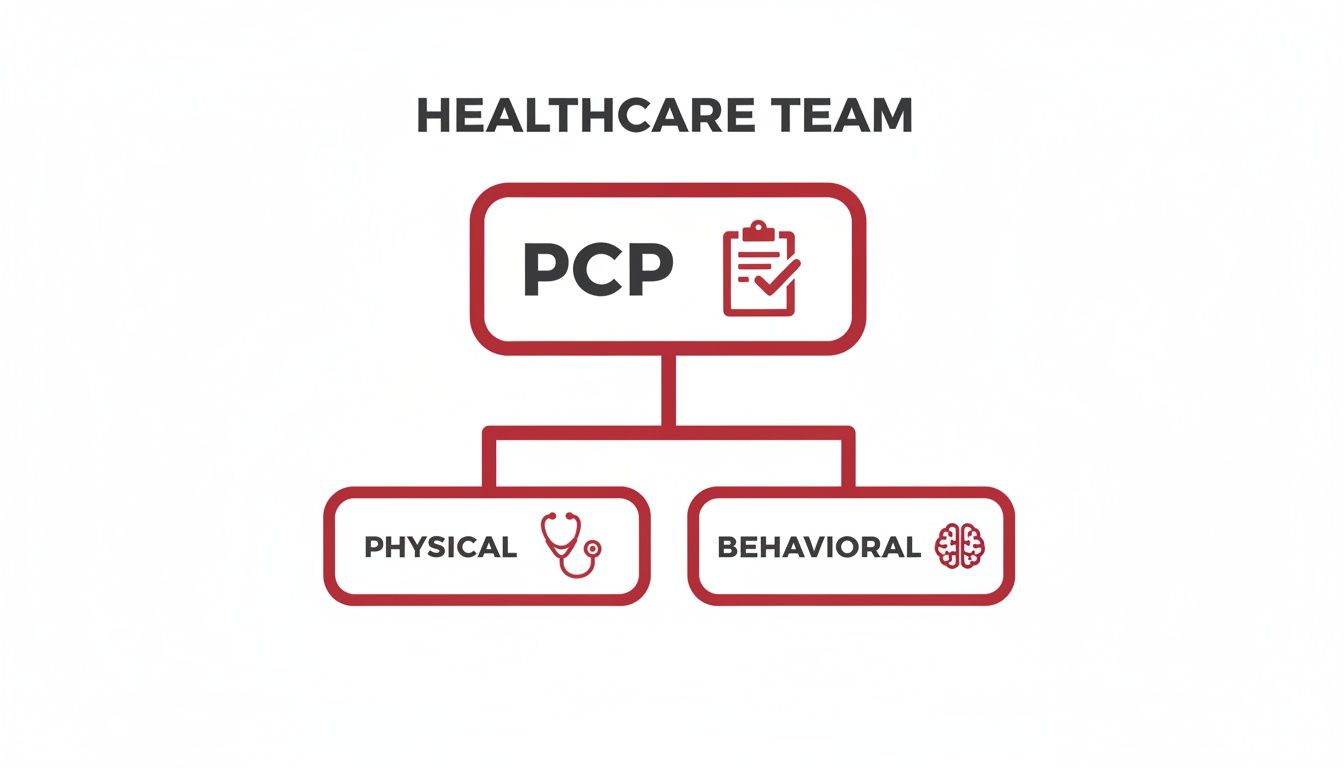
This visual really drives home the central idea of integrated care: the PCP directs a complete team to treat the whole person, seamlessly.
The Primary Care Behavioral Health (PCBH) Model
If CoCM is the structured specialist, then the PCBH model is the flexible generalist. In this setup, a Behavioral Health Consultant (BHC)—typically a psychologist or licensed clinical social worker—is physically embedded in the primary care clinic as a core member of the team.
The real power of PCBH lies in its immediacy. The BHC is available for "warm handoffs" from the PCP to address a huge range of issues right on the spot. We're talking about everything from a patient showing signs of anxiety to someone struggling with medication adherence or needing help with lifestyle changes to manage a chronic illness like diabetes.
Instead of traditional, 50-minute therapy sessions, the BHC delivers brief, focused interventions, often just 15-30 minutes long. The goal is to equip patients with practical, actionable skills they can use immediately and then smoothly transition them back to their trusted PCP's care.
Comparing Key Integrated Behavioral Health Models
To help you visualize the differences, this table breaks down how the two models operate across key dimensions. Think of it as a cheat sheet for deciding which approach best aligns with your clinic's goals and workflow.
| Feature | Collaborative Care Model (CoCM) | Primary Care Behavioral Health (PCBH) |
|---|---|---|
| Primary Goal | Treat specific conditions (e.g., depression, anxiety) for a defined population using a patient registry. | Address a broad range of behavioral and health-related issues for the entire patient population in real-time. |
| Team Structure | A trio: the PCP, a Behavioral Health Care Manager, and a Psychiatric Consultant. | A duo: the PCP and an embedded Behavioral Health Consultant working side-by-side. |
| Patient Contact | Proactive, scheduled follow-up by the BHCM, often by phone, to track progress and provide support. | Immediate, brief consultations in the exam room via a "warm handoff" from the PCP. |
| Best For | Practices wanting a systematic, data-driven approach to managing common mental illnesses at scale. | Practices needing a flexible, on-demand consultant to address diverse issues as they arise in the daily workflow. |
Ultimately, choosing the right model comes down to your primary objective. Do you want to systematically manage a specific set of high-priority conditions? Or do you need to provide broad, immediate support for whatever walks through the door? Answering that question is the first step toward building a program that truly delivers whole-person care.
The Strong Financial Case for Integration
While the clinical wins are obvious, the real magic of integrated behavioral health for healthcare leaders and entrepreneurs is that it’s just plain good business. This isn't just another patient care initiative; it’s a strategic move that strengthens your bottom line, opens up new ways to get paid, and positions your practice perfectly for where healthcare is headed.
Great patient care and great financial performance aren't competing forces—they feed each other. For growth-minded leaders like Robbie LaMattina, building a sustainable and impactful organization depends on this synergy. The business case for integration really stands on three solid pillars: new revenue, a powerful return on investment (ROI), and a natural fit with value-based care.
Let's get past the theory and dig into the dollars and cents that make this model so attractive.
Unlocking New Revenue Streams
One of the quickest financial perks you'll see is the ability to bill for services that were previously off the table. The system has finally caught up and created specific codes that recognize and reimburse this coordinated work.
- Collaborative Care Model (CoCM) Codes: These CPT codes let you bill for the crucial time spent on care management and psychiatric consultations. Before, this was often uncompensated work. Now, it's a direct and predictable revenue stream.
- Behavioral Health Integration (BHI) Codes: Much like the CoCM codes, general BHI codes provide a way to get paid for time spent coordinating care, checking in on patients, and keeping the treatment plan moving forward between visits.
These codes turn what used to be "extra work" into a core part of your revenue engine. Of course, getting paid means billing correctly, which is why a solid process for understanding revenue cycle management is non-negotiable. You have to capture every dollar you earn.
Analyzing the Powerful Return on Investment
Beyond the new billing codes, the long-term ROI is where things get really exciting. When you treat mental and physical health in the same place, you drive down the total cost of care for your patients, especially those juggling complex, chronic conditions.
Researchers estimate that a well-run integrated behavioral health program can save the U.S. healthcare system between $38 to $68 billion annually. Those aren't just abstract numbers; they come from real, measurable improvements.
Take the study at Intermountain Healthcare, for instance. Their team-based model resulted in an 18% reduction in ER visits and a 9.5% drop in hospital admissions. It makes perfect sense. When patients can get timely behavioral health support from their primary care team, they're far less likely to end up in expensive, last-resort crisis care. That’s a huge cost saving for the system and a massive quality-of-life improvement for the patient.
Aligning with Value-Based Care
The entire healthcare industry is making a slow but steady pivot away from fee-for-service and toward a future where providers are paid for good outcomes, not just for doing more stuff. Integrated behavioral health is tailor-made for this world.
This isn't a niche market, either. The global behavioral health sector is expected to hit $400-500 billion by 2025, with a steady 7.7% annual growth rate. This boom is driven by growing awareness and payers who are finally seeing the incredible value in integrated services. You can discover more insights about these behavioral health sector trends to see just how the market is changing.
By adopting an integrated model, you start collecting powerful data that proves your value, including:
- Improved patient outcomes (like lower PHQ-9 depression scores).
- Fewer hospital readmissions.
- Better follow-through on chronic disease management plans.
This data is your currency in a value-based system. It’s what you use to negotiate better contracts with insurance companies, qualify for shared savings programs, and demonstrate that your practice delivers high-quality, cost-effective care. You’re no longer just treating individual patients; you’re managing the health of a population—and that’s exactly what payers want to reward.
Your Roadmap to Implementing an IBH Program

Understanding the models and seeing the strong financial case for integrated behavioral health is one thing. Actually building a program from the ground up? That’s where the real work begins. This isn't just a clinical tweak; it's a fundamental organizational shift that demands a clear, step-by-step plan.
Successfully launching an IBH program takes thoughtful preparation and a real commitment to a new way of working. It’s easy to get tripped up. Skipping steps or underestimating the cultural change required are common pitfalls that can sink even the best-laid plans. A methodical, evidence-based approach is your best bet for building a program that lasts.
This roadmap breaks that journey down into four manageable phases, taking you from securing that initial buy-in all the way to measuring long-term success.
Phase 1: Assembling Your Foundation
Before a single workflow is designed or a new team member is hired, you have to build a rock-solid foundation of support. This starts at the top.
Your first move is to assemble a champion team. This group needs a mix of clinical leaders, administrative staff, and financial stakeholders—people who get the vision and can advocate for the resources you'll need. Their job is to hammer out the "why" behind this shift, clearly connecting it to big-picture goals like improving patient outcomes and boosting financial stability. This is where your business case becomes your most powerful tool.
Phase 2: Designing the Program
With leadership on board, it's time to design the nuts and bolts of the program. This kicks off with a thorough practice readiness assessment. You need an honest look at your current workflows, your patient population, and the resources you already have.
The results of that assessment will point you toward the right integrated care model. Will a structured, registry-driven approach like CoCM work best for your patients with depression? Or does the flexible, on-the-spot PCBH model better fit your clinic's fast-paced environment?
Once you’ve settled on a model, you can start mapping out the new clinical workflows. This means getting specific about:
- Screening Processes: How, exactly, will you identify patients who need behavioral health support?
- Warm Handoff Protocols: What are the precise steps a PCP will take to introduce a patient to the behavioral health consultant?
- Documentation Standards: How will the team share notes and updates seamlessly within the electronic health record (EHR)?
Getting crystal clear at this stage prevents a world of confusion down the road and ensures everyone understands their part.
Phase 3: Building Your Team and Technology
A great plan is just a piece of paper without the right people and tools. Recruiting and training your integrated care staff is arguably the most critical step of all. You aren't just hiring a therapist; you're looking for a collaborative partner who can thrive in a primary care culture.
And training is for everyone, not just the new hires. PCPs, medical assistants, and front desk staff all need to learn the new workflows and communication protocols to make integration feel natural, not forced. A solid framework for strategic planning for healthcare organizations can be invaluable for managing this kind of major organizational change.
At the same time, you'll need to line up the right technology. The essentials usually include:
- A patient registry to track outcomes, which is non-negotiable for CoCM.
- Telehealth platforms to expand access to psychiatric consultants.
- EHR templates customized for integrated care documentation.
Phase 4: Launching and Measuring Success
The final phase is going live. The smart way to do this is with a pilot program. A smaller, controlled launch gives you a chance to test your workflows, spot bottlenecks, and make adjustments before you scale up across the entire organization.
From day one, you absolutely must track your key performance indicators (KPIs). This isn't just about proving the program works; it's about continuous improvement.
Your metrics should cover the clinical, operational, and financial sides of the program. That means tracking patient outcomes with tools like the PHQ-9, monitoring warm handoff rates to see how well the team is collaborating, and analyzing billing data to make sure your financial projections are holding up. This data-driven approach is what will ultimately prove the value of integrated behavioral health and guide your program’s evolution for years to come.
FAQs About Integrated Behavioral Health
To wrap things up, let's tackle some of the most frequent and practical questions that healthcare leaders, administrators, and entrepreneurs like Robbie LaMattina often ask. These are the on-the-ground concerns that come up when an organization starts thinking seriously about adopting integrated care.
What is the biggest challenge when starting an integrated behavioral health program?
The biggest challenge usually comes down to two things: mindset and money. The financial hurdle requires building a solid business case that proves the return on investment, not just through new billing codes but by demonstrating long-term savings from reduced hospitalizations and ER visits. The cultural challenge is often tougher; it involves shifting from a traditional, siloed way of practicing to a truly collaborative, team-based approach, which requires retraining and buy-in from all staff.
How do you measure the success of an IBH program?
Success isn't measured by a single metric. You need to track performance across three key areas:
- Clinical Outcomes: Are patients getting better? This is tracked using evidence-based tools like the PHQ-9 for depression or the GAD-7 for anxiety.
- Operational Efficiency: Is the model working smoothly? This is measured by tracking patient engagement rates, the frequency of "warm handoffs," and other workflow metrics.
- Financial Viability: Is the program sustainable? This involves analyzing revenue from IBH-specific billing codes and calculating cost savings from a lower total cost of care.
Can small or solo practices implement integrated behavioral health?
Absolutely. While it may seem daunting, small practices can successfully implement this model. The key is to start small and be strategic. A small practice could begin with the flexible PCBH model, use telehealth to access psychiatric consultants affordably, and pilot the program with a specific patient group (like those managing both diabetes and depression) to refine workflows before expanding.
At Robert LaMattina, we believe that building a resilient and impactful healthcare organization starts with evidence-based strategies and a clear vision for growth. Explore more insights on leadership, strategy, and compassionate care by visiting https://robertlamattina.net.