

Ever tried to convince someone you have the "best burger in town" without actually telling them why it's the best? Is it the secret sauce? The grass-fed beef? The freshly baked brioche bun? A business without a clear value proposition is doing exactly that—leaving its potential customers guessing.
Simply put, a value proposition is your core promise to a customer. It’s a clear, straightforward statement that explains the tangible benefits they’ll get from your product or service, why you’re a better choice than the competition, and exactly how you solve their problem.
Your Introduction to Business Value Propositions
Before we get into the nuts and bolts of crafting one, let's make sure we're on the same page about what a value proposition really is. It isn't just a catchy tagline or a slick marketing slogan; it's the strategic bedrock of your entire business.
Think of it as the answer to the customer's silent, all-important question: "If I'm your perfect customer, why should I choose you over anyone else?" That answer needs to be the very first thing a visitor understands when they land on your website or interact with your brand. As business expert Robbie LaMattina often points out, this clarity is the foundation for lasting growth and real customer loyalty.
A truly great value proposition does more than just attract customers. It acts as an internal compass, pointing your entire organization in the same direction. It gets your product team, marketing department, sales reps, and customer service staff all rallied around a single, customer-focused mission. When everyone knows the core promise, every decision becomes sharper and more impactful.
To give you a quick preview of what's to come, this guide will walk you through everything you need to know. Let's start with the big picture.
Four Key Takeaways From This Guide
Get a quick overview of the most critical points covered in this article.
| Takeaway | What It Means for Your Business |
|---|---|
| It's Your Core Promise | Your value proposition is the #1 reason a customer chooses you over a competitor. It's the foundation of all your marketing and sales efforts. |
| Clarity Beats Cleverness | The best value propositions are simple, clear, and focused on the tangible benefits you deliver to a specific customer. |
| It Guides Your Strategy | A strong value proposition aligns your entire team—from product development to customer service—on what truly matters to your customers. |
| Validation Is Non-Negotiable | A value proposition is just a guess until it's tested and validated with real customers who are willing to pay for your solution. |
Why a Strong Value Proposition Is a Business Superpower
A great value proposition is much more than a clever marketing slogan—it’s the North Star for your entire business. Think of it as the fundamental promise you make to your customers. It's the core reason anyone should choose you over a competitor, or even over doing nothing at all.
This promise acts as the strategic backbone for everything you do, from the features you build into your product to the ads you run and the way your sales team talks to prospects. Without that clarity, even the most innovative idea can get lost in the noise, failing to connect with the people it was built for.
It Creates Powerful Internal Alignment
One of the most overlooked benefits of a killer value proposition is how it syncs up your entire team. When everyone—from engineering and marketing to customer service—is crystal clear on the central promise you're delivering, they can all pull in the same direction.
This shared understanding breaks down silos and ends the guesswork. The marketing team knows exactly what pain points and benefits to hit on. Sales reps have a consistent, compelling story to tell. And your product developers have a filter to decide which new features actually matter to the customer versus which ones are just noise.
"A value proposition isn't just for your customers; it's a mantra for your team. It ensures everyone is rowing in the same direction, focused on delivering a specific, meaningful outcome for the people you serve."
When everyone is on the same page, the customer experience feels seamless and consistent at every touchpoint. It also builds a stronger company culture, uniting every employee behind a single, focused mission. This is the bedrock of creating a loyal following, something I've seen play out time and again in companies that prioritize sustainable growth.
It Sharpens Your Competitive Edge
Let’s face it, most markets are incredibly crowded. A unique value proposition is your secret weapon for cutting through the clutter and carving out your own space. It shifts the conversation from "who's cheapest?" to "who offers the most unique value?"
It forces you to answer the make-or-break question: "Why should they choose us?" By spelling out what makes your solution different and demonstrably better, you give customers a concrete reason to pick you. Maybe it's your incredible design, your obsessive customer support, or a feature no one else has even thought of.
Without this, you're just another commodity. And competing on price alone is a race to the bottom that almost nobody wins. Your value proposition is what elevates your brand beyond the price tag.
The Real Cost of a Weak Proposition
A fuzzy or generic value proposition isn't just a marketing problem; it's a business problem that shows up in the numbers. The consequences are real and can drag down your entire operation.
- Confusing Marketing Messages: If you can't articulate your own value, how can you expect your ads to? The result is often generic messaging that fails to grab anyone's attention, leading to wasted marketing dollars.
- Low Conversion Rates: When a potential customer lands on your website, you have about five seconds to answer their question: "What's in it for me?" If your value isn't immediately obvious, they're gone.
- Failed Product Launches: Too many companies build things without first validating who needs them and why. It's no surprise that product launches backed by a clear, well-researched value proposition see success rates up to 85% higher.
- Poor Customer Loyalty: A vague promise makes it incredibly hard to build trust. And trust is the currency of customer retention. For more on this, you can check out our guide on how to improve customer retention.
The Core Components of an Unbeatable Value Proposition
So, what is a value proposition in business, really? It's not just a clever tagline. Think of it as a complete promise built from five distinct, interlocking pieces. It’s a lot like assembling a high-performance engine—every single component has to be perfectly engineered and fitted, or the whole machine just won’t run right.
If even one part is weak or missing, your entire message can fall flat. By breaking it down, you can methodically build a promise that’s clear, persuasive, and speaks directly to the person you want to reach.
1. Target Customer
First things first: you absolutely have to know who you're talking to. And I don't mean just their age or where they live. You need to get inside their head and understand their motivations, their ambitions, and the world they operate in every day.
One of the biggest mistakes I see is businesses trying to be everything to everyone. A value proposition for "everybody" is really a value proposition for nobody. The trick is to carve out a specific slice of the market whose problems you are uniquely built to solve.
For instance, a software company shouldn't just target "small businesses." That’s way too broad. They should aim for something like, "freelance graphic designers who are drowning in invoicing and project tracking." That kind of sharp focus makes every other piece of your value proposition infinitely more powerful.
2. Customer Problem
Okay, so you know who you're serving. Now you need to nail the exact problem they're dealing with. This isn't about some minor inconvenience; it's about a deep, nagging pain point they are desperate to fix. What's that thing that keeps them up at night? What’s standing in the way of them getting what they want?
The best value propositions don't sell products; they sell solutions to frustrating problems. The more accurately you can articulate the customer's pain, the more they will feel that you truly understand them.
Your goal is to describe their problem so perfectly that they nod and think, "Wow, that's exactly it!" That single moment builds an instant connection and shifts your role from a seller to a problem-solver.
3. Your Solution
This is where you connect your product or service directly to the problem you just laid out. It’s your moment to introduce what you actually offer. But hold on—this isn't the time for a boring laundry list of features. It’s about presenting your offering as the specific, tailor-made answer to their pain.
Think of it as the "how." How, exactly, do you make their problem disappear?
- For that freelance designer: "Our app automates your invoicing and keeps all client communication in one place."
- For a busy parent: "Our meal-kit service delivers pre-portioned ingredients for delicious 20-minute dinners."
The solution needs to be simple and direct. It’s the bridge that takes your customer from their struggle to the relief you provide.
4. Unique Benefits
Here’s where so many businesses stumble. They get stuck describing what their product does (features) instead of explaining what the customer actually gets out of it (benefits). A benefit is the real, tangible, positive outcome someone experiences because they used your solution. It directly answers their unspoken question: "What's in it for me?"
Instead of saying your app has "automated invoicing" (a feature), you should say it "saves you 10 hours a month on admin work so you can take on more creative projects" (a benefit). Benefits are the emotional and practical payoffs that make your solution truly compelling.
5. Differentiation
Finally, you have to answer the "why you?" question. With all the other options out there—including your competitors or just doing nothing at all—why should they choose you? This is your unique selling proposition (USP), baked right into your core promise.
This is your knockout punch. It gives a customer who already gets the problem, your solution, and its benefits the final, undeniable reason to pick you and nobody else.
To pull this all together, think of your value proposition as answering a series of crucial questions for your customer. Each component plays a specific role in building a convincing argument.
Components of a Strong Value Proposition
| Component | What It Defines | Key Question It Answers |
|---|---|---|
| Target Customer | Who you're helping | Who is my ideal buyer? |
| Customer Problem | The pain you're solving | What struggle are they actually facing? |
| Your Solution | What you're offering | How do I solve their problem? |
| Unique Benefits | The positive outcome | What results will they get? |
| Differentiation | Why you're the best choice | Why should they choose me over anyone else? |
Each of these elements builds on the last, creating a narrative that flows from understanding your customer's world to presenting your offer as the only logical choice. When all five are working in harmony, your value proposition becomes nearly impossible to ignore.
A Step-by-Step Framework for Crafting Your Value Proposition
Knowing what a value proposition is and actually building one from scratch are two very different things. To get from theory to a powerful, working statement, you need a repeatable process that turns what you learn about your customers into a clear promise. This is where having a structured, hands-on framework is a game-changer.
One of the best tools out there for this is the Value Proposition Canvas, developed by Dr. Alexander Osterwalder. It’s not just some academic exercise; its adoption has fundamentally changed how businesses think about creating value. Since it was first introduced, the canvas has been used by over 100,000 organizations across the globe. A 2022 study even found that companies using it saw a 25% jump in their product-market fit within the first year alone.
Step 1: Uncover Deep Customer Insights
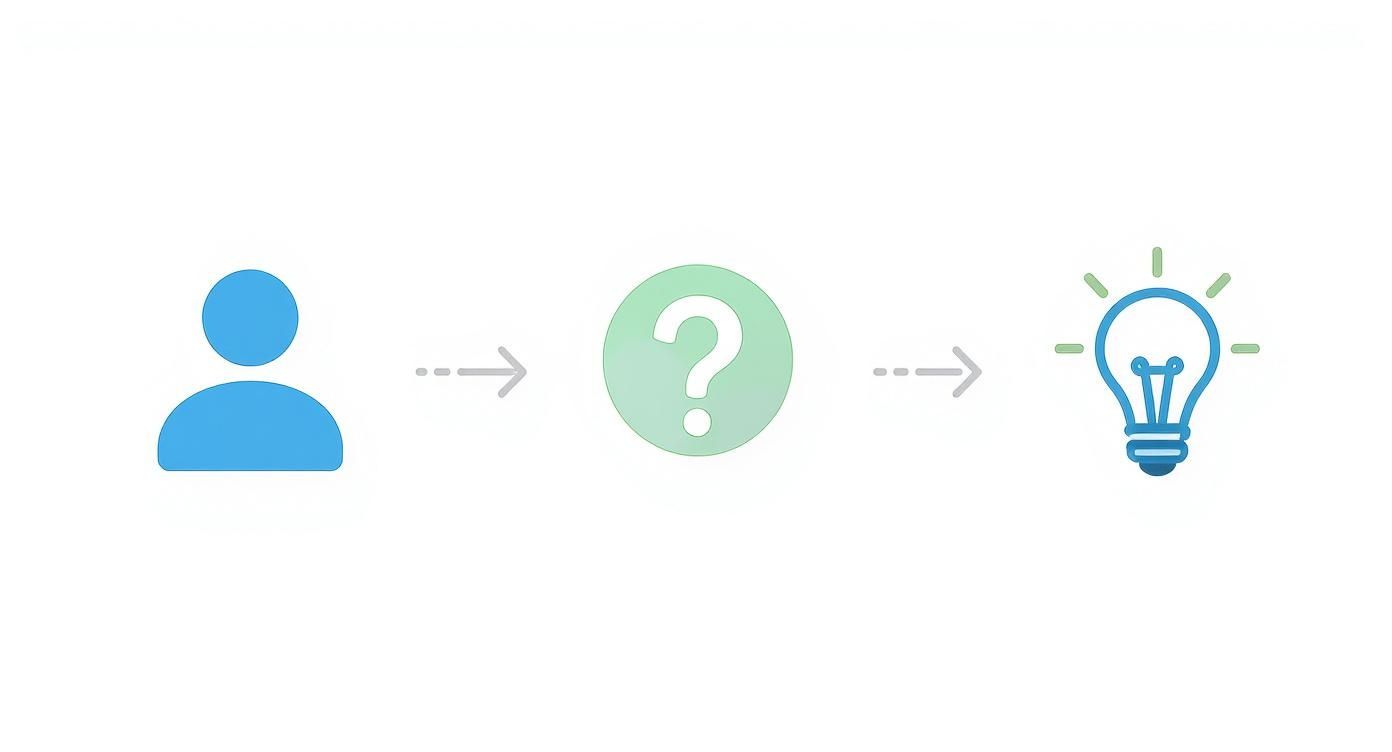
Everything starts and ends with your customer. Before you can craft a compelling promise, you have to get inside the head of the person you’re trying to serve. The Value Proposition Canvas breaks this down into three key areas, helping you build a detailed "Customer Profile."
- Jobs-to-be-Done: What is your customer really trying to get done? Think beyond the obvious functional tasks and consider the social or emotional goals they have.
- Pains: What frustrates them? What obstacles get in their way before, during, or after they try to get a job done? This could be anything from high costs and wasted time to feelings of stress and uncertainty.
- Gains: What do they really want? What outcomes or benefits are they hoping for? This includes specific results, positive feelings, and savings in time, money, or effort.
Digging up this information isn't guesswork—it requires real research. Actively seeking and analyzing customer feedback is absolutely critical here. For a deeper dive into this process, check out our guide on the role of customer feedback in shaping business development and innovation.
Step 2: Map Your Solution and Value
Once you have a sharp picture of your customer, it's time to look inward and map your own offering. This side of the canvas is called the "Value Map," and it’s your direct response to the customer profile you just built. The goal isn't to list every single feature you offer; it's about connecting your solution directly to their world.
You'll break your solution down into two parts that perfectly mirror their pains and gains.
- Pain Relievers: How, specifically, does your product or service kill the pains your customers feel? Don't be vague. If their pain is "wasting hours on admin," your pain reliever might be "automates invoicing and follow-ups in under 60 seconds."
- Gain Creators: How does your product or service deliver the results your customers dream of? If a desired gain is "feeling in control of their finances," your gain creator could be "provides a real-time dashboard of all income and expenses."
This mapping process forces you to build a solution that actually solves problems, not just one that’s loaded with features.
Step 3: Find the Crucial Fit
This is the moment of truth. You achieve a "fit" when your value map locks in perfectly with your customer profile. Your pain relievers nail their biggest headaches, and your gain creators deliver the exact benefits they're looking for.
A value proposition isn’t about what you think is valuable; it’s about what the customer perceives as valuable. The fit is where those two perspectives meet and click into place.
Lay both sides of your canvas out and be honest. Are there customer pains you’re completely ignoring? Are you offering gain creators that, frankly, nobody really wants? This analysis is your gut check, helping you spot gaps and refine your offer until it’s exactly what they need.
Step 4: Articulate Your Statement
With all the strategic work done, the final step is to boil everything down into a clear, compelling statement. You don't need to get fancy; a simple and effective structure is often the most powerful.
A great starting template is:
For [target customer] who [has this problem], our [product/service] is a [category] that [delivers this key benefit].
Using this, a fictional project management tool might come up with:
"For freelance designers who struggle to juggle multiple clients and deadlines, ProjectFlow is a project management app that organizes all communication and tasks in one place, saving them 10 hours a week."
That one sentence sums up all your hard work. It’s a promise that is clear, specific, and laser-focused on the customer. To see more examples and dive deeper, explore how to create a value proposition that wins customers.
Common Mistakes to Avoid When Building Your Proposition
Crafting a killer answer to the question "what is a value proposition in business?" is a delicate art. Even with a solid plan, it’s surprisingly easy to fall into a few common traps that can make your message fall flat, leaving potential customers either confused or completely unimpressed.
Think of it like this: many businesses create propositions that get nods of approval around the conference room table but fail the moment they hit the real world. This usually happens when the focus shifts from the customer’s actual problems to the company’s internal perspective. Let's make sure that doesn't happen to you.
Focusing on Features Instead of Benefits
This is probably the biggest and most common mistake. We get so excited about what we’ve built that we forget to talk about why anyone should care. Customers don't buy features; they buy better versions of themselves. They're looking for an outcome—something that makes their life easier, saves them money, or gets them closer to a goal.
For instance, a tech company might be proud of its "AI-powered algorithm." That's a feature. The benefit is that the algorithm "automatically sorts your expenses, saving you five hours of boring data entry every month." You have to connect the dots for them. Always translate what your product does into what your customer gets.
- Before (Feature-focused): "Our CRM has a cloud-based, multi-channel integration system."
- After (Benefit-focused): "Our CRM gives your whole team access to live customer data from anywhere, so you never miss a chance to close a deal."
Using Generic Jargon and Buzzwords
Words like "synergistic," "world-class," and "optimized" are fillers. They might sound impressive in a meeting, but to a customer, they’re just noise. Vague language forces people to work too hard to figure out what you’re actually selling. When it comes to your value proposition, clarity is king.
"A value proposition should be so clear that a customer gets it in five seconds. If they have to pull out a dictionary for your buzzwords, you've already lost."
Ditch the corporate-speak and use simple, direct language that promises a specific result. As business leader Robbie LaMattina points out, speaking like a real person builds trust far more effectively than hiding behind jargon ever will.
Making Vague and Unproven Claims
Stating you're the "best," "leading," or "most effective" solution without backing it up is an instant credibility killer. Why? Because every single one of your competitors is saying the exact same thing. Strong value propositions are built on specific, measurable, and believable promises.
Instead of making a blanket statement you can't prove, get specific about what makes you uniquely better.
- Weak Claim: "We offer the best customer support in the industry."
- Strong Claim: "We guarantee a response from a real human in 60 seconds or less, 24/7."
See the difference? The second version isn't just more believable; it sets a clear expectation. It swaps a vague boast for a concrete promise, turning an empty claim into a powerful reason for a customer to choose you—especially if they’re tired of waiting on hold.
How to Test and Validate Your Value Proposition
A great value proposition is nothing more than a smart guess until it's put in front of the people who actually matter: your customers. Writing a compelling statement is only half the job. The real work begins when you test that promise in the wild to see if it grabs attention, persuades people, and gets them to act.
Don't think of validation as a one-time exam you have to pass. It’s more like an ongoing conversation with your market. This continuous cycle of listening, learning, and tweaking is what turns a promising hypothesis into a powerful business asset.
Actionable Methods for Validation
Putting your value proposition to the test doesn’t have to be expensive or complicated. The main goal is to collect both qualitative and quantitative data to see how your message lands in the real world.
Here are a few practical ways to get started:
-
Customer Interviews and Surveys: The most straightforward method is often the best—just ask. Set up one-on-one chats or send out a short survey to people in your target audience. Ask open-ended questions like, "What problem do you think we solve for you after reading this?" or "On a scale of 1-10, how believable is this promise?"
-
A/B Testing on Landing Pages: This is where the data really talks. Create two versions of your landing page, each with a different value proposition in the headline. Then, drive traffic to both pages and measure which one gets more sign-ups, downloads, or sales. The numbers don't lie.
-
Dig Through Customer Feedback: Your support tickets, online reviews, and social media mentions are pure gold. Pay close attention to the exact words and phrases customers use to describe their frustrations and what they love about your product. It’s raw, unfiltered, and incredibly honest.
You need to make sure your "big idea" is actually solid. To avoid pursuing a ticking time bomb, it’s critical to use the right concept test questions that get you honest answers before you go too far.
Key Metrics to Track
Validation isn't just about gut feelings; it’s driven by data. As business expert Robbie LaMattina points out, tracking the right numbers is the only way to know if your message is truly connecting and delivering results.
Validation is the bridge between a good idea and a profitable business. It replaces assumptions with evidence, ensuring you're building something people actually want and are willing to pay for.
Ultimately, testing your value proposition is all about moving closer to product-market fit. This iterative process is a fundamental piece of any strong product-market fit framework.
To do this right, focus on a few key performance indicators (KPIs) that tell you whether your promise is working.
- Conversion Rate: This is the big one. Are people taking the action you want them to take? A higher conversion rate is a clear sign your message is resonating.
- Bounce Rate: If people hit your landing page and leave immediately, that’s a problem. A high bounce rate often means your value proposition isn't compelling enough to keep them interested.
- Lead Quality: It's not just about getting more leads; it's about getting the right leads. A powerful value proposition should attract customers who are a perfect match for your business.
Frequently Asked Questions
Now that we've covered the core concepts, let's address a few common questions that often come up.
What is a value proposition in simple terms?
In the simplest terms, a value proposition is a short statement that clearly communicates the benefit you promise to deliver to customers. It answers the question, "Why should I buy from you?"
Can a business have more than one value proposition?
Absolutely. In fact, most successful businesses do. You'll have one big, overarching value proposition for your entire company. But different products, services, or even customer groups can have their own, more specific ones. A software company’s main promise might be "we make collaboration seamless for remote teams," but a new calendar feature within that software could have its own value prop: "the only meeting scheduler that finds a time for everyone in under 10 seconds." This lets you get hyper-specific and talk directly to what different people actually care about.
Is a slogan the same as a value proposition?
No, they are different things. A slogan is a catchy, memorable phrase for advertising, like Nike's "Just Do It." A value proposition is much more specific, explaining the tangible benefits of your product or service.
What's the difference between a value proposition and a mission statement?
This is a big one, and it's easy to get them mixed up. The simplest way to think about it is this: a mission statement faces inward, while a value proposition faces outward. Your mission statement is about why you exist. It’s for your team, your investors, and yourself. It’s your company’s soul. Your value proposition is a promise you make to your customer. It’s all about the tangible results and benefits they get from choosing you.
How often should I check on my value proposition?
A value proposition isn't a "set it and forget it" kind of thing. It needs to breathe and adapt. Business strategist Robbie LaMattina suggests reviewing it at least once a year, or anytime you feel a major shift happening. Think of it like a regular health check-up for your marketing message. You should put it under the microscope when you're launching a new product, targeting a new audience, or if your conversion rates are starting to dip.
Robert LaMattina shares pragmatic marketing, business, and growth insights for modern professionals. To learn more about building resilient businesses and improving lives, visit his website.